
When to Hire Your First Employee: A 2026 Guide
August 23, 2026 · 17 min read
Hiring your first employee is not a celebration. It is a math problem. Most founders treat this decision like a gut feeling, but your gut is usually just exhausted. You are currently drowning in the solo founder trap, handling everything from sales to support while your spreadsheets offer no real answers. You know you need help. You also know that a single bad move could trigger a tax trap that sinks your cash flow. You need to know exactly when to hire your first employee without the typical industry fluff or financial guesswork.
You deserve to see the cold, hard numbers before you sign a single offer letter. This guide replaces vague growth talk with the radical simplicity of a Human Capital ROI framework. We are stripping away the jargon to show you how a new hire becomes a profit engine rather than a permanent liability. We will break down the real 2026 costs, from the 7.65 percent FICA obligation to the hidden 1.4x salary multiplier. You will learn how to use a Morning Number to track spendable income and gain a clear yes or no framework that protects your bank account and your sanity.
Key Takeaways
- Stop waiting for burnout to signal a change; learn to distinguish between low-value busy work and the tasks that actually generate revenue.
- Calculate the true cost of labor beyond the base salary by factoring in the 30% overhead for taxes, insurance, and benefits.
- Discover the exact math for when to hire your first employee by measuring your Human Capital ROI instead of trusting your gut.
- Use the "Morning Number" to protect your cash flow and ensure every new hire acts as a profit engine rather than a financial liability.
- Move from emotional guesswork to automated precision by modeling your bank balance with a decision engine before you sign an offer letter.
The Solo Founder Trap: Why Waiting for Burnout is a Mistake
Stop pretending your exhaustion is a badge of honor. Feeling busy is the most dangerous signal you can receive. It often means you've hit the "Founder's Ceiling." You have exactly 24 hours in a day. You cannot manufacture more. When you spend those hours on "busy work" like chasing invoices or scheduling meetings, you are actively killing your growth. You are trading high-value strategy for low-value admin. This is the moment you must decide when to hire your first employee before the weight of your own success crushes you.
Waiting until you are crispy and fried creates a massive "training debt." You'll be too tired to explain how things work. You'll be too impatient to let someone learn. Starting a recruitment process while you are already drowning is a recipe for disaster. You won't find the best fit; you'll find the first person who says yes. That is how you end up with a bad hire that costs you up to 50 percent of their annual salary in wasted time and turnover.
The Cost of Inaction
Every hour you spend on a task that doesn't grow the business is money left on the table. If your billable rate is $150 but you are doing $20-per-hour data entry, you are losing $130 every single hour. Inaction isn't free. It is expensive. Hiring out of desperation is even worse. It leads to a cycle of "do it yourself because they did it wrong." You must shift your mindset from "doing the work" to "owning the system." This shift is what separates a job you created for yourself from a business that can actually scale.
Capacity vs. Profitability
- Analyze the workload: Is this a temporary seasonal spike or a permanent plateau? If you've been working 60-hour weeks for three months, it's a plateau.
- Identify the tipping point: Calculate the revenue lost to admin. If ten hours of paperwork costs you a $1,000 sales call, the math is clear.
- Run an Invisible Work audit: Track your time for one week. Highlight every task that a competent assistant could do.
Knowing when to hire your first employee requires looking at your capacity as a finite resource. If your "Invisible Work" exceeds 10 hours a week, you aren't just busy. You're stalled. Stop being the bottleneck in your own company. Move toward a data-driven decision before the burnout becomes permanent. You need a system that measures your output, not just your effort.
Calculating Human Capital ROI: The Only Metric That Matters
Hiring is not an act of charity. It is an investment. Most founders treat payroll like a utility bill, paying it simply because they have to. This is why 2026 small business ideas often fail; they ignore the labor-to-profit ratio. You need to view every dollar spent on a salary as a seed that must grow. This is the core of Human Capital ROI. It is the only metric that tells you when to hire your first employee with total certainty. If the math doesn't work, the hire doesn't happen.
We use the 3x Rule. A new hire should ideally generate triple their total cost. If an employee costs you $60,000, they need to bring in $180,000 in value. This value can be direct revenue or the time they free up for you to go out and close bigger deals. You can check resources like the U.S. Chamber of Commerce for general advice on when it's time to hire, but the math is what ultimately saves your bank account.
The ROI Formula for Small Business
Human Capital ROI is defined as revenue minus non-labor costs, divided by total labor costs. This simple calculation strips away the emotion. You must separate your personal output from your first employee's output to see the truth. Don't expect them to be profitable on day one. Every hire has a "ramp-up" period where they are in the red. Your job is to project exactly when they move into the green. If you can't see that crossover point on a graph, you aren't ready to hire.
Revenue-Generating vs. Support Roles
Not all hires are created equal. A salesperson provides Direct ROI because they bill clients or close contracts. A virtual assistant provides Indirect ROI by reclaiming your time. If hiring an assistant allows you to spend 10 more hours a week on high-level sales, their ROI is tied to your increased performance. You can learn more about how to measure human capital ROI (without the HR jargon) to see which role you actually need first.
Stop guessing and start measuring. You can use a Human Capital ROI Engine to model these scenarios before you ever post a job description. This removes the "hope" from your hiring strategy and replaces it with a predictable path to profit. When the numbers show a clear 3x return, the decision to hire becomes the easiest choice you will make all year.
The Real Cost of a First Employee in 2026
Your bank balance is lying to you. It shows the cash currently sitting in your account, but it ignores the invisible debt you owe for the privilege of having help. When you decide when to hire your first employee, the salary is only 70 percent of the story. You are actually buying a "fully burdened" cost. In 2026, a new hire typically costs between 1.25 and 1.4 times their base salary. If you offer $60,000, your business is actually on the hook for up to $84,000. You need to look at your "Morning Number" instead of your gross balance. This is the only way to see your real spendable income after future payroll obligations are stripped away.
Before you post a job ad, consult a U.S. Chamber of Commerce guide on hiring your first employee to understand the regulatory landscape. However, the regulatory guide won't fix your cash flow. Only the math will do that. You must prepare for the second your tax reserve requirements double. If you don't have a plan for the extra weight, you'll end up "borrowing" from your tax savings to cover a Friday payroll. That is a death spiral.
Payroll Taxes and the 2026 Tax Trap
The employer's share of FICA is a mandatory 7.65 percent. This is split into 6.2 percent for Social Security and 1.45 percent for Medicare. If your new hire earns more than $184,500, the Social Security portion caps out, but the Medicare portion never stops. You also have FUTA taxes, which are 6.0 percent on the first $7,000 of wages. Most founders forget these numbers until the quarterly bill arrives. This is why you need an automated tax reserve for self employed before you bring someone on board. It automates the "saving" so you never see money that isn't yours to spend.
Equipment and Overhead Costs
The costs don't stop at the paycheck. The average cost to hire a new employee in 2026 is approximately $4,700. This includes recruitment, onboarding, and basic training. Then there is the "Desk and Laptop" tax. You'll need recurring software licenses, hardware, and workers' compensation insurance. These are not optional "extras" if you want to stay legal and productive. Review an Employee Cost Analysis for Small Business: The No-Nonsense 2026 Checklist to ensure you aren't missing a line item that could sink your profitability. Every dollar must be accounted for before the offer letter is signed.
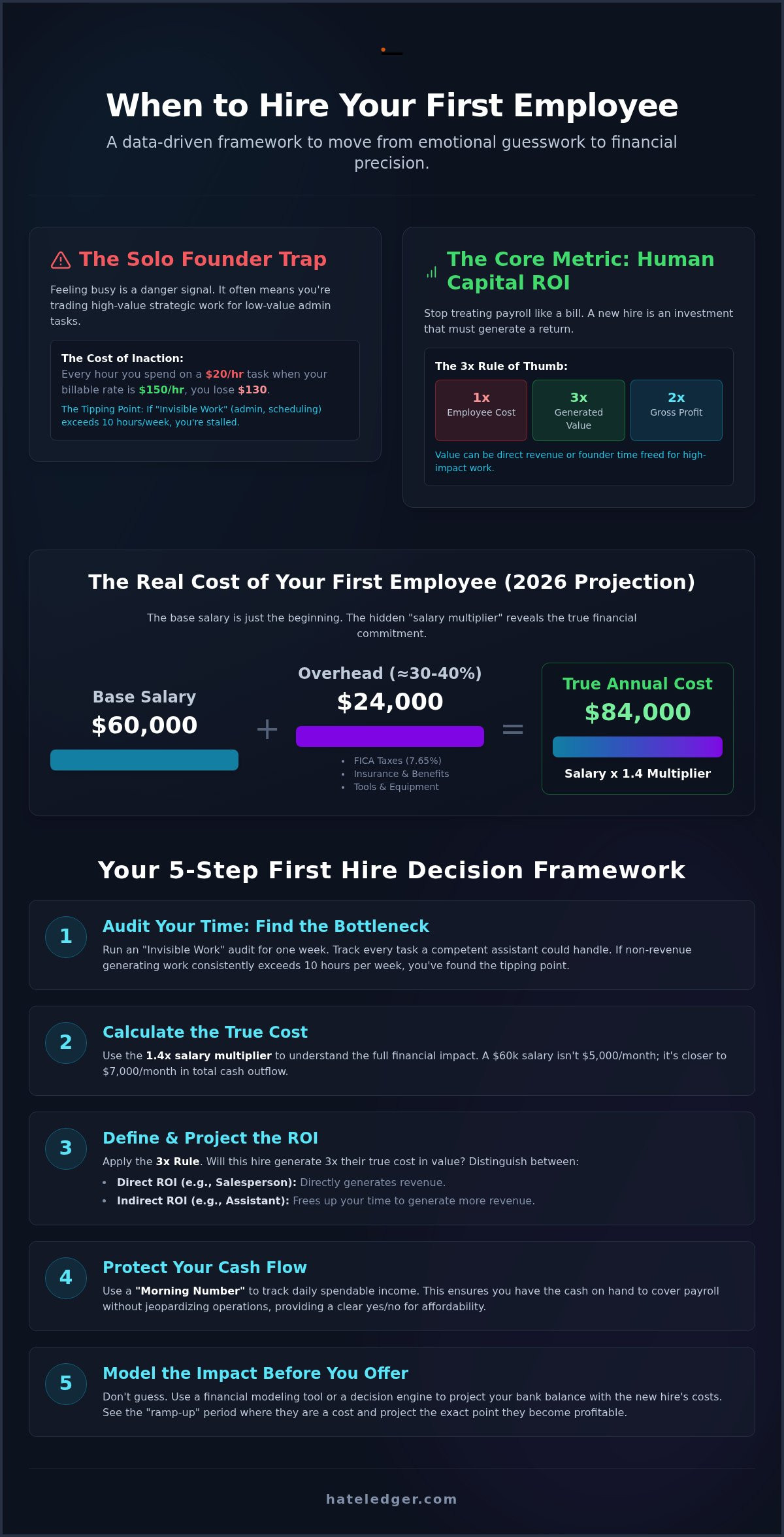
A 5-Step How-To: Your First Hire Decision Framework
Stop agonizing over a job description. Hiring is a process, not a prayer. You need a repeatable system to decide when to hire your first employee without the emotional baggage. If you follow these five steps, you'll move from "maybe I can afford it" to "I know I can afford it."
- Step 1: Audit your time. Track every minute for one week. Identify the "High-Value" tasks that make you money and the "Low-Value" tasks that just take up space. If more than 30 percent of your week is Low-Value, you are ready for help.
- Step 2: Check your Morning Number. Look at your real spendable income. If your Morning Number can absorb a monthly salary plus a 30 percent tax buffer without going into the red, you have the green light.
- Step 3: Choose your model. Decide between a contractor (1099) or a full-time employee (W2). Contractors are great for testing ROI, while employees are for building long-term systems.
- Step 4: Run a Pre-Mortem. Ask yourself what happens if your revenue drops by 20 percent tomorrow. If you can't pay your new hire for at least three months during a slump, you need more cash in reserve.
- Step 5: Use the data. Plug your numbers into a small business hiring decision tool to finalize the math.
Contractor vs. Employee: The 2026 Debate
Contractors offer the ultimate flexibility. They let you test a role before you commit to the full tax burden of a W2 staffer. But don't get sloppy. The IRS uses a "control" test to see if you're cheating. If you control exactly when, where, and how they work, they aren't a contractor. Use a cost to hire an employee calculator to see the real difference in your bank balance before you choose.
Defining the Role for Maximum ROI
Job descriptions are usually just a list of chores. That's a mistake. Write yours based on outcomes. Instead of "managing social media," the outcome should be "increasing lead generation by 15 percent." This sets a clear ROI milestone for their first 90 days. If they aren't hitting those numbers, you didn't hire help; you hired an expensive hobby. Avoid the "micromanagement tax" by giving them clear goals and getting out of the way. Your time is too expensive to spend it hovering over someone else's shoulder.
Ready to see the real impact on your cash flow? Use the Human Capital ROI Engine to model your first hire today.
Automating the Decision: How Hate Ledger Removes the Guesswork
Stop trusting your gut. Your gut is tired and probably needs a vacation. When you are trying to figure out when to hire your first employee, you don't need a spreadsheet that takes three hours to update. You need a system that thinks as fast as you do. Hate Ledger isn't just another ledger. It is accounting software for people who hate accounting, designed to act as your primary hiring advisor. It strips away the noise and focuses on the only thing that keeps you in business: spendable cash.
Most accounting tools look backward. They tell you what you spent last month. Hate Ledger looks forward. Its Human Capital ROI Engine treats every potential hire as a data point. You get to see the impact of a new salary before you ever post a job listing. This is radical simplification for the modern founder. You get the peace of mind that comes from automated tax reserves and real-time insights without the dry, detached professionalism of legacy systems.
The Decision Engine in Action
The Decision Engine models your financial future in seconds. You plug in a potential salary. The system immediately calculates the 7.65 percent FICA match, the FUTA obligations, and the necessary tax reserves. It then shows you exactly what happens to your Morning Number. You move from "I think I can afford this" to "I know the math works." Suddenly, calculating ROI of a new hire isn't a weekend project. It is a 30-second task that gives you the confidence to grow. You see the truth about your bank balance, not just the gross number your bank app shows you.
Scaling Without the Stress
Scaling isn't about working harder. It is about knowing your numbers. Automated bank syncing ensures your data is always fresh. You don't wait for a human to tell you how last month went. You see your Human Capital ROI in real time. This data is what tells you when to hire your first employee and exactly when it is time for employee number two or three. You aren't just hiring people; you are building a profitable engine. Stop guessing. Use the Hate Ledger Decision Engine today to protect your bank balance and reclaim your time.
Stop Guessing and Start Scaling
You now have the framework to escape the founder's ceiling. Stop waiting for burnout to force your hand; it is an expensive and exhausting way to run a company. Real growth happens when you treat labor as a profit engine rather than a liability. You understand the fully burdened costs, the 3x ROI rule, and the danger of the solo founder trap. You know how to audit your time and run a pre-mortem on your cash flow before signing an offer letter.
Deciding when to hire your first employee shouldn't keep you up at night. You can automate the entire decision process today. With Morning Number spendable income tracking and automated tax reserves, your bank balance will never lie to you again. We offer a 90-day setup promise to get your systems running at full speed without the typical accounting headaches. You deserve to move from doing the work to owning the system with total financial confidence.
Stop guessing and start growing; try Hate Ledger's Human Capital ROI Engine for free.
You have the data. You have the framework. Your business is ready for the next level. Go build it.
Frequently Asked Questions
Is it better to hire a contractor or an employee first?
Start with a contractor to test the role without a long-term commitment. It is the fastest way to see if the position actually generates a return for your business. Contractors handle their own taxes and equipment, which simplifies your initial overhead. However, if you need someone to follow your specific systems and work set hours every day, a W2 employee is the better legal choice for your company.
How much revenue should I have before hiring my first employee?
You need enough surplus to cover the employee's total cost plus a 20 percent safety margin. Don't just look at your gross revenue; look at your net profit after you have paid yourself. Knowing when to hire your first employee is about identifying a permanent plateau in your workload that a new hire can solve. If your profit has been stable for 90 days, the math usually supports the move.
What are the hidden costs of hiring an employee in 2026?
Hidden costs include workers' compensation insurance, payroll processing fees, and hardware. You also have to pay for software licenses that often charge per user. In 2026, the employer's share of FICA is a non-negotiable 7.65 percent of the gross wage. Most founders also forget the cost of their own time spent on training. If you ignore these extras, your "affordable" hire will quickly become a cash flow nightmare.
Can I afford an employee if my income is inconsistent?
You can afford a hire with inconsistent income only if you maintain a significant cash reserve. Aim for three to six months of their fully burdened salary in a dedicated account. This "payroll cushion" protects you during slow months. If you don't have that cash tucked away, stick to project-based help. Hiring without a reserve during income swings is the fastest way to end up in a dangerous tax trap.
How do I calculate the ROI of an administrative assistant?
ROI for support roles is measured by the revenue you generate with your reclaimed time. If you spend five hours a week on admin, that is time you aren't selling or creating. Multiply those hours by your hourly billable rate. If that number is higher than the assistant's weekly pay, the ROI is positive. An assistant doesn't just do tasks; they buy you the freedom to focus on high-value growth.
What is the 'Morning Number' and how does it help with hiring?
The Morning Number is a daily snapshot of your actual spendable cash. It subtracts upcoming bills, tax reserves, and payroll obligations from your bank balance. This number tells you the truth about your hiring capacity. While your bank app might show a large balance, the Morning Number shows what is actually yours to keep. It helps you decide when to hire your first employee by removing the guesswork from your cash flow.
What happens if I hire someone and then can't afford their payroll taxes?
Missing payroll taxes triggers immediate IRS penalties that can exceed 30 percent of the original debt. The government considers this "trust fund" money, and they can hold you personally liable for the payment. This is why automated tax reserves are vital for first-time employers. If you can't cover the taxes, you must downsize immediately. Never borrow from tax money to pay other bills; the IRS is the one creditor you cannot ignore.
Do I need a business plan before I make my first hire?
You don't need a traditional business plan, but you do need a financial model. Forget the long-winded mission statements and focus on the labor-to-profit ratio. You need to know exactly how this person will add value to your bottom line. A simple roadmap that outlines their specific goals and the expected ROI is more useful than a thick binder. If the math doesn't work on paper, it won't work in reality.
Frequently Asked Questions
Start with a contractor to test the role without a long-term commitment. It is the fastest way to see if the position actually generates a return for your business. Contractors handle their own taxes and equipment, which simplifies your initial overhead. However, if you need someone to follow your specific systems and work set hours every day, a W2 employee is the better legal choice for your company.
You need enough surplus to cover the employee's total cost plus a 20 percent safety margin. Don't just look at your gross revenue; look at your net profit after you have paid yourself. Knowing when to hire your first employee is about identifying a permanent plateau in your workload that a new hire can solve. If your profit has been stable for 90 days, the math usually supports the move.
Hidden costs include workers' compensation insurance, payroll processing fees, and hardware. You also have to pay for software licenses that often charge per user. In 2026, the employer's share of FICA is a non-negotiable 7.65 percent of the gross wage. Most founders also forget the cost of their own time spent on training. If you ignore these extras, your "affordable" hire will quickly become a cash flow nightmare.
You can afford a hire with inconsistent income only if you maintain a significant cash reserve. Aim for three to six months of their fully burdened salary in a dedicated account. This "payroll cushion" protects you during slow months. If you don't have that cash tucked away, stick to project-based help. Hiring without a reserve during income swings is the fastest way to end up in a dangerous tax trap.
ROI for support roles is measured by the revenue you generate with your reclaimed time. If you spend five hours a week on admin, that is time you aren't selling or creating. Multiply those hours by your hourly billable rate. If that number is higher than the assistant's weekly pay, the ROI is positive. An assistant doesn't just do tasks; they buy you the freedom to focus on high-value growth.
The Morning Number is a daily snapshot of your actual spendable cash. It subtracts upcoming bills, tax reserves, and payroll obligations from your bank balance. This number tells you the truth about your hiring capacity. While your bank app might show a large balance, the Morning Number shows what is actually yours to keep. It helps you decide when to hire your first employee by removing the guesswork from your cash flow.
Missing payroll taxes triggers immediate IRS penalties that can exceed 30 percent of the original debt. The government considers this "trust fund" money, and they can hold you personally liable for the payment. This is why automated tax reserves are vital for first-time employers. If you can't cover the taxes, you must downsize immediately. Never borrow from tax money to pay other bills; the IRS is the one creditor you cannot ignore.
You don't need a traditional business plan, but you do need a financial model. Forget the long-winded mission statements and focus on the labor-to-profit ratio. You need to know exactly how this person will add value to your bottom line. A simple roadmap that outlines their specific goals and the expected ROI is more useful than a thick binder. If the math doesn't work on paper, it won't work in reality.