
How to Measure Human Capital ROI (Without the HR Jargon)
August 19, 2026 · 17 min read
Your payroll isn't just an expense. It's a bet. Most founders place that bet every single month without ever knowing the odds or the payout. It is time to stop guessing. We are going to show you exactly how to measure human capital ROI using a framework that makes sense to a business owner, not a career bureaucrat.
You probably feel like your payroll is a black hole. One day the cash is there; the next, it's gone to a dozen different line items you barely understand. You want to grow, but the uncertainty of when it is safe to hire is paralyzing. You're right to be frustrated by "human resource" corporate speak that prioritizes fluff over financial reality. It's exhausting. It's inefficient. It's over.
This guide provides a radical simplification of your team's value. You will learn to calculate a clear number that proves whether your people are actually making you money. We will walk through the 2026 tax realities, the impact of the Social Security wage base hike to $184,500, and the exact steps to turn your bank data into a decision engine. Get ready for total confidence in your hiring decisions. No nonsense. No jargon. Just the math you need to lead.
Key Takeaways
- Stop viewing your team as a "resource" and start treating their collective brainpower as your company's most aggressive investment.
- Master a plain-English framework for how to measure human capital ROI by stripping away the fluff and focusing on cold, hard revenue.
- Uncover the hidden "fully burdened" costs, from employer taxes to office perks, that determine your team's true price tag.
- Use a data-driven "Hiring Threshold" to decide exactly when to add headcount without guessing or risking your cash flow.
- Move beyond manual spreadsheets by automating your team's value tracking for a clear, daily view of your financial health.
What is Human Capital? Why 'Human Resource' is a Bad Term
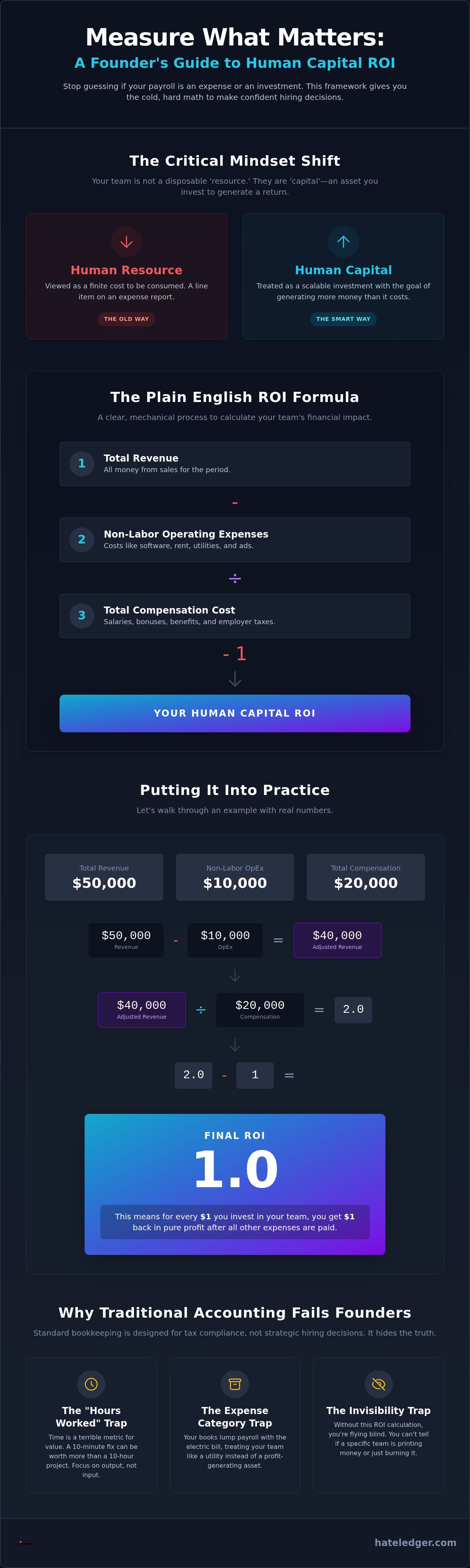
The word "resource" is an insult. In the corporate world, a resource is something you use up and throw away. It is coal. It is oil. It is a ream of printer paper. When you call your team a "human resource," you are mentally categorizing them as a finite supply to be consumed. This mindset is exactly why most founders struggle with how to measure human capital ROI. You cannot calculate a return on something you view as a disappearing cost.
Stop thinking about resources and start thinking about capital. Capital is an asset. You invest it with the specific, unapologetic goal of generating more money than you started with. Your team isn't a drain on your bank account; they are the engine that fills it. They are either a cost center, which is overhead you tolerate, or a profit center, which is an investment you scale. If you want to grow, you need to shift every person on your payroll into that second category.
The plain English definition of human capital
Human capital is the total value your team adds to every dollar of revenue your business collects. It is the collective brainpower, specialized skills, and raw effort your people trade for a paycheck. While physical capital like laptops, office chairs, and software subscriptions lose value every day, human capital is the only asset you own that can actually get more valuable over time. A well-trained team with a strong culture solves problems faster. They close deals more efficiently. They protect your time. Those aren't just "nice to have" traits; they are financial assets that belong on your balance sheet.
Why small businesses fail at measuring people value
Most owners fail here because they look at payroll as a bill rather than an investment. They see a $10,000 payroll run and feel the sting of the outgoing cash. They don't see the $50,000 in revenue that those specific people generated. It's a perspective shift that traditional accounting makes difficult.
- The "Hours Worked" Trap: You've been trained to track time, but time is a terrible metric for value. A developer who solves a bug in ten minutes is worth more than one who takes ten hours.
- The Expense Categorization: Your bookkeeper likely lumps payroll into "Operating Expenses" right next to the electric bill. But the electric bill doesn't find new customers or improve your product.
- Invisible Profitability: Without knowing how to measure human capital ROI, you're flying blind. You don't know if a specific department is printing money or just burning it.
Traditional accounting is designed to satisfy the government, not to help you make hiring decisions. It hides the true profitability of your staff behind a wall of dry numbers and generic categories. It is time to tear that wall down.
The Plain English Formula for Human Capital ROI
Accounting firms love to hide simple truths behind complex equations. They want you to think you need a degree to understand your own profit. You don't. Stripping away the jargon reveals a brutal, honest truth: your team is either making you money or costing you money. Here is how to measure human capital ROI without the headache.
Follow these four steps to find your number:
- Step 1: Start with your total revenue for the month. This is every dollar that hit your bank account from sales.
- Step 2: Subtract your non-labor operating expenses. Think software, rent, and ads. This leaves you with the "Adjusted Revenue" your team actually has to work with.
- Step 3: Divide that adjusted number by your total compensation cost. This includes salary, bonuses, and benefits.
- Step 4: Subtract 1 from the result. This final number is your return on every dollar spent on your team.
It is a mechanical process. It doesn't care about feelings or "potential." It only cares about the math. If you find yourself dreading this manual calculation every month, you can use the Human Capital ROI Engine to do it for you automatically.
A real-world calculation example
Let's put some meat on the bones. Imagine your business brought in $50,000 in revenue last month. Your rent, software, and marketing ads cost you $10,000. Your total payroll, including taxes and benefits, was $20,000.
First, subtract the overhead from the revenue: $50,000 minus $10,000 leaves you with $40,000. Next, divide that $40,000 by your $20,000 payroll. The result is 2.0. Finally, subtract 1. Your Human Capital ROI is 1.0.
What does a 1.0 actually mean? It means that for every $1 you pay your team, you get $1 in pure profit back after all expenses are covered. You are doubling your money on your people. That is a healthy, sustainable business.
What is a "good" Human Capital ROI?
Benchmarks matter, but they aren't universal. In a service business, a 1.0 ROI is a solid break-even point for growth. It means your team is paying for themselves and then some. If you are in SaaS or high-margin retail, you might expect that number to climb much higher. The danger zone is anything below 0. If your ROI is negative, your team is literally costing you money to keep them employed. You are subsidizing their jobs with your savings or debt. That is a red alert. Knowing how to measure human capital ROI is the only way to catch that slide before it becomes a collapse.
Beyond Payroll: Seeing the Total Cost of Your Team
Most founders think they know their labor costs. They look at a salary offer and think "I can afford $80,000." They are wrong. That $80,000 employee actually costs you $100,000 or more once they are through the door. If you ignore the hidden baggage, your math on how to measure human capital ROI will be dangerously optimistic. You will think you are profitable while your cash flow slowly bleeds out. Payroll is just the tip of the iceberg; the real danger is what lies beneath the surface.
Calculating your fully burdened labor cost
To get a real number, you have to look at "fully burdened" costs. This is the total price of keeping a human in a seat. You must add these five things to every base salary to see the truth:
- Employer Taxes: In 2026, the Social Security wage base is $184,500. You are on the hook for 6.2% for Social Security and 1.45% for Medicare. Don't forget the 0.6% FUTA tax.
- Benefits: Health insurance premiums and 401(k) matches are part of the price tag.
- Equipment: Laptops, monitors, and ergonomic chairs don't buy themselves.
- Software: Every seat on Slack, your CRM, or your project management tool adds up.
- Space: Whether it is desk rent or a home office stipend, every person takes up real estate.
Ignoring these costs makes your ROI look better than it actually is. It creates a false sense of security that can lead to disastrous hiring decisions. Use this small business hiring decision tool to factor these in before you sign another offer letter.
The ROI of your own time as a founder
The biggest hidden cost in your business is you. If you spend ten hours a week managing a "cheap" hire, that person is actually expensive. You are likely falling into the "Founder Trap." This happens when you do $20 per hour admin work while your time is worth $100 per hour or more. You are burning your own capital to save a few bucks on payroll.
Your salary, even if you aren't taking one yet, must be part of the math. If you aren't paying yourself, you are hiding the true cost of your business operations. Transitioning from a worker to an owner means knowing how to measure human capital ROI for your own time. If your involvement in a task doesn't scale revenue, you are a cost center. Efficiency is about total output, not how many hours you sat in front of a screen.
Making the Call: Using ROI to Decide Your Next Hire
Knowing your current number is step one. Using it to decide if you should add headcount is where the real power lies. Most founders hire because they feel "busy." Busy is a feeling, not a financial strategy. You need to know if adding a new salary will actually move the needle or just dilute your profits. This is the practical side of how to measure human capital ROI. You are moving from reactive guessing to proactive planning.
Predicting the ROI of a new role
Every role has a price and a payout. If you hire a salesperson for $60,000, they need to generate at least $120,000 in "Value Added" revenue to be a safe bet. This 2:1 ratio ensures you cover their fully burdened cost and still walk away with a profit. For a developer, the math is about speed and scale. Will their code allow you to serve 20% more customers without adding more staff? If the answer is "maybe," you're not ready to hire yet.
Remember the "Ramp-up Period." New hires almost always have a negative ROI for the first 90 days. They are learning your systems, meeting the team, and making mistakes. You are essentially paying for their education during this window. If you don't have the cash to float a negative ROI for three months, your business isn't stable enough for growth. Set clear ROI targets for after their 90-day probation to ensure they transition from a cost to an asset.
When to wait vs. when to hire
A high HC ROI isn't always a victory lap. If your team's ROI is consistently above 3.0, they are likely redlining. They are doing the work of two people, which leads to mistakes and eventual turnover. This is your "Hiring Threshold." When your ROI is too high, your quality drops and your burnout risk spikes. You hire now to protect the assets you already have.
Conversely, a declining ROI is an early warning sign of "bloat." It means you're adding people faster than you're adding revenue. Before you sign another offer letter, check your Morning Number. Do you have the spendable cash to cover the next 90 days of negative ROI? Follow the "Safe Spend" rule: never hire if your tax reserves aren't full. You can't grow a business on money you owe the government.
Stop being the bottleneck in your own business by letting data make the hard choices for you. If you're tired of manual spreadsheets and "gut feelings," check out this accounting software for people who hate accounting to automate your tracking. You can use the Decision Engine to simulate a new hire and see exactly how it impacts your bottom line before you commit to the expense.
Automating the Math with Hate Ledger’s ROI Engine
Spreadsheets are where data goes to die. If you are still trying to figure out how to measure human capital ROI by manually updating a 12-tab monster every Friday, you are losing money on the effort itself. You have a business to run. You don't have time to be a part-time data entry clerk. You need a system that works while you sleep, turning raw bank transactions into actionable intelligence.
Hate Ledger’s Human Capital ROI Engine pulls data directly from your bank sync. It identifies your labor costs, overhead, and revenue streams automatically. We call this "Invisible Double-Entry." The math happens in the background without you ever lifting a finger. You don't see the gears turning; you just see the results. It is the difference between building a car and just driving one. We provide the vehicle so you can focus on the destination.
This automation feeds into your daily Morning Number. Every single morning, you get a clear view of your spendable cash and your team’s current profitability. No more waiting three weeks for a monthly report from a bookkeeper who doesn't understand your growth goals. You know exactly where you stand before you even finish your first cup of coffee. If your ROI dips, you see it instantly. If it spikes, you know it is time to scale. Total visibility is the only way to stay safe in a fast-moving market.
From bookkeeping to business strategy
Traditional accounting is a rearview mirror. It tells you what you spent last month to keep the government happy. We turn that boring tax data into growth insights that keep you happy. Our platform moves you beyond simple record-keeping and into high-level business strategy. Our plain English reports strip away the fluff and tell you exactly what to do next. We also offer a 90-day setup promise. We get your ROI engine running fast so you can stop guessing and start leading with total confidence.
Start for free, grow with confidence
We believe every founder deserves financial clarity, regardless of their current size. That is why we offer a Free Forever Tier. No credit card is required. You get pure utility from day one without any financial risk. When you are ready to unlock deeper insights and the full Decision Engine, our paid plans start at $19/month. It is the best investment you’ll make in your human capital this year. You get the power of a Pro Plan or Business Plan without the enterprise price tag. Try the Hate Ledger ROI Engine today and see your team's true value in real time.
Stop Guessing and Start Leading with Data
You have shifted your mindset from viewing people as disposable resources to treating them as your most aggressive investment. You have the step-by-step formula to strip away the corporate fluff and the "fully burdened" reality to keep your math honest. Mastering how to measure human capital ROI is the ultimate survival tool for any founder. It gives you the cold, hard data needed to say "yes" to the right hire and "not yet" to the wrong one.
Stop letting your payroll be a black hole of uncertainty. You deserve to know if your team is actually making you money before you finish your morning coffee. Stop guessing and start measuring—try Hate Ledger for free. We offer a 90-day setup promise and no credit card is required for our free tier. You will finally get plain-English financial insights that tell you exactly how to grow. Your business is ready for the next level. Go get it.
Frequently Asked Questions
Is human capital ROI the same as employee productivity?
No. Productivity measures output, like how many widgets a team makes or how many tickets they close. ROI measures profit. You can have a highly productive team that is still losing you money if their fully burdened costs are higher than the revenue they generate. ROI is the only metric that tells you if your team is a financial asset or a liability.
Can I calculate ROI for a single employee or just the whole team?
You can do both, but starting with the whole team is usually more practical for founders. It is easy to see the ROI of a salesperson, but harder for an admin. By learning how to measure human capital ROI at the company level first, you get a clear baseline. Once that is stable, you can drill down into specific departments or high-impact roles.
What is the standard formula for human capital ROI?
The no-nonsense formula is (Adjusted Revenue divided by Total Compensation) minus 1. Adjusted Revenue is your total sales minus non-labor costs like rent and software. Total Compensation includes every dollar spent on your team, including taxes and benefits. If the result is 1.0, you are doubling your money. If it is 0, you are only breaking even on your staff costs.
How often should I measure my team ROI?
You should check this number every day. Waiting for a monthly report from a bookkeeper is too slow for a modern business. Real-time tracking lets you spot a dip in efficiency before it turns into a cash flow crisis. When you know how to measure human capital ROI daily, you can make fast adjustments to your hiring or pricing strategy without guessing.
What happens if my human capital ROI is negative?
A negative ROI means your team is costing you more than they generate in value. You are essentially paying for the privilege of having employees. This is a red alert. It usually means you have "bloat" in your headcount, your pricing is too low, or your team is focused on the wrong tasks. You must either cut costs or aggressively increase revenue to survive.
Do I need an accountant to measure human capital ROI?
You don't need a professional accountant to do this math. Most traditional accountants focus on tax compliance and looking backward at last year's data. They aren't built for growth strategy. You can handle these calculations yourself using the plain English framework we've provided. If you want to save time, you can automate the entire process using software that syncs with your bank.
How does automated software help with ROI math?
Automated software removes human error and the "time suck" of manual spreadsheets. It pulls your actual spending and revenue directly from your bank to calculate your Morning Number. This creates an "Invisible Double-Entry" system where the math happens in the background while you run your business. You get the insights you need to lead without having to become a part-time data entry clerk.
What is the difference between human resources and human capital?
Human resources is a corporate term that treats people like a finite supply to be consumed, like coal or printer paper. Human capital is a financial term that treats people as an asset to be invested in. Resources are a cost to be minimized; capital is an engine to be scaled. Shifting your vocabulary is the first step toward building a more profitable, data-driven team.
Frequently Asked Questions
Benchmarks matter, but they aren't universal. In a service business, a 1.0 ROI is a solid break-even point for growth. It means your team is paying for themselves and then some. If you are in SaaS or high-margin retail, you might expect that number to climb much higher. The danger zone is anything below 0. If your ROI is negative, your team is literally costing you money to keep them employed. You are subsidizing their jobs with your savings or debt. That is a red alert. Knowing how to measure human capital ROI is the only way to catch that slide before it becomes a collapse. Most founders think they know their labor costs. They look at a salary offer and think "I can afford $80,000." They are wrong. That $80,000 employee actually costs you $100,000 or more once they are through the door. If you ignore the hidden baggage, your math on how to measure human capital ROI will be dangerously optimistic. You will think you are profitable while your cash flow slowly bleeds out. Payroll is just the tip of the iceberg; the real danger is what lies beneath the surface.
No. Productivity measures output, like how many widgets a team makes or how many tickets they close. ROI measures profit. You can have a highly productive team that is still losing you money if their fully burdened costs are higher than the revenue they generate. ROI is the only metric that tells you if your team is a financial asset or a liability.
You can do both, but starting with the whole team is usually more practical for founders. It is easy to see the ROI of a salesperson, but harder for an admin. By learning how to measure human capital ROI at the company level first, you get a clear baseline. Once that is stable, you can drill down into specific departments or high-impact roles.
The no-nonsense formula is (Adjusted Revenue divided by Total Compensation) minus 1. Adjusted Revenue is your total sales minus non-labor costs like rent and software. Total Compensation includes every dollar spent on your team, including taxes and benefits. If the result is 1.0, you are doubling your money. If it is 0, you are only breaking even on your staff costs.
You should check this number every day. Waiting for a monthly report from a bookkeeper is too slow for a modern business. Real-time tracking lets you spot a dip in efficiency before it turns into a cash flow crisis. When you know how to measure human capital ROI daily, you can make fast adjustments to your hiring or pricing strategy without guessing.
A negative ROI means your team is costing you more than they generate in value. You are essentially paying for the privilege of having employees. This is a red alert. It usually means you have "bloat" in your headcount, your pricing is too low, or your team is focused on the wrong tasks. You must either cut costs or aggressively increase revenue to survive.
You don't need a professional accountant to do this math. Most traditional accountants focus on tax compliance and looking backward at last year's data. They aren't built for growth strategy. You can handle these calculations yourself using the plain English framework we've provided. If you want to save time, you can automate the entire process using software that syncs with your bank.
Automated software removes human error and the "time suck" of manual spreadsheets. It pulls your actual spending and revenue directly from your bank to calculate your Morning Number. This creates an "Invisible Double-Entry" system where the math happens in the background while you run your business. You get the insights you need to lead without having to become a part-time data entry clerk.
Human resources is a corporate term that treats people like a finite supply to be consumed, like coal or printer paper. Human capital is a financial term that treats people as an asset to be invested in. Resources are a cost to be minimized; capital is an engine to be scaled. Shifting your vocabulary is the first step toward building a more profitable, data-driven team.