
How to Reduce Financial Anxiety as a Small Business Owner
October 1, 2026 · 16 min read
Financial anxiety doesn’t need another spreadsheet you’ll avoid opening. It needs a clear next step. If you searched “reduce financial anxiety small business owner,” you may be trying to answer a more urgent question: what money is actually available, and what needs your attention first?
That pressure makes sense. Customer payments can arrive late while bills and taxes still come due, and financial admin doesn’t pause because you’re busy running the business. Guessing from your bank balance can add to the worry, especially when some of that cash is already committed.
You can’t remove every uncertainty, but you can replace vague money worries with a simple routine. Start by checking the key facts, keeping upcoming obligations in view, and reviewing cash regularly without letting the task take over your week. You’ll have a clearer picture of what’s happening and a practical way to decide what to do next, using information instead of panic.
Key Takeaways
- Separate cash-flow timing from profit so you can see what money is coming in and going out.
- Look beyond the bank balance: check unpaid invoices, upcoming bills, and tax obligations before deciding what’s available to spend.
- Sort money worries into missing information, timing pressure, or a real shortfall, then choose a next step that fits the situation.
- Use a simple review routine to reduce financial anxiety small business owner concerns and make decisions with clearer information.
- Let financial systems handle repetitive tracking where possible, while keeping your judgment in charge of decisions.
Why small business finances can trigger anxiety, and what you can control first
You’re managing customers, delivery, decisions, and admin. Money worries don’t wait until the rest of the work is done. An invoice is late, a bill is due, and a routine purchase can suddenly feel like a gamble. That pressure is real. But uncertainty can make a problem feel urgent before you’ve checked the facts.
Financial visibility means knowing your current cash, near-term obligations, and expected inflows. It can’t control future sales or make bills disappear, but it gives you something solid to work from. Check what’s due, follow up on an overdue invoice, or confirm a balance. You can’t guarantee when a customer will pay or how much work will come in next month. Separate the actions you can take from outcomes you can’t control yet.
The broader idea of Economic anxiety describes worry tied to financial uncertainty and its effects. For a business owner, that uncertainty can spill into everyday choices. Treat the worry as a prompt to investigate, not proof that your business is failing.
What is financial anxiety for a small business owner?
It’s worry about whether the business can cover what’s coming, pay people, or keep operating. It isn’t a diagnosis. It can grow when your bank balance doesn’t show the full picture: some money may need to cover upcoming bills or taxes, while expected customer payments haven’t arrived. Even an ordinary decision, like buying supplies, can feel risky when you don’t know what cash is truly available.
Which money worries need attention first?
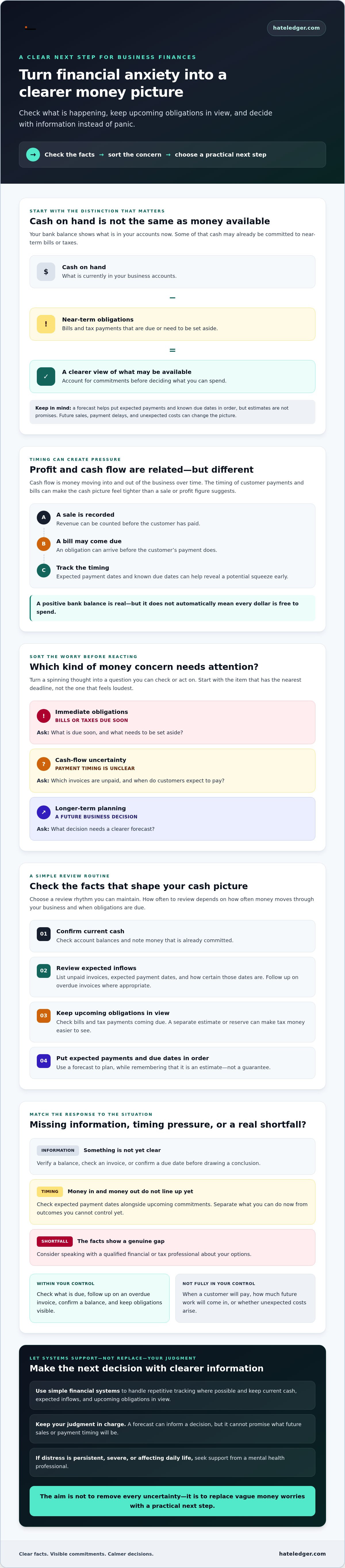
Put each concern into one of three buckets: immediate obligations, cash-flow uncertainty, or longer-term planning. Then turn it into a question you can check or act on. That replaces a spinning thought with a specific next step.
- Immediate obligations: What bills or tax payments are due soon, and what needs to be set aside?
- Cash-flow uncertainty: Which invoices are unpaid, and when do customers expect to pay?
- Longer-term planning: What upcoming business decision needs a clearer forecast?
Start with the item that has the nearest deadline, not the one that feels loudest. If the facts show a genuine shortfall, consider speaking with a qualified financial or tax professional about your options. If distress is persistent, severe, or affecting daily life, seek support from a mental health professional. A practical way to reduce financial anxiety small business owner worries is to clarify what you know, what you need to verify, and what requires support.
How clearer cash-flow information can reduce financial uncertainty
Cash flow is money moving into and out of your business over time. Profit and cash flow are related, but they aren’t the same: a sale can count as revenue before the customer pays, while a bill can come due before that money arrives. Tracking the timing helps you spot a potential squeeze early and distinguish a confirmed shortfall from uncertainty about when cash will arrive.
Cash on hand is what’s in your accounts now; money available is what remains after near-term obligations are accounted for. A forecast puts expected payments and known due dates in order. It can help you plan, but estimates aren’t promises. Future sales, payment delays, and unexpected costs can change the picture.
Why a bank balance is not the whole financial picture
Hypothetical example: A business owner sees a positive bank balance and considers making a purchase. But a customer invoice is still unpaid, and a supplier bill and tax payment are due soon. The balance is real; the assumption that all of it is available to spend may not be. Add the invoice’s expected payment date and upcoming obligations to see what you need to check before deciding.
Tax money can be easy to overlook when it sits in the same account as operating cash. A separate estimate or reserve can make that obligation more visible. For a focused explanation, see this guide to automated tax reserves for self-employed owners.
Which financial signals are worth checking regularly?
Start with four pieces of information. The right review frequency depends on how often money moves through your business and when obligations are due. Choose a rhythm you can maintain, and check more often when payment timing or upcoming commitments make it useful.
- Current cash: Check account balances and note any money already committed.
- Expected inflows: List unpaid invoices, expected payment dates, and how certain those dates are.
- Upcoming outflows: Record bills, payroll, and other known payments by due date.
- Tax obligations: Track what you’ve set aside and what you may need to verify.
Use the list to distinguish a missing fact from a real risk. If you don’t know when an invoice will be paid, follow up or confirm the expected date. If confirmed incoming cash won’t cover known obligations, that’s a shortfall to address, not just a forecasting concern. The U.S. Small Business Administration’s guidance on managing your business finances offers additional practical context for organizing financial information.
A clearer view won’t guarantee cash or make decisions for you. It can help you identify what’s known, what’s still an estimate, and what needs action. If you want a tool to bring financial information together, explore Hate Ledger accounting software as one option.
How to tell a manageable money problem from a decision that needs support
Not every money worry means the business is in trouble. Sometimes a key fact is missing. Sometimes cash is expected, but the timing is uncertain. And sometimes the numbers point to a genuine shortfall that needs more than checking records or cutting expenses. Identify which situation you’re facing before choosing what to do.
Is the problem missing information, timing, or a cash shortfall?
Use the signal to guide your next move. Rechecking the same balance without a question to answer can keep the worry going without producing new information. Check with a purpose, record what you learn, then take the next practical step.
| Signal | What to verify | Practical next action | When to seek help |
|---|---|---|---|
| Missing information | Is a balance, invoice, bill, or record incomplete or out of date? | Check the relevant account or document. Contact the customer or supplier if a date or amount needs confirmation. | Ask an accountant or qualified tax professional if you can’t reconcile the records or need accounting or tax guidance. |
| Timing pressure | When are receipts expected, and when are obligations due? How certain is each expected payment? | Put expected inflows and dated outflows side by side. Treat unconfirmed payments as uncertain, not guaranteed. | Contact a creditor or lender early if a payment may be missed. |
| Potential shortfall | After checking the facts, will available funds cover upcoming obligations? | Identify the size and timing of the gap. Don’t assume tracking or cost-cutting alone will solve it. | Discuss options promptly with relevant financial or professional advisers, and contact creditors or lenders if needed. |
A forecast can clarify a timing gap, but it can’t make a customer pay or create cash that isn’t there. If the information confirms a shortfall, that’s different from not knowing what’s in the account. It may call for a conversation, a change in plans, or professional input.
When should a business owner ask for outside help?
Bring in an accountant or qualified tax professional for accounting or tax questions you can’t confidently resolve. If you think you may miss a payment, contact the creditor or lender early rather than waiting for the due date. They can explain what options, if any, may be available. For legal or mental-health concerns, seek a suitably qualified professional; this guidance isn’t a substitute for their advice.
Set a clear stopping point: verify the facts, choose an action, and note when you’ll check again. That’s more useful than refreshing balances without a decision in mind. To reduce financial anxiety small business owner worries, distinguish what needs a simple check from what needs a conversation or expert support.
How to build a low-effort weekly routine for calmer business finances
A money review shouldn’t become another project you dread. Keep it small, repeatable, and tied to decisions you can act on. Choose a review rhythm that fits how often money moves through your business and when payments are due. The goal isn’t to inspect every detail. It’s to catch what needs attention and finish with a clear next step.
What to check during a weekly money review
Use the same checklist each time. Start with the facts that affect near-term decisions, then note anything that needs follow-up. Keep estimates separate from confirmed transactions so an expected payment doesn’t start to feel like money already received.
- Business cash: Review account balances and scan transactions that still need to be categorized or checked.
- Upcoming obligations: List bills and other payments by due date, including amounts that need confirmation.
- Expected receipts: Check overdue invoices and note expected payment dates. Label those dates as estimates unless the payment has cleared.
- Next action: Choose one useful follow-up, such as confirming a bill, contacting a customer, or checking a transaction. Assign it to someone or add a reminder.
One completed action is more useful than a long list of worries. If a review uncovers a bigger issue, capture it as a question to investigate rather than trying to solve everything on the spot.
How to make the routine easier to keep
Reduce the number of details you have to remember. Add a calendar reminder, use bank syncing if it suits your setup, or keep the checklist beside the records you review. Put questions in one running note or task list. That way, you won’t have to reopen multiple accounts and documents just to remember what you meant to check.
Keep the routine flexible, too. A quiet period may need less attention than a week with several large bills or uncertain customer payments. Adjust the timing to match your business activity, but keep the same basic sequence. Regular visibility comes from a routine you can sustain, not a rigid schedule that breaks when work gets busy.
To reduce financial anxiety small business owner concerns, end each review with one recorded decision: what you’ll do, who will do it, and when you’ll check back. If comparing tools could help reduce manual tracking, read this plain-English accounting software guide. Financial software can help organize information, but it can’t guarantee cash flow or replace your judgment. Explore Hate Ledger accounting software if you want a clearer view of your business finances.
How simple financial systems can help you make the next decision
A repeatable review turns a vague worry into a specific question: Is a bill due before a customer payment arrives? Has a transaction been recorded? How much cash can you safely use for the next decision? A financial system can bring those details together, so you spend less time searching and more time acting on what you find.
Choose a tool based on what you need to see, not how many features it advertises. Look for a clear view of transactions, upcoming obligations, and cash available for decisions. Check whether bank syncing or tax-reserve calculations fit your business, and whether the records are easy to access and understand. A tool only helps if it fits the way you actually work.
What to look for in a financial tool
Before changing your workflow, consider what information you repeatedly look for and where it currently lives. Then check whether a tool can bring those details together without making routine reviews harder. Confirm that its features suit your needs, and make sure you can find the records you’ll rely on when a decision needs a closer look.
What automation can, and cannot, do
Automatic bank syncing and summaries may reduce manual tracking and make it easier to spot information that needs attention. But automation can’t guarantee that expected revenue will arrive, remove uncertainty about future sales, or decide what’s right for your business. Treat the information as a clearer starting point, not an instruction to follow without thought.
Hate Ledger’s daily “morning number” is designed to bring revenue, tax obligations, and safely spendable money into view. That snapshot can help you start a review with a more focused question. It doesn’t replace checking details or using your own judgment.
If financing is the specific concern behind your next decision, use a focused resource such as this business financing decision guide to help frame what to consider. For other money questions, follow your review routine: verify the information, identify what’s uncertain, and decide on one next action. That’s a practical way to reduce financial anxiety small business owner worries without expecting software to solve every problem.
Want a clearer view of your business finances? Explore Hate Ledger’s plain-English financial tools.
Make your next money decision with more clarity
You don’t need to solve every financial question today. Start by checking the facts that affect your next decision, separating confirmed money from estimates, and choosing one action to follow through on. A simple review can turn a vague worry into a clear question, a practical step, or a signal to ask for support.
That’s a grounded way to reduce financial anxiety small business owner worries: build a routine you can keep, then use better information to guide your choices. The right tools can make that routine easier. Hate Ledger offers automated bank syncing and tax-reserve calculations, plus a daily “morning number” that brings revenue, tax obligations, and safely spendable money into view. Its Free Forever Tier doesn’t require a credit card.
These tools can organize information, but they can’t guarantee cash flow or make decisions for you. Your judgment still matters. If you want a clearer starting point for your financial review, explore Hate Ledger’s plain-English financial tools. One clear next step is enough to begin. You can build from there.
Frequently Asked Questions
Why do small business owners feel anxious about money?
Small business owners often feel anxious because money comes in and goes out on different schedules, while bills, taxes, customer needs, and daily work compete for attention. A bank balance may not show unpaid invoices or cash already committed to upcoming obligations. When key details are unclear, ordinary choices can feel risky. The worry is a reason to check the facts, not proof that the business is failing.
How can I stop worrying about my small business finances?
You may not be able to switch worry off, but you can give it a practical next step. If you’re searching for “reduce financial anxiety small business owner,” start by writing down the specific question behind the worry. Check current cash, near-term bills, expected customer payments, and tax obligations. Choose one action, such as confirming an invoice date, and decide when you’ll review the situation again.
Can cash-flow tracking reduce financial anxiety?
Cash-flow tracking can make uncertainty easier to investigate by showing when money is expected to enter and leave the business. It can help you notice a possible timing gap between a customer payment and a bill due date. It can’t guarantee expected income will arrive or eliminate financial risk. Label estimates clearly, and treat tracking as information for your decisions, not a promise about future cash.
What should a small business owner review each week?
Review business account balances, transactions that need checking, upcoming bills, unpaid invoices, and tax money set aside. Mark expected receipts as estimates until they arrive. Then choose one concrete follow-up, such as contacting a customer about an overdue invoice or confirming a bill amount. Set a reminder or assign the action to someone. Adjust how often you review based on transaction volume and upcoming obligations.
Is a high bank balance the same as money I can safely spend?
No. Your bank balance shows cash in the account, but some of it may already be needed for bills, payroll, taxes, or other commitments. Expected invoice payments aren’t available cash until they arrive. Before spending, compare the balance with obligations due soon and note which incoming payments are confirmed versus estimated. That gives you a more useful view of what may be available for a decision.
When should I ask an accountant for help with business finances?
Ask an accountant when you need help understanding financial records, interpreting business results, or resolving an accounting question you can’t confidently answer. For tax questions, contact a qualified tax professional. If you may miss a payment, contact the creditor or lender early to ask about possible options. Seek professional guidance when the issue goes beyond organizing information or checking a balance.
Can accounting software help with financial anxiety?
Accounting software can help organize financial information and reduce repetitive manual tracking, but it can’t treat anxiety, guarantee cash flow, or make decisions for you. Hate Ledger’s plain-English platform can sync bank activity and calculate tax reserves. Its daily “morning number” summarizes revenue, tax obligations, and money available to spend. Use those details as a practical aid, then check the underlying information and apply your own judgment.
Frequently Asked Questions
It’s worry about whether the business can cover what’s coming, pay people, or keep operating. It isn’t a diagnosis. It can grow when your bank balance doesn’t show the full picture: some money may need to cover upcoming bills or taxes, while expected customer payments haven’t arrived. Even an ordinary decision, like buying supplies, can feel risky when you don’t know what cash is truly available.
Put each concern into one of three buckets: immediate obligations, cash-flow uncertainty, or longer-term planning. Then turn it into a question you can check or act on. That replaces a spinning thought with a specific next step. Start with the item that has the nearest deadline, not the one that feels loudest. If the facts show a genuine shortfall, consider speaking with a qualified financial or tax professional about your options. If distress is persistent, severe, or affecting daily life, seek support from a mental health professional. A practical way to reduce financial anxiety small business owner worries is to clarify what you know, what you need to verify, and what requires support. Cash flow is money moving into and out of your business over time. Profit and cash flow are related, but they aren’t the same: a sale can count as revenue before the customer pays, while a bill can come due before that money arrives. Tracking the timing helps you spot a potential squeeze early and distinguish a confirmed shortfall from uncertainty about when cash will arrive. Cash on hand is what’s in your accounts now; money available is what remains after near-term obligations are accounted for. A forecast puts expected payments and known due dates in order. It can help you plan, but estimates aren’t promises. Future sales, payment delays, and unexpected costs can change the picture.
Start with four pieces of information. The right review frequency depends on how often money moves through your business and when obligations are due. Choose a rhythm you can maintain, and check more often when payment timing or upcoming commitments make it useful. Use the list to distinguish a missing fact from a real risk. If you don’t know when an invoice will be paid, follow up or confirm the expected date. If confirmed incoming cash won’t cover known obligations, that’s a shortfall to address, not just a forecasting concern. The U.S. Small Business Administration’s guidance on managing your business finances offers additional practical context for organizing financial information. A clearer view won’t guarantee cash or make decisions for you. It can help you identify what’s known, what’s still an estimate, and what needs action. If you want a tool to bring financial information together, explore Hate Ledger accounting software as one option. Not every money worry means the business is in trouble. Sometimes a key fact is missing. Sometimes cash is expected, but the timing is uncertain. And sometimes the numbers point to a genuine shortfall that needs more than checking records or cutting expenses. Identify which situation you’re facing before choosing what to do.
Use the signal to guide your next move. Rechecking the same balance without a question to answer can keep the worry going without producing new information. Check with a purpose, record what you learn, then take the next practical step. A forecast can clarify a timing gap, but it can’t make a customer pay or create cash that isn’t there. If the information confirms a shortfall, that’s different from not knowing what’s in the account. It may call for a conversation, a change in plans, or professional input.
Bring in an accountant or qualified tax professional for accounting or tax questions you can’t confidently resolve. If you think you may miss a payment, contact the creditor or lender early rather than waiting for the due date. They can explain what options, if any, may be available. For legal or mental-health concerns, seek a suitably qualified professional; this guidance isn’t a substitute for their advice. Set a clear stopping point: verify the facts, choose an action, and note when you’ll check again. That’s more useful than refreshing balances without a decision in mind. To reduce financial anxiety small business owner worries, distinguish what needs a simple check from what needs a conversation or expert support. A money review shouldn’t become another project you dread. Keep it small, repeatable, and tied to decisions you can act on. Choose a review rhythm that fits how often money moves through your business and when payments are due. The goal isn’t to inspect every detail. It’s to catch what needs attention and finish with a clear next step.
Small business owners often feel anxious because money comes in and goes out on different schedules, while bills, taxes, customer needs, and daily work compete for attention. A bank balance may not show unpaid invoices or cash already committed to upcoming obligations. When key details are unclear, ordinary choices can feel risky. The worry is a reason to check the facts, not proof that the business is failing.
You may not be able to switch worry off, but you can give it a practical next step. If you’re searching for “reduce financial anxiety small business owner,” start by writing down the specific question behind the worry. Check current cash, near-term bills, expected customer payments, and tax obligations. Choose one action, such as confirming an invoice date, and decide when you’ll review the situation again.
Cash-flow tracking can make uncertainty easier to investigate by showing when money is expected to enter and leave the business. It can help you notice a possible timing gap between a customer payment and a bill due date. It can’t guarantee expected income will arrive or eliminate financial risk. Label estimates clearly, and treat tracking as information for your decisions, not a promise about future cash.
Review business account balances, transactions that need checking, upcoming bills, unpaid invoices, and tax money set aside. Mark expected receipts as estimates until they arrive. Then choose one concrete follow-up, such as contacting a customer about an overdue invoice or confirming a bill amount. Set a reminder or assign the action to someone. Adjust how often you review based on transaction volume and upcoming obligations.
No. Your bank balance shows cash in the account, but some of it may already be needed for bills, payroll, taxes, or other commitments. Expected invoice payments aren’t available cash until they arrive. Before spending, compare the balance with obligations due soon and note which incoming payments are confirmed versus estimated. That gives you a more useful view of what may be available for a decision.
Ask an accountant when you need help understanding financial records, interpreting business results, or resolving an accounting question you can’t confidently answer. For tax questions, contact a qualified tax professional. If you may miss a payment, contact the creditor or lender early to ask about possible options. Seek professional guidance when the issue goes beyond organizing information or checking a balance.
Accounting software can help organize financial information and reduce repetitive manual tracking, but it can’t treat anxiety, guarantee cash flow, or make decisions for you. Hate Ledger’s plain-English platform can sync bank activity and calculate tax reserves. Its daily “morning number” summarizes revenue, tax obligations, and money available to spend. Use those details as a practical aid, then check the underlying information and apply your own judgment.