
Small Business Hiring Decision Tool: Stop Guessing and Start Growing (2026)
August 18, 2026 · 18 min read
Your bank balance is a trap. It shows you what happened yesterday, but it says nothing about what you can afford tomorrow. Most owners hire because they are tired or overwhelmed, only to spend the next six months paralyzed by payroll anxiety. You are likely exhausted by spreadsheet fatigue and "human capital" jargon that feels more like a lecture than a solution. You need a small business hiring decision tool that prioritizes your spendable cash over your gut feelings.
We are going to stop the guessing game right now. You deserve a clear "Yes" or "No" before you post a single job ad. This article teaches you how to move beyond basic recruiting software and use actual financial data to decide exactly when, who, and how much to pay for your next hire. We will break down how to measure employee profitability and find your "Morning Number" so you can grow without the constant fear of losing money. It is time to strip away the fluff and treat your team like the high-stakes investment they actually are.
Key Takeaways
- Stop confusing recruitment software with business logic. A real small business hiring decision tool tells you if a new salary will generate a return, not just how many resumes are in your inbox.
- Calculate your breakeven point before you sign an offer letter. Learn the exact math to determine when a new hire stops costing you money and starts making it.
- Ditch the bank balance trap for good. Use your "Morning Number" to see real spendable cash and confirm you can handle payroll without the usual 3 a.m. panic.
- Compare the big players in hiring tech. We show you why most platforms focus on sourcing candidates while ignoring the only thing that matters: your bottom line.
- Automate the decision process with the Human Capital ROI Engine. Get a definitive "Yes" or "No" on your next hire based on hard data rather than gut feelings.
Why Your ATS Isn’t a Real Hiring Decision Tool
An Applicant Tracking System (ATS) is a digital filing cabinet with a pulse. It organizes resumes, automates emails, and tracks where people are in your recruitment process. But it is not a decision engine. It cannot tell you if adding a $60,000 salary will bankrupt you by October. Most software sold as a small business hiring decision tool is actually just a glorified to-do list. It focuses on the speed of the hire, not the profitability of the human. Having 500 applicants doesn't matter if you can't afford a single one of them. You are solving the wrong problem when you focus on candidate volume over cash flow.
Hiring is an investment, not just an expense. When you look at a candidate's salary, you're only seeing a fraction of the true cost. You have to account for the employer's share of taxes, health insurance premiums, and the overhead of their equipment. If your software ignores these, it isn't helping you decide. It's helping you guess. True growth requires moving from "recruiting" to "investing in human capital" with eyes wide open. You need to know the all-in price before you sign an offer letter. Guesswork is for hobbyists; data is for founders who want to stay in business.
The Trap of Process Over Profit
Small businesses often get stuck in interview workflows. You spend hours reviewing portfolios and checking references because your software makes it easy to stay busy. This is a trap. Traditional HR software hides the real impact on your bottom line by focusing on "time-to-hire" metrics. These platforms want you to believe that a fast hire is a good hire. It isn't. Hiring based on a gut feeling or a busy schedule is dangerous. You need to base your next move on spendable cash, not just how tired you feel at the end of the day. If the math doesn't work, the best candidate in the world won't save you.
Defining a Hiring Decision Tool in 2026
A modern small business hiring decision tool must do more than store PDFs. It needs to provide three specific things to be useful for a pragmatic operator:
- Real-time cash flow visibility: You must see your "Morning Number" every day. This is your actual spendable cash after all obligations are met. This prevents the "Bank Balance Trap" where you think you're rich because you haven't paid your bills yet.
- Automated tax reserve calculation: The tool should automatically set aside what you owe the government. Payroll tax should be invisible and automated, not a quarterly crisis.
- Human Capital ROI tracking: You need to know if an employee is generating more value than they cost. This means measuring the specific revenue or time-savings they bring to the table.
Stop settling for tools that only manage the paperwork. If your software doesn't tell you exactly when you can afford to grow, it is just noise. You need a system that prioritizes your profit over its own process.
The Financial Logic of Your Next Hire: ROI vs. Cost
Your bank balance is a liar. It tells you that you have money, but it doesn't tell you how much of that cash is already spoken for. Most owners hire because they see a big number in their banking app and think they're safe. They aren't. A real small business hiring decision tool looks at your "Morning Number", which is the cash you actually own after taxes and overhead are cleared. You need to find the breakeven point. This is the exact day your new hire stops being a drain and starts being a fountain. For a small team, one bad hire isn't just a mistake; it's a catastrophe. You must know your runway before you post the job.
The breakeven point is the most ignored number in small business. It is the date when the cumulative value produced by an employee finally exceeds the total cost of hiring and training them. If it takes six months to reach breakeven and you only have three months of cash, you're headed for a cliff. A small business hiring decision tool must calculate this runway for you. It should show you exactly how much spendable cash you have so you never accidentally spend the rent money on a recruiter fee.
Measuring Human Capital ROI Without the Jargon
Stop using corporate speak. Human Capital ROI is just a fancy way of asking: "Is this person making me more money than they cost?" For sales, the math is easy. For admin or operations, it's about time recovery. If an assistant saves you 20 hours a month, and your time is worth $200 an hour, that is $4,000 in recovered value. Compare that to their total cost. If the value is higher than the cost, you have a green light. You can find more details on legal requirements in the SBA guide to hiring, but remember that the government won't calculate your profit for you. You need a system that connects your payroll costs to your actual revenue growth in real-time.
The Self-Employed Tax Trap and Hiring
Hiring usually triggers a tax surprise. You see the gross salary, but you forget the employer-side taxes and the impact on your own tax bracket. You must use automated tax reserves to stay safe. This isn't optional. It is the difference between a growing business and a frantic withdrawal from your savings in April. Set your tax money aside before you even write the job description. If you can't afford the tax, you can't afford the person. When you use the Human Capital ROI Engine, you stop guessing and start operating with total confidence.
Comparing Small Business Hiring Tools: Recruiting vs. Revenue
Most owners confuse "recruiting" with "hiring." Recruiting is about finding people. Hiring is about the math of keeping them. You have three main categories of software: Applicant Tracking Systems (ATS), Payroll Platforms, and Financial Decision Engines. An ATS like JazzHR is great for sourcing, but it won't tell you if you're about to go broke. Payroll platforms manage the distribution of money, but they don't help you decide if that money should be spent in the first place. A true small business hiring decision tool focuses on spendability rather than just sourcing. It connects your bank ledger to your growth plan.
Sourcing tools help you find candidates. Spendability tools help you find profit. If you use a tool that only tracks resumes, you are flying blind. You need to know your "Morning Number" before you look at a single LinkedIn profile. This is where "Invisible Double-Entry" comes in. It is the future of hiring data. It means your hiring decisions are automatically checked against your actual bank ledger without you doing any manual entry. It makes the math invisible so you can focus on the person. The SBA guide to hiring employees covers the legal basics, but your ledger covers the survival basics. You cannot grow on compliance alone.
Recruiting Platforms vs. Decision Engines
Platforms like JazzHR or Willo are fine for managing the interview pipeline. They reduce the time it takes to screen people. But time-to-hire is a vanity metric if the hire doesn't produce ROI. This is why accounting software for people who hate accounting is actually your most powerful hiring asset. Spreadsheets are static and prone to errors. A decision engine is dynamic. It moves with your cash flow. It tells you when the "Safe Spend" threshold has been crossed so you don't over-extend.
Selecting the Right Tool for Your Stage
If you are a solo contractor, you don't need a complex ATS. You need to focus on tax reserves and knowing your "Safe Spend" number. Our Free Forever Tier is built for this stage. Once you hit the growth phase, you need the Human Capital ROI Engine. You must see if your first three employees are actually making you money. For those scaling, integration is key. You need your payroll data talking to your decision engine. The Business Plan or Pro Plan provides this high-level clarity. Stop using tools meant for Fortune 500 HR departments. Use a small business hiring decision tool built for a founder's wallet.
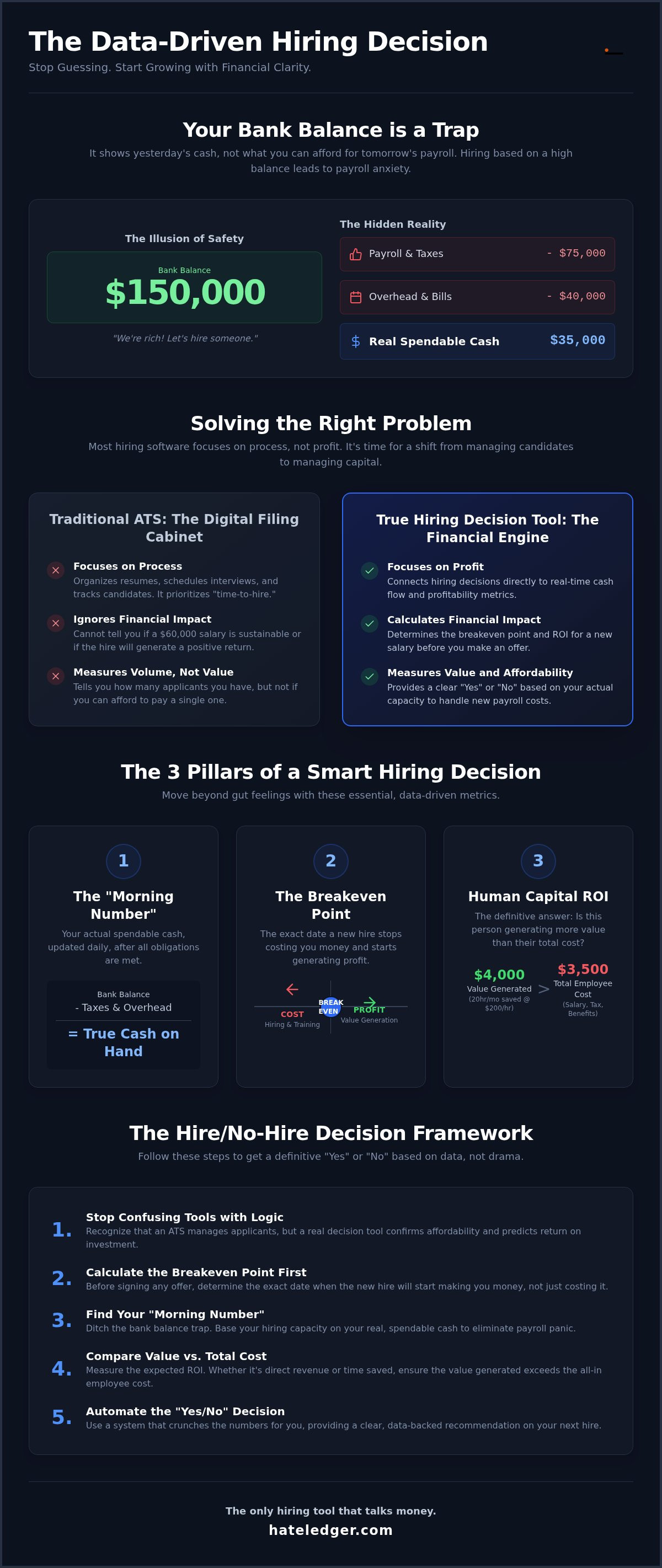
5 Steps to Making the Hire/No-Hire Decision
Most hiring happens in a panic. You are buried in work, so you hire to find air. This is a mistake. You are trading long-term profit for short-term relief. To grow safely, you need a methodical process that values your bank account over your calendar. Using a small business hiring decision tool allows you to move from emotional reactions to calculated investments. Follow these five steps to ensure your next team member is an asset, not a liability.
Step 1: The Morning Number Habit
You cannot make a good decision with bad data. Checking your bank balance once a week is a recipe for disaster. You must check your spendable cash every single morning. This habit prevents you from falling into the "Bank Balance Trap" where you feel rich because your tax money hasn't left your account yet. Set a specific hiring threshold in your accounting software. If your spendable cash doesn't stay above that line for 30 consecutive days, you aren't ready to hire. The Morning Number is your daily financial compass. It tells you exactly what is yours to keep and what is yours to spend.
Step 2: Define the specific goal. Every role must have a target. If it is a sales role, define the revenue. If it is an admin role, define the hours saved. If you can't put a dollar value on the output, don't post the job.
Step 3: Calculate the Total Cost of Employment (TCE). Salary is just the beginning. According to 2024 industry data, the average cost-per-hire is approximately $4,700 before the first paycheck is even written. You must factor in payroll taxes, benefits, and equipment. For a $50,000 salary, your actual TCE could easily reach $70,000.
Step 4: Modeling the Impact
Never guess how a new salary will feel. You need to simulate the impact on your current cash flow before you sign an offer letter. This requires a small business hiring decision tool that uses automated bank syncing. Manual entry is too slow and prone to errors. By modeling the new expense against your real-time revenue, you can see if your cash reserves will survive the onboarding period. This is how you avoid the panic of realizing you can't afford the person you just trained. If the simulation shows a red line in month three, you need to wait.
Step 5: Pull the trigger on ROI. Only hire when the projection is positive. If the math shows that the new hire will pay for themselves and then some, you have a green light. Anything else is just expensive help. If you want to see the math for yourself, get started with the Human Capital ROI Engine and stop the guesswork today.
Hate Ledger: The Only Hiring Tool That Talks Money
You have spent years listening to experts talk about culture and workflows. Those things are important, but they don't pay the bills. Hate Ledger is the only small business hiring decision tool that prioritizes your spendable cash over industry tradition. We created the Human Capital ROI Engine to give you a definitive answer on every hire. It removes the emotional weight of growth. If the math doesn't work, the tool tells you. If the math does work, you hire with total confidence. This is how you stop being a victim of your own success and start being a pragmatic operator.
Traditional bookkeeping is designed for tax authorities, not founders. It is slow, backward-looking, and full of jargon that obscures the truth. Hate Ledger uses plain-English reporting to show you exactly how your team impacts your bottom line. Our 90-day setup promise means we take you from financial fog to absolute hiring clarity in three months. We act as your protective guide, shielding you from the tedious details of ledger management while delivering the insights you need to win. You deserve a tool that talks about money as clearly as you do.
Stop Playing Accountant, Start Being a Founder
You didn't start a business to spend your weekends in a spreadsheet. Hate Ledger automates the work that usually drains your mental energy. Our system uses invisible double-entry to track every dollar spent on labor. It maps those costs against your revenue in real-time without you lifting a finger. This isn't just a convenience; it's a competitive advantage. You can explore these features right now with our Free Forever Tier. It costs nothing to start seeing your business clearly. No credit card, no risk, and no more excuses for staying in the dark about your payroll capacity.
Your Next Steps to a Confident Hire
The path to a confident hire starts with data. Stop guessing and start knowing. Your first move is simple: sign up for a free account and sync your bank. You will see your Morning Number today. This is the only small business hiring decision tool that connects your daily cash flow to your long-term growth goals. It is time to stop playing defense with your payroll and start investing in your future. Get started with Hate Ledger and transform your team from a terrifying expense into a reliable engine of growth.
Own Your Growth Strategy
Hiring doesn't have to be a high-stakes gamble. You now understand why a standard ATS cannot protect your bank account and why your total cost of employment is the only figure that truly matters. By shifting your focus from candidate volume to actual revenue generation, you turn your team into an engine rather than an anchor. You need a small business hiring decision tool that respects your time and your cash flow above all else.
The Human Capital ROI Engine provides real-time profitability data so you never have to guess again. Combined with Morning Number insights, you finally gain the clarity needed to scale without the 3 a.m. payroll panic. Our 90-day setup promise ensures you move from financial chaos to a streamlined, confident operation. It is time to stop playing defense with your payroll and start making moves that actually move the needle for your bottom line.
Stop guessing and start hiring with Hate Ledger. Free Forever Tier available.
You have the vision to grow your business. Now you finally have the math to back it up. Go build something great.
Frequently Asked Questions
What is a small business hiring decision tool?
A small business hiring decision tool is a financial engine that uses real-time data to tell you if a new hire will generate profit or trigger a cash crisis. Unlike an ATS that just manages resumes, this tool focuses on your Morning Number and Safe Spend limits. It bridges the gap between your bank ledger and your growth goals. You get a clear Yes or No based on your actual spendable cash.
How much does hiring software for small businesses cost in 2026?
In 2026, costs depend on the platform's depth. Basic recruitment modules like Rippling often start around $8 per employee monthly, but total costs usually hit $20 to $35 after adding payroll. Dedicated platforms like JazzHR range from $75 to over $420 per month depending on your tier. These prices cover the process, but they rarely include the financial modeling needed to prove a hire's long-term profitability.
Can I use accounting software to decide when to hire?
Most accounting software is backward-looking and focuses on what you already spent. It is great for taxes but terrible for growth decisions. To decide when to hire, you need a system that models future cash flow against your current reserves. A dedicated small business hiring decision tool looks forward to simulate how a new salary impacts your runway. It turns static data into an active growth plan.
What is Human Capital ROI and how do I calculate it?
Human Capital ROI measures the value an employee creates compared to their total cost. To calculate it, subtract the employee's total cost from the revenue or time-value they generate, then divide by that same cost. If an admin saves you $5,000 in billable time but costs $3,000, your ROI is positive. This math ensures every team member is a fountain of profit rather than a drain on resources.
Is there a free hiring decision tool for contractors?
Yes, solo operators can access a Free Forever Tier to manage their growth. For contractors, the focus isn't on managing resumes; it's on managing tax reserves and knowing your Safe Spend number. You need to know exactly how much cash is yours to keep before you commit to outside help. Starting with a free tool allows you to build the habit of data-driven growth without any initial overhead.
What happens if I hire too early without a decision tool?
Hiring too early creates a cash crunch that can sink a healthy company. Without a small business hiring decision tool, you might spend the average $4,700 in recruitment costs only to realize you can't cover the monthly payroll tax. This leads to payroll anxiety and forces you to cut marketing or equipment spending. You end up with more help but less money to actually run the business.
How does automated tax reserve software help with hiring?
Automated tax reserve software removes the guesswork from your payroll capacity. It calculates and sets aside employer-side taxes the moment you earn revenue, so your bank balance doesn't lie to you. This invisible double-entry ensures you only see cash that is truly available for hiring. It prevents the common trap of spending the government's money on a new salary, which usually leads to a crisis in April.
Do I need a recruiter if I have the right decision software?
You might still want a recruiter to source candidates, but software handles the high-stakes logic. A recruiter finds the who, but your decision software determines the when and the how much. Having the right data means you can give a recruiter a specific ROI target instead of a vague job description. It turns recruitment from a desperate search into a calculated business move that guarantees a return.
Frequently Asked Questions
A small business hiring decision tool is a financial engine that uses real-time data to tell you if a new hire will generate profit or trigger a cash crisis. Unlike an ATS that just manages resumes, this tool focuses on your Morning Number and Safe Spend limits. It bridges the gap between your bank ledger and your growth goals. You get a clear Yes or No based on your actual spendable cash.
In 2026, costs depend on the platform's depth. Basic recruitment modules like Rippling often start around $8 per employee monthly, but total costs usually hit $20 to $35 after adding payroll. Dedicated platforms like JazzHR range from $75 to over $420 per month depending on your tier. These prices cover the process, but they rarely include the financial modeling needed to prove a hire's long-term profitability.
Most accounting software is backward-looking and focuses on what you already spent. It is great for taxes but terrible for growth decisions. To decide when to hire, you need a system that models future cash flow against your current reserves. A dedicated small business hiring decision tool looks forward to simulate how a new salary impacts your runway. It turns static data into an active growth plan.
Human Capital ROI measures the value an employee creates compared to their total cost. To calculate it, subtract the employee's total cost from the revenue or time-value they generate, then divide by that same cost. If an admin saves you $5,000 in billable time but costs $3,000, your ROI is positive. This math ensures every team member is a fountain of profit rather than a drain on resources.
Yes, solo operators can access a Free Forever Tier to manage their growth. For contractors, the focus isn't on managing resumes; it's on managing tax reserves and knowing your Safe Spend number. You need to know exactly how much cash is yours to keep before you commit to outside help. Starting with a free tool allows you to build the habit of data-driven growth without any initial overhead.
Hiring too early creates a cash crunch that can sink a healthy company. Without a small business hiring decision tool, you might spend the average $4,700 in recruitment costs only to realize you can't cover the monthly payroll tax. This leads to payroll anxiety and forces you to cut marketing or equipment spending. You end up with more help but less money to actually run the business.
Automated tax reserve software removes the guesswork from your payroll capacity. It calculates and sets aside employer-side taxes the moment you earn revenue, so your bank balance doesn't lie to you. This invisible double-entry ensures you only see cash that is truly available for hiring. It prevents the common trap of spending the government's money on a new salary, which usually leads to a crisis in April.
You might still want a recruiter to source candidates, but software handles the high-stakes logic. A recruiter finds the who, but your decision software determines the when and the how much. Having the right data means you can give a recruiter a specific ROI target instead of a vague job description. It turns recruitment from a desperate search into a calculated business move that guarantees a return.