
How to Calculate Employee ROI: A No-Nonsense Guide for 2026
August 21, 2026 · 17 min read
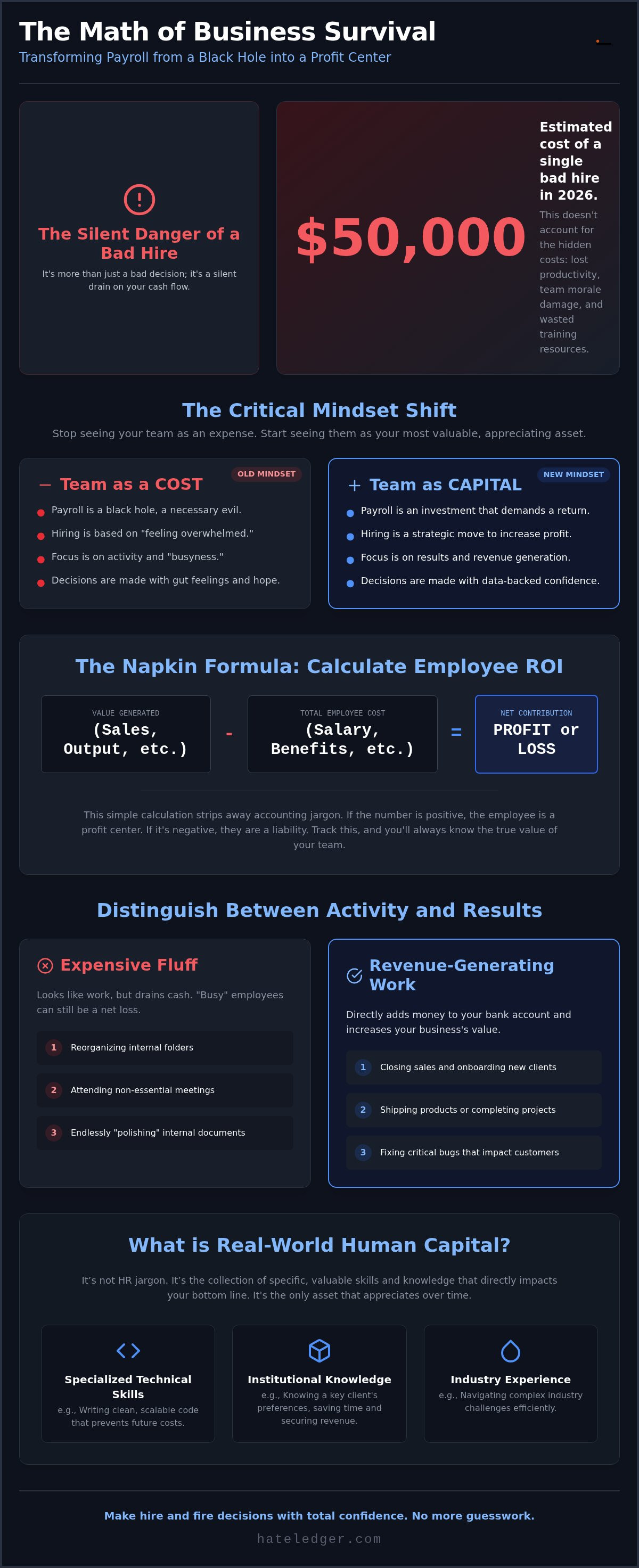
A bad hire in 2026 can cost you $50,000; however, the real danger is the silent drain of a team that looks busy but leaks cash. You shouldn't need a CPA to tell you if your latest account manager is a profit center or a liability. If calculating ROI of a new hire feels like trying to read a dead language, it's because traditional accounting was built to confuse you. It keeps you stuck in a cycle of hiring and hoping instead of hiring and knowing.
We know the feeling. Payroll feels like a black hole where your revenue disappears every two weeks. You're tired of reports that offer zero clarity on whether you can actually afford that next developer. This guide changes that. We're stripping away the corporate HR jargon to show you exactly what your team is worth to your bottom line. You'll learn how to turn employee value into a clear component of your Morning Number. We will show you how to track team profitability daily and make hire or fire decisions with total confidence. No more guesswork. Just the math of business survival.
Key Takeaways
- Stop treating payroll like a black hole. Learn to view every team member as a profit center by comparing their output directly against their total cost.
- Define human capital without the HR jargon. Identify the specific skills and industry experience that actually move the needle for your bottom line.
- Master a simple napkin formula for calculating ROI of a new hire. Get a clear, objective number that replaces accounting gibberish.
- Move from gut feelings to data-backed choices. Use your ROI insights to decide exactly when to scale up or when a role is costing you too much.
- Automate the heavy lifting. Integrate your team’s profitability data into your daily Morning Number to see what you can safely spend today.
What is Employee ROI (And Why Should You Care?)
ROI is just a fancy way of asking a simple question. Is this person making you more money than they cost? In the corporate world, they'll bury this under layers of jargon. We won't. For a business owner, ROI is the difference between a thriving company and a slow, expensive death. If you aren't calculating ROI of a new hire before you sign the offer letter, you're gambling with your rent money. Most owners hire because they feel "overwhelmed." They want relief. But relief that costs more than it earns is just a debt you haven't realized yet.
Every dollar you spend on payroll should return more than a dollar in profit. That sounds obvious. Yet, most founders treat payroll like a utility bill. They pay it, they grumble, and they move on. This mindset keeps you broke. When you understand employee value, it translates directly to your Morning Number. This is the actual amount of cash you can safely pull from the business today without breaking anything. If your team isn't profitable, your Morning Number shrinks. It's that simple.
The Trap of the "Productive" Employee
Busy is a mask. An employee can answer 200 emails a day and still be a net loss for the company. You need to distinguish between revenue-generating work and expensive fluff. Revenue-generating work puts money in the bank. Fluff just fills the calendar. If you wait until tax season to look at these numbers, you've already lost. By then, the "busy" employee has already drained thousands from your accounts. You've spent months paying for activity instead of results.
- Revenue-generating: Closing sales, shipping products, or fixing high-level technical bugs.
- Fluff: Reorganizing folders, attending non-essential meetings, or "polishing" internal documents.
Shifting from Cost to Capital
Stop looking at your team as an expense. Start looking at them as capital. To understand the economic theory behind this, you can look into What is Human Capital? Essentially, your team’s skills are assets that should appreciate over time. At Hate Ledger, we prioritize utility over tradition. We don't care about "years of experience" if those years don't result in a higher Morning Number. Shifting this mindset changes how you lead. You stop being a boss who pays bills. You become an investor who manages assets.
Calculating ROI of a new hire becomes a routine part of your strategy, not a stressful math problem you avoid. It gives you the power to say no to "good" candidates who won't actually grow your bank account. It removes the guilt of firing someone who is "nice" but unprofitable. When you treat payroll as an investment, you demand a return. That isn't being mean; it's being a responsible operator.
Which of the Following is an Example of Human Capital?
Most search results treat this like a high school economics quiz. They list generic terms like "knowledge" or "health" and call it a day. That is useless for an operator. In the real world, human capital is the collective skills, knowledge, and experience your team brings to the table. Specific examples include professional certifications, specialized technical skills, and years of industry experience. It is the only asset in your business that actually appreciates when you treat it right.
There is a massive difference between a human resource and human capital. A resource is finite; you use it up, like printer ink or electricity. Capital is investable. When you focus on Human Capital ROI, you are tracking the growth of an asset. Calculating ROI of a new hire isn't just about what they did this week. It is about how their growing expertise makes your business more valuable over time.
Real-World Examples of Human Capital
Think about a developer who writes clean, scalable code. That isn't just "labor." It is an asset that prevents future technical debt and speeds up every future update. Institutional knowledge is another heavy hitter. This is the employee who knows exactly how your top client likes their reports formatted without being told. That knowledge saves time and secures revenue. Employee training and ongoing education act as value multipliers here. You are essentially upgrading the software of your business.
Why Small Businesses Often Ignore Their Best Asset
Small business owners often make the mistake of valuing equipment over people in their ledger. You see the depreciation of a $5,000 laptop, but you ignore the appreciation of a $60,000 hire who just mastered a new sales process. Traditional accounting is blind to this. It sees the paycheck but misses the profit. Calculating ROI of a new hire becomes impossible if your software only tracks expenses. This is where invisible double-entry accounting helps. It tracks these intangibles so you can see the real value. If you want to stop guessing, you can see how our Human Capital ROI Engine handles this for you. Human capital is the engine of your business growth.
The Simple Formula: Calculating ROI Without the Math Headache
Stop using spreadsheets that look like flight manuals. You need a formula that fits on a napkin. The core math is simple: (Net Profit Generated - Cost) divided by Cost. When you're calculating ROI of a new hire, clarity beats complexity every time. Experts often debate how to calculate recruitment ROI with dozens of variables; however, for a founder, the math needs to move at the speed of business. You need to know if your bank account is growing or shrinking right now.
Breaking Down the Cost to Hire
Your payroll number is a lie. Usually, the salary you agreed upon is only about 70% of the true cost of keeping that person in a chair. You have to factor in the invisible drains on your cash flow. This includes software licenses, desk space, payroll taxes, and insurance. If you ignore these, your ROI calculation will be wrong from day one. You'll think you're profitable while you're actually bleeding. To get your specific numbers without the headache, use our cost to hire an employee calculator. It strips away the guesswork and gives you the hard reality of your overhead.
Measuring the "Unmeasurable" Revenue
It's easy to track a salesperson who brings in $50,000 a month. It's harder to track an executive assistant or a support rep. But "harder" isn't "impossible." You assign value by looking at what they enable. If an admin saves you 10 hours a week, and your time is worth $300 an hour, that's $3,000 of value they generated just by existing. Use time-tracking data to see where the effort goes. If they're spending 80% of their time on tasks that free up your lead producers, they're a high-ROI asset. Run the math to see your percentage of return. A 200% return means for every dollar spent, you got two back in profit.
Calculating ROI of a new hire requires an accurate revenue estimate. If you can't tie an employee to a dollar amount, you're just running a charity. Your Morning Number depends on this accuracy. If you overestimate an employee's value, you'll spend money you don't actually have. If you underestimate it, you'll be too scared to scale. Get the numbers right. Keep your business alive.
Beyond the Math: Using ROI to Make Smarter Hiring Decisions
Calculating ROI of a new hire gives you a hard number. But a number without a plan is just trivia. Most founders wait until they are drowning to hire. They make decisions based on stress levels instead of profit margins. This leads to expensive mistakes. You need to move from gut feelings to data-backed choices. You need to identify which roles will provide the fastest return on capital before you post a job description. If a role doesn't have a clear path to profitability, it shouldn't exist in your company.
Success in 2026 requires a cold, mechanical approach to growth. You aren't just looking for "help." You are looking for a value multiplier. If you're stuck in the "maybe" phase, use our small business hiring decision tool to stop guessing and start growing. It forces you to look at the reality of your bank account instead of the hope in your head.
The "When to Hire" Checklist
Capacity is your first signal. If you are turning away work because there aren't enough hands to do it, you are losing money every day. But check your own schedule first. Is your own ROI dropping because you are stuck doing $20/hour tasks? If you are a founder worth $300 an hour, every minute spent on data entry is a massive financial leak. Finally, look at your safety net. Does the math support a new salary without killing your tax reserve? If a new hire puts your business at risk during a slow month, you can't afford them yet. Period.
Hiring vs. Automating
Sometimes the best human capital move is not hiring a human at all. Software doesn't need health insurance, office space, or a desk. In 2026, automation can handle a significant portion of administrative "work about work." If a tool can do the job for a fraction of the cost, hiring a person is a bad investment. It drags down your overall team ROI. Our Decision Engine helps you choose between a person and a tool by comparing the long-term impact on your spendable cash. We prioritize utility over tradition. If you want to see how this fits into your daily operations, check out our Decision Engine for hiring. Stop hiring based on "vibes" and start hiring based on what actually grows your Morning Number.
Automating Your Human Capital Insights with Hate Ledger
Manual math is a burden you don't need. You have a business to run, not a calculator to exhaust. Hate Ledger’s Human Capital ROI Engine takes over the heavy lifting. It turns the complex task of calculating ROI of a new hire into a background process that stays out of your way. We don't believe in making you work for your data. We believe your data should work for you. By automating these insights, we strip away the mental load of managing a team and replace it with total clarity.
This isn't just about historical reports. It's about your Morning Number. This is the single most important figure in your business: the amount of cash you can safely spend today. By integrating your team's performance data directly into your cash flow, you see the real-time impact of every salary. If you want to dive deeper into the "why" behind these metrics, check out how to measure human capital ROI. We give you a 90-day promise to get your books and your team metrics sorted for good. No more lingering questions about your profitability.
Real-Time ROI Tracking
Waiting for quarterly reports is a relic of the past. If you're losing money on a specific role, you need to know today; waiting three months to find out is a recipe for bankruptcy. Our system uses automated bank syncing to feed your ROI engine. No manual entry. No human error. It is accounting software for people who hate accounting. You get a live view of profitability that updates as fast as your bank balance does. You see exactly what your team is worth to your bottom line at any given moment.
Getting Started for Free
We know the fear of hiring someone you cannot afford. It keeps many founders stuck in a cycle of overwork. That is why we offer a Free Forever tier for small businesses just starting out. You can start calculating ROI of a new hire without spending a dime on software. Move away from that messy, half-finished spreadsheet that lives on your desktop. Step into a clean decision engine that protects your time and your profit. Stop guessing and start measuring with Hate Ledger. Build a team that actually pays for itself and grows your Morning Number every single day.
Stop Guessing and Start Growing Your Morning Number
Payroll doesn't have to be a black hole. You've learned that human capital is your business's most valuable engine; however, it only works if you treat it as an investment rather than a bill. By calculating ROI of a new hire with a simple profit versus payroll formula, you gain the clarity needed to scale without the stress. You now know how to spot the difference between a busy employee and a profitable one. This is the math of survival.
You don't need to be an accountant to master your team's value. We've built the Human Capital ROI Engine for founders who hate the tedious details of bookkeeping. Join thousands of business owners who have already ditched the gibberish for real-time insights. We offer a 90-day setup promise to get your metrics sorted for good. There is no credit card required for our Free Forever tier. Start tracking your team’s ROI for free with Hate Ledger. It's time to make every hire a win for your bottom line. You've got this.
Frequently Asked Questions
Is employee ROI the same as productivity?
Productivity measures how much work someone does, while ROI measures how much money that work actually makes you. You can have a productive assistant who clears 500 emails but generates zero dollars in revenue. ROI is the only metric that keeps your business alive and scaling. It's the difference between being busy and being profitable. Focus on the money, not the activity, to ensure your business remains healthy and your cash flow is protected.
What is a good ROI percentage for a small business employee?
A healthy target for most small businesses is a 3:1 ratio, which translates to a 200% or 300% return on investment. If you spend $1 on an employee, you should see at least $3 in value returned to the business. This covers their salary, overhead, and your profit margin. If the number is lower than 2:1, you are essentially trading dollars and taking on all the risk for zero reward.
How do I calculate ROI for a remote worker with different overhead?
You adjust the Cost variable in your formula. Remote workers usually eliminate the cost of office space and utilities, but they might increase your spend on software licenses or home office stipends. calculating ROI of a new hire who works remotely requires tracking these specific digital overheads. Don't assume they are cheaper; verify it by looking at the actual impact on your Morning Number. This ensures your data remains accurate and useful for decision making.
Can I calculate ROI for non-revenue generating roles like an admin?
Yes, by calculating the value of time saved. If an admin handles 10 hours of work that a $200 per hour consultant used to do, that admin just generated $2,000 in value. You measure their ROI by how much they increase the capacity of your revenue producing team members. Without them, your top earners are stuck doing $20 per hour tasks instead of growing the business. They are a value multiplier, not just an expense.
Which of the following is an example of human capital in a service-based business?
In a service business, human capital looks like a copywriter’s ability to convert leads or a project manager’s institutional knowledge of a client’s history. These aren't just tasks; they are assets. Other examples include specialized technical certifications and years of niche industry experience. These skills are the engine that allows you to charge premium prices while your competitors stay stuck in the bargain bin. Protect these assets to grow your profit and your Morning Number.
How often should I check my team’s ROI metrics?
You should check your high-level Morning Number every single day. When calculating ROI of a new hire, a monthly deep dive is usually enough to spot trends without becoming a micromanager. Quarterly reviews are too slow for a fast-moving small business. If a role is bleeding cash, you need to know within 30 days, not 90. Regular checks prevent small leaks from becoming business-ending floods. Stay on top of your numbers to stay in control.
What happens if an employee has a negative ROI?
A negative ROI means you are paying for the privilege of giving someone a job. First, check if they need better training or tools to succeed. If the ROI doesn't turn positive within a set timeframe, you have a hard decision to make. Keeping an unprofitable employee isn't kind; it’s a threat to every other person on your payroll. Use data to remove the emotion from the choice and stay profitable for the long term.
Does Hate Ledger calculate tax reserves for my employees too?
No, Hate Ledger does not provide tax filing or submission services. Our software focuses on your Human Capital ROI Engine and your daily Morning Number. We help you understand what you can safely spend and how much your team is worth to your bottom line. While we track the costs that impact your profit, you should check with a tax professional for your specific filing needs. We prioritize utility and radical simplification over traditional accounting services.
Frequently Asked Questions
Productivity measures how much work someone does, while ROI measures how much money that work actually makes you. You can have a productive assistant who clears 500 emails but generates zero dollars in revenue. ROI is the only metric that keeps your business alive and scaling. It's the difference between being busy and being profitable. Focus on the money, not the activity, to ensure your business remains healthy and your cash flow is protected.
A healthy target for most small businesses is a 3:1 ratio, which translates to a 200% or 300% return on investment. If you spend $1 on an employee, you should see at least $3 in value returned to the business. This covers their salary, overhead, and your profit margin. If the number is lower than 2:1, you are essentially trading dollars and taking on all the risk for zero reward.
You adjust the Cost variable in your formula. Remote workers usually eliminate the cost of office space and utilities, but they might increase your spend on software licenses or home office stipends. calculating ROI of a new hire who works remotely requires tracking these specific digital overheads. Don't assume they are cheaper; verify it by looking at the actual impact on your Morning Number. This ensures your data remains accurate and useful for decision making.
Yes, by calculating the value of time saved. If an admin handles 10 hours of work that a $200 per hour consultant used to do, that admin just generated $2,000 in value. You measure their ROI by how much they increase the capacity of your revenue producing team members. Without them, your top earners are stuck doing $20 per hour tasks instead of growing the business. They are a value multiplier, not just an expense.
In a service business, human capital looks like a copywriter’s ability to convert leads or a project manager’s institutional knowledge of a client’s history. These aren't just tasks; they are assets. Other examples include specialized technical certifications and years of niche industry experience. These skills are the engine that allows you to charge premium prices while your competitors stay stuck in the bargain bin. Protect these assets to grow your profit and your Morning Number.
You should check your high-level Morning Number every single day. When calculating ROI of a new hire, a monthly deep dive is usually enough to spot trends without becoming a micromanager. Quarterly reviews are too slow for a fast-moving small business. If a role is bleeding cash, you need to know within 30 days, not 90. Regular checks prevent small leaks from becoming business-ending floods. Stay on top of your numbers to stay in control.
A negative ROI means you are paying for the privilege of giving someone a job. First, check if they need better training or tools to succeed. If the ROI doesn't turn positive within a set timeframe, you have a hard decision to make. Keeping an unprofitable employee isn't kind; it’s a threat to every other person on your payroll. Use data to remove the emotion from the choice and stay profitable for the long term.
No, Hate Ledger does not provide tax filing or submission services. Our software focuses on your Human Capital ROI Engine and your daily Morning Number. We help you understand what you can safely spend and how much your team is worth to your bottom line. While we track the costs that impact your profit, you should check with a tax professional for your specific filing needs. We prioritize utility and radical simplification over traditional accounting services.