
Cost to Hire an Employee Calculator: 2026 Guide
August 20, 2026 · 17 min read
Your new hire's salary is a lie. If you're staring at a $60,000 offer letter and thinking that's the total hit to your bank account, you're already losing money. Between the 7.65% FICA tax and the $4,700 average recruitment fee, that "affordable" hire is actually an $80,000 commitment. You need a cost to hire an employee calculator that doesn't hide the truth behind accounting jargon or "maybe" numbers.
It's stressful to feel like every growth move is a gamble with the IRS. You're right to worry about cash flow when health benefit costs are spiking by 6.7% this year. We're here to strip away the complexity. This guide gives you a plain-English breakdown of every tax, benefit, and hidden fee hitting your bottom line in 2026.
We'll provide a single, safe number you can trust and a framework to see if your new talent will actually generate more profit than they cost. It's time to stop guessing and start growing with total confidence. Let's get to the real numbers.
Key Takeaways
- Salary is just the sticker price. Expect the total cost of a new hire to be 1.25 to 1.4 times their base salary once you factor in taxes and overhead.
- Mandatory taxes like the 7.65% FICA hit are non-negotiable cash drains. We simplify the IRS alphabet soup into a 10% safety margin for your payroll budget.
- Use a cost to hire an employee calculator to find your "safe number." This allows you to audit your 2026 cash flow before you sign a single offer letter.
- Stop treating hiring as an expense and start viewing it as a bet. Use our Human Capital ROI engine to ensure every new team member generates more profit than they cost.
- Protect your bank account with automated tax reserves. Ditch the manual spreadsheets and let a decision engine handle the complex math for you.
Why Salary is a Lie: The Real Multiplier of Hiring
The number on the offer letter is a trap. If you think a $50,000 salary means $50,000 leaves your bank account, you’re in for a brutal surprise. That "sticker price" only covers the gross pay. It ignores the mandatory contributions, the overhead, and the equipment that actually make employment possible. In reality, that $50,000 hire will likely cost you closer to $70,000 in its first year. Ignoring this gap is how profitable businesses suddenly run out of cash.
Hiring without a reliable cost to hire an employee calculator is like flying a plane without a fuel gauge. You might feel like you're soaring, but you have no idea when you're going to drop out of the sky. Precision matters because your bank account doesn't care about your good intentions. It only cares about the total amount of money moving out every two weeks.
The 1.4x Multiplier Explained
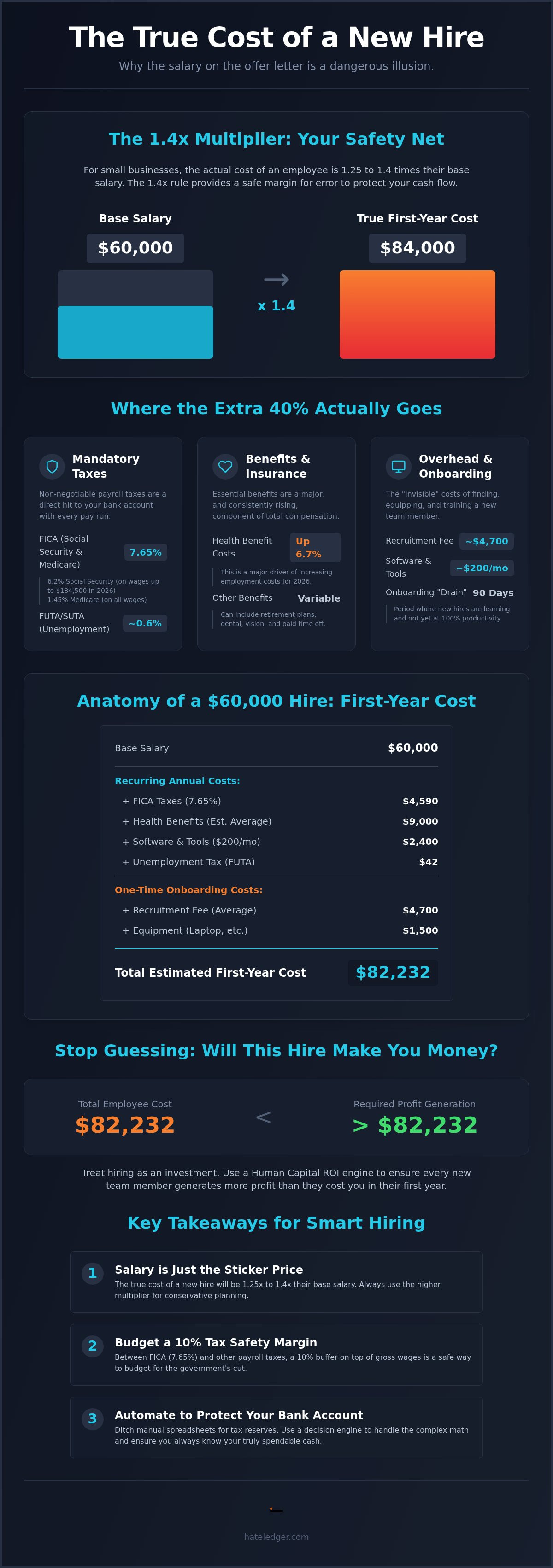
The 1.4x multiplier is the gold standard for small business hiring safety. While massive corporations can sometimes operate on a 1.25x multiplier due to their scale and bulk benefits, small teams lack that luxury. You need a higher margin for error. Using the 1.4x rule gives you a fast, no-nonsense baseline for any hiring decision. Multiply the base salary by 1.4. If that total number makes you sweat, you aren't ready to hire yet. It is the simplest "stress test" for your growth plans.
Where the Extra 40% Actually Goes
That extra 40% isn't just "extra" money; it's the cost of doing business legally and efficiently. It covers the 7.65% employer share of FICA taxes and the effective 0.6% FUTA tax. It also tracks the Employment Cost Index, which highlights how benefits and non-wage costs continue to climb across the private sector. When you add health insurance premiums, which are projected to rise by over 6.5% in 2026, the burden is clear.
Beyond the taxes, you have the "onboarding drain." A new hire rarely hits 100% productivity on day one. For the first 90 days, you are essentially paying full price for a trainee. When you add in the cost of laptops, software seats, and the $4,700 average recruitment fee, the bill stacks up fast. If you don't account for these invisible drains, your cash flow will vanish before the first quarterly tax payment is even due.
The Brutal Breakdown: Taxes, Benefits, and Invisible Overhead
Most accounting guides sound like they were written by a robot for a robot. We're going to translate the IRS alphabet soup into plain English. When you hire someone, you aren't just paying for their time. You're paying for the privilege of being their employer. If you aren't using a cost to hire an employee calculator to track these moving parts, you're essentially giving the government and your vendors a blank check.
Taxes: The Government’s Cut of Your Hire
FICA is the big one. It stands for the Federal Insurance Contributions Act, but you can just call it the 7.65% surcharge. You pay this on top of every dollar your employee earns. It splits into 6.2% for Social Security and 1.45% for Medicare. For 2026, the Social Security portion applies to wages up to $184,500. It’s a direct hit to your bank account every single pay period.
Then comes the unemployment tax. FUTA (Federal) and SUTA (State) are designed to protect workers if they lose their jobs. The standard FUTA rate for 2026 is 6.0% on the first $7,000 of wages, though most owners pay an effective rate of 0.6% after state credits. Payroll tax is a tax on your growth. It is a mandatory cost that must be reserved daily so you don't get hit with a surprise bill at the end of the quarter. According to the Small Business Administration, these combined burdens are why the true cost of an employee is significantly higher than their hourly rate.
Overhead: The Cost of Giving Them a Place to Work
Your new hire needs tools. Every seat in your tech stack costs money. Whether it’s Slack, Zoom, or specialized project management software, expect to add roughly $200 per month to your SaaS bill for every person you bring on. This is the invisible weight of growth. It isn't just the software; it's the hardware, too. A reliable laptop and a workspace setup are upfront costs that eat into your cash reserves immediately.
Don't forget the "Distraction Tax." This is the time you spend managing, training, and answering questions instead of building your business. It’s hard to put a price on your focus, but losing hours of founder-level work a day is a massive hidden expense. To keep your bank balance safe from these surprises, you can automate your tax reserves so you always know exactly what is spendable cash. Between rising health insurance premiums, which are climbing by 6.7% this year, and 401(k) matches of 3% to 6%, you need a system that tracks these leaks before they sink the ship.
The ROI Engine: Will This Hire Actually Make You Money?
Checking the price of a hire without looking at the return is like obsessing over the price of gas while ignoring the destination. Cost is only half the story. If you use a cost to hire an employee calculator to find your safe number, you have only solved for survival. To win, you must solve for profit. Every person on your payroll should be an engine, not an anchor.
Calculating Your Team Profitability
Most owners hire when they feel "busy." That is a gut-feeling trap that leads to layoffs. Instead, you need to use a hard formula to justify the move. The math is simple: (Revenue Generated minus Total Cost of Hire) divided by Total Cost of Hire. This gives you your return. If this number is zero, you just bought yourself more management work for no extra money. A "break-even" hire is actually a losing hire for a small business because it doesn't account for the risk of a bad hire.
In 2026, the average cost of a bad hire is estimated at $14,900. You need a margin to cover that risk. You can learn how to measure Human Capital ROI without the HR jargon by focusing on the specific revenue each role unlocks. Data stops the stress. It turns a scary "what if" into a calculated bet on your own company's future.
The Opportunity Cost of NOT Hiring
Staying small feels safe, but it's often the most expensive choice you can make. Every hour you spend doing $20 work is an hour you aren't doing $200 work. That is a $180 loss per hour. If you are drowning in admin or basic fulfillment, you aren't saving money by staying solo. You are bleeding opportunity. You are essentially paying yourself a low wage to act as a bottleneck for your own growth.
Then there is the "Founder Burnout" factor. Burnout isn't just a mood; it's a financial liability. When you are exhausted, you make expensive mistakes. You miss leads. You lose your edge. Putting a price on your mental health is a pragmatic business move. Hiring for capacity keeps the lights on, but hiring for growth builds wealth. Use your cost to hire an employee calculator results as a baseline, then flip the script. Ask yourself how much revenue that extra set of hands will actually unlock. If the answer is more than the cost, pull the trigger.
Small Business Hiring Template: Your 5-Minute Cost Audit
Most interactive tools make you fill out fifty fields before giving you a single answer. You don't have time for that. You need a fast audit to decide if you can afford to grow today. This template acts as your manual cost to hire an employee calculator so you can see the truth in five minutes without the software bloat.
- Step 1: Gross Annual Salary. Start with the base number you'll put on the offer letter.
- Step 2: Add 10% for Taxes. This is your safety margin. It covers the 7.65% FICA hit and your state unemployment obligations.
- Step 3: Add $5,000 for Setup. Between the $4,700 average recruiting cost and a new workstation, this is your entry fee for Year 1.
- Step 4: Add Benefits. Include your health insurance premiums and 401(k) matches. Remember, health costs are rising by 6.7% this year.
- Step 5: Divide by 12. This is the real monthly impact on your bank balance.
The "Hiring Preparedness" Checklist
Don't sign a contract until you pass the three-month test. You should have three months of the total hire cost sitting in a reserve account. Check your Morning Number daily. If that spendable cash figure doesn't stay healthy after subtracting your new monthly outflow, you aren't ready. Every hire must have a "Job Result." This is a specific, measurable outcome that proves they are generating more value than they cost. Using a cost to hire an employee calculator is useless if you don't have a plan for the revenue they will create.
Year 1 vs. Year 2 Costs
Year 1 is always your most expensive year. You're paying for the search, the equipment, and the low productivity during onboarding. Expect the first twelve months to be 15 to 20% more expensive than the years that follow. However, Year 2 brings its own challenges. You have to account for annual raises and the "Creeping Cost of Retention" as you add more perks to keep talent. Build these escalations into your long-term business plan now so a 2027 raise doesn't catch you off guard. Stop running your growth on "gut feelings" and napkins. You can use the Hate Ledger Decision Engine to automate these calculations and protect your cash flow today.
Stop Guessing: Using Hate Ledger to Predict Your Next Move
A static cost to hire an employee calculator is a decent starting point. It gives you a snapshot of a moment in time. But your business isn't a photograph. It's a living operation that changes every single day. You don't need a one-time calculation; you need a predictive system that protects your bank account while you scale. You need to know if that new salary will break your cash flow before you sign the offer letter.
Hate Ledger replaces the "Stress and Guess" method with a definitive Decision Engine. Instead of staring at a spreadsheet and wondering if you'll have enough for payroll in three months, the software tells you exactly where you stand. It automates your tax reserves by setting aside every penny of employer-side tax the moment you run payroll. You never have to fear the IRS because the money is already moved before you can accidentally spend it. It makes your financial obligations invisible and your growth safe.
The Decision Engine in Action
The software analyzes your current revenue and recurring expenses to determine your actual hiring capacity. It moves you from "I think we need help" to "The data says we can hire on Tuesday." You get a clear view of your Human Capital ROI in real-time, not six months too late when the damage is already done. We promise a 90-day setup to get your books and your hiring plan in order fast. It's radical simplification for people who want to lead, not labor over ledgers.
The "Morning Number" is your ultimate advantage. It's the single, daily figure that tells you exactly how much spendable cash you have after all future obligations, including that new hire, are covered. If the Morning Number stays healthy, you're safe to grow. If it dips, you know exactly why. It turns the complex math of employment into an automated background process that works while you sleep.
Your Next Step: From Calculator to Growth
A calculator is a tool for planning. Hate Ledger is a tool for winning. You need a living financial system that grows as you do. Stop treating your business like a series of guesses and start treating it like a machine. You can join our Free Forever tier today to start tracking your spendable income and see the difference for yourself. When you're ready to scale with total confidence, the Hate Ledger Decision Engine is ready to guide your next move. It's time to stop calculating and start growing.
Build Your Growth on Data, Not Luck
The sticker price of a new team member is a dangerous distraction. By now, you understand that the 1.4x multiplier isn't a suggestion; it's a survival requirement. You've mapped out the mandatory taxes and the climbing costs of benefits that define 2026 hiring. Relying on a one-time cost to hire an employee calculator is a start, but true growth requires a living system that moves as fast as you do.
It's time to trade the stress of manual spreadsheets for the clarity of automation. Stop guessing and start growing with the Hate Ledger Decision Engine. We deliver a 90-day setup promise to get your hiring plan on solid ground. You'll get real Human Capital ROI insights and our signature Morning Number tracking. This is the radical simplification you need to see exactly what you can spend on payroll every single morning. You have the tools and the truth. Now, go build your engine.
Frequently Asked Questions
How much does an employee really cost beyond their salary?
An employee typically costs 25% to 40% more than their base salary once you include taxes, benefits, and equipment. For a $60,000 role, your actual bank account hit is likely between $75,000 and $84,000. This includes the 7.65% FICA tax, unemployment insurance, and health benefits that are rising by 6.7% in 2026. Using a cost to hire an employee calculator helps you see these hidden drains before they cause a cash flow crisis.
What is the 1.4x rule for hiring?
The 1.4x rule is a no-nonsense safety baseline that suggests your total cost of employment is 1.4 times the gross salary. While big corporations might scrape by with 1.25x, small businesses need the extra cushion to cover recruitment, training, and software seats. If you don't have the cash to cover the 1.4x number, you aren't ready to hire yet. It is a simple tool to prevent over-leveraging your business during a growth spurt.
Do I have to pay payroll taxes for a part-time employee?
Yes, you are responsible for the employer share of FICA and unemployment taxes for every W-2 employee, regardless of their hours. You must pay 6.2% for Social Security and 1.45% for Medicare on every dollar they earn. You also owe FUTA on the first $7,000 of their wages. These mandatory costs don't scale down just because the person works fewer hours; they are the entry price for building a team.
Is it cheaper to hire a contractor or an employee?
Contractors are often cheaper upfront because you skip payroll taxes and health insurance, but they cost more per hour and offer less control. An employee is a long-term investment in your company's infrastructure. While a contractor might save you 30% on overhead, a dedicated employee typically generates higher ROI through consistent output and brand alignment. The cheaper option usually depends on whether you need a temporary fix or a permanent engine.
How do I calculate the ROI of a new hire?
Calculate ROI by subtracting the total cost of the hire from the revenue they generate, then dividing that result by the total cost. If a salesperson costs $80,000 and brings in $240,000, your ROI is 200%. For non-revenue roles, measure how much founder time they free up. If they save you 20 hours a week of $200/hour work, they are saving the business $16,000 per month in opportunity cost.
What happens if I hire someone and my revenue drops?
This is why you need a Morning Number to track spendable cash daily. If revenue drops, your cash reserves must absorb the blow while you pivot. A bad hire can cost you $14,900 on average, but a revenue dip with a fixed payroll is even more dangerous. You should have a clear exit strategy or a pivot plan to reassign the new hire to revenue-generating tasks immediately to protect your bottom line.
How much cash reserve should I have before hiring?
You should have at least three months of the total employment cost in a liquid reserve account before signing an offer letter. This includes the salary, taxes, and benefits for ninety days. This cushion protects you from the typical onboarding lag where a new hire isn't yet fully productive. Without this safety net, a single slow month could force you into a painful layoff scenario that kills team morale.
Can I use a business plan template to project hiring costs?
You can use a template as a skeleton, but it must be populated with 2026 data to be useful. Static templates often ignore the 6.7% spike in healthcare costs or the updated $184,500 Social Security wage base. A cost to hire an employee calculator provides the raw data, but your plan needs to account for annual raises and retention perks. A living financial system is always superior to a one-time template.
Frequently Asked Questions
An employee typically costs 25% to 40% more than their base salary once you include taxes, benefits, and equipment. For a $60,000 role, your actual bank account hit is likely between $75,000 and $84,000. This includes the 7.65% FICA tax, unemployment insurance, and health benefits that are rising by 6.7% in 2026. Using a cost to hire an employee calculator helps you see these hidden drains before they cause a cash flow crisis.
The 1.4x rule is a no-nonsense safety baseline that suggests your total cost of employment is 1.4 times the gross salary. While big corporations might scrape by with 1.25x, small businesses need the extra cushion to cover recruitment, training, and software seats. If you don't have the cash to cover the 1.4x number, you aren't ready to hire yet. It is a simple tool to prevent over-leveraging your business during a growth spurt.
Yes, you are responsible for the employer share of FICA and unemployment taxes for every W-2 employee, regardless of their hours. You must pay 6.2% for Social Security and 1.45% for Medicare on every dollar they earn. You also owe FUTA on the first $7,000 of their wages. These mandatory costs don't scale down just because the person works fewer hours; they are the entry price for building a team.
Contractors are often cheaper upfront because you skip payroll taxes and health insurance, but they cost more per hour and offer less control. An employee is a long-term investment in your company's infrastructure. While a contractor might save you 30% on overhead, a dedicated employee typically generates higher ROI through consistent output and brand alignment. The cheaper option usually depends on whether you need a temporary fix or a permanent engine.
Calculate ROI by subtracting the total cost of the hire from the revenue they generate, then dividing that result by the total cost. If a salesperson costs $80,000 and brings in $240,000, your ROI is 200%. For non-revenue roles, measure how much founder time they free up. If they save you 20 hours a week of $200/hour work, they are saving the business $16,000 per month in opportunity cost.
This is why you need a Morning Number to track spendable cash daily. If revenue drops, your cash reserves must absorb the blow while you pivot. A bad hire can cost you $14,900 on average, but a revenue dip with a fixed payroll is even more dangerous. You should have a clear exit strategy or a pivot plan to reassign the new hire to revenue-generating tasks immediately to protect your bottom line.
You should have at least three months of the total employment cost in a liquid reserve account before signing an offer letter. This includes the salary, taxes, and benefits for ninety days. This cushion protects you from the typical onboarding lag where a new hire isn't yet fully productive. Without this safety net, a single slow month could force you into a painful layoff scenario that kills team morale.
You can use a template as a skeleton, but it must be populated with 2026 data to be useful. Static templates often ignore the 6.7% spike in healthcare costs or the updated $184,500 Social Security wage base. A cost to hire an employee calculator provides the raw data, but your plan needs to account for annual raises and retention perks. A living financial system is always superior to a one-time template.