
Employee Cost Analysis for Small Business: The No-Nonsense 2026 Checklist
August 22, 2026 · 17 min read
Hiring your next team member shouldn't feel like a high-stakes gamble with your company's survival. Most industry experts bury the truth in human capital terminology that means absolutely nothing to a busy founder. You need a raw, honest employee cost analysis for small business that answers one simple question: can you actually afford this person? If you're tired of the payroll sticker shock that comes from ignored taxes and insurance premiums, you're in the right place. We're done with the guessing games and the corporate double-speak.
You already know that a base salary is only half the story. You feel the weight of every dollar leaving your account, and the fear of hiring someone who doesn't pay for themselves is a valid concern. This 2026 checklist is your radical shortcut to clarity. We'll show you exactly how to calculate the true cost of a hire without the fluff. You'll get a clear framework to see if a hire is profitable and the confidence to finally hit that "hire" button. It's time to stop looking at employees as line-item expenses and start treating them as the engines that drive your daily safe-to-spend number.
Key Takeaways
- Stop falling for the salary trap. Your real cost is the Total Cost of Employment, a number that includes every hidden dollar from desk space to software.
- Kill the payroll sticker shock. Use this employee cost analysis for small business to map out the 40 percent in taxes and insurance you're probably forgetting.
- Stop guessing if a hire's worth it. Learn to measure team members as profit centers rather than just expensive line items.
- Protect your survival. Run a six month cash flow projection to ensure you've got the spendable income to grow without hitting a wall.
- Automate your sanity. Swap messy spreadsheets for a single Morning Number that tells you exactly what you can safely spend on staff every single day.
Beyond the Salary: Why Your Payroll Number Is Only Half the Story
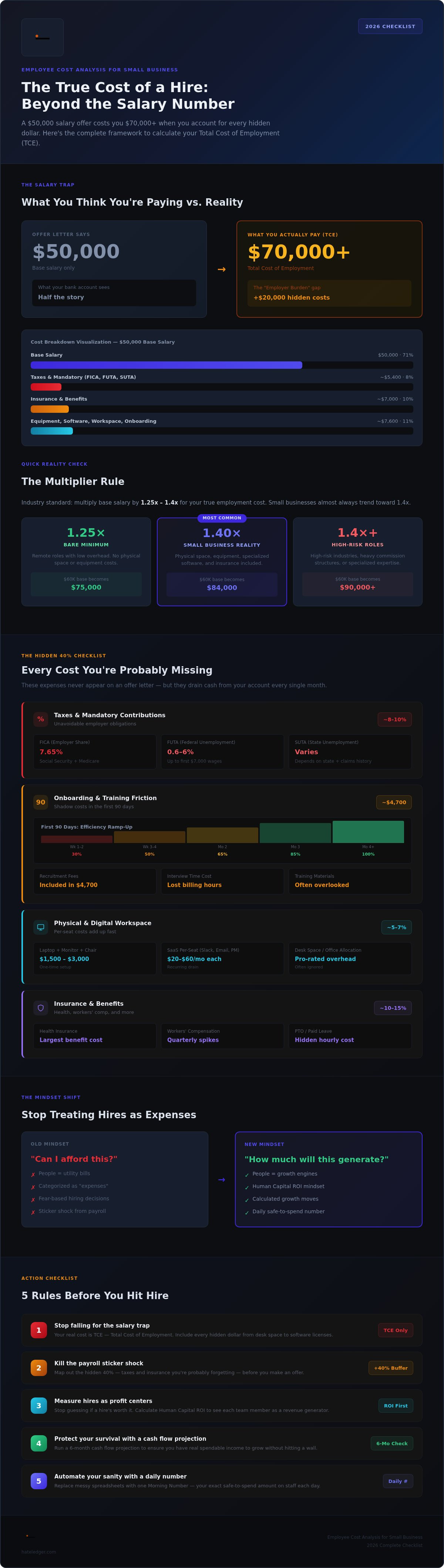
Hiring isn't about the number on the offer letter. It's about the cash that actually leaves your bank account. A $50,000 salary is a lie. By the time you add in mandatory taxes, insurance, and the tech stack they need to work, that person costs you $70,000 or more. This gap is what we call the "Employer Burden." If you don't perform a proper employee cost analysis for small business, you're flying blind. Your bank balance looks healthy today, but it doesn't account for the quarterly tax spikes or the workers' comp premiums hiding around the corner. Your bank balance lies to you because it only shows what happened yesterday; it doesn't show the liability you're building for tomorrow.
Total Cost of Employment (TCE) is the only number that matters. Gross pay is just the starting point. TCE includes every cent required to keep that person in their seat. Think of it as the price of admission for growth. Without this number, you aren't growing; you're just increasing your personal stress levels.
The Psychology of the Hiring Decision
Hiring feels like a high-stakes gamble because traditional accounting treats people like utility bills. They're categorized as "expenses." This mindset is a trap. You aren't just buying hours; you're investing in human capital. The anxiety you feel when looking at a new salary is your survival instinct warning you about the unknown. Shifting from an "expense" mindset to a "human capital ROI" mindset changes everything. It turns a scary cost into a calculated growth move. You stop asking "can I afford this?" and start asking "how much will this person generate?"
The Multiplier Rule: A Quick Reality Check
You need a fast way to estimate before you post a job ad. Use the multiplier rule. Industry standards suggest a range of 1.25x to 1.4x of the base salary. If you hire someone at $60,000, expect to pay between $75,000 and $84,000. Small businesses almost always trend toward the 1.4x end. You don't have the scale of a corporation. You pay more for software seats, equipment, and specialized insurance. Use this multiplier for a quick gut check. If the 1.4x number makes you sweat, stop. You need a deep-dive analysis before you commit to a new team member.
- 1.25x Multiplier: The bare minimum for remote, low-overhead roles.
- 1.4x Multiplier: The safe reality for most small businesses with physical space and equipment.
- Beyond 1.4x: High-risk industries or roles with heavy commission structures.
The "Hidden 40%" Checklist: Every Cost You Are Probably Missing
Your payroll number is a starting line, not a finish line. When you run an employee cost analysis for small business, you'll find a mountain of expenses that never show up in a job offer. We call this the "Hidden 40%." It’s the collection of mandatory payments, insurance premiums, and operational leaks that turn a profitable hire into a cash flow crisis if you aren't prepared. Most founders ignore these details until the quarterly tax bill hits. By then, it's too late to adjust your margins.
Taxes and Mandatory Contributions
Uncle Sam takes his cut before your employee even sees their first check. You're responsible for the employer share of FICA, which covers Social Security and Medicare at a rate of 7.65 percent. Then there's FUTA (Federal Unemployment) and SUTA (State Unemployment). SUTA is the wild card. It fluctuates based on your state's rules and your company's claims history. If you don't set up an automated tax reserve, these payments will feel like a recurring gut punch. Building a buffer into your daily numbers ensures you never "borrow" from the IRS just to cover Friday's payroll.
Onboarding and Training Friction
A new hire doesn't arrive at 100 percent efficiency. The first 90 days are a "Shadow Cost" where you pay full price for half-speed output. You also have to account for recruitment fees and the literal hours you spent interviewing instead of billing clients. Industry estimates suggest the average cost to recruit and onboard a single employee for a small firm in 2026 is approximately $4,700 before they've even finished their first week of training. This is why measuring your results with a Human Capital ROI Engine is vital; it shows you exactly when that investment starts paying you back.
The Physical and Digital Workspace
Every new person needs a toolkit. A laptop, a second monitor, and an ergonomic chair aren't optional anymore. Then come the "per-seat" SaaS subscriptions. Slack, email, and project management tools might only be $20 each, but they stack up fast. Performing a granular employee cost analysis for small business means looking at these digital overheads. Use our Cost to Hire an Employee Calculator: 2026 Guide to see how these small leaks create a massive hole in your budget. If you aren't accounting for the desk space or the extra gigabytes of cloud storage, your margins will vanish before the new hire even settles in.
Human Resources Human Capital: Calculating Your Real ROI
Stop calling it Human Resources. Resources are things you consume and throw away, like printer paper or coffee pods. Your team is Human Capital. Capital is an asset you invest in to generate a return. If you aren't running an employee cost analysis for small business with this mindset, you're just tallying up bills. You need to know if every person on your payroll is a profit center or a cost center. A cost center drains your bank account. A profit center fills it. It's that simple.
How do you know the difference? Look at your Morning Number. This is the daily reality of what your team produces versus what they cost. If your team spent four hours yesterday fighting with a broken printer or manually entering data, that is low-value work. You paid for high-level talent but got low-level results. Identifying these leaks is the first step toward fixing your ROI. You can't improve what you don't track, and you can't track what you haven't defined.
The ROI Formula for Non-Accountants
Calculating ROI doesn't require a CPA. Take your total revenue and divide it by your headcount. Now, compare that to your Total Cost of Employment. If the gap isn't wide enough to cover your overhead and profit, you have a productivity problem, not a payroll problem. Remember: being busy isn't the same as being profitable. A team that runs in circles still costs you money. For a deeper dive, check out How to Measure Human Capital ROI (Without the HR Jargon).
Measuring Intangible Value
Not every return shows up as a direct sale. Sometimes the ROI is the three hours of sanity you gained back because someone else handled the customer support tickets. That is time saved for the founder. It allows you to focus on high-level strategy. You're also buying specialized skills that you don't have the time or desire to master. Strategically managing human resources human capital increases business valuation by proving the company can run profitably without the founder doing every single task. This shift in perspective turns a "scary" hire into a calculated move for long-term wealth.
The Hiring Decision Framework: Can You Safely Afford to Grow?
Hiring on a gut feeling is how businesses die. You feel busy. You feel overwhelmed. You assume a new body in a chair will solve the chaos. That's a trap. A real employee cost analysis for small business requires a mechanical framework that removes your emotions from the equation. If the data says no, the answer is no. Period. You need a process that protects your cash flow while you hunt for growth.
- Step 1: Determine Spendable Income. Forget your gross revenue. Subtract your automated tax reserves and fixed overhead from your monthly intake. What is left is your true hiring budget.
- Step 2: Run a 6-Month Projection. Don't just look at next month. Model your cash flow for half a year with the new Total Cost of Employment included. One bad month shouldn't be enough to sink your ship.
- Step 3: Identify the Revenue Trigger. Define the exact dollar amount or project load that mandates a new hire. If you haven't hit that trigger yet, you aren't ready to hire.
- Step 4: Audit the Morning Number. For 30 days after the hire, watch your productivity-to-profit ratio every single morning. If the number drops and stays down, your new hire isn't producing the ROI you expected.
The "Decision Engine" Logic
Data is the only antidote to hiring anxiety. Most founders struggle to choose between a full-time employee and a contractor. A contractor is a variable cost that you can scale back. An employee is a fixed, long-term commitment. Use our Small Business Hiring Decision Tool: Stop Guessing and Start Growing (2026) to see which path fits your current cash flow. Don't let a temporary spike in work trick you into a permanent payroll obligation. If you want to scale without the stress, calculate your hiring capacity now.
Preparing for the "What Ifs"
Never hire from a place of desperation. You need a three month payroll runway sitting in cash before that person's first day. This is your safety net. If a major client leaves or the market shifts, you have 90 days to pivot without being forced to fire people immediately. If the ROI doesn't show up as planned, you need a pre-set exit strategy. Read our How to Calculate Employee ROI: A No-Nonsense Guide for 2026 to learn how to spot a failing investment before it drains your reserves. Safety isn't an accident. It's a calculation. Performing a rigorous employee cost analysis for small business ensures you stay in control of the outcome.
Automating Human Capital ROI with Hate Ledger
Spreadsheets are where profit goes to hide. Most founders waste hours trying to maintain an employee cost analysis for small business using broken formulas and outdated data. It is a mess. Hate Ledger kills that mess. We replace the chaos with a single Morning Number. This is your daily reality check. It tells you exactly what you can safely spend without guessing. You don't need more tabs; you need more truth.
Our Human Capital ROI Engine does the heavy lifting for you. It identifies exactly what each team member contributes to your bottom line. This isn't about corporate jargon or "utilization rates." It is about seeing who moves the needle and who just takes up space. If you don't know the ROI of your team, you don't have a business; you have an expensive hobby. We make that ROI visible so you can make decisions based on facts rather than feelings.
We also fix the biggest threat to your cash flow: the IRS. Hate Ledger automates your tax reserves. The money for FICA, FUTA, and SUTA is set aside before you even see it. You will never "borrow" from the government to make payroll again. The money stays invisible until it is needed. It is safe. It is automated. It is done.
Invisible Double-Entry for Busy Founders
You aren't an accountant. You shouldn't have to act like one. Hate Ledger tracks every employee cost in the background while you run your company. It builds a Decision Engine for your next hire so you know the exact moment to scale. We promise a 90-day setup to move your business from chaos to total clarity. We systematically replace complex accounting dimensions with plain English results. You get the insights of a CFO without the six-figure salary.
Stop Playing Accountant, Start Being a CEO
Reclaim your mental load. Stop worrying about the math and start focusing on the mission. Every minute you spend fighting with a ledger is a minute you aren't growing your brand. Our Free Forever Tier lets you test the waters without a credit card. You can see the value of a real employee cost analysis for small business before you spend a dime. If you're ready to stop guessing and start leading, start measuring your Human Capital ROI for free with Hate Ledger.
Take Control of Your Growth
You now have the checklist to stop the payroll sticker shock. You know that a base salary is only the starting line. Your true Total Cost of Employment includes that hidden 40 percent in taxes and overhead. Most importantly, you understand that every team member must be a profit center. Running a manual employee cost analysis for small business every month is a recipe for burnout. You have a company to lead. You don't have time to babysit a spreadsheet.
Hate Ledger takes the guesswork out of your expansion. Our Human Capital ROI Engine and decision engine for hiring choices give you the clarity to move fast. With automated tax reserves, you'll never worry about a surprise bill from the government again. It's time to trade your hiring anxiety for total confidence. Stop guessing your hiring budget and start your Free Forever Hate Ledger account today. You've done the hard work of building a team; now let's make sure that team builds your wealth.
Frequently Asked Questions
What is the most common hidden cost when hiring a new employee?
The most common hidden cost is onboarding friction and the lost productivity of the founder. While most owners worry about taxes, the silent killer is the "Shadow Cost" of the first 90 days. You are paying 100 percent of a salary for roughly 50 percent of the output while you spend your own billable hours training them. If your employee cost analysis for small business doesn't account for your own lost time, you're missing the biggest leak.
How much should a small business set aside for employee payroll taxes?
You should set aside approximately 10 to 15 percent above the gross salary to stay safe. This covers your mandatory 7.65 percent FICA share for Social Security and Medicare, plus federal and state unemployment taxes. Because SUTA rates vary wildly based on your state and claims history, a 15 percent buffer prevents quarterly sticker shock. Automating these reserves ensures you never have to "borrow" from your future self to pay the tax man.
Is it cheaper to hire a contractor or a full-time employee?
Contractors are cheaper on paper because you skip the 40 percent "burden" of taxes, benefits, and insurance, but they usually command a higher hourly rate. A full-time employee offers a lower base rate but requires a long-term commitment and mandatory tax contributions. Use contractors for variable project work and full-time staff for core operations that require institutional knowledge. Choose the model that protects your daily cash flow rather than just the lowest sticker price.
What is a good Human Capital ROI for a small business?
A solid benchmark for service-based businesses is a 3:1 ratio, meaning for every dollar spent on a team member, they generate three dollars in revenue. This isn't a rigid law, but it's a healthy target to ensure the hire is a profit center. If your ratio drops toward 1:1, that person has become a cost center. You need to track this number to decide if your expansion is actually building wealth or just increasing your stress.
How do I calculate the "burdened" hourly rate for an employee?
Take the annual salary and add every mandatory tax, insurance premium, and overhead cost like software seats. Divide that total by the number of work hours in a year, which is typically 2,080 for a full-time role. This is your true cost per hour. If you only look at the gross hourly pay, you will underprice your services and end up paying for the privilege of having a team.
Can I use accounting software to decide when to hire?
Yes, modern platforms use a decision engine to analyze your current spendable income and project future needs. Instead of guessing when you feel "busy enough," the software identifies the exact revenue trigger that makes a new hire safe. It removes the emotion and the gamble from the process. This ensures you only hit the hire button when your employee cost analysis for small business proves the move is sustainable.
What happens if I forget to account for SUTA or FUTA taxes?
Forgetting these leads to massive quarterly cash flow spikes and potential penalties from the IRS or state agencies. These aren't optional suggestions; they are legal obligations that build up with every paycheck you issue. If you don't track them, you'll find yourself with a healthy bank balance on Monday and a drained account by Friday. Automated reserves are the only way to shield your business from this avoidable financial trauma.
How does the "Morning Number" help with employee cost analysis?
The Morning Number is your daily snapshot of what you can safely spend after accounting for all liabilities, including staff costs. It turns complex accounting into a single, actionable data point you can check over coffee. By watching this number, you see the immediate impact of a new hire on your daily liquidity. It moves you from reactive bookkeeping to proactive leadership by showing you the truth of your bank balance in real-time.
Frequently Asked Questions
The most common hidden cost is onboarding friction and the lost productivity of the founder. While most owners worry about taxes, the silent killer is the "Shadow Cost" of the first 90 days. You are paying 100 percent of a salary for roughly 50 percent of the output while you spend your own billable hours training them. If your employee cost analysis for small business doesn't account for your own lost time, you're missing the biggest leak.
You should set aside approximately 10 to 15 percent above the gross salary to stay safe. This covers your mandatory 7.65 percent FICA share for Social Security and Medicare, plus federal and state unemployment taxes. Because SUTA rates vary wildly based on your state and claims history, a 15 percent buffer prevents quarterly sticker shock. Automating these reserves ensures you never have to "borrow" from your future self to pay the tax man.
Contractors are cheaper on paper because you skip the 40 percent "burden" of taxes, benefits, and insurance, but they usually command a higher hourly rate. A full-time employee offers a lower base rate but requires a long-term commitment and mandatory tax contributions. Use contractors for variable project work and full-time staff for core operations that require institutional knowledge. Choose the model that protects your daily cash flow rather than just the lowest sticker price.
A solid benchmark for service-based businesses is a 3:1 ratio, meaning for every dollar spent on a team member, they generate three dollars in revenue. This isn't a rigid law, but it's a healthy target to ensure the hire is a profit center. If your ratio drops toward 1:1, that person has become a cost center. You need to track this number to decide if your expansion is actually building wealth or just increasing your stress.
Take the annual salary and add every mandatory tax, insurance premium, and overhead cost like software seats. Divide that total by the number of work hours in a year, which is typically 2,080 for a full-time role. This is your true cost per hour. If you only look at the gross hourly pay, you will underprice your services and end up paying for the privilege of having a team.
Yes, modern platforms use a decision engine to analyze your current spendable income and project future needs. Instead of guessing when you feel "busy enough," the software identifies the exact revenue trigger that makes a new hire safe. It removes the emotion and the gamble from the process. This ensures you only hit the hire button when your employee cost analysis for small business proves the move is sustainable.
Forgetting these leads to massive quarterly cash flow spikes and potential penalties from the IRS or state agencies. These aren't optional suggestions; they are legal obligations that build up with every paycheck you issue. If you don't track them, you'll find yourself with a healthy bank balance on Monday and a drained account by Friday. Automated reserves are the only way to shield your business from this avoidable financial trauma.
The Morning Number is your daily snapshot of what you can safely spend after accounting for all liabilities, including staff costs. It turns complex accounting into a single, actionable data point you can check over coffee. By watching this number, you see the immediate impact of a new hire on your daily liquidity. It moves you from reactive bookkeeping to proactive leadership by showing you the truth of your bank balance in real-time.