
How to Calculate the Real Cost of Hiring an Employee in 2026
September 6, 2026 · 18 min read
Your bank balance is a liar. Most founders look at a healthy account and assume they're ready to scale, but that "sticker price" salary is a trap. If you want to know how to calculate cost of hiring an employee in 2026, you have to look past the gross pay. Between the 7.65 percent FICA bite and the rising 6.7 percent healthcare spike, a new hire usually costs 1.4 times their base salary. If you don't account for the hidden drain on your daily spendable income, you aren't growing. You're just subsidizing a payroll tax bill.
I know the frustration. You're tired of wasting hours on complex spreadsheets that fail to tell the whole story. You want a simple "Yes" or "No" before you sign an offer letter. This guide delivers a no-nonsense framework to calculate the true impact of a new hire on your business growth. We'll strip away the jargon and focus on the Human Capital ROI. You'll learn exactly how to protect your profit and ensure every new team member generates more than they cost. No more guessing. Just cold, hard utility.
Key Takeaways
- Stop looking at base salary as your total spend. Learn how to calculate cost of hiring an employee by accounting for the 25 to 40 percent overhead that actually drains your cash.
- Decode the "Alphabet Soup" of payroll taxes without the industry jargon. We break down how FICA, FUTA, and SUTA impact your bottom line in plain English.
- Protect your take-home pay with the "Morning Number" philosophy. See the immediate impact on your spendable income so you never fall into the bank balance trap.
- Transition from "guessing" to "knowing" with a clear ROI framework. Learn to identify if a new hire is a growth engine or a debt trap before you sign the offer letter.
- Stop wasting time on broken spreadsheets. Discover how the Human Capital ROI Engine automates the math so you can make fast, confident decisions without a human bookkeeper.
The Sticker Price Trap: Why Salary is Only Half the Story
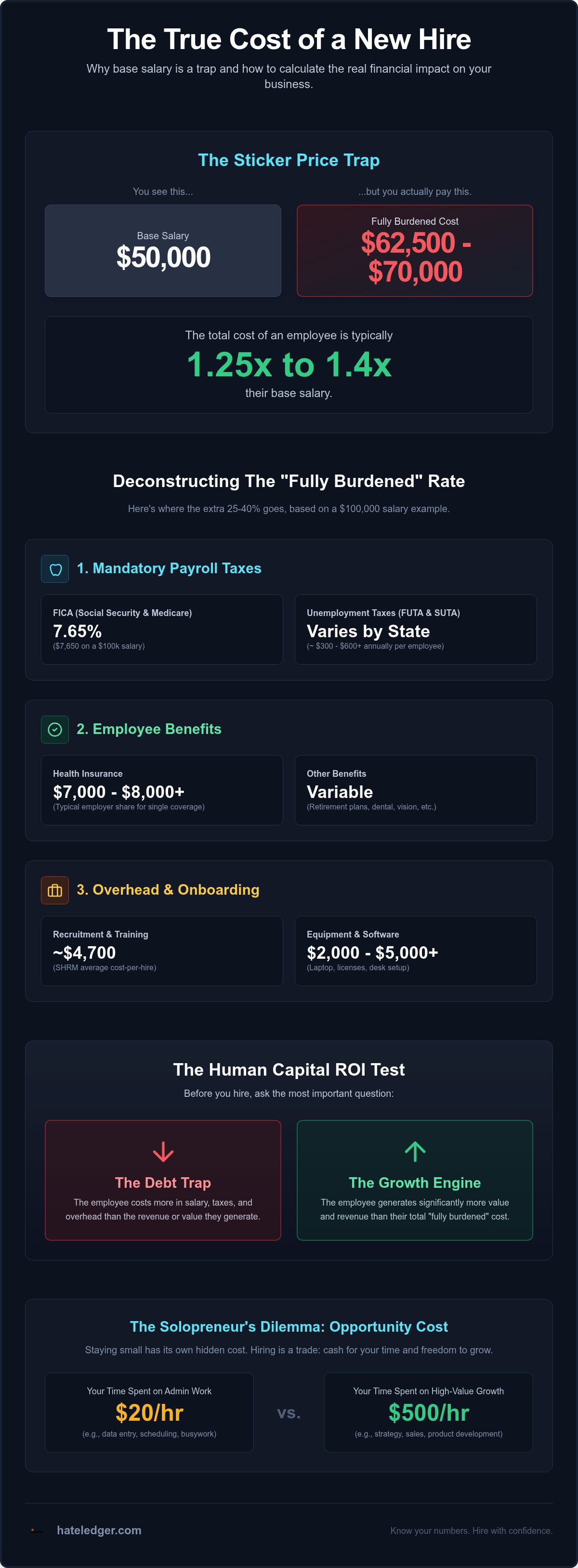
Your bank account is a master of deception. You look at your balance, see a healthy number, and think you can afford that $50,000-a-year marketing assistant. You're wrong. When you're figuring out how to calculate cost of hiring an employee, the salary is just the tip of the iceberg. The Sticker Price Trap is the gap between salary and total cash outlay. In reality, that $50,000 hire will likely cost your business closer to $65,000 or $70,000 in actual cash flow. This is the "Fully Burdened Rate." It is the only number that dictates whether your business grows or chokes.
Most founders fall into the Bank Balance Trap. They see money sitting in the account and assume it is spendable income. It isn't. Much of that cash is already "owned" by future tax liabilities and overhead. If you hire based on what you have today without accounting for the total impact, you are setting a debt trap for your future self. You need to know your "Morning Number" before you even post a job description. Knowing what you can actually spend is the difference between a calculated risk and a blind gamble.
The 1.25x Rule of Thumb
If you need a quick mental shortcut, use the 1.25x rule. Take the base salary and multiply it by 1.25. For many industries, this gives you a rough estimate of the total cost including basic taxes and benefits. However, this is just a starting point. In 2026, the average total cost of a new hire is often closer to 1.4 times their salary. This multiplier shifts wildly based on your location. A hire in California, with its 3.4 percent new employer SUI rate, hits harder than a hire in Texas at 2.7 percent. This rule fails when you ignore the $4,700 average cost-per-hire reported by SHRM. Recruitment isn't free. Onboarding isn't free. The rule of thumb is a shield, not a strategy.
The Solopreneur’s Dilemma
Hiring is a trade. You are trading your hard-earned cash for their time. But there is a hidden cost to staying small: the opportunity cost. Every hour you spend doing $20-an-hour admin work is an hour you aren't doing $500-an-hour strategy. You have to decide if the cost of the hire is greater than the cost of your own stagnation. Learning how to calculate cost of hiring an employee isn't just about payroll; it's about valuing your own freedom. You don't need a human bookkeeper to tell you if you're drowning in busywork. You just need the right math to prove the investment will pay off. Stop guessing and start measuring the return on your most expensive asset.
The Hidden Math of Payroll: Taxes, Benefits, and Overhead
Most payroll advice reads like a boring textbook. We don't have time for that. When you look at how to calculate cost of hiring an employee, you're looking at a list of entities that want a piece of your profit before you even see it. This "Alphabet Soup" of taxes is the first place your cash disappears. If you aren't setting these funds aside every single day, you're spending money you don't actually have. You need an automated tax reserve for the self-employed to stop the guessing game and see your real spendable income.
Employer-Paid Taxes 101
FICA is your primary mandatory match. You pay 7.65 percent of an employee's gross wages for Social Security and Medicare. For a worker earning $100,000, you owe $7,650 just for the privilege of having them on the team. Then comes the unemployment tax. Federal unemployment (FUTA) is usually a flat 0.6 percent on the first $7,000 of wages, provided you pay your state taxes on time. State unemployment (SUI) varies wildly. In 2026, a new employer in California pays 3.4 percent on a $7,000 base, while a Texas employer pays 2.7 percent on a $9,000 base. These aren't suggestions. They're legal mandates that eat your profit before you can reinvest it.
Workers' Compensation is the other mandatory drain you can't ignore. It's insurance for on-the-job injuries. The cost fluctuates based on your industry and your history of claims. If you're hiring for a desk job, it's a nuisance. If you're hiring for a warehouse, it's a major line item. Don't forget the "Empty Chair" overhead. Every new hire needs a laptop, a desk, and a stack of software licenses. Slack, Zoom, and CRM seats add up fast. These tools often account for a significant portion of the $4,700 average cost-per-hire that catches founders off guard.
Benefits and "The Extras"
Health insurance is the steepest hurdle for small teams in 2026. Annual premiums for single coverage are now hitting between $9,000 and $9,500. Most employers cover 70 to 80 percent of that cost. It's a massive hit to your cash flow that doesn't show up in a simple salary calculation. If you're struggling to balance these costs, check out our small business PEP guide for a smarter way to offer benefits without tanking your take-home pay.
Paid Time Off (PTO) is the final hidden drain on your productivity math. When an employee is on vacation, you're paying 100 percent of their cost for 0 percent of their output. Your calculation must account for these "dead" weeks. Every day they're away, your Human Capital ROI drops. To keep your business healthy, you must ensure their active weeks generate enough profit to cover their rest weeks. Anything less is a slow leak in your business growth.
Beyond the Check: Calculating Human Capital ROI
Hiring is not an expense. It is a capital investment. If you treat payroll like a utility bill, you have already lost. When you master how to calculate cost of hiring an employee, you stop obsessing over the cash leaving your account and start focusing on the cash they bring in. This is Human Capital ROI. It is the only metric that determines if your business is a growth engine or a sinking ship. You are buying time, skill, and scale. If that purchase doesn't yield a profit, you aren't growing. You're just getting busier.
Every hire has a break-even point. This is the moment their cumulative profit exceeds the total cost of bringing them on board. Remember the $4,700 average cost-per-hire we discussed? That is your starting debt. On top of that, you have the "Fully Burdened Rate" of taxes and benefits. Most hires take three to six months to reach full productivity. If you don't have the data to track this timeline, you're flying blind. You need to move from "I think we need help" to "I know this person will pay for themselves by month four."
Revenue per Employee
This is the ultimate efficiency hack. Take your total revenue and divide it by your head count. It is a brutal, honest number. If you add a new team member and your revenue per head drops, you are in a death spiral. You are adding complexity without adding value. High-growth founders use the Small Business Hiring Decision Tool to model these scenarios before they commit to a contract. It allows you to see the future of your profit margins before the first payroll run.
The ROI vs. Cost Debate
Cheap hires are often the most expensive mistakes you can make. A $20-per-hour admin might save you time, but if they don't help you close more deals, they are a pure cost. Contrast that with a $50-per-hour salesperson who brings in $500 an hour in new business. The salesperson costs more on paper, but they are infinitely more "affordable" because they are a profit center. A hire is only "expensive" if their ROI is below 1x. If they don't make you more than they cost, they are a liability. Period. Stop looking for the lowest price and start looking for the highest return. That is how you build a business that funds your life instead of consuming it.
The Spendable Income Test: Can You Afford the Hit?
Most payroll calculators tell you what an employee costs the business. They don't tell you what that employee costs you. When you are figuring out how to calculate cost of hiring an employee, the final step isn't a payroll figure. It's a lifestyle figure. Your bank balance is a liar; it shows you the cash you have today while hiding the taxes you owe tomorrow. To survive a new hire, you must move past the "Bank Balance Trap" and embrace the "Morning Number" philosophy. This is the radical simplification of your finances: knowing exactly what you can safely spend right now without touching your tax reserves or owner draws.
Step 1: Determine Your Current Spendable Income
Start with the truth. Look at your total cash and subtract your automated tax reserves. Then, subtract your fixed operating costs. What remains is your spendable income. This is the only money you actually own. Before you commit to a new salary, you must identify your personal "Owner Draw" requirements. If hiring someone reduces your spendable income below what you need to live, the hire is a liability, not an asset. You need a hiring safety buffer. This is a cash cushion specifically designed to cover the first 90 days of a new hire's tenure before they become fully productive. If you don't have that buffer, you aren't ready to scale.
Step 2: Project the Monthly Cash Drain
Calculate the real monthly hit to your cash flow. Take the fully burdened rate, which we established is roughly 1.4 times the base salary, and divide it by 12. This is your new monthly baseline cost. Now, factor in the "Ramp-up" period. For the first three months, a new hire is a net drain. They cost 100 percent of their burdened rate but often produce less than 30 percent of their expected value. This creates a "Dip" in your spendable income. You must stress-test your cash flow to ensure you can survive this three month dip before their Human Capital ROI kicks in. If the math feels tight, stop guessing. Use The Business Financing Decision Tool: Stop Guessing and Start Growing to see if you should fund this expansion through cash reserves or external growth capital.
Hiring when you "feel busy" is a recipe for a cash crunch. Business is an emotional state, but payroll is a mathematical reality. By running this spendable income test, you ensure that your business growth doesn't come at the expense of your personal financial safety. You deserve to know that your next hire will fund your life, not consume it.
Stop Guessing: Using a Decision Engine for Your Next Hire
Spreadsheets are where growth plans go to die. They are clunky. They are manual. They are almost always out of date the moment you hit "Save." If you are still trying to figure out how to calculate cost of hiring an employee by manually plugging numbers into a grid, you are wasting the very time you are trying to buy back. You don't need another complex template or a human bookkeeper who charges by the hour to tell you what happened last month. You need a decision engine that tells you what you can do today.
Hate Ledger’s Human Capital ROI Engine replaces the guesswork with automated precision. It takes every tax rate, benefit premium, and overhead cost we've covered and condenses them into a single, actionable truth. This is the "Morning Number" in action. It is your daily green light. When you wake up and see that number, you know exactly how much spendable income is available to fund a new hire. You move from the stress of "Hating Accounting" to the clarity of "Loving Growth." It’s about building a business that operates with the speed of a quick decision, not the lag of a legacy system.
The Automated Advantage
The secret is invisible double-entry. Hate Ledger handles the back-end mechanics without you ever touching a ledger. There is no manual payroll entry or tedious reconciliation. Instead, you get real-time ROI tracking of your team members. You can see exactly when a hire moves from being a net drain to a profit generator. This is the ultimate accounting software for people who hate accounting. It shields you from the tedious details so you can focus on the results. You get the utility of a high-end finance department without the detached professionalism or the high price tag.
Your 90-Day Growth Promise
We don't believe in long, drawn-out implementations. We offer a 90-day setup promise to get your Human Capital ROI Engine firing on all cylinders. You'll have total confidence in your hiring framework before the next quarter begins. If you aren't ready to commit to a paid plan, start with our Free Forever tier. It allows you to test the waters and see the impact on your spendable income without a credit card. Paid plans start at just $19 per month, which is a fraction of the cost of a single bad hiring decision. It is time to stop the bank balance gamble. Stop guessing and start hiring with Hate Ledger. Protect your profit. Scale your team. Reclaim your time.
Secure Your Growth and Reclaim Your Profit
Stop treating your payroll like a guessing game. You now know that the sticker price is a lie. Real growth happens when you look past the base salary and master how to calculate cost of hiring an employee by factoring in the 40 percent overhead that actually hits your bank account. You've seen the difference between a "dead cost" hire and a true profit center. Now, it's time to put that knowledge into motion.
You don't need to be an accountant to run a profitable team. You just need the right engine. With our plain-English financial decision tools and a 90-day setup promise, we strip away the jargon and give you the truth. You can test the waters with our Free Forever Tier. No credit card is required. It's time to stop letting "Alphabet Soup" taxes dictate your future.
Get your Morning Number and see if you can afford to hire today; Free Forever. You have the framework. Now, take the lead. Your business is ready for the next level. You've got this.
Frequently Asked Questions
What is the average cost to hire an employee in 2026?
The average cost-per-hire in 2026 is approximately $4,700 according to SHRM data. This figure includes recruitment technology, background checks, and the administrative time spent interviewing. However, this is just the entry fee. Once the employee starts, your total annual cost typically ranges from 1.25 to 1.4 times their base salary. For executive roles, the initial hiring cost can easily exceed $25,000. Don't let the average figure distract you from your specific cash flow impact.
How do I calculate the fully burdened cost of an employee?
To understand how to calculate cost of hiring an employee, you must add every dollar that leaves your business for that hire. Start with the gross salary. Add 7.65 percent for FICA taxes. Include federal and state unemployment taxes (FUTA/SUTA). Add worker’s compensation insurance and health benefits, which average $9,000 to $9,500 annually in 2026. Finally, factor in software licenses and equipment. This total figure represents the real-world hit to your daily spendable income.
Is it cheaper to hire a contractor or a full-time employee?
On paper, a contractor is cheaper because you skip the 7.65 percent FICA match, health insurance, and unemployment taxes. You also avoid the $4,700 average hiring fee. However, contractors often charge higher hourly rates to cover their own overhead. The real question isn't the price; it's the ROI. If a full-time employee generates three times their cost through consistent output, they are a better long-term investment than an expensive, intermittent contractor.
How much should I set aside for payroll taxes?
You should set aside roughly 10 to 12 percent of the gross salary to cover employer-paid taxes safely. This covers your 7.65 percent FICA obligation plus state and federal unemployment taxes. SUI rates vary by state, with new employers in California paying 3.4 percent and Texas paying 2.7 percent in 2026. Using automated tax reserves ensures this money is invisible and protected, so you never accidentally spend the government's share of your revenue.
What is a good Human Capital ROI for a small business?
A healthy Human Capital ROI for a small business is typically 3x or higher. This means for every dollar you spend on a fully burdened employee, they generate three dollars in gross profit. If the ratio is 1x, you are just trading dollars and increasing your stress. If it is below 1x, that hire is a liability. Focus on revenue per employee to ensure your team is a growth engine rather than a slow leak in your profit.
Can I afford to hire an employee if my bank balance is low?
Your bank balance is a poor indicator of hiring readiness. If your balance is low but your "Morning Number" shows high spendable income after tax reserves, you might be ready. However, you should generally have a 90-day cash buffer to cover the ramp-up period. Hiring when you're desperate for cash is a high-stakes gamble. Use a decision engine to stress-test your cash flow before you commit to a recurring payroll obligation that could tank your business.
What are the most common hidden costs of hiring?
The biggest hidden costs are the productivity dip and the "Empty Chair" overhead. A new hire takes three to six months to reach full speed, meaning you pay 100 percent of their cost for a fraction of the output. Other invisible drains include software licenses, which add up fast, and the 6.7 percent annual increase in healthcare premiums. These small leaks can easily turn a $50,000 salary into a $70,000 business expense without you noticing.
How does a new hire affect my spendable business income?
A new hire immediately reduces your daily spendable income by increasing your tax reserve requirements and fixed costs. Every time you run payroll, your "Morning Number" drops. To maintain your lifestyle, that hire must increase your total revenue enough to offset their fully burdened cost plus your desired profit margin. If they don't, you are effectively paying for their job out of your own personal take-home pay. That is the definition of the bank balance trap.
Frequently Asked Questions
The average cost-per-hire in 2026 is approximately $4,700 according to SHRM data. This figure includes recruitment technology, background checks, and the administrative time spent interviewing. However, this is just the entry fee. Once the employee starts, your total annual cost typically ranges from 1.25 to 1.4 times their base salary. For executive roles, the initial hiring cost can easily exceed $25,000. Don't let the average figure distract you from your specific cash flow impact.
To understand how to calculate cost of hiring an employee, you must add every dollar that leaves your business for that hire. Start with the gross salary. Add 7.65 percent for FICA taxes. Include federal and state unemployment taxes (FUTA/SUTA). Add worker’s compensation insurance and health benefits, which average $9,000 to $9,500 annually in 2026. Finally, factor in software licenses and equipment. This total figure represents the real-world hit to your daily spendable income.
On paper, a contractor is cheaper because you skip the 7.65 percent FICA match, health insurance, and unemployment taxes. You also avoid the $4,700 average hiring fee. However, contractors often charge higher hourly rates to cover their own overhead. The real question isn't the price; it's the ROI. If a full-time employee generates three times their cost through consistent output, they are a better long-term investment than an expensive, intermittent contractor.
You should set aside roughly 10 to 12 percent of the gross salary to cover employer-paid taxes safely. This covers your 7.65 percent FICA obligation plus state and federal unemployment taxes. SUI rates vary by state, with new employers in California paying 3.4 percent and Texas paying 2.7 percent in 2026. Using automated tax reserves ensures this money is invisible and protected, so you never accidentally spend the government's share of your revenue.
A healthy Human Capital ROI for a small business is typically 3x or higher. This means for every dollar you spend on a fully burdened employee, they generate three dollars in gross profit. If the ratio is 1x, you are just trading dollars and increasing your stress. If it is below 1x, that hire is a liability. Focus on revenue per employee to ensure your team is a growth engine rather than a slow leak in your profit.
Your bank balance is a poor indicator of hiring readiness. If your balance is low but your "Morning Number" shows high spendable income after tax reserves, you might be ready. However, you should generally have a 90-day cash buffer to cover the ramp-up period. Hiring when you're desperate for cash is a high-stakes gamble. Use a decision engine to stress-test your cash flow before you commit to a recurring payroll obligation that could tank your business.
The biggest hidden costs are the productivity dip and the "Empty Chair" overhead. A new hire takes three to six months to reach full speed, meaning you pay 100 percent of their cost for a fraction of the output. Other invisible drains include software licenses, which add up fast, and the 6.7 percent annual increase in healthcare premiums. These small leaks can easily turn a $50,000 salary into a $70,000 business expense without you noticing.
A new hire immediately reduces your daily spendable income by increasing your tax reserve requirements and fixed costs. Every time you run payroll, your "Morning Number" drops. To maintain your lifestyle, that hire must increase your total revenue enough to offset their fully burdened cost plus your desired profit margin. If they don't, you are effectively paying for their job out of your own personal take-home pay. That is the definition of the bank balance trap.