
The Business Financing Decision Tool: Stop Guessing and Start Growing
August 29, 2026 · 17 min read
Your bank balance is lying to you. It shows you a number, but it doesn't show you the debt repayment due next week or the true cost of that "urgent" new hire. Relying on your gut to grow is a fast track to the Bank Balance Trap. You deserve better than guessing. You need a data-backed business financing decision tool that turns "maybe" into "move."
You know that feeling. The late-night anxiety over whether a loan will fuel growth or just bury you in interest. You want to scale, but the math feels like a moving target. It's frustrating to see your hard-earned profit swallowed by hidden costs while you try to build something real. You aren't alone in feeling like the traditional accounting world is designed to keep you in the dark.
This article gives you a framework to stop the guessing game. You'll learn how to find your "Safe to Spend" number and decide between debt and equity in minutes. We're replacing intuition with real-world ROI. We will break down the Human Capital ROI Engine, the 2026 interest rate landscape, and the exact steps to ensure every dollar you borrow or every person you hire pays for itself.
Key Takeaways
- Stop trusting your bank balance as a growth guide. It hides invisible debts like tax reserves and future payroll that can lead you straight into a cash crunch.
- Replace gut feelings with a data-backed business financing decision tool to see the real-world ROI of every dollar you borrow before you sign the paperwork.
- Calculate Human Capital ROI before you hire. Turn your payroll from a stressful monthly expense into a predictable investment with clear growth targets.
- Master the ROI vs. Cost of Capital framework. Learn how to identify when a loan will fuel your business and when it is safer to bootstrap your next move.
- Get your daily Morning Number. Stop the manual math and know exactly how much cash is safe to spend on growth without risking your operational stability.
Why Your Bank Balance is a Dangerous Business Financing Decision Tool
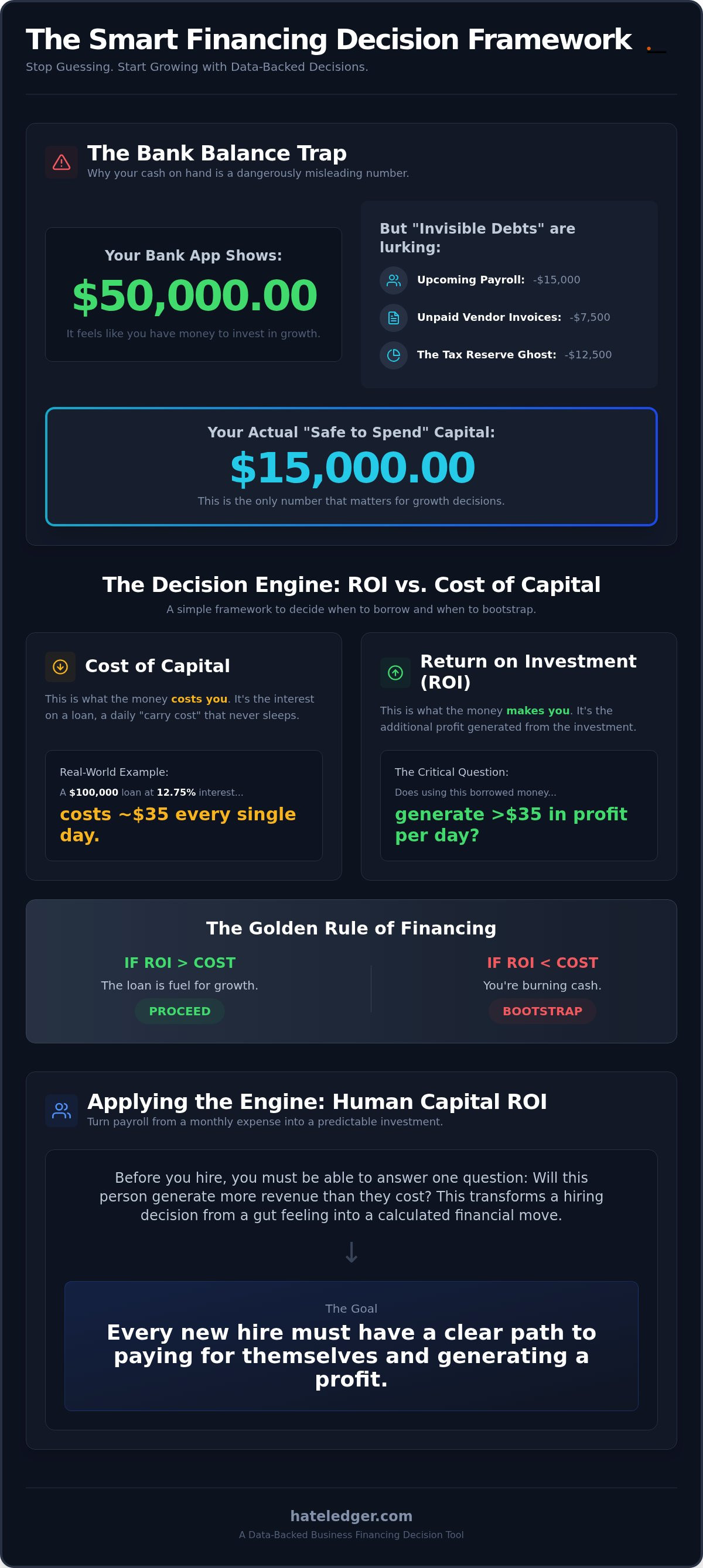
Your bank account is a liar. It shows you a number that looks like victory, but it's often a trap. Seeing $50,000 in your balance doesn't mean you have $50,000 to spend. If you use that raw number as your primary business financing decision tool, you're gambling with your company's survival. You're looking at a snapshot of the past, not a map of your future.
Most founders confuse cash on hand with actual profit. It's a common mistake that leads to the "Bank Balance Trap." You have "Invisible Debt" lurking beneath the surface at all times. This includes upcoming payroll, vendor invoices you haven't paid yet, and the biggest ghost of all: the tax man. To grow safely, you must understand Corporate Finance Principles like liquidity and capital structure. You need to know your "Safe to Spend" capital, which is the only number that matters when weighing a new loan or a big purchase.
The Lagging Indicator Problem
Your P&L statement is a history book. It tells you what happened thirty days ago. Using last month's report to decide on today’s financing needs is like trying to drive a car while looking only at the rearview mirror. It's dangerous. This delay creates a massive emotional toll. It leads to a sense of "financial blindness" that makes every loan offer feel like a high-stakes guess. You feel the pressure, but you lack the clarity to act.
You didn't start a business to spend your weekends staring at spreadsheets. It's time to stop playing accountant and start focusing on your future growth. If your data is old, your decisions are wrong. Fast-growth companies don't wait for a bookkeeper's report to know if they can afford a new hire. They use tools that work in real-time to replace gut feelings with hard math.
The Tax Reserve Ghost
A huge chunk of the money in your bank account actually belongs to the IRS. If you spend it on a loan repayment or a new marketing campaign, you're just stealing from your future self. This is why an automated tax reserve for self-employed is a critical safety metric. It carves out what isn't yours before you even see it.
- The Morning Number: This is your true north. It's the cash you actually own after every debt and tax obligation is removed.
- Invisible Debt: These are the obligations that haven't hit your bank statement yet but are already "spent" in reality.
- Real-Time ROI: If your loan interest is 12.75% but your "Safe to Spend" number is trending down, the loan is a risk you can't afford.
Knowing your Morning Number prevents bad debt. It gives you the confidence to say yes to an opportunity because you know the money is actually yours. Stop guessing. Start using a framework that prioritizes your safety.
The 2026 Decision Engine: ROI vs. Cost of Capital
Stop building spreadsheets. If you need a degree in finance to understand a loan offer, it's a bad offer. A real business financing decision tool shouldn't require a calculator and three hours of your time. It should require five minutes. You're comparing two numbers: what the money costs and what the money makes. That's it. We call this the Decision Engine.
Debt is fuel. Growth is the destination. If the fuel costs more than the distance you travel, you're burning cash for no reason. You don't need to know about "WACC" or "Liquidity Ratios" to grow. You need to know if you'll have more money in your pocket at the end of the month than you did at the start. Bootstrap when your profit margins are thin. Borrow when you have a proven system that scales. If you can't see the profit in five minutes, walk away from the deal.
Calculating Your Carry Cost
What does a $100,000 loan actually cost you per day? With the bank prime rate at 6.75% as of August 2026, many SBA financing programs carry variable rates between 9.75% and 13.25%. That isn't just a percentage on a piece of paper. It's a daily bill. A 12.75% loan on $100k costs you roughly $35 every single day in interest alone. It's a "carry cost" that never sleeps.
Does your daily revenue grow by more than $35 specifically because of that money? If not, you're losing. Use your Morning Number to see if your current cash flow can swallow that daily carry cost without choking. If your Morning Number starts to trend down after taking the money, the loan is a weight, not a wing. You can track your spendable cash in real-time to ensure your revenue growth stays ahead of your debt.
The ROI Minimum Threshold
You need a "Hard No" limit on financing costs. For most small businesses, 2x ROI is the baseline. If you spend $1 on interest and fees, you better see at least $2 in profit. Anything less leaves too little room for error. Inflation and cash flow were the top challenges for 29% of small businesses recently. You can't afford "break-even" debt in this environment.
- The 2x Rule: Every dollar of debt must generate two dollars of profit.
- The Five-Minute Check: If the math is too fuzzy to solve on a napkin, it's a bad deal.
- Automated Vetting: Use a system that flags when a repayment schedule threatens your tax reserves.
You don't need to be a math genius to win. You just need to be disciplined. Set your threshold, stick to your Morning Number, and only take the money when the ROI is undeniable.
Human Capital ROI: The Missing Piece of the Financing Puzzle
Most founders think debt only comes from a bank. They're wrong. When you sign an employment contract, you're taking on a recurring debt that hits your balance sheet every two weeks. If you hire a manager for $6,000 a month, you've effectively taken out a loan with a $1,500 weekly repayment. You need a business financing decision tool that treats people with the same mathematical rigour as a line of credit. You wouldn't take a $72k loan without checking the ROI. Don't hire without doing the same.
Hiring is the most common form of financing in a small business. You're borrowing someone's time in exchange for future profit. If that person doesn't generate at least 2x their cost, they're a bad investment. Equipment is easy to calculate because it doesn't have "bad days" or require health insurance. People are complex. This is why using a small business hiring decision tool is non-negotiable for lean teams. You have to know the ROI before the first paycheck clears.
People vs. Platforms
Should you spend $5,000 a month on a new sales rep or $5,000 on an automated lead-gen platform? The platform is a fixed cost. The person is a variable risk. A bad hire drains your Morning Number through management time and missed opportunities. Predict labor profitability by understanding cost of capital in a human context. If the platform does 80% of the work for 20% of the risk, the platform wins every time.
Measuring Real-Time Labor ROI
Stop looking at payroll as a flat expense. It's an investment engine. If you aren't tracking "Revenue per Head," you're flying blind. Lean teams in 2026 win by keeping this number high. Use human capital data to drive financing choices. If revenue per head drops, you have an efficiency problem. Your business financing decision tool should flag this before it tanks your cash flow and ruins your growth trajectory.
- Investment Mindset: Treat every salary like a high-interest loan that must be repaid through profit.
- The 2x Threshold: A hire is only safe if they are projected to bring in twice their total cost.
- Morning Number Impact: Track how each new team member affects your daily spendable cash in real-time.
You can't afford to guess with people. Every hire should be a calculated move that strengthens your "Safe to Spend" number. If the math doesn't work, don't sign the contract.
How to Use a Business Financing Decision Tool (Step-by-Step)
Traditional lenders want you to write a 30-page business plan. That is a waste of your time. In a fast-moving market, you need a business financing decision tool that works at the speed of your ambition. You don't need a manifesto; you need a green light. Follow these five steps to vet any loan or hire in minutes.
- Step 1: Identify your "Safe to Spend" capital. This is your Morning Number. It's the cash left over after your automated tax reserves and upcoming payroll are stripped away.
- Step 2: Input the total cost. Don't just look at the interest rate. Include origination fees and closing costs. With 2026 SBA 7(a) rates reaching up to 13.25% for smaller loans, the "all-in" cost is what matters.
- Step 3: Estimate Growth Velocity. How quickly will this capital hit your bottom line? A new piece of equipment might take 60 days to generate revenue. A new sales hire might take 90.
- Step 4: Compare Daily Costs. Divide your monthly repayment by 30. If your daily carry cost is $50, but your daily profit increase is only $40, you're losing money every time the sun rises.
- Step 5: Check the Decision Engine. If the ROI is at least 2x and your Morning Number stays positive, it’s a go. If not, walk away.
The 90-Day Setup Promise
You shouldn't wait for tax season to organize your data. That's a legacy mindset. Modern growth requires automated bank syncing that feeds your decision tool instantly. If you're still wrestling with spreadsheets, you're playing a losing game. Transitioning to a Xero alternative for freelancers allows you to stop playing accountant. You get the decisions you need without the manual labor. We promise a full setup in 90 days, giving you total financial visibility.
Spotting Financing Red Flags
Sometimes the data says "No." Listen to it. "Vampire debt" is any financing that sucks more cash out of your business than it helps you generate. Be especially careful with "Stacking" loans. This happens when you take a second loan to cover the cash flow gap created by the first. It's a death spiral. If your business financing decision tool contradicts your gut feeling, trust the math. Your gut wants to grow, but the math wants you to survive. You can get your Morning Number today and see exactly where you stand before taking the leap.
Automate Your Growth Decisions with Hate Ledger
Accounting is a legacy tax chore. For most founders, it's a box to check once a year. For you, it should be a competitive advantage. Traditional software forces you to play bookkeeper. It buries you in ledgers, reconciliations, and technical jargon that doesn't help you grow. Hate Ledger kills the friction. It turns your financial data into a high-speed business financing decision tool. We handle the "Invisible Double-Entry" system behind the scenes. You stay compliant with the IRS without ever touching a spreadsheet or learning what a "debit" is.
Forget complex ratios and detached professional reports. You need plain-English answers to your hardest questions. Can I afford this loan? Is this hire going to pay for itself? We give you the result, not the process. You can start for free today with our Free Forever Tier. No credit card is required. No risk. Just immediate clarity for your business. We believe you should spend your time building your company, not auditing it.
The Morning Number Advantage
You need your vital signs before your first cup of coffee. The Morning Number is your daily safety net. While you focus on operations, our Decision Engine runs the math in the background. It accounts for your automated tax reserves, pending payroll, and current debt carry costs. It strips away the money that isn't yours so you can see exactly what you actually own.
Imagine you find a $20,000 equipment upgrade that could boost your production by 15%. In the old world, you'd call an accountant and wait three days for a reply. With Hate Ledger, you check your Morning Number and the Decision Engine. It compares the daily cost of the financing to your projected revenue lift. You get a Green or Red light in 60 seconds. That is the speed of growth in 2026. You don't guess. You decide.
Take Control of Your Future
"I'll check it later" is the most expensive phrase in business. It's the sound of missed opportunities and creeping debt. You can't lead if you are blind to your own numbers. Radical simplification isn't just about saving time. It's about saving your sanity. Knowing exactly what you can safely spend today changes how you lead. It replaces late-night anxiety with daytime assertion.
You stop being a reactive operator. You start being a proactive founder. The business financing decision tool you've been looking for isn't a complex model. It's a clear number. The tools are ready. The math is done. It's time to stop fighting legacy systems and start using a platform built for the way you actually work. Try the Hate Ledger Decision Engine for Free and see your real numbers for the first time.
Own Your Numbers and Outpace the Competition
Stop looking at your bank balance for permission to grow. It's a lagging indicator that hides your real obligations. By shifting to a data-backed business financing decision tool, you transform from a reactive operator into a strategic founder. You now have the framework to weigh daily carry costs against real-world revenue gains. You can treat every new hire as a high-yield investment rather than a flat expense.
You don't need to be a math genius to win. You just need the right engine. We deliver that clarity with a 90-day setup promise and automated daily ROI tracking. You get your Morning Number before you even start your day. No credit card is required for our Free Forever tier. It's time to stop the late-night anxiety and start making moves with total certainty.
Stop playing accountant. Get your Morning Number for free with Hate Ledger.
You have the framework. Now, take the lead and build the business you deserve.
Frequently Asked Questions
What is a business financing decision tool?
A business financing decision tool is a framework that replaces gut feelings with real-world math. It compares the daily cost of capital to the profit that capital generates. Instead of guessing if a loan is a good deal, you see a green or red light based on your actual data. It strips away technical jargon and focuses on one outcome: will this move leave more cash in your pocket?
How do I know if my business can afford a loan?
You afford a loan when the daily profit it creates is at least double its daily carry cost. Use your Morning Number to see if your cash flow can swallow the repayment without hitting your tax reserves. If your spendable cash trends down after taking the money, you can't afford it. A reliable business financing decision tool makes this math visible in seconds so you don't gamble with your survival.
What is the "Morning Number" and why does it matter?
The Morning Number is the only figure that truly matters for your daily operations. It's the amount of cash you can safely spend right now after every obligation is removed. We automatically strip out your tax reserves, upcoming payroll, and vendor bills. While your bank balance shows you everything, the Morning Number shows you what is actually yours. It is your ultimate financial safety net.
Is debt financing better than equity for a small business?
Debt is often better because you keep 100% of your company. It is a fixed cost that eventually disappears. Equity is the most expensive money you'll ever take because you give away a piece of every future dollar you earn. If your ROI is high enough to cover interest, debt is the smarter move. Use a decision engine to ensure the loan fuels growth rather than just creating a new bill.
How do I calculate the ROI of a new employee?
Calculating labor ROI means looking at the revenue a person generates versus their total cost. This includes salary, taxes, and software seats. We use a Human Capital ROI Engine to turn payroll from a flat expense into a measurable investment. If a hire doesn't project to bring in twice their cost, they are a risk to your stability. You need to see this math before you sign the contract.
Why is my bank balance different from my spendable income?
Your bank balance is a liar because it includes money that already belongs to the IRS or your employees. This is the "Bank Balance Trap." It doesn't account for "invisible debt" like pending invoices or quarterly tax obligations. Spendable income is what remains after those ghosts are cleared. Understanding this difference is the first step toward total financial clarity and making safe growth decisions for your future.
Can I use this tool if I hate accounting and math?
Absolutely. This platform is built for founders who want results, not a bookkeeping hobby. We use "Invisible Double-Entry" to handle the technical requirements while giving you answers in plain English. You don't need to know how to reconcile a ledger or build a spreadsheet. The system does the math and provides the decisions you need to grow. You focus on your business; we handle the numbers.
How do I automate my tax reserves so I don’t overspend?
You automate reserves by using a system that carves out tax money the moment revenue hits your account. We calculate your specific obligation based on your income and local requirements. This money is moved "out of sight" in your reporting so you never see it as spendable cash. It prevents the panic of tax season and ensures you never accidentally spend money that belongs to the government or your team.
Frequently Asked Questions
A business financing decision tool is a framework that replaces gut feelings with real-world math. It compares the daily cost of capital to the profit that capital generates. Instead of guessing if a loan is a good deal, you see a green or red light based on your actual data. It strips away technical jargon and focuses on one outcome: will this move leave more cash in your pocket?
You afford a loan when the daily profit it creates is at least double its daily carry cost. Use your Morning Number to see if your cash flow can swallow the repayment without hitting your tax reserves. If your spendable cash trends down after taking the money, you can't afford it. A reliable business financing decision tool makes this math visible in seconds so you don't gamble with your survival.
The Morning Number is the only figure that truly matters for your daily operations. It's the amount of cash you can safely spend right now after every obligation is removed. We automatically strip out your tax reserves, upcoming payroll, and vendor bills. While your bank balance shows you everything, the Morning Number shows you what is actually yours. It is your ultimate financial safety net.
Debt is often better because you keep 100% of your company. It is a fixed cost that eventually disappears. Equity is the most expensive money you'll ever take because you give away a piece of every future dollar you earn. If your ROI is high enough to cover interest, debt is the smarter move. Use a decision engine to ensure the loan fuels growth rather than just creating a new bill.
Calculating labor ROI means looking at the revenue a person generates versus their total cost. This includes salary, taxes, and software seats. We use a Human Capital ROI Engine to turn payroll from a flat expense into a measurable investment. If a hire doesn't project to bring in twice their cost, they are a risk to your stability. You need to see this math before you sign the contract.
Your bank balance is a liar because it includes money that already belongs to the IRS or your employees. This is the "Bank Balance Trap." It doesn't account for "invisible debt" like pending invoices or quarterly tax obligations. Spendable income is what remains after those ghosts are cleared. Understanding this difference is the first step toward total financial clarity and making safe growth decisions for your future.
Absolutely. This platform is built for founders who want results, not a bookkeeping hobby. We use "Invisible Double-Entry" to handle the technical requirements while giving you answers in plain English. You don't need to know how to reconcile a ledger or build a spreadsheet. The system does the math and provides the decisions you need to grow. You focus on your business; we handle the numbers.
You automate reserves by using a system that carves out tax money the moment revenue hits your account. We calculate your specific obligation based on your income and local requirements. This money is moved "out of sight" in your reporting so you never see it as spendable cash. It prevents the panic of tax season and ensures you never accidentally spend money that belongs to the government or your team.