
Affording Employee Benefits: Small Business PEP Guide
September 1, 2026 · 17 min read
Stop believing the lie that top-tier benefits are reserved for the giants with infinite HR budgets. You're losing your best people to corporations because you think you can't compete on perks. The truth is, you aren't failing at math; you're just paying for bureaucracy you don't need. Figuring out how to afford employee benefits small business owners actually want to provide doesn't require a miracle. It requires a better system. You're likely drowning in HR jargon and compliance paperwork while watching monthly liabilities fluctuate. It's exhausting and unnecessary.
We know you want to protect your team and your margins. This guide shows you how to provide enterprise-level benefits on a small business budget by leveraging Pooled Employer Plans (PEPs) and cutting administrative waste. With the PEP market hitting $30 billion, the secret is finally out. We'll show you a predictable, automated way to fund benefits and use your Morning Number to stay in control of your cash. You'll learn to offer perks that keep talent from walking out the door without the typical corporate headache. It's time to prioritize your Human Capital ROI and stop the waste.
Key Takeaways
- Stop paying for bureaucracy. Use a Pooled Employer Plan to access institutional pricing and enterprise-level perks by grouping with other businesses.
- Discover how to afford employee benefits small business teams actually value by using SECURE Act tax credits to slash your out-of-pocket costs.
- Use the Morning Number concept to set aside benefit reserves automatically and keep your monthly cash flow predictable.
- Offload the liability. A PEP moves the fiduciary burden and expensive audit costs away from you and onto a professional provider.
- Measure the impact. Use a Human Capital ROI Engine to track the data and prove your benefits are a high-return investment in your team.
The Small Business Benefits Trap: Why Tradition is Expensive
Tradition is killing your cash flow. Most founders think the cost of benefits is just the monthly premium. They're wrong. The real drain is the "Scale Gap." Large corporations pay less per head for better perks because they have the volume. You're stuck paying retail prices for a wholesale world. Understanding how to afford employee benefits small business owners can actually sustain starts with recognizing that your time is the most expensive line item. If you're spending ten hours a month chasing paperwork, you aren't saving money. You're burning it.
Traditional 401(k) plans are built for companies with entire HR departments. For a small team, these plans are a minefield of high fees and audit risks. You're forced to act like a benefits expert when you should be acting like a CEO. This mismatch creates a trap where you either offer nothing and lose talent, or you offer a legacy plan that drains your mental energy. It is a binary choice that fails every time. You need a third option that prioritizes utility over tradition.
The Administrative Burden Nobody Talks About
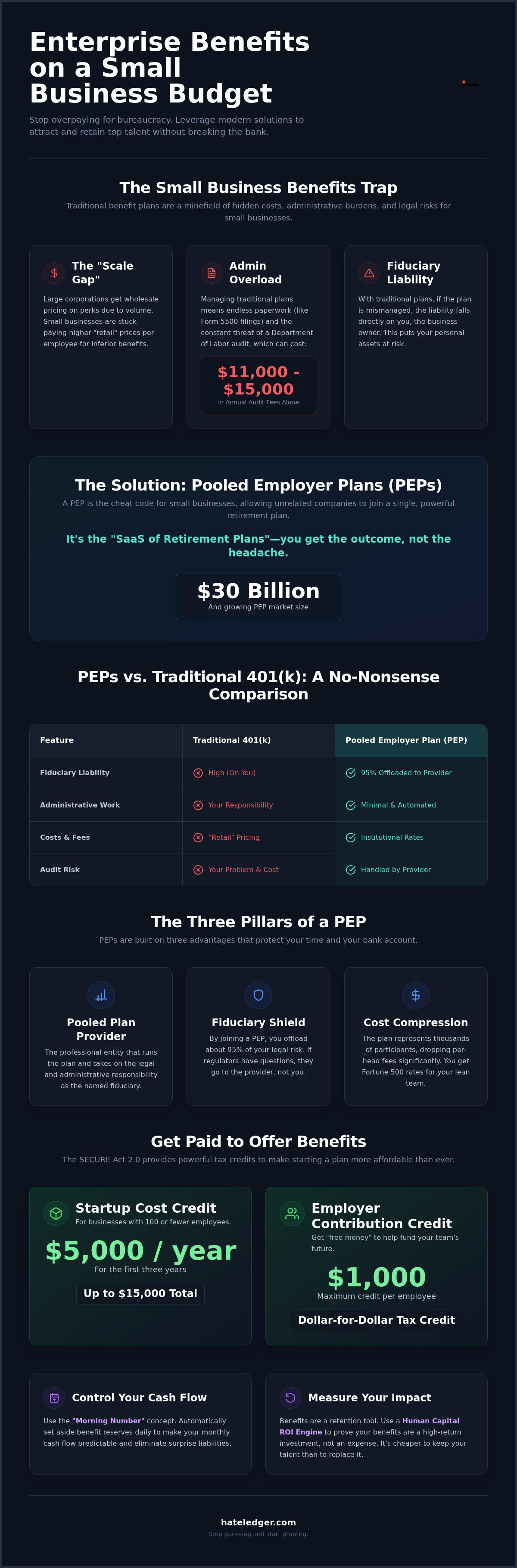
Managing a traditional retirement plan is a second job you didn't apply for. You're hit with Form 5500 filings and the constant threat of a Department of Labor audit. For a single-employer plan with at least 100 participants, an annual audit can cost between $11,000 and $15,000. That's money burned before a single employee sees a dime of savings. Then there's the fiduciary liability. If the plan is mismanaged, it's your personal neck on the line. At Hate Ledger, we believe in "Invisible Double-Entry" logic. If a process isn't automated and invisible, it's a liability. Traditional plans are the opposite of invisible. They're loud, clunky, and dangerous for your bottom line.
Measuring the ROI of Your People
Stop viewing benefits as a generous gift. They are a cold, hard retention tool. Your team is your biggest expense; they should also be your biggest lever for growth. When a good employee leaves, you lose more than just a body. You lose institutional knowledge, momentum, and the thousands of dollars spent on training. You can use Human Capital ROI software for small business to see the real numbers. Compare the cost of a solid benefits package against the brutal cost of 25% turnover. The data usually tells a clear story. It's cheaper to keep your talent than to replace it. High-performing teams require high-performing perks. If you can't prove the ROI of your people, you're just guessing with your most valuable asset.
What is a Pooled Employer Plan (PEP)?
Think of a PEP as the cheat code for small business retirement. In plain English, a Pooled Employer Plan allows a group of unrelated businesses to join a single retirement plan. You get the strength of a crowd without needing to know the other people in the room. It is the end of the "Scale Gap" we discussed earlier. You finally get institutional pricing without having an institutional headcount. It is effectively the SaaS of retirement plans. You pay for the service and the outcome, not the administrative headache.
Before the SECURE Act of 2020, grouping together was a legal nightmare. You had to prove a "common bond" with other businesses. Now, that wall is gone. Any business can join a PEP. This structural shift is the secret to how to afford employee benefits small business owners previously thought were out of reach. It moves the needle from "impossible" to "automated."
The Three Pillars of a PEP
A PEP stands on three specific advantages that protect your time and your bank account. First is the Pooled Plan Provider (PPP). This is the professional entity that takes on the legal heat. They are the named fiduciary. Second is the Fiduciary Shield. By joining, you offload about 95% of your legal responsibility. If the DOL has questions, they go to the PPP, not you. Third is Cost Compression. Because the plan represents thousands of participants across dozens of companies, the per-head fees drop significantly. You get the same rates as a Fortune 500 company while running a lean operation.
SECURE Act 2.0: Getting Paid to Offer Benefits
The government is currently subsidizing your transition to better benefits. Under SECURE Act 2.0, businesses with 100 or fewer employees can claim a tax credit of up to $5,000 per year for the first three years to cover startup costs. That is $15,000 in total. There are also additional credits for employer contributions, providing up to $1,000 per employee in "free money" to help fund their futures. This isn't just a deduction; it is a dollar-for-dollar credit against your tax bill. To keep these credits straight, you need accounting software for people who hate accounting that tracks your Morning Number in real time. If you aren't tracking these credits, you're leaving money on the table. You can start managing your Human Capital ROI today by switching to a Business Plan that automates the boring stuff.
PEPs vs. Traditional 401(k): A No-Nonsense Comparison
Traditional 401(k) plans are a relic of the past. They were built for companies that have time to waste on administrative bloat. If you're trying to figure out how to afford employee benefits small business teams actually value, you need to look at the structural differences. A traditional plan puts the target on your back. You are the fiduciary. You are the one responsible for every investment choice and compliance filing. In a PEP, you offload that target. The Pooled Plan Provider (PPP) takes the legal heat, letting you focus on growth instead of litigation risks. You get the protection of a professional shield while your team gets a better retirement outcome.
Speed is another differentiator. Setting up a traditional plan often takes months of back-and-forth with providers and legal teams. A PEP can be live in days. It's a plug-and-play solution that mirrors the speed of a modern startup. Your employees also get a better deal. They gain access to high-quality investment options usually reserved for the Fortune 500, with institutional pricing that isn't available to standalone small plans. It's about giving your team the best while doing the least amount of busywork.
The Audit Threshold Reality
The "100-participant rule" is a scaling trap. Once your traditional plan hits 100 participants, you're usually required to pay for an annual independent audit. As we noted earlier, these audits cost between $11,000 and $15,000 every single year. That's a massive tax on your success. PEPs bypass this individual company audit entirely. Because the plan is pooled, the audit is centralized at the plan level. You never see the bill. You get to grow your headcount without triggering a five-figure administrative penalty. It's a simple way to keep your overhead low as you scale.
Lowering the "Expense Ratio" for Your Team
High fees are a silent thief. In traditional small-business plans, it's common to see expense ratios around 1% or higher. That sounds small, but it's a disaster over a 20-year career. A 1% fee can eat up nearly 25% of an employee's total retirement wealth compared to a 0.1% fee. Low-fee PEPs are the straight-shooting move for your team. By joining a pool, you drop these costs to institutional levels. You're effectively putting more money in your employees' pockets without spending an extra dime of your own capital. It is the ultimate answer for how to afford employee benefits small business owners can be proud of. It's a data-driven win for everyone involved.
The Affordability Audit: Calculating Your "Spendable" Benefit Budget
Your bank account is lying to you. It shows a number that includes money that isn't actually yours. It includes sales tax, upcoming payroll, and the IRS's inevitable cut. To understand how to afford employee benefits small business owners must stop looking at the balance and start looking at the Morning Number. This is the cash you actually own after all tax and operational reserves are set aside. If you don't know this number, you're just guessing. Guessing leads to cash flow panics and missed opportunities.
Auditing your affordability happens in four specific steps:
- Step 1: Identify your Morning Number. Strip away the liabilities to see your real cash.
- Step 2: Calculate the tax-adjusted cost. Subtract the $5,000 startup credit and the $1,000 per-employee contribution credits from your gross expense.
- Step 3: Run a Human Capital ROI check. A stable, insured team is more productive than a team constantly looking for their next exit.
- Step 4: Set up an automated reserve. Move the funds daily so you never "feel" the monthly hit.
Using the Morning Number to Fund Benefits
Your bank balance is a snapshot, not a strategy. You shouldn't wait for a massive monthly bill to hit your account. That is how tradition breaks your spirit. Instead, apply the same logic used for an automated tax reserve for self employed to your benefit budget. By moving small amounts of cash into a dedicated reserve every day, the cost disappears into your daily operations. It is the "Invisible" funding method. You don't feel the hit because the money was never in your spendable balance to begin with. It is the only sustainable way to solve how to afford employee benefits small business teams need to stay loyal.
The True Cost of Turnover
Losing a key employee is a financial disaster. It costs roughly 33% of an employee’s annual salary just to replace them. That is the "Labor Burden" in action. Labor Burden is the total cost of an employee beyond their gross salary, including taxes, insurance, and administrative overhead. When you use a business financing decision tool, you can weigh the cost of a PEP against the cost of a 25% turnover rate. The math usually favors the benefits. You aren't just buying insurance; you're buying stability. Stop guessing and start growing by switching to the Pro Plan to see your real-time Human Capital ROI.
Implementation: Moving from "I Can’t Afford It" to "It’s Handled"
Execution is where most founders fail. They get excited about the math and then get buried in the setup. Stop overthinking it. Implementation isn't about becoming an HR expert. It's about finding a Pooled Plan Provider (PPP) that speaks plain English and handles the legal heat for you. If a provider starts quoting regulations instead of results, walk away. You need a partner who understands that your time is your most limited resource. This is how to afford employee benefits small business owners can actually manage without hiring a full-time administrator.
Communicate the value immediately. Don't let the "enterprise" quality of the plan go unnoticed. Tell your team they have the same investment power as a corporate giant. When they understand the structural advantage of the PEP, their loyalty increases. Finally, monitor your Human Capital ROI Engine quarterly. Use the data to see exactly how your benefits package is impacting retention. If the numbers aren't moving, adjust your strategy. ROI is a lever, not a static report.
The 90-Day Setup Promise
We don't believe in endless onboarding. Your accounting and benefits should be live and automated within one quarter. This is our 90-day setup promise. The manual entry nightmare ends here. By integrating your payroll and bank feeds with invisible double-entry accounting, the data flows without you touching a keyboard. Set a hard deadline for your benefits rollout. If you aren't live in 90 days, your system is too complex. Automation is the only way to keep your Morning Number accurate while providing top-tier perks.
Beyond Retirement: The "Affordable" Stack
Retirement is just the foundation. To build a complete stack, pair your PEP with a QSEHRA. This allows you to provide tax-free health reimbursements without the crushing cost of a traditional group plan. You set the budget. The employees buy the plan they want. Add high-impact, zero-cost fringe benefits like birthday PTO or flexible "deep work" hours. These perks show you value their mental energy. It's about building a culture of utility over flashy, useless office snacks. This is how to afford employee benefits small business owners win the talent war. Focus on what actually moves the needle for your team.
Stop Overpaying for Tradition
The days of choosing between your cash flow and your talent are over. You now have the blueprint for how to afford employee benefits small business owners used to think were impossible. By ditching legacy plans for a Pooled Employer Plan, you offload the legal heat and the administrative waste. You gain institutional pricing without the corporate headcount. It is a radical simplification of a system that was designed to be difficult.
Success comes down to visibility and automation. Use your Morning Number spendable cash indicator to see exactly what you can spend without risking your tax reserves. With our 90-day setup promise, you can move from chaos to a fully automated benefits stack in a single quarter. Stop guessing about your team's value and start measuring it with the Human Capital ROI Engine. You deserve a system that works as hard as you do. It's time to stop fighting legacy bureaucracy and start building your legacy.
Stop guessing and start growing—see how Hate Ledger measures your team ROI.
Your team is your biggest lever for growth. Protect them, protect your margins, and get back to the work that actually matters.
Frequently Asked Questions
How much does a Pooled Employer Plan (PEP) cost to set up?
Setup costs for a PEP are typically much lower than traditional single-employer plans because you are sharing the administrative burden with others. Small businesses with fewer than 100 employees can also claim a tax credit of up to $5,000 per year for three years to offset these expenses. This is a key step in how to afford employee benefits small business owners used to avoid due to high entry costs. You also save on the $11,000 to $15,000 annual audit fee required by legacy plans.
Do I lose control of my 401(k) if I join a Pooled Employer Plan?
You retain control over the most important parts of your plan, such as matching contributions and employee eligibility rules. What you lose is the liability and the administrative paperwork. The Pooled Plan Provider (PPP) acts as the lead fiduciary, handling the filings and investment oversight for you. It is like hiring a professional pilot for your plane. You still choose the destination, but you stop worrying about engine maintenance and compliance. It is utility over tradition.
What are the tax credits for small businesses starting a retirement plan in 2026?
In 2026, the SECURE Act 2.0 provides two massive incentives for small teams. First, a startup credit of up to $5,000 for three years covers 100% of administrative costs for businesses with 50 or fewer employees. Second, an employer contribution credit provides up to $1,000 per employee for the first five years. This is essentially the government subsidizing your Human Capital ROI. Tracking these credits requires a system that shows your real spendable cash, not just a bank balance.
Can I join a PEP if I only have one or two employees?
Yes. PEPs are specifically designed to bridge the scale gap for the smallest teams in the country. Even with one or two employees, you can access the same institutional pricing and investment quality as a corporation with thousands of workers. This is a core part of how to afford employee benefits small business owners previously thought were out of reach. You don't need a massive headcount to stop being treated like a retail customer by big banks and insurance companies.
What is the difference between a PEP and a MEP (Multiple Employer Plan)?
The main difference is the "common bond" requirement. Traditional Multiple Employer Plans (MEPs) require businesses to be in the same industry or trade group to join. Pooled Employer Plans (PEPs) removed this wall entirely. Now, a local plumbing company and a digital software agency can join the same plan. This change allows for much larger pools, which drives down fees and offloads more fiduciary risk than a standard MEP. It is a more flexible approach to group benefits.
Is a PEP better than a SIMPLE IRA for a small business?
PEPs usually win on power and protection. SIMPLE IRAs have lower contribution limits compared to the 401(k) limits found in PEPs, which is $24,500 for 2026. PEPs also offer fiduciary relief that a SIMPLE IRA simply does not provide. While a SIMPLE IRA might seem cheaper on the surface, it lacks the scalability and retention power of a high-quality 401(k). PEPs offer a more professional team experience and better long-term wealth building for your employees.
How do I know if my business can actually afford employee benefits today?
Stop looking at your bank balance to make this decision. To know if you can afford benefits, you must look at your Morning Number. This is the cash you own after setting aside tax reserves and operational liabilities. If your Morning Number stays consistent after factoring in the SECURE Act credits, you can afford it. Most owners find that the cost of turnover is much higher than the cost of an automated benefit plan. Visibility is the cure for fear.
Does Hate Ledger integrate with PEP providers?
Hate Ledger integrates with your financial ecosystem through automated bank and payroll syncing. This ensures that your benefit contributions flow through your invisible double-entry system without manual intervention. By tracking your Human Capital ROI Engine, you can see the direct impact of your benefits on your bottom line. We handle the data so you can handle the growth. Our 90-day setup promise ensures your accounting and benefits are fully automated within one quarter.
Frequently Asked Questions
Setup costs for a PEP are typically much lower than traditional single-employer plans because you are sharing the administrative burden with others. Small businesses with fewer than 100 employees can also claim a tax credit of up to $5,000 per year for three years to offset these expenses. This is a key step in how to afford employee benefits small business owners used to avoid due to high entry costs. You also save on the $11,000 to $15,000 annual audit fee required by legacy plans.
You retain control over the most important parts of your plan, such as matching contributions and employee eligibility rules. What you lose is the liability and the administrative paperwork. The Pooled Plan Provider (PPP) acts as the lead fiduciary, handling the filings and investment oversight for you. It is like hiring a professional pilot for your plane. You still choose the destination, but you stop worrying about engine maintenance and compliance. It is utility over tradition.
In 2026, the SECURE Act 2.0 provides two massive incentives for small teams. First, a startup credit of up to $5,000 for three years covers 100% of administrative costs for businesses with 50 or fewer employees. Second, an employer contribution credit provides up to $1,000 per employee for the first five years. This is essentially the government subsidizing your Human Capital ROI. Tracking these credits requires a system that shows your real spendable cash, not just a bank balance.
Yes. PEPs are specifically designed to bridge the scale gap for the smallest teams in the country. Even with one or two employees, you can access the same institutional pricing and investment quality as a corporation with thousands of workers. This is a core part of how to afford employee benefits small business owners previously thought were out of reach. You don't need a massive headcount to stop being treated like a retail customer by big banks and insurance companies.
The main difference is the "common bond" requirement. Traditional Multiple Employer Plans (MEPs) require businesses to be in the same industry or trade group to join. Pooled Employer Plans (PEPs) removed this wall entirely. Now, a local plumbing company and a digital software agency can join the same plan. This change allows for much larger pools, which drives down fees and offloads more fiduciary risk than a standard MEP. It is a more flexible approach to group benefits.
PEPs usually win on power and protection. SIMPLE IRAs have lower contribution limits compared to the 401(k) limits found in PEPs, which is $24,500 for 2026. PEPs also offer fiduciary relief that a SIMPLE IRA simply does not provide. While a SIMPLE IRA might seem cheaper on the surface, it lacks the scalability and retention power of a high-quality 401(k). PEPs offer a more professional team experience and better long-term wealth building for your employees.
Stop looking at your bank balance to make this decision. To know if you can afford benefits, you must look at your Morning Number. This is the cash you own after setting aside tax reserves and operational liabilities. If your Morning Number stays consistent after factoring in the SECURE Act credits, you can afford it. Most owners find that the cost of turnover is much higher than the cost of an automated benefit plan. Visibility is the cure for fear.
Hate Ledger integrates with your financial ecosystem through automated bank and payroll syncing. This ensures that your benefit contributions flow through your invisible double-entry system without manual intervention. By tracking your Human Capital ROI Engine, you can see the direct impact of your benefits on your bottom line. We handle the data so you can handle the growth. Our 90-day setup promise ensures your accounting and benefits are fully automated within one quarter.