
How to Calculate Spendable Income for Your Small Business (Without the Guesswork)
August 30, 2026 · 17 min read
Your bank balance is a liar. It shows you a number that feels like safety, but it's actually a trap waiting to spring at tax time. Most owners see cash on hand and assume it's theirs to keep. That's the quickest way to end up broke when the IRS comes knocking. You need to know how to calculate spendable income for small business operations before you make another "gut-feeling" purchase that you'll regret later.
We know the feeling. You've spent nights staring at spreadsheets, trying to figure out why a record-breaking sales month left you with no actual cash. It's exhausting to play part-time accountant when you should be running your company. You want a number you can trust. You want to stop worrying about quarterly payments and start focusing on growth. You deserve to know exactly what you can afford without the midnight anxiety.
This article ends the guessing game. We're handing you the exact formula to find your true spendable income and avoid the bank balance trap for good. You'll learn how to separate your "future self" obligations from your actual profits. We're breaking down the "Morning Number" method, automated tax protection, and the radical simplification of your daily finances. It's time to stop guessing and start knowing.
Key Takeaways
- Stop trusting your bank balance; it's a mirage that hides your real tax and operating obligations.
- Learn how to calculate spendable income for small business by stripping away reserves before you touch a cent.
- Adopt the 25-30% rule for tax reserves to keep your business safe and your anxiety low.
- Distinguish between survival cash and scaling cash so you don't accidentally reinvest money you owe to someone else.
- Use the "Morning Number" concept to get the absolute truth about your finances in five seconds flat.
Why Your Bank Balance is Lying to You about Spendable Income
Your bank balance is a mirage. It's a snapshot of every dollar that hasn't left your account yet, not a reflection of what you actually own. This is the "Cash-on-Hand" mirage, and it's the fastest way to sink a promising company. Revenue is a vanity metric; it tells people how big you are. Spendable income is a sanity metric; it tells you if you'll still be in business next year. When you look at a high balance and feel a false sense of security, you're stepping right into a trap.
Traditional accounting focuses on "Net Income." That sounds official, but it's often a paper number that doesn't account for the messy reality of your cash flow. To survive, you must learn how to calculate spendable income for small business needs by looking at what is truly yours to keep. This is similar to the economic concept of Disposable income, but for a business, the stakes are much higher. If you spend money that belongs to the government or your future vendors, you aren't growing. You're stealing from your future self.
The "Invisible" Obligations Hiding in Your Account
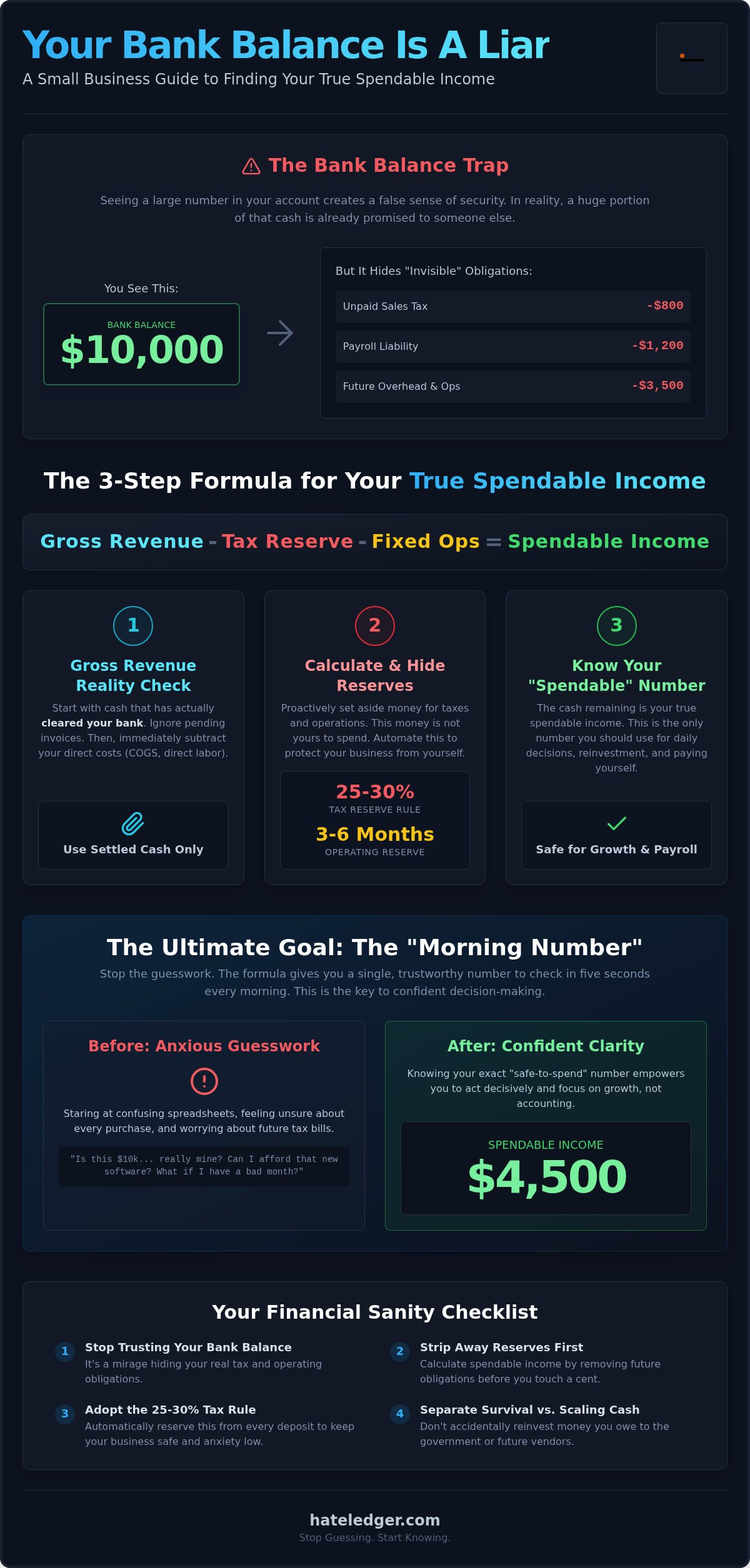
Every dollar in your account has a job. Some of those jobs are invisible. You might see $10,000 and think it's time for a new hire. In reality, $800 of that is unpaid sales tax. Another $1,200 is payroll liability. A significant chunk is set aside for the lag time between today's work and next month's overhead. You've already "spent" this money; it just hasn't walked out the door yet. When you ignore these hidden weights, you fall into the Bank Balance Trap. You over-hire, you over-spend, and you end up with a tax bill you can't pay.
The Emotional Toll of Financial Guesswork
Guessing your way through a bank statement is a recipe for founder burnout. The mental load of "roughly" knowing your numbers is heavy. It leads to 2:00 AM panic sessions and hesitant decision-making. You shouldn't have to play accountant to know if you can afford a new laptop. There is a massive psychological relief in having a "safe-to-spend" number every morning. It shifts you from a defensive, anxious posture to an offensive, confident one. Most software makes this harder by burying the truth under layers of jargon. You don't need a ledger; you need a number you can trust.
The 3-Step Formula for Real-World Spendable Income
Spendable income isn't a guess. It is the liquid cash remaining after you've stripped away every single obligation. This means taxes, operating reserves, and debt are gone before you count what's left. The formula is simple: [Gross Revenue] - [Tax Reserve] - [Fixed Ops] = Spendable Income. If you only look at this once a quarter, you're driving with your eyes closed. You need a daily number to stay agile. Learning how to calculate spendable income for small business needs is the only way to distinguish between "Business Spendable," which fuels your operations, and "Personal Spendable," which is your actual take-home pay. Mixing these two is a recipe for a financial disaster.
Step 1: The Gross Revenue Reality Check
Gross revenue is raw material, not the finished product. It's the starting point, but it's often inflated by funds that haven't actually cleared your bank. Stop counting "pending" invoices as real money. If the cash isn't settled in your account, it doesn't exist for this calculation. You must subtract your direct costs immediately to find your true baseline. The IRS provides specific guidance on calculating your net earnings, which is the first hurdle in understanding what you actually take home. Once you strip away the costs of goods and direct labor, you finally see the raw numbers you're actually working with. This is the only way to find your real-world starting point.
Step 2: Accounting for Operating Reserves
Safety requires a buffer. You need to set aside three to six months of "keep the lights on" cash. This is your operating reserve. It's the money that ensures a bad month doesn't become a terminal one for your company. Here's the catch: when your growth ambitions rise, your spendable income often drops. Scaling costs money. You're trading today's spendable cash for tomorrow's potential. This is where most founders get confused and start "playing accountant" instead of being the CEO. You need a system that handles the invisible double-entry work for you. It should track these reserves automatically so you don't have to manually move money between spreadsheets. If you want to see how to calculate spendable income for small business without the manual grind, you can explore a simpler way to track your cash and see your real numbers today. By automating the reserve logic, you protect your business from your own spending impulses. You see the truth, not the bank balance mirage.
Calculating Your Automated Tax Reserve
The Tax Trap kills more businesses than bad marketing ever will. It happens because founders treat tax as a year-end surprise instead of a daily debt. Every dollar that hits your account already has a lien on it from the IRS. If you spend it, you're stealing from your future self. This is why learning how to calculate spendable income for small business requires a brutal, honest look at your tax liability before you consider any other expense. You aren't just managing cash; you're managing a debt that is due every single day.
The safest rule of thumb is the 25-30% reserve. It sounds high. It feels painful. But it's the only way to ensure you aren't the one scrambling for a high-interest loan when tax season arrives. This percentage typically covers the 15.3% self-employment tax rate plus your estimated personal income tax bracket. You can set up an automated tax reserve for self employed to handle this math for you, ensuring every sale is protected the moment it clears. Paying your "future self" today is the only way to avoid the sting later.
How to Set Your Tax Reserve Percentage
Your exact number depends on your entity type and where you live. If you're an S-Corp, your payroll might handle a portion of this burden. If you're an LLC in a high-tax state, 30% is likely your floor. It's always better to over-reserve. Think of it as a forced savings account. If you over-save, you get to "refund" yourself a bonus at the end of the year. If you under-save, you're in debt to the government. One feels like a win; the other feels like a crisis. Keep this money in a separate, untouchable account so you aren't tempted to dip into it for "emergencies" that aren't actually emergencies.
Automating the Deduction Process
The quarterly panic is a choice. You can choose to ignore your taxes until they're due, or you can make them invisible. Modern software can slice every incoming dollar before you even see it. This "pre-paid" approach gives you total peace of mind. You don't have to play accountant or remember to manually move money between accounts. By the time you check your spendable balance, the tax man is already paid in spirit. This level of automation removes the mental load of financial guesswork. It turns a complex legal obligation into a background process that just works while you sleep.
Spendable vs. Discretionary: Knowing When to Reinvest
Spendable income keeps the lights on. Discretionary income builds the empire. Most founders fail because they spend survival cash on growth dreams. They buy the expensive software or hire the "rockstar" consultant before they've actually cleared their base obligations. This is why knowing how to calculate spendable income for small business is the foundation of every move you make. If you don't have a surplus after taxes and reserves, you don't have permission to scale. You're just gambling with the IRS's money.
When you're looking at taking on debt to grow, don't trust your gut. Use the business financing decision tool to evaluate if that new liability is a smart move. It turns a stressful "maybe" into a binary yes or no. You shouldn't be playing the role of a guessing accountant when you're making high-stakes decisions. You need a decision engine that tells you if the math actually moves the needle. If the debt doesn't increase your future spendable income, it's a weight, not a wing.
When to Take a Draw vs. When to Reinvest
You have a "Founder’s Minimum." This is the non-negotiable cash you need to pay your personal bills and stay sane. Anything above that is your "Growth Surplus." If your spendable income doesn't cover your minimum, you aren't ready to reinvest. You use your surplus to calculate your next hire’s potential impact. Don't hire because you're tired; hire because the math says it's profitable. You can use this small business hiring decision tool to see if a new team member will actually increase your bottom line or just increase your stress level.
Measuring Human Capital ROI
Is your team making you more money, or just more work? This is the core of Human Capital ROI. In plain English, a profitable team member should generate significantly more spendable income than they cost. If their salary eats your entire surplus, they aren't an asset. They're an expensive hobby. Payroll is a reinvestment. Like any investment, it needs a clear, measurable return. If you can't see that return in your daily numbers, you're just drifting. Stop guessing and get the Human Capital ROI Engine to see exactly who is driving your growth and who is just taking up space.
The Morning Number: Making Spendable Income Invisible
The Morning Number is your financial North Star. It is the single figure that tells you what is safe to spend right now, without the mental gymnastics of subtracting taxes or reserves in your head. Most owners spend their mornings logging into three different bank portals and a dusty spreadsheet. That is not leadership; it's data entry. Learning how to calculate spendable income for small business isn't about being a better bookkeeper; it's about being a better operator. The goal is to make the process invisible. You shouldn't have to think about the math. You should only have to think about the decision.
Hate Ledger automates this entire logic while you sleep. By the time you pour your first cup of coffee, the platform has already synced your transactions, sliced off your tax reserves, and updated your operating buffer. It moves you from "Playing Accountant" to "Acting as CEO." A CEO doesn't wonder if they can afford a new project. A CEO looks at the dashboard and sees the green light. We offer a 90-day promise to get your books into a state of total clarity. If you're tired of the fog, it's time to clear the air. You deserve to work with a system that protects you from the bank balance trap automatically.
Ending the Manual Entry Nightmare
Manual entry is where truth goes to die. If you're waiting until the end of the month to "do the books," you're already flying blind. Bank syncing is the only foundation for a real-time morning number. Traditional systems focus on accounting for the past, telling you what you spent three weeks ago. That's an autopsy. You need a system that helps you decide for the future. This is why we built accounting software for people who hate accounting. It stops the forensic work and starts the forward-thinking work. It changes your daily habits from reactive panic to proactive moves. Our invisible double-entry accounting handles the complex details so you don't have to.
Your Next Steps to Financial Clarity
Clarity starts with a single habit: stop checking your bank balance. That number is a fiction. Start checking your spendable income instead. Even if your books are currently a disaster, start today. You don't need a perfect history to have a clear future. We offer a Free Forever tier with no credit card required. It's built for founders who value their time more than their spreadsheets. You can't lead a company if you're buried in the ledger. Get your morning number, find your safety, and get back to the work that actually matters. The formula for how to calculate spendable income for small business shouldn't be a chore; it should be your competitive advantage.
Take Control of Your Financial Truth
The fog of financial guesswork is optional. You've seen why your bank balance is a liar and how the bank balance trap leads to ruin. By mastering how to calculate spendable income for small business, you've taken the first step toward actual freedom. You now have the formula to strip away taxes, operating reserves, and debt before you touch a single cent of profit. This isn't just about math. It's about moving from a state of constant anxiety to a state of total clarity.
You don't have to play accountant to keep your business safe. Our 90-day setup promise ensures you achieve total financial clarity with automated tax reserves built-in. You can see your "Morning Number" every day and know exactly what is safe to spend. Stop guessing and start leading. There is no credit card required for the Free Forever tier; you have nothing to lose but your stress.
Get your "Morning Number" for free; start hating accounting less today. You've built a business to create a life, not to manage a ledger. It's time to get back to the work you love.
Frequently Asked Questions
How is spendable income different from net profit?
Net profit is a paper number; spendable income is a survival number. Net profit shows what you earned after expenses, but it ignores the tax man and your need for a safety buffer. You can have a high net profit and still be broke if you haven't set aside cash for the IRS. Spendable income is the liquid truth that remains only after taxes and operating reserves are fully funded.
What percentage of my business income should I set aside for taxes?
Aim for 25% to 30% to stay safe. This range covers the 15.3% self-employment tax and your personal income tax brackets for 2026. It feels like a lot because it is. However, it's better to over-reserve and pay yourself a "bonus" later than to face a surprise bill you can't pay. Learning how to calculate spendable income for small business requires this discipline every single day.
Can I use my spendable income to pay off business debt faster?
Absolutely. Debt is a fixed obligation that eats your future cash. Using spendable income to kill debt is a high-ROI move. It lowers your fixed costs in the formula, which automatically increases your safe-to-spend cash in the following months. It's the difference between being a slave to interest and owning your own growth. Deploy your surplus where it creates the most safety.
Does spendable income include my own salary as the owner?
Treat your base salary as a non-negotiable expense. Your "Founder's Minimum" should be part of your fixed operations costs. Spendable income is the surplus that exists after your personal bills and business essentials are covered. If you don't have spendable income after paying yourself, you don't have money to scale. This distinction keeps you from accidentally spending your rent money on a new marketing campaign.
What happens if my spendable income is negative but I have cash in the bank?
You are caught in the Bank Balance Trap. Having cash in the bank while your spendable income is negative means you're holding money that isn't yours. It belongs to the government or your future vendors. If you spend that cash now, you're stealing from your future self. This is why you need to know how to calculate spendable income for small business rather than just checking your banking app.
How often should I recalculate my small business spendable income?
You should check it every morning. Recalculating once a month is just looking at a graveyard of old decisions. You need a "Morning Number" that reflects yesterday's sales and today's obligations. Daily visibility allows you to pivot quickly. It turns your finances from a stressful mystery into a tool for rapid decision-making. If you wait until the quarter ends, you've already missed your chance to adjust.
Is spendable income the same as cash flow?
Cash flow is just the movement of money; spendable income is the residue of safety. Cash flow tells you that money is coming in, but it doesn't tell you if you can keep it. You can have massive cash flow and still go bankrupt if your obligations outpace your reserves. Spendable income is the only metric that accounts for the "liens" the IRS and your vendors have on your account.
Can software really calculate my spendable income automatically?
Yes, if the software is built for it. Hate Ledger ignores traditional jargon to focus on your "Morning Number." It syncs with your bank and automatically slices off tax reserves and operating buffers. You don't have to play accountant or move money between spreadsheets. The system handles the invisible double-entry work so you can focus on acting like a CEO instead of a data entry clerk.
Frequently Asked Questions
Net profit is a paper number; spendable income is a survival number. Net profit shows what you earned after expenses, but it ignores the tax man and your need for a safety buffer. You can have a high net profit and still be broke if you haven't set aside cash for the IRS. Spendable income is the liquid truth that remains only after taxes and operating reserves are fully funded.
Aim for 25% to 30% to stay safe. This range covers the 15.3% self-employment tax and your personal income tax brackets for 2026. It feels like a lot because it is. However, it's better to over-reserve and pay yourself a "bonus" later than to face a surprise bill you can't pay. Learning how to calculate spendable income for small business requires this discipline every single day.
Absolutely. Debt is a fixed obligation that eats your future cash. Using spendable income to kill debt is a high-ROI move. It lowers your fixed costs in the formula, which automatically increases your safe-to-spend cash in the following months. It's the difference between being a slave to interest and owning your own growth. Deploy your surplus where it creates the most safety.
Treat your base salary as a non-negotiable expense. Your "Founder's Minimum" should be part of your fixed operations costs. Spendable income is the surplus that exists after your personal bills and business essentials are covered. If you don't have spendable income after paying yourself, you don't have money to scale. This distinction keeps you from accidentally spending your rent money on a new marketing campaign.
You are caught in the Bank Balance Trap. Having cash in the bank while your spendable income is negative means you're holding money that isn't yours. It belongs to the government or your future vendors. If you spend that cash now, you're stealing from your future self. This is why you need to know how to calculate spendable income for small business rather than just checking your banking app.
You should check it every morning. Recalculating once a month is just looking at a graveyard of old decisions. You need a "Morning Number" that reflects yesterday's sales and today's obligations. Daily visibility allows you to pivot quickly. It turns your finances from a stressful mystery into a tool for rapid decision-making. If you wait until the quarter ends, you've already missed your chance to adjust.
Cash flow is just the movement of money; spendable income is the residue of safety. Cash flow tells you that money is coming in, but it doesn't tell you if you can keep it. You can have massive cash flow and still go bankrupt if your obligations outpace your reserves. Spendable income is the only metric that accounts for the "liens" the IRS and your vendors have on your account.
Yes, if the software is built for it. Hate Ledger ignores traditional jargon to focus on your "Morning Number." It syncs with your bank and automatically slices off tax reserves and operating buffers. You don't have to play accountant or move money between spreadsheets. The system handles the invisible double-entry work so you can focus on acting like a CEO instead of a data entry clerk.