
How to Calculate Human Capital ROI: Stop Treating People Like Machines
September 2, 2026 · 16 min read
Your payroll isn't an expense. It's an investment that is either printing money or setting it on fire. Most legacy software treats your team like a fleet of laptops. They call it human capital and then hide the real value under a mountain of confusing spreadsheets. You're left staring at a bank balance that feels like a black hole. With benefit costs projected to exceed $17,000 per employee in 2026, you can't afford to guess. It's time to learn how to calculate human capital ROI without the academic fluff.
Traditional accounting is broken. It's built for tax collectors. It's not built for founders who need to move fast and make hard decisions. You deserve to know if your team is actually generating profit or just burning cash. This article delivers the no-nonsense formula for measuring your team's true profitability. We'll dismantle the "machines and equipment" definition of human capital and show you how to use a real Human Capital ROI Engine. We're moving from confusing accounting formulas to radical clarity. You'll finally see exactly how your labor costs translate into revenue.
Key Takeaways
- Stop treating your team like office furniture; human capital is the collective brainpower that actually generates your revenue.
- Discover how to calculate human capital ROI using four simple numbers pulled straight from your bank feed.
- Uncover the "iceberg" of hidden labor costs, from payroll taxes to software seats, that are currently draining your bank account.
- Stop guessing when to hire and start using hard data to identify high-performers versus roles that are costing you more than they're worth.
- Trade your messy spreadsheets for the Human Capital ROI Engine to track your team's profitability in real-time without the jargon.
Busting the Myth: Human Capital is Not Machines or Equipment
Accounting textbooks have lied to you for decades. They lump "human capital" into the same category as property, plant, and equipment. It's a lazy shortcut that treats your team like a fleet of delivery trucks. This is a massive mistake. Your team isn't a collection of meat-machines that perform repetitive tasks until they break. If you view people as static equipment, you'll never understand how to calculate human capital ROI. You'll just see a massive payroll bill and feel the urge to cut costs until you're left with a skeleton crew that can't actually grow your business.
What is Human Capital, Really?
Forget the HR department for a moment. Human resources is a corporate function; Human capital is the actual value your team brings to the table. It's the sum of their specialized skills, their industry knowledge, and their ability to solve problems under pressure. It's the invisible asset that doesn't show up on a standard balance sheet but dictates every dollar of your profit. Human capital is the profit-generating potential of your workforce. When you stop looking at salaries and start looking at potential, your entire financial strategy shifts from defense to offense.
Why the 'Machinery' Definition is Dangerous
Machines are predictable and depressing. You buy a laptop, it depreciates every day, and eventually, you throw it away. People are the exact opposite. A junior hire who learns your internal systems and masters your sales process becomes exponentially more valuable over time. Machines don't innovate; people do. Treating your team like machinery leads to "efficiency" cuts that destroy your long-term revenue. You might save a few bucks on the payroll line, but you'll lose thousands in lost expertise and momentum. You have to accept that human capital is more than just machines.
Mistaking people for equipment ruins your profit margin. If you treat a lead developer like a piece of hardware, you'll try to find the cheapest "unit" available. That's a recipe for disaster. A cheap laptop just runs slow; a "cheap" hire creates technical debt that can sink your company. To master how to calculate human capital ROI, you have to stop buying hours. You're investing in outcomes. This mindset shift is the difference between a business that survives and one that scales. It turns your biggest expense into your most powerful growth engine.
The Plain English Formula: How to Calculate Human Capital ROI
You don't need a PhD in finance to understand your team's profitability. Most legacy systems make this too hard. They give you spreadsheets that look like flight manuals and expect you to play accountant. We're going to strip away the jargon. To understand how to calculate human capital ROI, you only need four numbers from your bank feed. No complex formulas. No guesswork. Just the cold truth about your cash flow and your team's output.
The 3-Step ROI Calculation
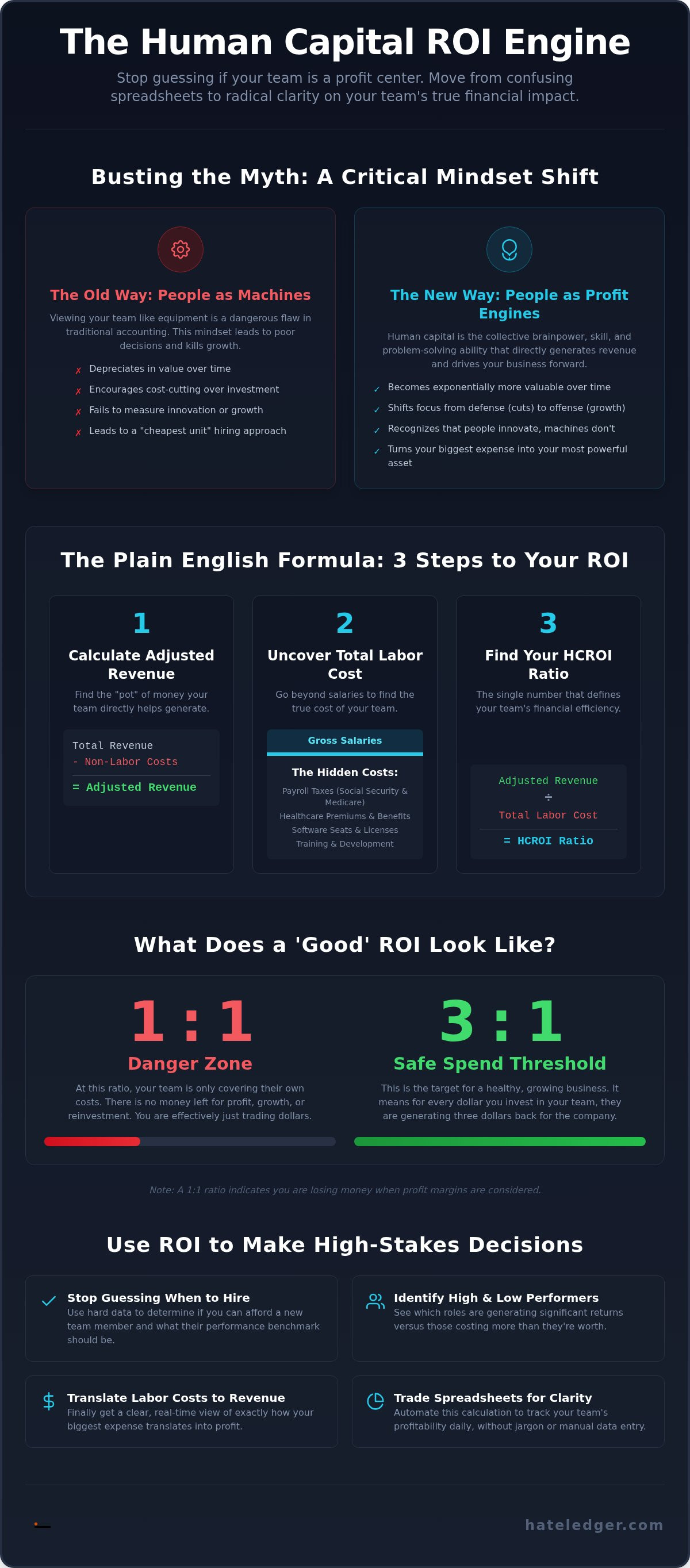
We use a radical simplification of the standard Human Capital ROI Formula. It's designed for speed and clarity. Follow these three steps to find your score:
- Step 1: Calculate Adjusted Revenue. Take your total revenue and subtract every non-labor operating cost. This includes rent, software, and supplies. This is the "pot" of money your team helps generate.
- Step 2: Total your Labor Costs. This is the big one. Don't just look at gross salaries. You must include the 6.2% Social Security tax, Medicare, and your healthcare premiums. If you aren't counting the "hidden" costs, your ROI is a lie.
- Step 3: Divide Adjusted Revenue by Labor Costs. This gives you your ratio. It's the singular number that defines your team's efficiency.
What a 'Good' ROI Number Looks Like
If your ratio is 1:1, you're losing money. You're just trading dollars for pennies. A 1:1 ratio means your team is barely covering their own costs, leaving zero room for profit or growth. Small businesses should aim for a ratio of 3:1 or higher. This is the "Safe Spend" threshold. It means your team is paying for themselves three times over. To get this right, you need to know exactly what you owe the government every day. Using automated tax reserves for the self-employed ensures your ROI calculation isn't inflated by money that actually belongs to the IRS.
This calculation is the foundation of your Morning Number. It's the daily guide that gives you the confidence to know your labor costs are covered before you even finish your coffee. When you know your ratio, you stop feeling like payroll is a black hole of cash. You start seeing it as fuel for your growth engine. If you're tired of manual math and messy spreadsheets, the Human Capital ROI Engine can automate this entire process for you. It tracks these movements in real-time so you can stop playing accountant and start being a founder.
Why Most Small Businesses Get Labor Costs Wrong
Most founders treat payroll like a single line item on a bank statement. They see the direct deposit leave their account and think that's the total cost of their team. This is a dangerous half-truth. If you want to master how to calculate human capital ROI, you have to look below the surface. Your labor costs are an iceberg. The salary is just the tip. Everything underneath is what actually sinks your profit margin if you aren't tracking it with surgical precision.
You're paying more than just a wage. For every employee, you're on the hook for a 6.2% Social Security tax and a 1.45% Medicare tax. Then there's the Federal Unemployment Tax (FUTA), which effectively adds another 0.6% on the first $7,000 of wages. Add in the cost of software seats, office equipment, and the projected $17,000 average for benefits in 2026, and your "affordable" hire suddenly looks a lot more expensive. Ignoring these numbers doesn't make them go away; it just makes your ROI calculation a work of fiction.
The Hidden Costs of Hiring
Hiring isn't a one-day event. It's a long-term drain on your resources before it ever becomes a gain. You have to factor in recruitment fees, training downtime, and the inevitable "learning curve" tax. During the first 90 days, a new hire almost always shows a negative ROI. They're consuming more management time and resources than they're producing in revenue. If you don't account for this dip, you'll panic and think you made a bad hire when you're actually just in the normal gestation period of growth. Use this small business hiring decision tool to see if you can actually afford the temporary hit to your cash flow.
Automation vs. Manual Tracking
Manual spreadsheets are where good data goes to die. They're static, they're prone to human error, and they're out of date the second you hit "save." You didn't start a business to play accountant. You started it to build something. Tracking every cent shouldn't require a weekend in Excel. The secret is invisible double-entry bookkeeping. By syncing your bank feed directly to your accounting system, labor cost tracking becomes an automated background process. It's the difference between guessing your numbers and knowing them. When software handles the math, you can focus on how to calculate human capital ROI to make high-stakes decisions rather than just trying to survive the next tax season. Stop wasting your mental energy on data entry and let the Human Capital ROI Engine do the heavy lifting.
Using ROI to Make High-Stakes Decisions
Data without action is just trivia. Once you understand how to calculate human capital ROI, you stop making decisions based on "vibes" or gut feelings. You move from reactive panic to strategic scaling. Most founders hire because they feel overwhelmed. That's a mistake. Overwhelm is a signal of poor process just as often as it's a signal of low headcount. Your ROI ratio tells you which one it is. It shifts your focus from the price tag of a person to the profit potential of a role.
The Decision Engine in Action
Your ratio is your primary decision engine. If your team is hitting a 5:1 ROI, they are likely redlining. They're at capacity. You're leaving money on the table because you don't have enough hands to catch the revenue. This is when you scale. Conversely, a low ROI ratio means your team is inefficient. Adding more people to a broken system just accelerates your burn rate. You need better automation, not a bigger payroll. Use your Morning Number to validate every new salary. If adding a $70,000 role drops your Morning Number into the red, you can't afford that hire yet, regardless of how "busy" you feel.
ROI and Employee Benefits
Benefits are often viewed as a "leak" in the bucket. With healthcare costs expected to climb by 8-10% in 2026, it's easy to see why. However, high-quality benefits like a Pooled Employer Plan (PEP) can actually protect your ROI. Retention is the secret weapon of high-profit teams. Every time a seasoned employee leaves, you're hit with the "learning curve" tax we discussed earlier. You lose the momentum of their expertise and replace it with a 90-day period of negative ROI. A PEP allows you to offer competitive retirement options while sharing the administrative load. Check out the PEP guide for small businesses to see how cost-sharing keeps your capital value high.
Stop guessing if your next move is the right one. Use the data to confirm your path. If you're ready to stop playing accountant and start using these insights to grow, get started with the Human Capital ROI Engine today. It turns your bank feed into a roadmap for your next big hire.
Automate Your Human Capital ROI with Hate Ledger
Knowing how to calculate human capital ROI is the first step. Automating it is the second. You can spend your weekends wrestling with Excel or you can let software handle the friction. Hate Ledger replaces the manual grind with a real-time Human Capital ROI Engine. It doesn't just show you what you spent. It shows you what that spend earned you. No jargon. No balance sheets that require a translator. Just plain English insights delivered straight to your dashboard.
Your bank feed is more than a list of transactions. It's a strategic roadmap. By syncing your accounts, the engine tracks every payroll tax, software seat, and benefit cost automatically. It turns invisible double-entry bookkeeping into visible, actionable data. You'll see exactly which roles are driving growth and which ones are dragging down your margin. It's the end of "playing accountant" and the beginning of actual leadership. You'll finally have the confidence to make high-stakes hiring decisions without the typical midnight anxiety.
The 90-Day Promise
We don't do endless implementation cycles. Our 90-day setup promise means your books and ROI engine are firing on all cylinders in under three months. Once you're live, you only need 60 seconds a day. That's the Morning Number habit. It's a quick check to ensure your labor costs are covered and your profit is protected. This is why accounting software for people who hate accounting is the only way to scale without losing your mind. It's built for the speed of a quick decision-making process, not the slow crawl of traditional bookkeeping.
Ready to Stop Guessing?
You can continue being the frustrated boss who wonders where the cash went. Or you can become the data-backed founder who knows their team's value to the penny. The transformation starts with a single click. Paid plans start at $19/month, a tiny price for total financial clarity and radical simplification. Stop treating your payroll like a mystery and start treating it like the investment it is. Try Hate Ledger for Free and see your real numbers for the first time. It's time to stop guessing and start growing.
Build a Profit Engine, Not a Meat-Machine
Stop treating your team like a line item. They aren't depreciating assets like laptops or office chairs. They are the engine of your business. You've learned the truth about how to calculate human capital ROI by looking past the tip of the payroll iceberg. You know that missing hidden taxes or benefit costs ruins your data. Now, it's time to stop doing the math by hand.
You didn't start this company to play accountant. You started it to be a founder. Radical simplification is the only path to financial mastery. With our 90-day setup promise, you can trade messy spreadsheets for a real-time guide. Use the Morning Number daily spending guide to know exactly where you stand every single day. Stay stuck in the manual grind or build a data-backed growth machine.
Stop guessing and start growing with Hate Ledger's Human Capital ROI Engine. Start for free today with no credit card required. You have the formula. Now get the engine.
Frequently Asked Questions
Is human capital the machines and equipment produced by workers?
No. That is a textbook myth. Human capital is the collective brainpower, skill set, and effort of your team. It represents the profit-generating potential of your people, not the physical tools they use. Machines depreciate over time, but human capital grows as your team gains experience. Mistaking people for equipment leads to bad cost-cutting decisions that eventually kill your revenue and destroy team morale.
How often should a small business calculate its human capital ROI?
You should track it daily. Most owners wait for a quarterly report, but that is too late to fix a cash leak. By the time you see the data, the money is already gone. Learning how to calculate human capital ROI in real-time allows you to make adjustments before a small dip becomes a disaster. Our software automates this daily check through the Morning Number guide.
What is a 'good' human capital ROI ratio for a service-based business?
Aim for a ratio of 3:1 or higher. A 1:1 ratio means you are just breaking even on labor. That actually means you are losing money after you account for rent, software, and overhead. A 3:1 ratio provides the "Safe Spend" buffer you need to reinvest in growth. If your ratio is lower, you are either overstaffed or your internal processes are broken and wasting your team's time.
Does human capital ROI include the cost of the founder's salary?
Yes. If you are working in the business, your cost must be part of the equation. Many founders ignore their own pay to make the numbers look better. That is lying to yourself. To get an accurate picture of how to calculate human capital ROI, you must include every cent of compensation. This includes your own salary, payroll taxes, and any healthcare benefits you take from the company.
Can I calculate ROI if my employees don't generate direct sales?
Absolutely. Every role should contribute to the adjusted revenue of the company. Support staff, admins, and operations teams create the capacity for sales to happen. You calculate the ROI for the whole team first. If the collective ratio is high, your support staff is doing their job. If the ratio drops as you add non-sales roles, it is a sign your operations aren't scaling efficiently.
What is the difference between human capital and human resources?
Human resources is a department that handles paperwork, compliance, and hiring logistics. Human capital is the actual value and profit potential those people bring to your business. One is a cost center; the other is your primary asset. You don't manage human capital; you invest in it. Shifting your mindset from managing resources to growing capital is what separates a frustrated boss from a data-backed founder.
How do I improve my human capital ROI without firing people?
Focus on automation and better processes. Most low ROI isn't caused by lazy employees. It is caused by bad systems. If your team spends half their day on manual data entry or messy spreadsheets, their ROI will be trash. Automating the grunt work allows them to focus on high-value tasks that actually move the needle. You improve the ratio by increasing the output per person, not by cutting headcount.
Does Hate Ledger's ROI engine work for contractors and freelancers?
Yes. The Human Capital ROI Engine treats every labor dollar the same, whether it goes to a W-2 employee or a 1099 contractor. You need to know if that freelancer is generating more value than they cost. Our platform syncs with your bank feed to track these payments automatically. It gives you the same radical clarity for your flexible workforce as it does for your full-time team.
Frequently Asked Questions
Forget the HR department for a moment. Human resources is a corporate function; Human capital is the actual value your team brings to the table. It's the sum of their specialized skills, their industry knowledge, and their ability to solve problems under pressure. It's the invisible asset that doesn't show up on a standard balance sheet but dictates every dollar of your profit. Human capital is the profit-generating potential of your workforce. When you stop looking at salaries and start looking at potential, your entire financial strategy shifts from defense to offense.
You can continue being the frustrated boss who wonders where the cash went. Or you can become the data-backed founder who knows their team's value to the penny. The transformation starts with a single click. Paid plans start at $19/month, a tiny price for total financial clarity and radical simplification. Stop treating your payroll like a mystery and start treating it like the investment it is. Try Hate Ledger for Free and see your real numbers for the first time. It's time to stop guessing and start growing. Stop treating your team like a line item. They aren't depreciating assets like laptops or office chairs. They are the engine of your business. You've learned the truth about how to calculate human capital ROI by looking past the tip of the payroll iceberg. You know that missing hidden taxes or benefit costs ruins your data. Now, it's time to stop doing the math by hand. You didn't start this company to play accountant. You started it to be a founder. Radical simplification is the only path to financial mastery. With our 90-day setup promise, you can trade messy spreadsheets for a real-time guide. Use the Morning Number daily spending guide to know exactly where you stand every single day. Stay stuck in the manual grind or build a data-backed growth machine. Stop guessing and start growing with Hate Ledger's Human Capital ROI Engine. Start for free today with no credit card required. You have the formula. Now get the engine.
No. That is a textbook myth. Human capital is the collective brainpower, skill set, and effort of your team. It represents the profit-generating potential of your people, not the physical tools they use. Machines depreciate over time, but human capital grows as your team gains experience. Mistaking people for equipment leads to bad cost-cutting decisions that eventually kill your revenue and destroy team morale.
You should track it daily. Most owners wait for a quarterly report, but that is too late to fix a cash leak. By the time you see the data, the money is already gone. Learning how to calculate human capital ROI in real-time allows you to make adjustments before a small dip becomes a disaster. Our software automates this daily check through the Morning Number guide.
Aim for a ratio of 3:1 or higher. A 1:1 ratio means you are just breaking even on labor. That actually means you are losing money after you account for rent, software, and overhead. A 3:1 ratio provides the "Safe Spend" buffer you need to reinvest in growth. If your ratio is lower, you are either overstaffed or your internal processes are broken and wasting your team's time.
Yes. If you are working in the business, your cost must be part of the equation. Many founders ignore their own pay to make the numbers look better. That is lying to yourself. To get an accurate picture of how to calculate human capital ROI, you must include every cent of compensation. This includes your own salary, payroll taxes, and any healthcare benefits you take from the company.
Absolutely. Every role should contribute to the adjusted revenue of the company. Support staff, admins, and operations teams create the capacity for sales to happen. You calculate the ROI for the whole team first. If the collective ratio is high, your support staff is doing their job. If the ratio drops as you add non-sales roles, it is a sign your operations aren't scaling efficiently.
Human resources is a department that handles paperwork, compliance, and hiring logistics. Human capital is the actual value and profit potential those people bring to your business. One is a cost center; the other is your primary asset. You don't manage human capital; you invest in it. Shifting your mindset from managing resources to growing capital is what separates a frustrated boss from a data-backed founder.
Focus on automation and better processes. Most low ROI isn't caused by lazy employees. It is caused by bad systems. If your team spends half their day on manual data entry or messy spreadsheets, their ROI will be trash. Automating the grunt work allows them to focus on high-value tasks that actually move the needle. You improve the ratio by increasing the output per person, not by cutting headcount.
Yes. The Human Capital ROI Engine treats every labor dollar the same, whether it goes to a W-2 employee or a 1099 contractor. You need to know if that freelancer is generating more value than they cost. Our platform syncs with your bank feed to track these payments automatically. It gives you the same radical clarity for your flexible workforce as it does for your full-time team.