Small Business Accounting Basics: Stop Playing Accountant and Start Making Money
August 31, 2026 · 16 min read
Most accounting advice is a trap. It's written by people who love spreadsheets for people who want to be accountants. You aren't an accountant. You're an operator. You didn't start this business to drown in "double-entry" jargon or waste your Sundays manually typing data into a flickering screen. You started it to make money. Mastering small business accounting basics shouldn't feel like a second job. It should feel like a secret weapon that keeps you safe and profitable.
We know the feeling. Tax season feels like a looming threat, especially with the IRS now using AI to hunt for errors. Your bank balance shouldn't be a guessing game. This guide promises a radical simplification of your books. You'll learn the high-impact essentials to keep your business safe without the technical headaches. We'll show you how to find your "morning number" for spendable cash and automate your tax reserves. Here is how you build a financial system that runs itself in the background while you get back to the real work.
Key Takeaways
- Stop treating accounting like a math class and start using it as a tool to see exactly how much cash you can safely spend.
- Master the small business accounting basics by separating personal and business funds to keep your records clean and audit-proof.
- Kill manual data entry by syncing your bank accounts for real-time visibility into your cash flow without the spreadsheet errors.
- Use a "morning number" to calculate your true spendable income after accounting for upcoming bills and automated tax reserves.
- Move beyond fragile spreadsheets to an automated system that manages your financial life in the background while you focus on growth.
Forget the Textbooks: The Real Purpose of Small Business Accounting
Traditional accounting is built for people who want to spend their lives inside a ledger. It's marketed as the "language of business," but for a founder, it usually feels like a foreign tongue. Most small business accounting basics are taught through the lens of compliance and theory. They want you to master double-entry systems and memorize where a "debit" goes. You don't need a degree. You need a way to know if you're actually making money or just moving it around.
Jargon is a wall. Words like "accrual" and "depreciation" are barriers to your growth. They turn a simple question—"Can I afford this?"—into a weekend-long research project. The only real goal of your financial system is to tell you if you are safe. If your setup doesn't provide immediate clarity on your spendable cash, it's not a system. It's a chore. You should be driving the business, not acting as its historian.
The Bank Balance Trap
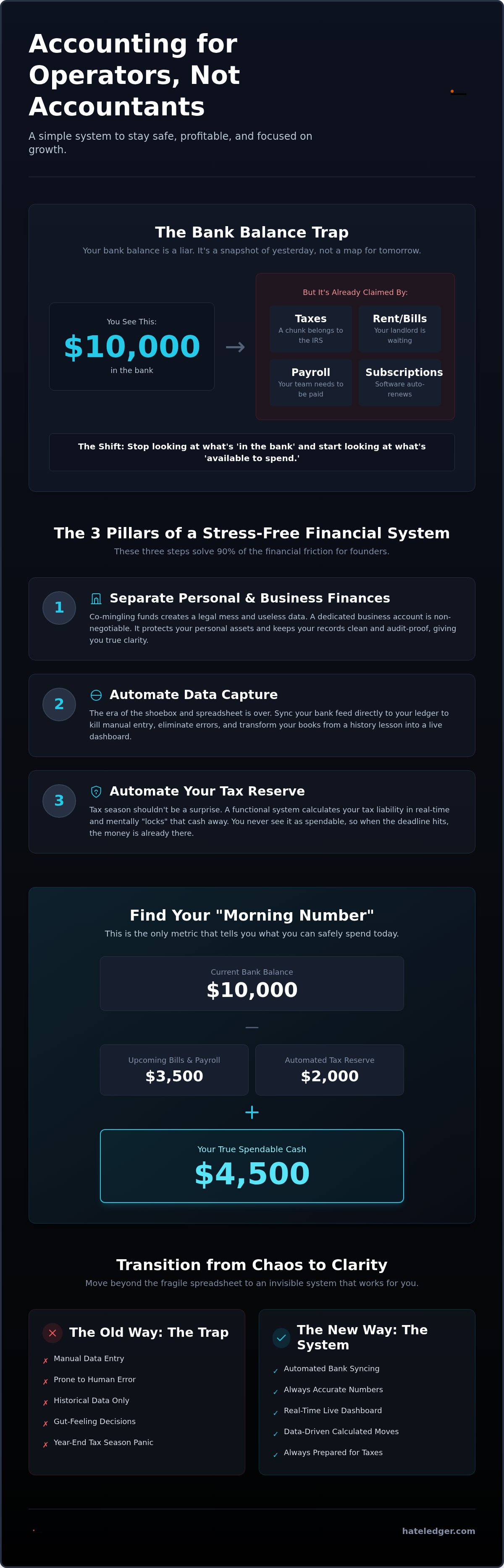
Your bank balance is a liar. It is a snapshot of what happened yesterday, not a map of what's happening tomorrow. You might see $10,000 in your business checking account and feel like a success. That feeling is dangerous. That money isn't all yours. A chunk of it belongs to the IRS. Another piece is already claimed by your landlord. A third portion is reserved for that annual software subscription that auto-renews next week. Real small business accounting basics focus on the "truth" rather than the balance.
- Hidden Obligations: These are the silent killers of cash flow. Taxes, upcoming payroll, and vendor bills eat your profit before you even touch it.
- The Snapshot Illusion: A high balance on Tuesday can become a crisis by Friday if you haven't tracked your committed spend.
- The Shift: You must stop looking at what's "in the bank" and start looking at what's "available to spend."
Accounting as a Decision Engine
Stop treating bookkeeping basics as a task for tax day. If you only look at your numbers once a year, you're flying blind. Your financial data should be a decision engine that powers your growth. It should tell you exactly when you can afford to hire a new employee or upgrade your equipment. Don't rely on gut feelings or "vibes" when making big moves. Use business financing decision tools to replace guesses with hard data. When you have real-time visibility, you stop playing defense and start making aggressive, calculated moves for your future.
The Three Pillars of Functional Bookkeeping
Most financial advice drowns you in complexity. You don't need a 20-step checklist to master small business accounting basics. You need three pillars. These steps solve 90% of the financial friction that keeps founders awake at night. They move you from reactive panic to proactive control. By focusing on these essentials, you stop acting like a clerk and start acting like a CEO.
Separating Personal and Business Finances
Co-mingling funds is a recipe for disaster. It creates a legal mess and a mental fog. When your grocery bill sits next to your client's payment, your data is useless. You need a dedicated business account from day one. This separation is a core part of SBA financial management advice for a reason. It protects your personal assets and keeps your records clean for the IRS. It also ensures that accounting software for people who hate accounting can actually do its job. If the system doesn't have to guess which transactions are "real" business costs, it can provide the clarity you need in seconds.
Automating Data Capture
The era of the shoebox is over. If you're still saving paper receipts or typing numbers into a spreadsheet every Sunday, you're losing money. Manual entry is slow. It's prone to error. It's a waste of your talent. Automated bank syncing is the foundation of modern efficiency; it connects your bank feed directly to your ledger so every dollar is tracked the moment it moves. This kills the need for "Sunday afternoon math." You get a real-time view of your world without lifting a finger. It transforms your books from a static history book into a live dashboard.
The Automated Tax Reserve
Tax season shouldn't be a surprise. The third pillar is the automated tax reserve. This is money you never touch. A functional system calculates your tax liability in real-time and mentally "locks" that cash away. You never see it as spendable income. By the time the deadline hits, the money is already there. No stress. No frantic borrowing. Just a clean, automated exit. If you want a system that runs itself in the background, starting with a Free Forever Tier is the fastest way to see these pillars in action. It moves the mental load of "what do I owe" from your brain to the machine.
Cash vs. Accrual: Choosing a Method Without the Headache
Most accounting debates are a waste of time. When you strip away the theory, the choice between cash and accrual comes down to one thing: timing. Do you want to see what happened today, or what will happen next month? Understanding these small business accounting basics shouldn't require a finance degree. It's about picking the lens that lets you make the fastest decisions. Choose a side and move on.
When to Use Cash-Basis Accounting
Cash-basis is the default for a reason. It's simple. You count the money when it hits your hand. You record the expense when the cash leaves your account. It matches your bank statement exactly. This is why freelancers and solo operators love it. It's visceral. It's real. If the money isn't there, it doesn't exist on your books. This Small Business Bookkeeping Guide highlights how this method keeps things straightforward for new founders. However, it has a blind spot. It can hide long-term debt or upcoming obligations because it only cares about the "now."
The Power of Accrual for Scaling
Scaling businesses eventually outgrow cash-basis. Accrual-basis accounting records income when you send the invoice and expenses when you receive the bill. It allows you to see the future. You can track money that is owed to you before it actually arrives. This perspective is vital for high-level decisions. For instance, you can't accurately measure your human capital ROI if you don't know your committed revenue versus your labor costs. It's the difference between surviving and strategizing.
You don't have to choose between simplicity and power. Modern "Invisible Double-Entry" technology handles the complexity of accrual in the background while giving you the simple cash-flow view you need to breathe. Mastering small business accounting basics means letting the software do the heavy lifting while you focus on the results. You get the scale of a corporation with the speed of a startup. It's about utility over tradition. Stop playing accountant and start using your data to drive the business forward.
The Daily Spendable Number: Mastering Your Cash Flow
Traditional small business accounting basics focus on the past. They tell you what happened last month. But business in 2026 moves at the speed of a quick decision. You cannot wait for a monthly Profit and Loss (P&L) statement to tell you if you can afford to hire or buy equipment. You need a "Morning Number." This is your total cash minus every known obligation. It accounts for your rent, your payroll, and your upcoming software bills. It's the only truth that matters.
The psychological relief is massive. When you know exactly what is "safe to spend," the anxiety of the unknown disappears. You aren't guessing. You aren't crossing your fingers when you swipe your business card. You are operating from a position of absolute certainty. This is the difference between surviving and dominating your market.
Automating Your Tax Reserve
The "tax surprise" is the #1 killer of small businesses. It's a gut punch that usually arrives when you are least prepared. You should never be surprised by a bill from the IRS. Setting up an automated tax reserve for the self-employed ensures that every dollar you earn is pre-scrubbed for taxes. Tax reserves should be calculated daily, not annually. This money is mentally locked away in real-time so it never feels like it was yours to begin with. When the quarterly deadline hits, you just pay the bill and move on.
Daily Financial Habits for Founders
Your morning routine should start with your finances. Check your Morning Number before you open your inbox. Your inbox is other people's priorities. Your Morning Number is your priority. Categorizing transactions should take seconds, not hours. If your system is automated, you're just confirming what the machine already knows. This habit turns small business accounting basics into a live decision engine. Before you weigh a new equipment purchase, look at the number. If the cash is available after all obligations, buy it. If not, wait. It's that simple.
Stop letting bank balance anxiety dictate your growth. You can see your true spendable income today with the Hate Ledger Business Plan. It’s time to move from "keeping books" to driving results.
Transitioning to Invisible Accounting: Beyond the Spreadsheet
Spreadsheets are where business clarity goes to die. They are the ultimate "old way" of managing small business accounting basics. You start with a simple grid. You end with a twelve-tab monster that only you understand. It is fragile. It is slow. It is a job you never applied for. If your financial system requires you to be a formula expert, it is not a system. It is a liability.
Real growth requires invisible systems. You shouldn't have to think about your books once the foundation is laid. Automation turns your financial data into a protective shield. It keeps you safe. It keeps you informed. Most importantly, it lets you get back to the work that actually generates revenue.
Why Spreadsheets Are a Liability
A single manual entry error can ripple through your entire year. One broken formula can hide a massive tax bill or trick you into thinking you're profitable when you're actually bleeding cash. Spreadsheets are static. They cannot tell you the real-time ROI of your team or warn you about a cash crunch three weeks away. They rely on you being perfect every single Sunday afternoon.
- The Error Cost: Manual data entry has an inherent failure rate that spreadsheets cannot catch.
- The Time Drain: If software saves you five hours a month, the subscription has already paid for itself ten times over.
- The Blind Spot: Static grids cannot calculate complex metrics like team profitability without hours of manual manipulation.
Getting Started with Hate Ledger
You don't need a six-week course to master your books. You need a system that works while you sleep. Our 90-day setup promise ensures your financial life is in order fast. You can start with the Free Forever Tier to see the difference without even touching your credit card. It is designed for the operator who values time over tradition.
Once you sync your bank, the system builds your first Morning Number in minutes. You move from "playing accountant" on the weekends to being the CEO every single day. You will finally have access to the Human Capital ROI Engine to see exactly which parts of your team are driving profit. Stop looking at cells and start looking at results. The Business Plan and Pro Plan are there when you are ready to scale, but the goal remains the same: total financial invisibility.
Take Control of Your Financial Truth
Accounting is not a math problem. It's a visibility problem. You've learned that the real purpose of small business accounting basics is to give you a clear "morning number" so you know exactly what's safe to spend. By separating your funds, automating your data capture, and letting technology handle the tax reserves, you move from a state of constant anxiety to a position of absolute authority. Spreadsheets are a liability you can no longer afford to carry.
The days of wasting Sundays on manual entry are over. You deserve a system that runs itself in the background while you focus on scaling your team and your revenue. With real-time tax reserve calculations and our 90-day setup promise, you can finally stop looking at the past and start driving your future. It's time to trade the jargon for results.
Stop playing accountant and get your Morning Number for free today. There's no credit card required to start the Free Forever tier and reclaim your time. You have the tools. You have the truth. Now, get back to making money.
Frequently Asked Questions
What is the most basic accounting for a small business?
The absolute foundation of small business accounting basics is tracking every dollar that enters or leaves your business. You must separate your personal bank account from your business account immediately. This clarity allows you to see your true profit without the noise of personal grocery bills or rent. It isn't about master-level math; it's about clean data and knowing exactly what you owe the IRS before you spend a dime.
Do I really need accounting software if I only have a few clients?
You don't need software to count to ten, but you need it to protect your time. Even with three clients, manual spreadsheets are a liability. They don't sync with your bank. They don't calculate tax reserves in real-time. Using a system from day one builds a "morning number" habit that scales with you. It's about buying back your Sundays so you can focus on getting client number four instead of typing into a grid.
What is the difference between bookkeeping and accounting?
Bookkeeping is the daily act of recording transactions. It is the "what happened" of your business. Accounting is the "what now" part. It involves looking at those records to make strategic decisions, like whether you can afford to hire help. Think of bookkeeping as the fuel and accounting as the dashboard. You need both to drive, but modern software makes the recording part invisible so you can focus on the strategy.
How do I calculate my spendable income every day?
Your spendable income is your total bank balance minus every known future obligation. This includes your automated tax reserve, upcoming software subscriptions, and vendor bills. If you have $5,000 in the bank but owe $2,000 in taxes and $1,000 in rent, your spendable income is $2,000. Calculating this daily prevents bank balance anxiety and ensures you never accidentally spend money that actually belongs to the government or your landlord.
What expenses can I legally write off as a small business owner?
You can write off any expense that is both ordinary and necessary for your specific trade. This includes your home office, marketing costs, professional software, and travel for business purposes. For the 2026 tax year, remember that the standard mileage rate for business use is 76 cents per mile for the second half of the year. Keep your records clean. If an expense helps you generate revenue, it's likely a valid deduction.
Can I do my own small business accounting without a degree?
You don't need a degree to master small business accounting basics in the age of automation. You just need a system that translates jargon into plain English. Most founders aren't accountants, and they shouldn't try to be. Focus on the results, not the process. If your software handles the invisible double-entry and calculates your spendable cash, you've already done 90% of the work required to stay safe and profitable.
How much should I set aside for taxes as a self-employed professional?
Most professionals should set aside between 25% and 30% of their gross income. However, a flat percentage is just a guess. You should use a system that calculates your exact tax reserve in real-time based on your actual earnings and local requirements. This ensures you aren't over-saving and starving your growth, or under-saving and facing a crisis in April. Real-time accuracy is the only way to avoid the dreaded tax surprise.
Why is double-entry accounting important for my business?
Double-entry is the industry standard because it creates a system of checks and balances. Every dollar moved is recorded twice, ensuring your books always stay in balance. It sounds technical, but it's the foundation of audit-proof records. You shouldn't have to do the math yourself. Modern software uses invisible double-entry to keep your records professional and accurate while you only see the simple, functional numbers that matter for your daily operations.
Frequently Asked Questions
The absolute foundation of small business accounting basics is tracking every dollar that enters or leaves your business. You must separate your personal bank account from your business account immediately. This clarity allows you to see your true profit without the noise of personal grocery bills or rent. It isn't about master-level math; it's about clean data and knowing exactly what you owe the IRS before you spend a dime.
You don't need software to count to ten, but you need it to protect your time. Even with three clients, manual spreadsheets are a liability. They don't sync with your bank. They don't calculate tax reserves in real-time. Using a system from day one builds a "morning number" habit that scales with you. It's about buying back your Sundays so you can focus on getting client number four instead of typing into a grid.
Bookkeeping is the daily act of recording transactions. It is the "what happened" of your business. Accounting is the "what now" part. It involves looking at those records to make strategic decisions, like whether you can afford to hire help. Think of bookkeeping as the fuel and accounting as the dashboard. You need both to drive, but modern software makes the recording part invisible so you can focus on the strategy.
Your spendable income is your total bank balance minus every known future obligation. This includes your automated tax reserve, upcoming software subscriptions, and vendor bills. If you have $5,000 in the bank but owe $2,000 in taxes and $1,000 in rent, your spendable income is $2,000. Calculating this daily prevents bank balance anxiety and ensures you never accidentally spend money that actually belongs to the government or your landlord.
You can write off any expense that is both ordinary and necessary for your specific trade. This includes your home office, marketing costs, professional software, and travel for business purposes. For the 2026 tax year, remember that the standard mileage rate for business use is 76 cents per mile for the second half of the year. Keep your records clean. If an expense helps you generate revenue, it's likely a valid deduction.
You don't need a degree to master small business accounting basics in the age of automation. You just need a system that translates jargon into plain English. Most founders aren't accountants, and they shouldn't try to be. Focus on the results, not the process. If your software handles the invisible double-entry and calculates your spendable cash, you've already done 90% of the work required to stay safe and profitable.
Most professionals should set aside between 25% and 30% of their gross income. However, a flat percentage is just a guess. You should use a system that calculates your exact tax reserve in real-time based on your actual earnings and local requirements. This ensures you aren't over-saving and starving your growth, or under-saving and facing a crisis in April. Real-time accuracy is the only way to avoid the dreaded tax surprise.
Double-entry is the industry standard because it creates a system of checks and balances. Every dollar moved is recorded twice, ensuring your books always stay in balance. It sounds technical, but it's the foundation of audit-proof records. You shouldn't have to do the math yourself. Modern software uses invisible double-entry to keep your records professional and accurate while you only see the simple, functional numbers that matter for your daily operations.