
Safe Business Spending Guide for Non-Accountants
September 3, 2026 · 17 min read
Your bank balance is a hallucination. It's a dangerous number that tells you what you have today while ignoring everything you owe tomorrow. If you're tired of the manual math fatigue and the constant anxiety that tax season will ruin your growth, you aren't alone. Most business owners are operating in the dark, wondering how to know how much money is safe to spend in my business while their actual profit remains a mystery. It's an exhausting way to run a company, and it's the fastest path to a cash flow crisis.
We believe you deserve a daily number you can trust without needing a degree in accounting. This guide promises to replace your guesswork with a definitive formula for safe spendable income that requires zero spreadsheets. We'll show you how to automate your tax reserves and find a "Morning Number" so you can reinvest in your business with total confidence. It's time to stop letting your bank balance lie to you and start using a system that protects your cash and your sanity. We are moving from the old way of "guess and pray" to a streamlined approach where your growth is backed by hard data.
Key Takeaways
- Stop treating your bank balance as spendable income. Learn why the IRS and your future obligations are the invisible owners of the cash currently sitting in your account.
- Discover the exact, non-technical formula for how to know how much money is safe to spend in my business by isolating tax reserves and your 30-day burn rate.
- Move past the rigid 3-6 month reserve rule. Replace it with a dynamic system that provides real-time "yes" or "no" answers for hiring and growth decisions.
- Adopt a "Two-Account" strategy to physically separate your daily operating funds from the money you cannot afford to touch for taxes or debt.
- Automate your financial safety with a daily Morning Number that calculates your true spendable cash before you even start your workday.
The Bank Balance Trap: Why Your Account is Lying to You
Your bank balance is a liar. You log in, see five figures, and feel like a winner. You start thinking about that new hire or the high-end equipment upgrade. This is the Bank Balance Trap. It's the dangerous assumption that the number on your screen is yours to keep. In reality, that money is already spoken for. It's a hallucination that leads to tax-season panic and late-night math on the back of a napkin. If you want to scale, you have to stop looking at the balance and start looking at the truth.
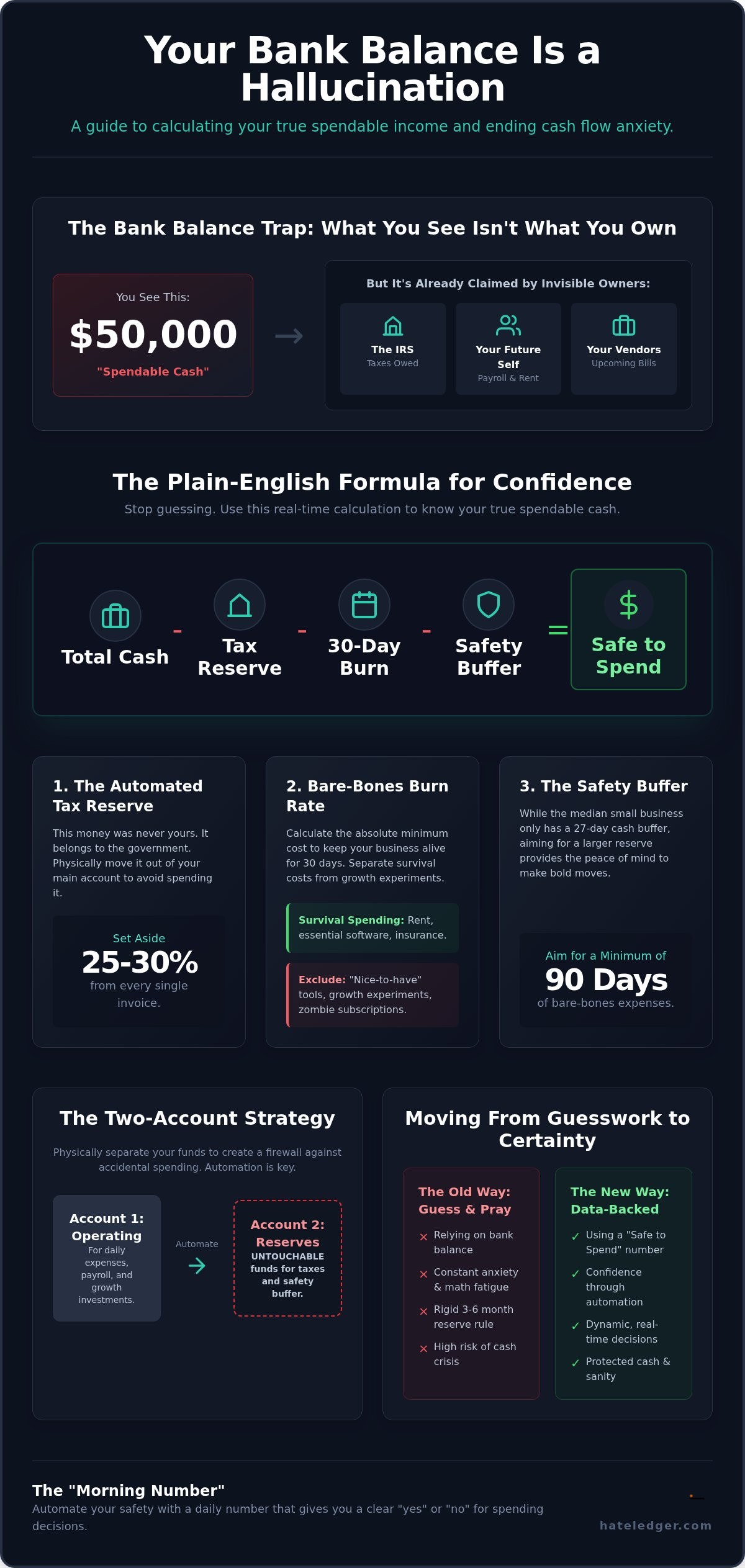
There are three invisible owners sitting in your bank account right now. First, the IRS. They own a slice of every dollar you make. Second, your future self. That's the version of you that needs to pay rent and payroll next month. Third, your vendors. These are the subscriptions and bills that haven't hit yet but are already scheduled to drain your account. Your "Profit" on paper is just an accounting opinion. Cash is the only fact that matters. Spending blindly based on a balance creates a cycle of anxiety that prevents real growth.
The Illusion of Liquidity
Imagine you have $10,000 in your account. It feels like plenty. But if you have $4,000 in upcoming payroll, $3,000 in quarterly taxes due, and $5,000 in credit card debt from last month, you aren't up $10,000. You're actually $2,000 in the hole. Traditional cash flow forecasting often feels like a chore for accountants, but for a founder, it's about survival. The Accountant Way uses complex reports that take weeks to produce. The Founder Way asks a single question: "Can I buy this right now?" Most owners forget to subtract pending obligations mentally. They see the cash and ignore the debt.
The Tax Liability Ghost
For contractors and freelancers, the self-employed tax trap is the primary cause of small business failure. You receive a $5,000 payment and spend it like it's a $5,000 paycheck. It isn't. Roughly 25 to 30 percent of that money belongs to the government the moment it hits your account. Spending your tax money is the fastest way to trigger a crisis. You need a reliable way to understand how to know how much money is safe to spend in my business without doing manual math every morning. Safe Spendable Income is the cash left over after every future obligation, tax debt, and operating cost is stripped away.
Calculating Your "Safe to Spend" Number (The Plain-English Formula)
Forget annual revenue percentages. They are useless when you're deciding whether to buy a new laptop or hire a freelancer on a Tuesday. To master how to know how much money is safe to spend in my business, you need a formula that works in real-time. It's not about what you earned last year. It's about what you can afford to lose today without sinking the ship. We strip away the complexity and focus on four hard numbers.
The Automated Tax Reserve
Tax money was never yours. It's a pass-through that belongs to the government. If you treat it like spendable cash, you're building a business on a foundation of debt. Taking 25 to 30 percent off the top of every invoice is non-negotiable. Using an automated tax reserve for self employed removes the mental load of manual math. Move this money to a separate, untouchable account immediately. If it's invisible, you won't spend it. If it stays in your main balance, it's a ticking time bomb for September 15.
Defining Your Bare-Bones Burn Rate
Your burn rate is the price of staying alive for 30 days. This includes rent, essential software, and insurance. It does not include "nice-to-have" growth experiments. Scan your statements for zombie subscriptions. These are the $40 tools you haven't opened in six months. They eat your spendable cash while you sleep. Survival spending keeps the lights on; growth spending buys the future. You must separate the two to see your true safety margin.
Once you have these numbers, the final subtraction is simple. Start with your total cash. Subtract your tax reserve. Subtract your 30-day burn rate. Finally, subtract a safety buffer. While the 3-6 month rule is the gold standard, research shows the median small business only holds a cash buffer of 27 days. That's a dangerous gamble. Aiming for at least 90 days of expenses in a static reserve provides the breathing room you need to make bold moves.
The result of this subtraction is your Safe Spendable Income. If the number is positive, you have the green light to reinvest. If it's negative, you're currently spending money that belongs to someone else. You can stop the manual math and see this data instantly by checking your daily Morning Number instead of a confusing spreadsheet.
The 3-6 Month Rule vs. Real-Time Decision Making
The 3-6 month rule is a great destination. It's a terrible daily map. Traditional banks love telling you to park six months of expenses in a savings account and forget about it. While that provides a safety net, it doesn't solve the problem of how to know how much money is safe to spend in my business on a random Tuesday. If you only look at your long-term destination, you'll miss the opportunities right in front of you. You need to distinguish between your Static Reserve and your Dynamic Reserve.
A Static Reserve is your doomsday fund. It sits still. It protects you against market crashes or losing your biggest client. A Dynamic Reserve is your fuel. It's the money that moves. It's the cash you use to buy inventory, test ads, or upgrade your tech. Most founders get stuck because they can't tell which is which. They either hoard everything and stop growing, or they spend their doomsday fund and risk everything. To bridge this gap, you need a system that evaluates big purchases in real-time. Before you commit to a new loan or a large expense, use a business financing decision tool to see if the math actually checks out.
The ROI of Human Capital
Hiring is the ultimate safe spend test. Most owners see a salary as a fixed drain on their bank account. That is the wrong way to look at it. A great hire is an ROI engine. They should produce more value than they cost. The real risk isn't the salary; it's the cost of you staying a solo-operator and burning out. But you can't just hire on vibes. You need to know if the salary fits your safe-spend profile today. Using a small business hiring decision tool allows you to see the impact of a new team member before you sign the offer letter. It turns a terrifying gamble into a calculated move.
The Reinvestment Threshold
There is such a thing as having too much cash. If you have hit your 6-month buffer and you're still hoarding money in a low-interest account, you're losing. Inflation and opportunity cost are eating your potential. Every dollar above your safety threshold should be working for you. This is your green light for equipment upgrades or market expansion. When your safety is guaranteed, your only job is to reinvest. Stop letting your cash rot. If your reserves are full, it's time to hit the gas. True safety isn't just about having cash; it's about knowing exactly when that cash is no longer needed for defense and can be used for offense.
Building a System That Tells You "Yes" or "No"
Spreadsheets are a graveyard for your time. If you are still manually entering data into a grid, you are already behind. By the time you finish the math, your bank balance has already shifted. Manual entry is the enemy of safe spending because it relies on your discipline to stay updated. You need a system that works as fast as you do. Stop guessing about how to know how much money is safe to spend in my business and start building a wall between your cash and your obligations.
Adopt the "Two-Account" strategy immediately. One account is for Operating. This is your fuel for daily costs. The other is Untouchable. This is where your tax reserves and safety buffers live. When money hits your business, it gets split. You only ever look at the Operating account for daily decisions. This physical separation prevents you from accidentally spending the government's money or your emergency fund. It turns your bank login into a reliable signal instead of a confusing mess.
Automation is your protector. Your system should sync with your bank in real-time to capture every penny of obligation. You shouldn't have to go looking for debt; it should find you. Set up alerts for when your spendable cash drops below a specific threshold. This turns your finances into a binary decision engine. If the money isn't in the Operating account, the answer is "No." If it is, the answer is "Yes." It's that simple.
Invisible Double-Entry
Most founders hate accounting because of the jargon. You don't need to know what a "current ratio" is to run a successful shop. You need to know if you can buy that new camera or hire that editor today. This is why you need accounting software for people who hate accounting. It categorizes your spending in the background without you touching a single key. It replaces technical debt with pure utility, giving you the answer you need without the homework you hate.
The Daily Financial Ritual
Your financial ritual should take 60 seconds. You don't need ten reports or a board meeting. You need one number. Looking at your dashboard should feel like checking the weather. Is it safe to go out? Or should you stay inside? The best financial system is the one you actually look at every day. Let the software handle the math while you do the work that actually generates the cash. Build your own decision engine today by joining the Hate Ledger Business Plan.
The Morning Number: How Hate Ledger Automates Your Safety
Your bank balance is a ghost. It haunts you because it doesn't account for the money you owe the IRS or the rent due next week. Stop asking how to know how much money is safe to spend in my business and start looking at the only number that matters. Hate Ledger provides the Morning Number. This is your daily safe-to-spend figure, calculated and delivered to your dashboard before you even open your email. It isn't a complex report. It's a green light.
The software works as your invisible financial guard. It systematically strips away tax liabilities, debt repayments, and overhead costs. By the time you see your Morning Number, the math is already done. No more manual entry. No more spreadsheet fatigue. We promise a 90-day transition that moves you from being a stressed bookkeeper to a focused founder. It's about radical simplification. You do the work; we protect the cash. This is the definitive answer for anyone wondering how to know how much money is safe to spend in my business without hiring a full-time CFO.
No More Tax Season Panic
Tax season is only scary when you haven't prepared for it. Our automated tax reserves ensure the government's cut is isolated from the moment an invoice is paid. This creates a level of relief that tradition-heavy accounting can't match. Every dollar in your spending account is actually yours. If you want to buy a $2,000 laptop, you check the number. If it's there, you buy it with 100% confidence. You aren't guessing; you're operating with certainty. The IRS gets their share, and you get your peace of mind.
Scaling Without the Stress
Hiring shouldn't be a gut feeling. The Human Capital ROI engine analyzes your cash flow to tell you exactly when a new hire is a safe move for your bottom line. It removes the risk of over-leveraging your team before the revenue is ready. For founders ready to lead larger teams, the Pro Plan offers advanced tools to keep your safety margin visible as you scale. You get a decision engine that prioritizes your survival and your growth simultaneously. It's time to stop playing small because you're afraid of the math. Get your Morning Number for free with Hate Ledger.
Reclaim Your Time and Your Growth
Your bank balance is no longer allowed to lie to you. You've learned that true safety isn't found in a static savings account or a complex spreadsheet. It's found in a system that strips away obligations in real-time. By isolating your tax reserves and identifying your true burn rate, you've mastered how to know how much money is safe to spend in my business. No more guessing. No more tax season panic. Just a clear path to reinvesting in your future.
It's time to automate your safety. Hate Ledger provides daily Morning Number updates and automated tax reserves for self-employed founders. You get the clarity of a CFO without the jargon or the high fees. Stop guessing and start spending safely with Hate Ledger. Sign up for free today. There's no credit card required for the Free Forever tier. You built this business to lead, not to crunch numbers. Start spending with total confidence and get back to the work that actually generates revenue.
Frequently Asked Questions
How much cash should a small business have on hand at all times?
The standard goal is three to six months of expenses, but research shows the median small business survives on just 27 days of cash. You need enough to cover your bare-bones burn rate without raiding your tax reserves. If your revenue is cyclical, aim for six to nine months. The key isn't the total pile of cash; it's the amount that isn't already promised to the IRS or your vendors.
Is it safe to spend the money I have set aside for taxes?
Never. That money was never yours to begin with. It is a pass-through that belongs to the government the second an invoice is paid. Spending your tax reserve is the primary cause of small business failure. It creates a debt trap that hits hardest on September 15. You should treat these funds as invisible and untouchable, physically separating them from your daily operating cash to avoid accidental spending.
What is a "Safe Spend" number and how is it different from profit?
Profit is an accounting opinion; Safe Spend is a cold, hard fact. You can be profitable on paper while your bank account is empty. Profit doesn't account for the taxes you still owe or the debt you haven't paid. A Safe Spend number tells you exactly how to know how much money is safe to spend in my business by stripping away every future obligation before you look at the balance.
How do I know if I can afford to hire a new employee?
You can afford a new hire when your Safe Spend remains positive after subtracting the new salary and overhead. Don't hire on vibes or a temporary spike in revenue. Use a decision engine to model the impact on your cash flow. A safe hire is an ROI engine that generates more value than they cost. If the math doesn't show a clear path to growth, you're just increasing your risk.
Should I pay myself a salary if my safe spend number is low?
Yes. Your own pay is a non-negotiable part of your burn rate. If your Safe Spend number is low, it means your business model is broken or you're over-leveraged. You aren't a volunteer; you're a founder. If the math doesn't allow for your salary, you need to cut unnecessary costs or raise your prices immediately. A business that can't pay its owner isn't a business; it's an expensive hobby.
What happens if my business expenses are higher than my safe spend number?
You are in the danger zone. This means you are spending money that legally belongs to the IRS or is promised to future vendors. It is a red alert for your cash flow. You must immediately stop all growth spending and audit your essential costs. Ignoring this gap is how founders end up with tax-season panic. When expenses outpace safety, your only job is to cut the fat and protect your reserves.
Is there a simple app to track how much I can safely spend?
Hate Ledger is the definitive tool for this. It replaces traditional bookkeeping jargon with a single, daily Morning Number. The app syncs with your bank to automatically calculate revenue, tax obligations, and your Safe Spend limit. It's built for founders who want the answer to how to know how much money is safe to spend in my business without spending hours inside a complex accounting platform or a manual ledger.
Can I use a spreadsheet to calculate safe spending?
You can, but it's a dangerous trap. Spreadsheets are static; your business is dynamic. By the time you finish your manual entry, the numbers are already wrong. They rely on your discipline to stay updated, which is the first thing to go when you're busy. Real safety requires an automated system that captures every obligation in real-time. Spreadsheets are where pending bills go to be forgotten until it's too late.
Frequently Asked Questions
The standard goal is three to six months of expenses, but research shows the median small business survives on just 27 days of cash. You need enough to cover your bare-bones burn rate without raiding your tax reserves. If your revenue is cyclical, aim for six to nine months. The key isn't the total pile of cash; it's the amount that isn't already promised to the IRS or your vendors.
Never. That money was never yours to begin with. It is a pass-through that belongs to the government the second an invoice is paid. Spending your tax reserve is the primary cause of small business failure. It creates a debt trap that hits hardest on September 15. You should treat these funds as invisible and untouchable, physically separating them from your daily operating cash to avoid accidental spending.
Profit is an accounting opinion; Safe Spend is a cold, hard fact. You can be profitable on paper while your bank account is empty. Profit doesn't account for the taxes you still owe or the debt you haven't paid. A Safe Spend number tells you exactly how to know how much money is safe to spend in my business by stripping away every future obligation before you look at the balance.
You can afford a new hire when your Safe Spend remains positive after subtracting the new salary and overhead. Don't hire on vibes or a temporary spike in revenue. Use a decision engine to model the impact on your cash flow. A safe hire is an ROI engine that generates more value than they cost. If the math doesn't show a clear path to growth, you're just increasing your risk.
Yes. Your own pay is a non-negotiable part of your burn rate. If your Safe Spend number is low, it means your business model is broken or you're over-leveraged. You aren't a volunteer; you're a founder. If the math doesn't allow for your salary, you need to cut unnecessary costs or raise your prices immediately. A business that can't pay its owner isn't a business; it's an expensive hobby.
You are in the danger zone. This means you are spending money that legally belongs to the IRS or is promised to future vendors. It is a red alert for your cash flow. You must immediately stop all growth spending and audit your essential costs. Ignoring this gap is how founders end up with tax-season panic. When expenses outpace safety, your only job is to cut the fat and protect your reserves.
Hate Ledger is the definitive tool for this. It replaces traditional bookkeeping jargon with a single, daily Morning Number. The app syncs with your bank to automatically calculate revenue, tax obligations, and your Safe Spend limit. It's built for founders who want the answer to how to know how much money is safe to spend in my business without spending hours inside a complex accounting platform or a manual ledger.
You can, but it's a dangerous trap. Spreadsheets are static; your business is dynamic. By the time you finish your manual entry, the numbers are already wrong. They rely on your discipline to stay updated, which is the first thing to go when you're busy. Real safety requires an automated system that captures every obligation in real-time. Spreadsheets are where pending bills go to be forgotten until it's too late.