
Invisible Double Entry Accounting: Why You Should Never See a Ledger Again
August 12, 2026 · 16 min read
Double-entry accounting is a 14th-century engine that belongs under the hood, not on your dashboard. You didn't build a company to spend your weekends wrestling with "debits" and "credits." It's exhausting to waste hours on manual data entry only to end up more confused about your bank balance than when you started. This is why invisible double entry accounting is the only way forward for modern founders. You deserve a system that works in the background, providing total clarity without forcing you to learn a dead language.
You're right to be frustrated with legacy systems that prioritize tradition over your time. This article will show you how to bury that complexity so you can focus on profit instead of paperwork. We're going to break down how technology now handles the heavy lifting, ensuring your tax reserves are set and your spending is safe. We will explore the tools that give you a clear morning number and the confidence to grow. It's time to stop playing accountant and start being a CEO again.
Key Takeaways
- Stop guessing with spreadsheets that hide real tax liabilities. Use the power of double-entry without the manual headache.
- Leverage invisible double entry accounting to automate your bookkeeping. Turn complex ledger lines into a background process that just works.
- Replace confusing balance sheets with a single "morning number." Know exactly what you can safely spend after taxes and expenses.
- Reclaim your weekends by ditching manual data entry. Use a decision engine that categorizes transactions and calculates tax reserves automatically.
- Follow a simple three-step transition to end financial chaos. Gain total clarity over your business growth and tax obligations for 2026.
The Hidden Engine: Why Double-Entry Accounting Still Rules (But Sucks to Learn)
Double-entry accounting is the DNA of every reliable financial system on the planet. It was popularized by a Franciscan monk in the 14th century. Think about that. We are running high-tech, 21st-century companies on a system designed for merchant ships and spice trades. We still use it because it is bulletproof. It is the gold standard for accuracy. However, for a modern founder, it is also pure agony. You're forced into a brutal trade-off between total financial accuracy and the time you need to actually grow your revenue. Most owners eventually give up. They retreat to messy spreadsheets because the traditional double-entry bookkeeping system feels like a second job they never applied for.
This is where invisible double entry accounting changes everything. It keeps the heavy-duty engine running under the hood without forcing you to get grease on your hands. You get the reliability of a professional system without the manual labor of a medieval clerk. It's about having a foundation that supports your growth instead of a ledger that slows you down.
The Math Behind the Magic
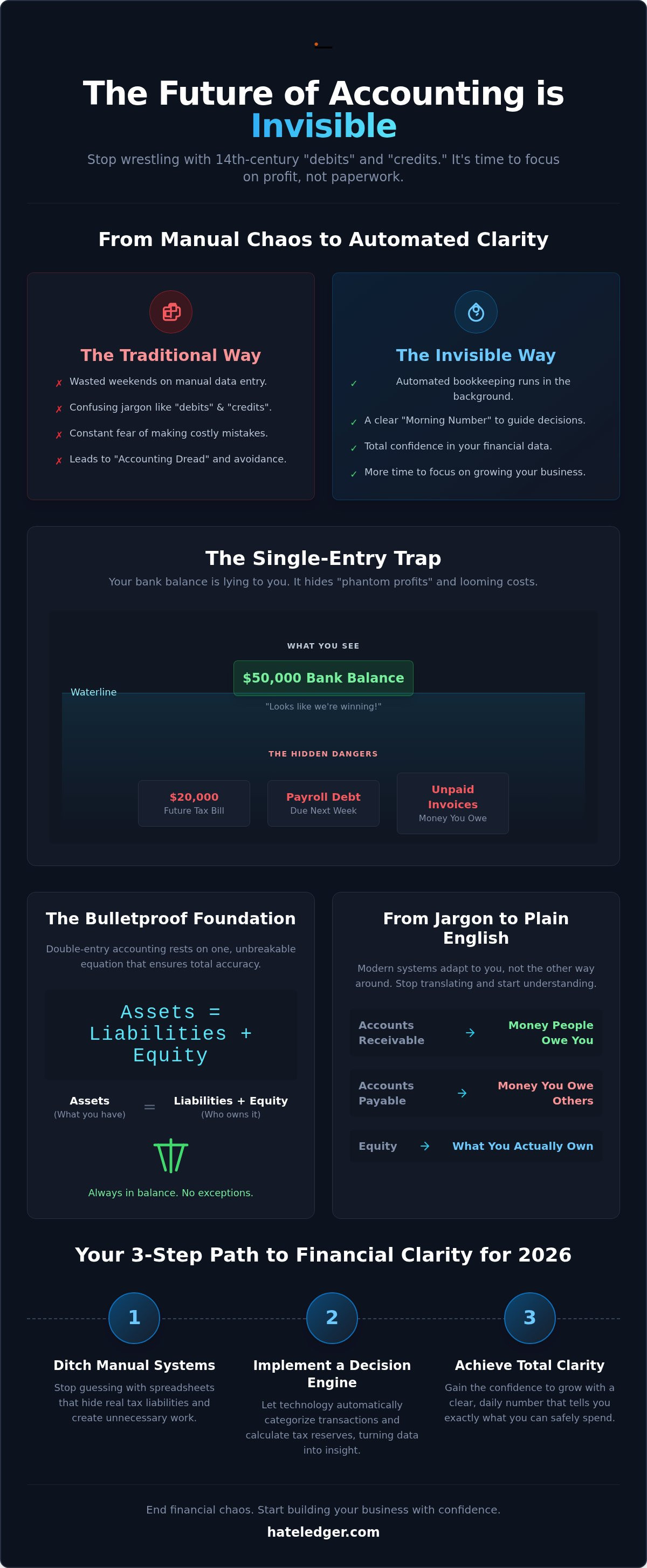
The entire system rests on one rigid equation: Assets = Liabilities + Equity. It must always balance. No exceptions. If you buy a new laptop, your cash goes down, but your equipment assets go up. Every single transaction has two sides to tell the whole story. This prevents money from simply "vanishing" into thin air. There's a massive difference between just "keeping books" to satisfy an auditor and actually running a business to generate wealth. One is a compliance chore. The other is a growth strategy. You need the data, but you don't need the data entry.
Why Single-Entry is a Trap
Many founders fall into the single-entry trap by relying on basic spreadsheets or just checking their banking app. They look at their bank balance and think they're winning. This is a dangerous lie. Your bank balance doesn't show the tax bill looming in three months or the payroll debt hiding in the corner. Single-entry leads to "phantom profits" that disappear the moment a real bill arrives. You might think you have $50,000 to spend, but $20,000 of that is already promised to the IRS. Double-entry is a self-correcting safety net that ensures your business data is a clear window rather than a hall of mirrors. By leveraging invisible double entry accounting, you gain this protection without ever having to touch a ledger line yourself.
Breaking the Code: Debits, Credits, and the Jargon Holding You Back
Jargon is a weapon. Professionals use it to stay relevant; you use it to feel confused. "Debits" and "credits" are the worst offenders in the business world. In your daily life, a debit is a charge on your card. In the upside-down world of accounting, it's just a position on the left side of a ledger. This linguistic friction creates "Accounting Dread." It's a heavy mental load that forces you to avoid your books because you're afraid of making a mistake. This fear is a silent killer of growth. You can't scale what you're afraid to measure. By moving toward invisible double entry accounting, you stop playing the jargon game and start playing the winning game.
Translating Accountant-Speak into Plain English
Your business doesn't care about Latin roots. It cares about cash flow and sustainability. Software should adapt to your brain, not the other way around. You shouldn't need a degree to read your own financial data. Modern systems are finally automating repetitive tasks so you can replace complex terms with functional reality:
- Accounts Receivable becomes "Money People Owe You."
- Accounts Payable becomes "Money You Owe Others."
- Equity becomes "What You Actually Own."
The goal is invisible double entry accounting that protects your business while staying out of your way. You get the high-level data you need without the dictionary. It's about results, not terminology.
The T-Account Nightmare
Manual journal entries are a relic of a slower age. They are a trap for human error. One mistyped digit and you're hunting through 400 lines for a missing penny. It's a total waste of your genius. You should be closing deals and building products, not balancing T-accounts. If you want a deeper look at managing money without the headache, check out our guide on bookkeeping for non accountants. You deserve a system that hides the gears and shows you the path. If you are just starting out, our Free Forever Tier is the perfect way to see how simple your finances can actually be.
The Rise of Invisible Accounting: How Technology Buried the General Ledger
By 2026, manual bookkeeping isn't just slow; it's obsolete. We have entered the era of invisible double entry accounting. In the past, you were the data entry clerk for your own business. You spent hours recording transactions that already happened. Now, technology has buried the general ledger deep beneath a clean user interface. The best software is the one you never have to open. It shifts your focus from recording the past to predicting the future. You don't need to see the ledger to know it's working for you. It's a silent partner that manages the technical debt of your finances while you focus on high-leverage decisions.
Automation as the New Gatekeeper
Bank syncing and AI categorization have replaced the "Year-End Box of Receipts." Algorithms now handle the complex balancing act of debits and credits in milliseconds. While human bookkeepers might take weeks to deliver a monthly report, real-time automation gives you answers instantly. This isn't just about speed. It's about accuracy. Machines don't get tired or skip lines. They categorize your spending and calculate your tax obligations the moment money moves. Real-time data beats a delayed report every single time. It's the difference between looking at an old paper map and using a live GPS. You no longer have to wait until the 15th of the next month to know if you had a profitable week.
The "Under the Hood" Philosophy
Think of your accounting system like a car engine. You drive the car to get to a destination. You don't pull over every mile to tune the timing belt or check the fuel injectors. You expect the engine to work invisibly so you can focus on the road. Your online accounting software should operate with the same philosophy. It must be intuitive enough that you never have to think about the underlying math. These "invisible" systems maintain audit-grade records in the background without requiring a single manual entry from the user. You get the safety of a professional ledger without the agony of maintaining it. By using invisible double entry accounting, you ensure your books are always ready for an audit without ever touching a journal entry. If you're ready to stop being a part-time clerk, our Pro Plan is designed to take the entire burden off your plate so you can focus on scaling.
From Ledger Lines to Decision Engines: Why Your "Morning Number" Matters More
A balance sheet is usually a graveyard where good data goes to die. If you cannot read your financial health in five seconds, the system has failed you. Most founders just check their bank balance and hope for the best. This is a trap. Invisible double entry accounting processes the technical chaos in the background to give you one clear "Morning Number." This is the only figure that actually matters for your daily operations. It is your total revenue minus tax reserves and operating expenses. The result is exactly what is safe for you to spend today. It is the difference between guessing and knowing.
The Safe Spending Zone
Automated tax reserves are the ultimate stress-killer. You should never have to guess what you owe the IRS. Legacy accounting platforms fail here because they present a raw balance without any context. They show you have money in the bank but ignore the liabilities hiding in the corner. You need to know your real burn rate without opening a single spreadsheet or performing mental gymnastics. This clarity creates a "Safe Spending Zone" where you can invest in your business without the fear of a surprise audit or a drained account. When the math is done for you, the dread disappears.
Beyond Bookkeeping: The Decision Engine
Data is for more than just staying out of jail. It is for winning. When you stop manual entry, your financial data transforms into a decision engine. Can you afford to hire a new account manager? Is your current marketing spend actually returning a profit? Our Human Capital ROI Engine uses your invisible double entry accounting data to answer these questions with cold, hard math. It measures the value of your own time versus the cost of outsourced labor. It tells you exactly when a new hire will pay for themselves and start generating a surplus. This isn't just bookkeeping; it is strategic growth.
This is the shift from reactive to proactive management. You stop looking in the rearview mirror at last month's mistakes and start looking at the road ahead. You turn a tedious chore into a sharp competitive advantage. High-growth founders don't have time for ledgers, but they have plenty of time for profit. If you are ready to see your business through a clearer lens, our Business Plan provides the decision-making power you need to scale with confidence.
Implementing Invisible Systems: Reclaiming Your Time in 2026
Transitioning to a modern system shouldn't feel like a root canal. Most traditional services bury you in weeks of onboarding and "discovery calls" that go nowhere. We reject that friction. Reclaiming your time requires a system that prioritizes utility over legacy ceremonies. The shift to invisible double entry accounting follows a logical path that moves you from manual chaos to total order in a fraction of the time. We stand by a 90-day setup promise. If it takes longer than three months to get your financial life in order, the system is too complex for a growing business. You need a solution that scales at your pace without the setup tax.
Step 1: Connect the Pipes
The first move is simple. You connect your bank accounts and credit cards to the engine. This is where the automation starts. By setting up "Rules," the software learns your specific business patterns. It identifies your recurring software subscriptions, your payroll cycles, and your client payments. You can clean up your historical mess without losing your mind because the machine handles the categorization. It's about building a digital foundation that never needs manual repair. This is a core feature you should demand from the best accounting software available in 2026.
Step 2: Trust the Dashboard
Once the pipes are connected, you have to change your habits. Stop checking your banking app to see if you can afford a new project. Look at your "Morning Number" instead. This dashboard view is your true north. It accounts for your automated tax reserves and fixed expenses before showing you a single cent of spendable cash. Make evaluating your Human Capital ROI a weekly habit. This data tells you if your team is producing the value you expect or if you're overpaying for underperformance. Trusting the machine is the hardest part for most founders, but it's the only way to achieve radical simplification.
Step 3: Forget It Exists
The final stage is a "Review Only" workflow. You spend five minutes a week confirming what the AI already knows. Tax season becomes a non-event. Instead of 15 days of hunting for receipts and arguing with a bookkeeper, you handle your obligations in 15 minutes. The records are already audit-grade because invisible double entry accounting has been working since day one. If you're just starting, our Free Forever Tier is the ultimate low-risk entry point to test this reality. Stop playing accountant and start running your business with Hate Ledger.
Stop Playing Accountant and Start Scaling
You didn't start a business to become a part-time clerk. The era of manual ledgers and confusing jargon is over. By embracing invisible double entry accounting, you keep the accuracy of a professional financial engine without ever touching the gears yourself. You get to focus on your "Morning Number" and high-level growth while the software handles the tax reserves and the credits. It is about radical simplification and total financial safety. You deserve a system that works as hard as you do.
We built this specifically for people who hate accounting. We offer a 90-day setup promise to get your world in order fast. You can Get your "Morning Number" for free with Hate Ledger right now. Our Free Forever tier requires no credit card to start. It is the lowest-risk way to reclaim your weekends and your mental energy. It is time to bury the paperwork and get back to the work that actually matters. Your future self will thank you for making the switch today.
Frequently Asked Questions
What is the difference between single-entry and double-entry accounting?
Single-entry is just a simple list of transactions, much like a personal checkbook or a basic spreadsheet. It tracks cash coming in and going out but fails to show what you owe others. Double-entry records two sides for every transaction to keep your books balanced. It provides a complete map of your assets, liabilities, and equity. This prevents money from "vanishing" and ensures your financial data is audit-grade.
Do I need to be an expert to use invisible double-entry accounting software?
No, you don't need any accounting expertise because the technology hides the technical complexity. invisible double entry accounting handles the debits and credits in the background while you interact with a clean dashboard. It’s designed specifically for founders who hate accounting jargon. You focus on making business decisions based on clear results rather than wrestling with ledger lines or manual journal entries.
Is double-entry accounting required by law for small businesses?
The IRS doesn't strictly mandate double-entry for most small businesses, but they do require accurate and complete records. While single-entry is legal, it's risky because it's prone to errors that trigger audits. Double-entry is the professional standard for a reason. If you ever plan to scale, apply for a business loan, or bring on investors, they will demand the accuracy that only a professional system provides.
How does automated tax reserve calculation work?
The system tracks your profit in real-time and calculates exactly how much you need to set aside for the IRS. It uses current tax regulations to pull a percentage of every dollar earned into a digital reserve. You don't have to guess or use a separate savings account. This ensures you always know your true "spendable" cash and never face a surprise bill at the end of the year.
Can I switch from legacy accounting software to an invisible system easily?
Yes, switching is a straightforward process that involves connecting your existing bank feeds to the new engine. We offer a 90-day setup promise to ensure your transition from traditional platforms is fast and painless. You don't need to manually move years of messy data. The goal is to replace the friction of outdated systems with a "review only" workflow that respects your time and mental energy.
What is a "Morning Number" and why is it more accurate than my bank balance?
Your bank balance is often a lie because it doesn't account for money that is already promised to someone else. The Morning Number is your actual cash minus your tax reserves and upcoming expenses. invisible double entry accounting calculates this figure every day so you know exactly what is safe to spend. It provides a level of financial clarity that a simple banking app just can't match.
How does accounting software measure Human Capital ROI?
Our Human Capital ROI Engine compares the cost of your team against the revenue their work generates. It uses your financial data to show you the actual return on every dollar spent on labor. This moves beyond simple payroll tracking and turns your books into a decision engine. It helps you decide when to hire, when to outsource, and how to maximize the value of your team's time.
Is there a free version of double-entry accounting software for freelancers?
Yes, our Free Forever Tier is built for solo operators and freelancers who need professional accuracy without the overhead. It gives you access to the same invisible engine used by larger companies to track spending and calculate tax reserves. It’s the perfect entry point for anyone moving away from messy spreadsheets. You get total financial protection and clarity at zero cost while you grow your business.
Frequently Asked Questions
Single-entry is just a simple list of transactions, much like a personal checkbook or a basic spreadsheet. It tracks cash coming in and going out but fails to show what you owe others. Double-entry records two sides for every transaction to keep your books balanced. It provides a complete map of your assets, liabilities, and equity. This prevents money from "vanishing" and ensures your financial data is audit-grade.
No, you don't need any accounting expertise because the technology hides the technical complexity. invisible double entry accounting handles the debits and credits in the background while you interact with a clean dashboard. It’s designed specifically for founders who hate accounting jargon. You focus on making business decisions based on clear results rather than wrestling with ledger lines or manual journal entries.
The IRS doesn't strictly mandate double-entry for most small businesses, but they do require accurate and complete records. While single-entry is legal, it's risky because it's prone to errors that trigger audits. Double-entry is the professional standard for a reason. If you ever plan to scale, apply for a business loan, or bring on investors, they will demand the accuracy that only a professional system provides.
The system tracks your profit in real-time and calculates exactly how much you need to set aside for the IRS. It uses current tax regulations to pull a percentage of every dollar earned into a digital reserve. You don't have to guess or use a separate savings account. This ensures you always know your true "spendable" cash and never face a surprise bill at the end of the year.
Yes, switching is a straightforward process that involves connecting your existing bank feeds to the new engine. We offer a 90-day setup promise to ensure your transition from traditional platforms is fast and painless. You don't need to manually move years of messy data. The goal is to replace the friction of outdated systems with a "review only" workflow that respects your time and mental energy.
Your bank balance is often a lie because it doesn't account for money that is already promised to someone else. The Morning Number is your actual cash minus your tax reserves and upcoming expenses. invisible double entry accounting calculates this figure every day so you know exactly what is safe to spend. It provides a level of financial clarity that a simple banking app just can't match.
Our Human Capital ROI Engine compares the cost of your team against the revenue their work generates. It uses your financial data to show you the actual return on every dollar spent on labor. This moves beyond simple payroll tracking and turns your books into a decision engine. It helps you decide when to hire, when to outsource, and how to maximize the value of your team's time.
Yes, our Free Forever Tier is built for solo operators and freelancers who need professional accuracy without the overhead. It gives you access to the same invisible engine used by larger companies to track spending and calculate tax reserves. It’s the perfect entry point for anyone moving away from messy spreadsheets. You get total financial protection and clarity at zero cost while you grow your business.