
Accounting Platforms: Why Most Small Business Owners Hate Their Software
August 11, 2026 · 16 min read
Most accounting platforms are built for the person who files your taxes, not the person who actually runs the company. You didn't start a business to become a part-time data entry clerk or a junior bookkeeper. Yet, you're likely staring at a screen full of jargon and manual bank reconciliations every Sunday night. It's exhausting. You feel the constant weight of potential tax penalties and the nagging uncertainty of not knowing your actual safe-to-spend balance. It's a waste of your mental energy.
We get it. Your software should work for you, not the other way around. You deserve better than a glorified spreadsheet that demands hours of your life. You're about to discover why traditional systems fail founders and how to switch to a system that actually tells you what's in the bank. We'll show you how to automate your tax reserves, kill off manual entry, and finally get a clear daily number showing your spendable profit. It's time to stop fighting your tools and start making decisions with real confidence.
Key Takeaways
- Stop fighting tools built for tax filers and start using accounting platforms that translate raw bank data into clear business moves.
- Ditch the manual data entry for an "invisible" system that automates bank syncing and hides your tax money before you can accidentally spend it.
- Strip away the enterprise fluff to focus on the numbers that matter, like the Human Capital ROI of your team.
- Recognize the red flags of a dying spreadsheet system, from version control hell to tax season panic.
- Find a software solution that gives you a daily "Safe-to-Spend" figure instead of a 40-hour certification course.
The Accounting Platform Trap: Why Jargon Is Killing Your Business
Stop pretending you understand your books. Most accounting platforms are designed for people with degrees in tax law, not people with payroll to meet. An accounting platform should be a tool that translates raw bank data into actual business decisions. Instead, it's a wall of numbers that makes you feel stupid. It's a trap. It forces you to spend your Sundays acting like a junior bookkeeper instead of a CEO.
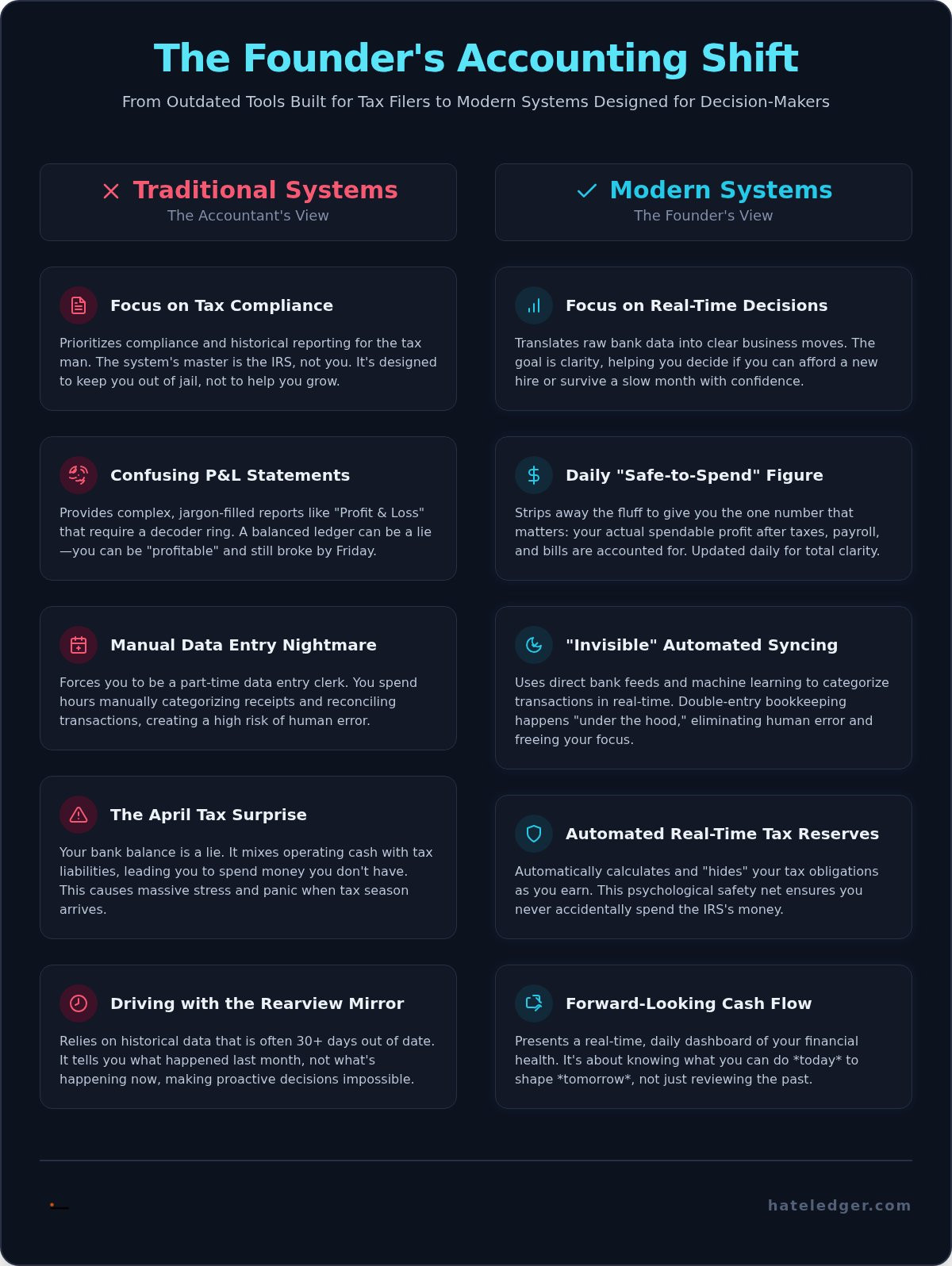
Traditional software has a master. It isn't you. It's the tax man. These systems prioritize compliance over your company's survival. They trap you in a world of "accrual" and "depreciation." These terms don't tell you if you can afford a new hire. They don't tell you if you can survive a slow month. They just hide your actual cash flow behind layers of CPA-speak. This "Accountant-First" approach is the reason you feel a pit in your stomach every time you log in.
The Disconnect Between Ledgers and Reality
A balanced ledger is a lie. You can have a perfect balance sheet and still be broke by Friday. Relying on reports that are 30 days out of date is like driving a car while looking only at the rearview mirror. It's dangerous. Most modern accounting systems focus on historical data. They tell you what happened last month. They don't tell you what's happening now. Founder-First accounting is the prioritization of spendable cash over balance sheets.
When you focus on reality, you stop worrying about "balancing" and start worrying about spending. You need a daily number. You need to know that after taxes, bills, and payroll are covered, you have exactly $4,302 left to play with. Traditional software won't give you that. It gives you a Profit and Loss statement that requires a decoder ring to understand. You don't have time for that.
Why 'Double-Entry' Shouldn't Be Your Problem
Double-entry bookkeeping has been around since the 1400s. It works. It's necessary for the IRS. But it belongs under the hood. You wouldn't rebuild your engine every time you want to drive to the store. Why are you manually reconciling lines in a ledger? It's an outdated process that wastes your most valuable resource: your focus.
"Invisible Double-Entry" is the solution. It means the software does the heavy lifting in the background while you focus on growth. You get the compliance the government demands without the manual headache you've grown to hate. If you want to skip the fluff entirely, check out our guide on Bookkeeping for Non-Accountants to manage your money without the jargon. Stop playing accountant. Start being a founder again.
The Anatomy of a Modern, 'Invisible' Accounting System
Traditional accounting platforms are loud. They demand your constant attention. They want you to categorize every coffee receipt and reconcile every minor transaction manually. An "invisible" system is the opposite. It stays out of your way. It turns your bank data into a roadmap while you focus on actually serving your customers. This is the difference between owning a tool and being owned by one.
The goal is radical simplification. You don't need more features. You need more clarity. A modern system should act as a protective shield, keeping the messy details of bookkeeping under the hood while delivering the high-level insights you need to stay profitable. It replaces manual labor with automated intelligence.
Automated Bank Syncing: Ending the Manual Entry Nightmare
Manual data entry is the primary cause of tax-time panic. One mistyped digit in a spreadsheet can cascade into a week of forensic accounting later. Direct bank feeds eliminate this risk entirely. These feeds don't just dump data into a list. They provide integrated intelligence that recognizes patterns and categorizes expenses in real-time. This isn't just a "connected" app; it's a system that learns your business. When your accounting platforms handle the entry, human error disappears. You stop chasing receipts and start trusting your data.
Real-Time Tax Reserves: No More April Surprises
Most founders fall into the "Self-Employed Tax Trap." You see $50,000 in your bank account and assume it's all yours to spend. Then April arrives, and the IRS demands a check you can't afford to write. An invisible system solves this by "hiding" your tax money as you earn it. It calculates your obligations in real-time and separates them from your operating cash. This shifts your focus from a misleading "Bank Balance" to a realistic "Safe-to-Spend" figure. It's a psychological safety net that ensures you always manage your business finances with total accuracy.
If you're tired of the guessing games, check out our guide on Online Accounting Software for People Who Hate Doing Accounting. It's built for those who want results without the headache.
The Morning Number and Decision Engines
Imagine waking up to a single figure: your Morning Number. This is the one amount you can safely spend today without compromising payroll or taxes. It removes the need for mental math. When you're faced with a big choice, like "Can I afford to hire a new lead?", you shouldn't have to call an accountant. A modern decision engine uses your historical data to give you a clear "Yes" or "No" based on your actual profitability. You can see how this automated approach works to keep your growth on track without the manual grind.
Features vs. Fluff: What Founders Actually Need
Stop paying for bloat. Most accounting platforms are packed with enterprise-level features that small business owners never touch. If you aren't managing a global supply chain, you don't need complex inventory modules or multi-currency consolidation tools. You need data that helps you make payroll and scale your profit. While many entrepreneur-recommended bookkeeping tools focus on the basics, you should look for features that actually drive your daily growth. Clarity is the only feature that matters when you're trying to build a sustainable company.
The 'Morning Number' vs. Traditional Balance Sheets
A balance sheet is a rearview mirror. It tells you where you were thirty days ago, which is useless when you're making decisions today. The Morning Number is your windshield. It represents the intersection of your current revenue, outstanding debt, and automated tax obligations. This single figure gives you "Safe-to-Spend" mastery. You know exactly what's in the bank for you, and what belongs to the IRS or your vendors. You don't have to guess if a check will clear. You just look at the number and move on with your day.
Human Capital ROI: Is Your Team Profitable?
Most software treats payroll as a black hole. You see money leaving your account, but you don't see what it's actually buying you. You need to move beyond simple payroll tracking to see the return on every dollar spent on labor. This helps you identify which roles are driving growth and which are just overhead. Human capital is the total value of your team's skills and output, not just a line item on an expense report. When you understand this ROI, hiring stops being a gamble and starts being a calculated investment in your future.
A real founder's tool includes a Decision Engine. This isn't just a calculator. It's a simulator. It lets you model financial choices before you commit a single cent. Want to know if you can afford that $10k marketing spend or a new office lease? The engine looks at your current cash and future obligations to give you a green light or a warning. Combine this with simple invoicing that strips away the finance degree requirements. You don't need a complex billing system. You need a way to get paid 2x faster by making it easy for clients to click and pay. No portals. No passwords. Just results.
5 Signs You Have Outgrown Your Spreadsheet Setup
Spreadsheets are the ultimate "good enough" tool until they aren't. They're flexible. They're free. But eventually, they become a liability. If you're still using a manual sheet to manage a scaling company, you're building on sand. Your business has evolved, but your tools are stuck in the past. When your "free" setup starts costing you hours of sanity, it's time to admit the spreadsheet is dead. Here are the red flags that your manual system is about to collapse.
First, the Tax Season Panic. If finding one specific receipt takes over an hour, you've already lost. You're wasting billable time on a digital scavenger hunt. Second, the Bank Balance Lie. This is the most dangerous sign. You see cash in the bank and commit to a new equipment lease. Then you realize half that cash belonged to the IRS. Spreadsheets only show you what you've typed; they don't show you what you owe. Finally, there's Manual Entry Fatigue. You skipped last week's entries. Then you skipped last month's. Now you're making decisions based on data from ninety days ago. That's not a strategy. It's a guess.
Spreadsheet Sprawl and Version Control Hell
Spreadsheets are built for one person. As soon as you have a team or a bookkeeper, you enter Version Control Hell. You're staring at "Final_v2" while your partner is editing "Master_Copy_Updated." It's a recipe for expensive errors. Centralized accounting platforms provide a single source of truth. Everyone sees the same data in real-time. No more overwriting formulas. No more broken links. The hidden cost of "free" spreadsheets is the hours you spend fixing them. You need a system that calculates real-time tax reserves automatically so you never spend money that isn't yours.
Missing the 'Safe-to-Spend' Window
A raw bank balance is a trap. It doesn't account for the check you wrote yesterday or the tax bill due next quarter. Making hiring or equipment decisions based on a raw balance is how businesses go under during growth spurts. Moving to a platform provides the "Morning Number" clarity spreadsheets lack. You need to know if you can afford that new hire right now, not after you spend three hours updating a ledger. If you're ready to stop the manual grind, check out our Accounting Software for People Who Hate Accounting: The 2026 Guide.
Stop guessing and start knowing exactly what your business can afford. Get your Morning Number and reclaim your Sundays at Hate Ledger.
Choosing a Platform That Doesn't Suck: The Founder's Checklist
Most accounting platforms feel like they were built for the person auditing you, not the person paying you. You don't have time for a degree in finance. You need a tool that stays out of your way. If the software requires a 40-hour certification just to send an invoice, it's not for you. That's a tool for a specialist, not a founder. Your software should be a utility, like electricity. It should just work in the background.
- Rule 1: No Certifications Required. If you need a week of training to understand the dashboard, keep looking.
- Rule 2: Daily 'Safe-to-Spend' Figure. If you have to do mental math to check your actual balance, the software is failing you.
- Rule 3: Native Bank Syncing. Automated syncing must be part of the core product. Clunky add-ons and third-party connectors break constantly.
- Rule 4: Invisible Double-Entry. You need the compliance for the IRS. You don't need to see the debits and credits. Keep the complexity under the hood.
- Rule 5: The 90-Day Setup Promise. Don't fall into the 'half-finished' software trap. If they won't promise to have you fully operational in 90 days, walk away.
Moving from 'Accountant-First' to 'Founder-First'
Evaluate every interface for plain-English utility. If you see "Accounts Receivable" instead of "Money People Owe Me," the platform is built for an accountant. Prioritize 'Decision Engines' like a Human Capital ROI Engine over 'Ledger Entry' screens. You need to know if you can afford to hire a new lead or buy that new server today. You don't need to spend your afternoon recording journal entries. Look for a Free Forever Tier to test the waters. You should be able to see the value before you commit your budget to a Business Plan or Pro Plan.
The 90-Day Setup Promise
Most accounting transitions fail in the first thirty days. Founders get overwhelmed by data migration and give up. A professional setup process removes this friction. It ensures your historical data is mapped correctly and your automated tax reserves are functioning from day one. You deserve a system that is ready to work as hard as you do. Stop fighting your tools. Stop playing accountant and get your Morning Number with Hate Ledger.
Stop Fighting Your Software and Start Running Your Business
You've seen the traps. You know the jargon is designed to keep you confused. Traditional accounting platforms aren't broken by accident; they're built for a world that doesn't care about your time. It's time to stop guessing if you can afford a new hire or a tax payment. You need a system that works in the background and speaks plain English. You deserve a clear Morning Number that tells you exactly what's safe to spend. No more Sunday night spreadsheets. No more tax season panic.
Get your books under control with our Free Forever Tier and a 90-day setup promise. It's time to prioritize your mental energy over manual entry. We provide plain-English reporting that actually makes sense for your daily operations. Stop hating your books and start loving your Morning Number. Join Hate Ledger for Free.
Your business is waiting for you to lead it. Stop playing bookkeeper and start being a founder again. You've got this.
Frequently Asked Questions
What is the difference between an accounting platform and a spreadsheet?
A spreadsheet is a manual record that requires you to type every transaction while a platform is an automated ecosystem. Accounting platforms pull data directly from your bank feeds to eliminate manual entry errors. One is a historical log that is always out of date; the other is a real-time decision engine. You stop being a data entry clerk and start being a business owner.
Do I need an accountant if I use an accounting platform?
You still need an accountant for high-level strategy and filing, but you don't need them for basic bookkeeping. The platform handles the daily grind so your accountant can focus on saving you money. It turns your relationship from a messy receipt hand-off into a strategic partnership. You pay for their tax-saving brain, not their typing speed or data entry skills.
Is my data safe on a cloud-based accounting platform?
Your data is significantly safer in the cloud than on a local hard drive or a shared spreadsheet. Modern platforms use bank-level encryption and automated backups to protect your financial history. If your laptop breaks or your office floods, your books remain intact and accessible. It's about redundancy and professional-grade security that a manual file simply cannot match.
How much does a small business accounting platform usually cost?
Most accounting platforms use tiered subscription models that scale as your revenue grows. You can often find a Free Forever Tier for basic needs, while Pro or Business plans add more advanced decision tools. You should prioritize the value of your time over the monthly fee. If a system saves you five hours of manual work, it has already paid for itself.
What is 'Invisible Double-Entry' and why does it matter?
Invisible Double-Entry is a system that handles complex ledger requirements in the background while you use plain-English tools. You see "Money In" and "Money Out," but the software creates the debits and credits needed for IRS compliance. It matters because it keeps you legal without forcing you to learn 15th-century bookkeeping terminology. It's professional-grade accounting without the mental headache.
Can an accounting platform help me with my taxes?
Yes, by automating your tax reserves and organizing your deductions throughout the year. Instead of a year-end panic, you have a clear record of every business expense and a set-aside fund for your obligations. While the platform doesn't file the return for you, it makes the filing process a simple data export instead of a forensic investigation into your receipts.
What is a 'Morning Number' in business finance?
The Morning Number is a single figure that tells you exactly how much cash is safe to spend today. It's calculated by taking your bank balance and subtracting upcoming bills, payroll, and automated tax reserves. It removes the guesswork from your daily operations. You don't have to check three different accounts or a spreadsheet; you just look at one number and make your move.
How long does it take to set up a new accounting platform?
A professional setup should be fully operational within a 90-day window. This includes migrating your historical data, connecting your bank feeds, and training the system to recognize your spending patterns. It's a structured process designed to move you away from spreadsheets without disrupting your daily cash flow. Fast setup means faster clarity for your business and an immediate reduction in your mental load.
Frequently Asked Questions
Most software treats payroll as a black hole. You see money leaving your account, but you don't see what it's actually buying you. You need to move beyond simple payroll tracking to see the return on every dollar spent on labor. This helps you identify which roles are driving growth and which are just overhead. Human capital is the total value of your team's skills and output, not just a line item on an expense report. When you understand this ROI, hiring stops being a gamble and starts being a calculated investment in your future. A real founder's tool includes a Decision Engine. This isn't just a calculator. It's a simulator. It lets you model financial choices before you commit a single cent. Want to know if you can afford that $10k marketing spend or a new office lease? The engine looks at your current cash and future obligations to give you a green light or a warning. Combine this with simple invoicing that strips away the finance degree requirements. You don't need a complex billing system. You need a way to get paid 2x faster by making it easy for clients to click and pay. No portals. No passwords. Just results. Spreadsheets are the ultimate "good enough" tool until they aren't. They're flexible. They're free. But eventually, they become a liability. If you're still using a manual sheet to manage a scaling company, you're building on sand. Your business has evolved, but your tools are stuck in the past. When your "free" setup starts costing you hours of sanity, it's time to admit the spreadsheet is dead. Here are the red flags that your manual system is about to collapse. First, the Tax Season Panic. If finding one specific receipt takes over an hour, you've already lost. You're wasting billable time on a digital scavenger hunt. Second, the Bank Balance Lie. This is the most dangerous sign. You see cash in the bank and commit to a new equipment lease. Then you realize half that cash belonged to the IRS. Spreadsheets only show you what you've typed; they don't show you what you owe. Finally, there's Manual Entry Fatigue. You skipped last week's entries. Then you skipped last month's. Now you're making decisions based on data from ninety days ago. That's not a strategy. It's a guess.
A spreadsheet is a manual record that requires you to type every transaction while a platform is an automated ecosystem. Accounting platforms pull data directly from your bank feeds to eliminate manual entry errors. One is a historical log that is always out of date; the other is a real-time decision engine. You stop being a data entry clerk and start being a business owner.
You still need an accountant for high-level strategy and filing, but you don't need them for basic bookkeeping. The platform handles the daily grind so your accountant can focus on saving you money. It turns your relationship from a messy receipt hand-off into a strategic partnership. You pay for their tax-saving brain, not their typing speed or data entry skills.
Your data is significantly safer in the cloud than on a local hard drive or a shared spreadsheet. Modern platforms use bank-level encryption and automated backups to protect your financial history. If your laptop breaks or your office floods, your books remain intact and accessible. It's about redundancy and professional-grade security that a manual file simply cannot match.
Most accounting platforms use tiered subscription models that scale as your revenue grows. You can often find a Free Forever Tier for basic needs, while Pro or Business plans add more advanced decision tools. You should prioritize the value of your time over the monthly fee. If a system saves you five hours of manual work, it has already paid for itself.
Invisible Double-Entry is a system that handles complex ledger requirements in the background while you use plain-English tools. You see "Money In" and "Money Out," but the software creates the debits and credits needed for IRS compliance. It matters because it keeps you legal without forcing you to learn 15th-century bookkeeping terminology. It's professional-grade accounting without the mental headache.
Yes, by automating your tax reserves and organizing your deductions throughout the year. Instead of a year-end panic, you have a clear record of every business expense and a set-aside fund for your obligations. While the platform doesn't file the return for you, it makes the filing process a simple data export instead of a forensic investigation into your receipts.
The Morning Number is a single figure that tells you exactly how much cash is safe to spend today. It's calculated by taking your bank balance and subtracting upcoming bills, payroll, and automated tax reserves. It removes the guesswork from your daily operations. You don't have to check three different accounts or a spreadsheet; you just look at one number and make your move.
A professional setup should be fully operational within a 90-day window. This includes migrating your historical data, connecting your bank feeds, and training the system to recognize your spending patterns. It's a structured process designed to move you away from spreadsheets without disrupting your daily cash flow. Fast setup means faster clarity for your business and an immediate reduction in your mental load.