
Bookkeeping for Non-Accountants: How to Manage Your Money Without the Jargon
August 9, 2026 · 16 min read
You didn't start a business to become a part-time data entry clerk for the IRS. Most traditional advice on bookkeeping for non accountants is written by people who love spreadsheets for people who despise them. It's a broken system. You're likely exhausted by manual data entry and paralyzed by the fear of a surprise tax bill. You're tired of checking five different tabs just to see if you can afford a new office chair. It's a mental load you don't need.
We agree that the old way is dead. Bookkeeping shouldn't be a second job; it should be an invisible utility that stays out of your way. This guide will show you how to stop playing accountant and get back to the work that actually makes you money. We'll walk through automating your tax reserves and finding your "Morning Number" every single day. You're about to learn how to spend safely and simplify your finances without touching a single piece of jargon.
Key Takeaways
- Stop fighting the jargon; traditional bookkeeping for non accountants is built for experts, not operators.
- Adopt "Invisible Bookkeeping" to automate complex data entry and keep your focus on growth.
- Replace bank-balance guessing with your "Morning Number" to see exactly what’s safe to spend after taxes and obligations.
- Master a 5-minute daily workflow that ensures your tax reserves are handled and your finances stay organized.
The Jargon Trap: Why Traditional Bookkeeping Fails Non-Accountants
You didn't start a company to spend your Sundays staring at a ledger. Most systems for bookkeeping for non accountants feel like a second job because they were designed by accountants, for accountants. They use words like "accruals" and "reconciliation" to make a simple process feel like a secret society. If you find yourself confused, it isn't your fault. The system is built on a foundation that prioritizes the needs of the IRS over the needs of the person actually running the business.
To understand the disconnect, you have to look at What is Bookkeeping? at its core. Traditionally, it is the recording of financial transactions. But for a business owner, it should be a decision-making tool. When the language is wrapped in technical jargon, it creates a mental barrier that leads to avoidance. You stop looking at the numbers because the numbers don't speak your language. This avoidance is where the danger begins.
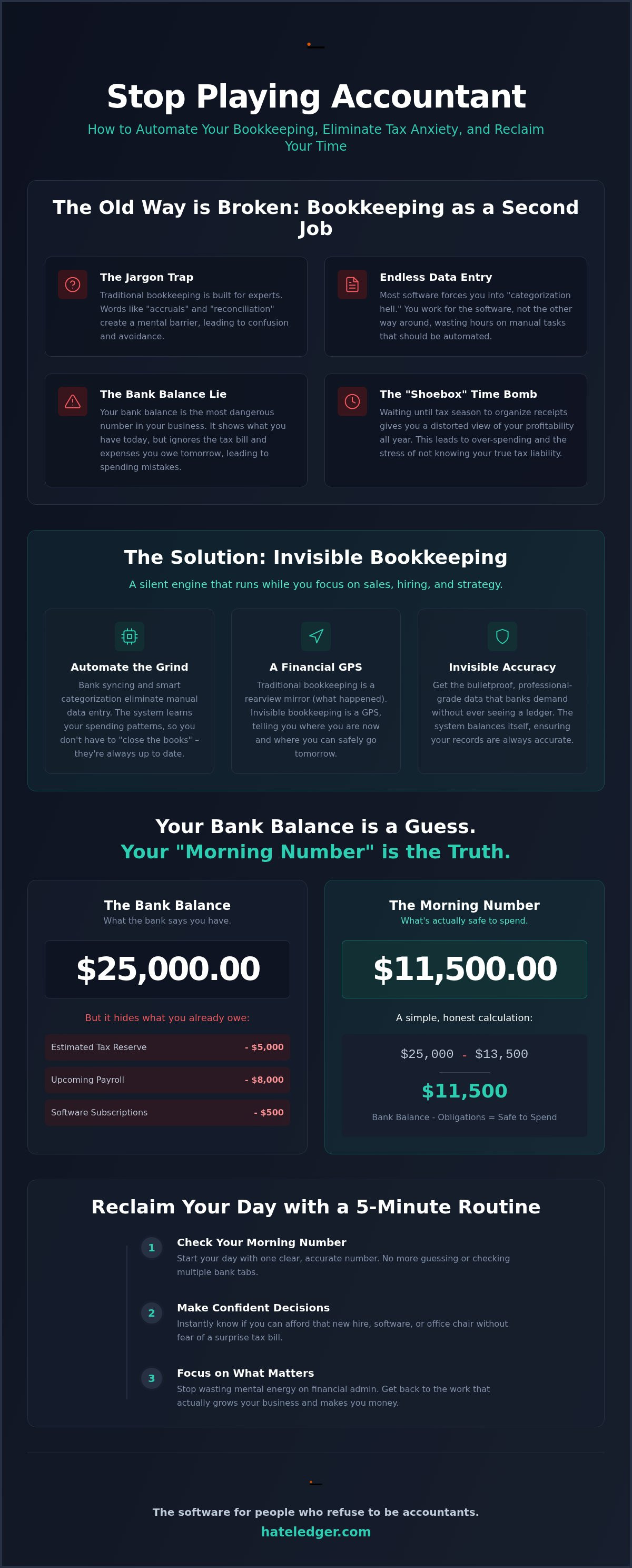
Your bank balance is the most dangerous lie in your business. It tells you what you have today, but it ignores what you owe tomorrow. It doesn't account for the tax bill growing in the corner or the subscription that hits next Tuesday. Relying on that single number leads to "accounting anxiety," a specific brand of mental exhaustion that drains your productivity. You spend more time worrying about whether you can afford a purchase than you do actually growing your revenue.
The Problem with "Accountant-Lite" Software
Most modern apps are just digital versions of 14th-century ledgers. They take the same complex double-entry logic used by medieval merchants and put a pretty interface on top of it. You're still trapped in categorization hell. These tools force you to do the heavy lifting that the software should handle. If you have to manually tell a program that a "Chevron" charge is a "Fuel" expense every single month, the software isn't working for you; you're working for the software. It's an inefficient use of your mental energy.
Why "Good Enough" Bookkeeping Isn’t Enough
The "shoebox method" of saving receipts and hoping for the best is a ticking time bomb. It isn't just about the risk of an audit. The real cost is the distorted reality of your profit. Missing a single recurring entry or a small set of expenses can make you feel more successful than you actually are. This leads to over-hiring or over-spending at the worst possible times. The stress of not knowing your true tax liability until April 14th is a weight no founder should carry. You deserve to know your standing in real time, not six months after the fact.
What is Invisible Bookkeeping? A Plain-English Definition
Most guides on bookkeeping for non accountants try to turn you into a junior clerk. We don't do that. Invisible Bookkeeping is financial tracking that happens without your intervention. It is the silent engine that runs while you focus on sales, hiring, and strategy. You don't need to know how the engine works; you just need to know it's getting you to your destination. Traditional bookkeeping is a rearview mirror. It only tells you what happened last month. Invisible bookkeeping is a GPS. It tells you where you are right now and where you can safely go tomorrow.
Following official SBA guidance on financial management usually involves choosing an accounting system that works for your scale. But most systems fail because they prioritize the administrative process over the actual result. We believe non-accountants should prioritize outcomes over procedures. You don't get paid to categorize transactions; you get paid to run a profitable company. By shifting your focus to results, you reclaim the mental space needed to lead.
Automating the Boring Stuff
Bank syncing is the end of manual receipt typing. It pulls data directly from the source, eliminating the human error that usually happens during late-night data entry sessions. Automatic categorization takes it further. Modern technology learns your spending patterns. It recognizes that a specific recurring vendor is always "Office Supplies" or "Software." This creates a shift from "closing the books" once a month to having real-time updates every hour. If you're tired of the manual grind, you can explore a simpler way to track finances and see these automated features in action.
The Role of Invisible Double-Entry
Invisible double-entry is the backbone of financial accuracy that operates entirely behind the scenes without requiring you to learn debits or credits. Traditional accounting relies on T-accounts and complex balancing acts that confuse most humans. Our system ensures your numbers balance automatically. This matters for your long-term scale. When you eventually need a loan or want to sell your company, your records must be bulletproof. You get the professional-grade data that banks demand without ever seeing a ledger. It's about building a foundation for growth without the administrative weight that usually slows you down.
The Morning Number vs. The Bank Balance
Checking your bank balance is the fastest way to make a bad decision. Most traditional resources for bookkeeping for beginners focus on historical reports like the Profit and Loss statement. While those documents are fine for tax season, they are useless for daily operations. Seeing $10,000 in your account doesn't mean you have $10,000 to spend. That money is already spoken for by the government, your landlord, and your software subscriptions. Relying on the bank balance is a trap that leads to the "Self-Employed Tax Trap," where you realize too late that you've spent the IRS's share of your revenue.
The "Morning Number" is the only metric that actually matters for bookkeeping for non accountants. It is a simple, daily calculation: your total cash minus your tax reserves, overhead, and future obligations. It tells you exactly what is safe to spend right now. When you know your Morning Number, you can make guilt-free purchases. You stop guessing and start operating with total confidence. You don't need a degree to understand it. You just need to know if the number is high enough to cover your next move.
Calculating Your Real Spendable Income
True financial safety comes from a specific formula. You take your current cash and immediately strip away 25 to 30 percent for taxes. Doing this daily is far superior to doing it quarterly. It turns a massive, terrifying bill into a non-event. Next, you subtract your "invisible" expenses. These are the annual fees and monthly software subs that usually surprise you mid-month. By accounting for these obligations before they hit your statement, you ensure your spendable income is actually spendable. It's about protecting your future self from your current impulses.
Making Decisions with the Decision Engine
Stop saying "I think I can afford this" and start looking at the data. A real decision engine takes the emotion out of growth. If you want to hire a new team member, you shouldn't rely on a gut feeling. You need to calculate your Human Capital ROI. This means looking at how much revenue each dollar spent on payroll actually generates. Our Business Plan includes a Human Capital ROI Engine specifically for this reason. It moves you from "maybe" to a definitive "yes" or "no." When the data says you can afford to scale, you can do it without the 3:00 AM panic. You aren't just tracking money; you're building a machine that tells you exactly when to hit the gas.
A 5-Minute Routine for People Who Hate Bookkeeping
Most traditional advice on bookkeeping for non accountants suggests setting aside four hours a month to "do the books." That is a lifetime for a busy operator. It is also a guaranteed way to ensure the work never gets done. When you leave your finances for a monthly deep-dive, you aren't managing your business; you're performing a financial autopsy on the past. You need a routine that fits between your first cup of coffee and your first email. This isn't about being meticulous. It's about being fast and consistent.
Follow these four steps to regain control of your time:
- Step 1: Check your Morning Number. Do this every day before you open your inbox. It takes ten seconds and grounds your day in financial reality before the chaos starts.
- Step 2: Review "unrecognized" transactions. Spend exactly 60 seconds confirming any outliers the software didn't automatically categorize.
- Step 3: Verify your automated tax reserve. Seeing your tax obligations sitting safely in a separate bucket provides instant peace of mind.
- Step 4: Consult the Decision Engine. If you're about to make a purchase over $100, run the numbers first to see how it impacts your long-term safety.
The Power of Micro-Habits
One minute a day beats five hours a month every single time. When you wait until the end of the month, the "dread factor" grows into an insurmountable mountain of data. By making finances a quick daily check-in, you remove the emotional weight of the task. This consistency directly impacts your Human Capital ROI. You cannot lead a team or make high-level strategic moves if your brain is bogged down by a messy, unorganized ledger. Simplified bookkeeping for non accountants is about protecting your mental energy for the work that actually generates revenue.
Tools That Do the Heavy Lifting
Your spreadsheet is a liability as you scale. Formulas break, data entry errors multiply, and manual tracking becomes a source of constant stress. You need a system that handles the grunt work so you can focus on growth. If you are still typing numbers by hand, you are wasting the most valuable resource in your company. You can start with The Free Forever Guide to Simple Business Bookkeeping to see how automation replaces manual labor. For those ready for a complete transition, our Business Plan includes a 90-day setup promise to ensure your system is running perfectly from the start. Simplify your daily routine today and stop letting your books steal your time.
Hate Ledger: The Software for People Who Refuse to be Accountants
Traditional software is built for people who love numbers. Hate Ledger is built for people who love their business but hate the busywork. We don't just add features to a ledger; we strip the ledger away entirely. Plain English isn't a setting you toggle in our app; it is our native language. We've built the definitive solution for bookkeeping for non accountants by focusing on what you actually need to know: can I afford this, and how much do I owe the IRS?
We know the biggest barrier to better finances is the "it's too hard to switch" excuse. That's why our Business Plan comes with a 90-day setup promise. We handle the heavy lifting to ensure your transition is seamless. If you're just starting out, our Free Forever Tier requires no credit card. You can test the waters without any financial risk. It's time to stop letting 14th-century systems dictate how you run a 21st-century company.
What You Get with Hate Ledger
You get professional-grade accuracy without the professional-grade headache. Our system uses invisible double-entry logic. This means your records stay perfectly balanced for your CPA, but you never have to see a debit or a credit. It is the best of both worlds. For those looking to scale, the Human Capital ROI Engine measures exactly how much profit your team generates. You'll know which hires are paying for themselves and which aren't. This moves you from guessing about payroll to knowing your exact return on every dollar spent.
Everything is automated. Bank syncing pulls your transactions in real-time. Daily tax reserve calculations happen in the background. You don't have to remember to set money aside; the system does it for you. This is the difference between a tool that records the past and an engine that powers your future. By removing the manual entry, we remove the human error that typically leads to tax-season surprises.
Start Your 90-Day Journey Today
Signing up takes less than five minutes. You can sync your first bank account and see your initial data before your coffee gets cold. This is the first step on the path from financial chaos to total clarity. Within days, you'll be checking your Morning Number as a habit. Within months, the accounting anxiety we discussed earlier will be a distant memory. You'll finally have a system that works as hard as you do.
The goal is simple: get you back to work. You are a founder, an operator, and a leader. You are not a bookkeeper. Stop playing accountant and start your Free Forever plan today. It's time to make your finances invisible so your business can become undeniable.
Take Back Your Time and Your Sanity
You didn't start your company to spend your life in a spreadsheet. Traditional accounting is a relic designed for people who love ledgers, but you are an operator who needs results. Mastering bookkeeping for non accountants isn't about learning a new trade; it's about using the right tools to make the financial admin invisible. You've learned that your bank balance is a distraction and your Morning Number is the only truth that matters. By adopting a five-minute routine, you replace tax-season panic with daily confidence.
It's time to stop playing accountant and start being the CEO again. We've removed every barrier to entry. Our Free Forever Tier requires no credit card, and our 90-day setup promise ensures you won't get stuck in transition hell. You get daily Morning Number insights and automated tax reserves without touching a single piece of jargon. The old way is dead. The invisible way is here. Stop playing accountant and start your Free Forever plan today. You have a business to grow. Go build it.
Frequently Asked Questions
Do I need to know math to do my own bookkeeping?
You don't need to be a math whiz to manage your finances. Modern software handles the arithmetic, additions, and subtractions for you. Your job is to make decisions, not to solve complex equations. If you can read a bank statement, you can manage your business. We've automated the heavy lifting so you can focus on the work that actually generates revenue.
Can I use Hate Ledger if I already have an accountant?
Absolutely. Hate Ledger is designed to keep your CPA happy while staying out of your way. We use invisible double-entry logic that provides the professional records your accountant needs for tax season. You get the plain-English insights you want, and they get the balanced books they require. It is a win for both sides that simplifies your annual filing.
How much does it cost to automate my bookkeeping for a small business?
Costs vary based on your needs, but you can start for nothing. We offer a Free Forever Tier that requires no credit card to get you moving. For growing companies, our Business Plan provides advanced tools like the Human Capital ROI Engine. You should always check current provider sites for the latest rates, as software prices across the industry have seen significant increases in 2026.
What is the difference between bookkeeping and accounting for a freelancer?
Bookkeeping is the daily recording of money moving in and out of your business. Accounting is the high-level analysis and tax strategy that happens later. As a freelancer, you need the daily data to know if you're actually profitable. Effective bookkeeping for non accountants ensures that when you finally sit down with an expert, you aren't handing them a disorganized mess.
Is automated tax software safe for self-employed professionals?
It is significantly safer than manual data entry. Human error is the leading cause of tax-season disasters and IRS audits. Automated systems pull data directly from your bank, ensuring every cent is accounted for. By using automated tax reserves, you're protected from the "Self-Employed Tax Trap" because the money is already set aside before you have a chance to spend it.
What happens if I forget to record a transaction in my bookkeeping app?
Bank syncing prevents this error entirely. Because the software pulls data directly from your connected accounts, nothing gets missed or forgotten. If a transaction is "unrecognized," the system flags it for a quick 60-second review. You don't have to remember to record anything; you just have to confirm the details occasionally. It's a safety net for your busy schedule.
How do I calculate how much money I can safely spend today?
Stop looking at your bank balance to make spending decisions. To find your real spendable cash, take your total balance and subtract your tax reserves, upcoming overhead, and future obligations. This is your "Morning Number." Hate Ledger calculates this for you every single day so you can make guilt-free purchases without checking five different spreadsheets or guessing your standing.
Can I switch from over-engineered legacy software to a simpler bookkeeping tool?
Yes, and you should if you're tired of the jargon. Switching from complex, bloated systems to a streamlined solution doesn't have to be a nightmare. We offer a 90-day setup promise with our Business Plan to ensure the transition is seamless and your data is accurate. You deserve a tool that speaks plain English and respects your time, not one that requires a certification to use.
Frequently Asked Questions
No. You only need to know how to read your bank balance and click a button. Modern software handles the arithmetic and double-entry logic behind the scenes. If you can use a smartphone, you can handle bookkeeping for non accountants. The system does the heavy lifting so you don't have to worry about manual calculations or balancing ledgers. Focus on your business and let the automation handle the numbers.
Yes. Hate Ledger acts as the clean data source for your professional accountant. It organizes your daily transactions in plain English while maintaining the technical structure they need for tax filings. By using an automated system, you give them a clean ledger. This usually reduces the time they spend cleaning up your manual mistakes. It turns you into a better client and keeps your professional fees focused on strategy rather than data entry.
Pricing varies across the market, with some traditional tools starting as low as $19 or $25 per month as of mid-2026. However, you don't always have to pay a monthly fee to get started. Many platforms offer a Free Forever Tier to help you get organized without an initial investment. The real cost to consider is the time you waste doing it manually. Automating your finances is an investment in your mental energy and productivity.
Bookkeeping is the daily process of recording what you spend and earn. Accounting is the high-level analysis of that data for tax planning and growth strategy. Think of it this way: bookkeeping is the raw data, and accounting is the interpretation of that data. As a freelancer, you need the daily visibility of bookkeeping for non accountants to know if you can pay your bills today, while your accountant uses that data to protect you in April.
Yes, provided the system uses real-time bank syncing and automated reserves. Automation is often safer than manual entry because it eliminates human error and forgetfulness. By calculating your tax liability as revenue comes in, you avoid the shock of a massive bill at year-end. These systems use bank-level security to protect your data while ensuring you are always compliant with current tax requirements and deadlines.
If your app uses automated bank syncing, you can't forget a transaction. The software pulls every cent directly from your account. If a specific purchase is unrecognized, the system will flag it for a quick review. You don't have to remember anything; you just have to verify what the software already found. This safety net prevents the missing entries that distort your profit reality and cause tax-season stress.
You look at your Morning Number. This is your total bank balance minus your automated tax reserves, upcoming overhead, and future obligations. Calculating this manually across five spreadsheets is a nightmare. An automated system does this for you every morning. It gives you a single, spendable figure so you can make purchases without the guilt or the fear of accidentally spending your tax money.
Yes. Most owners feel trapped by bloated, expensive platforms they've used for years, but transitioning is straightforward. You can import historical data or simply start fresh from your last tax filing. With a 90-day setup promise, the move is designed to be painless. Don't let the fear of a migration keep you stuck in a system that forces you to play accountant every weekend. Switching to a simplified tool is the fastest way to reclaim your time.