
Human Capital Analytics for Small Business: Measuring ROI Without the HR Jargon
September 21, 2026 · 16 min read
Your payroll is likely your biggest expense, yet you're probably treating it like a utility bill you can't control. It feels like a black hole where cash disappears every two weeks. Most software tries to fix this with fluffy metrics like "cultural alignment" or "employee engagement scores." Those words don't pay your rent. You need to know if adding a new hire will actually put more money in your pocket or just bleed your margins dry. We're stripping away the corporate fluff to show you how human capital analytics for small business actually works in the real world.
We agree that traditional HR reports are useless for a lean operation. You're tired of guessing if your team is a profit engine or a cash leak. This guide will show you how to turn your payroll into a measurable profit engine using a single Morning Number. We'll cover how to automate your reporting, gain the data-backed confidence to scale, and finally see the real return on your biggest investment without opening a single HR textbook.
Key Takeaways
- Stop looking at salary alone. Learn to calculate the "fully loaded" cost of every hire, including taxes and overhead, to see their true impact on your bottom line.
- Simplify human capital analytics for small business by ignoring HR jargon. Focus on unit economics: does this person generate more revenue than they cost?
- Ditch the enterprise bloat. Lean teams need automated tools that provide answers in plain English, not complex dashboards that require a dedicated HR department to manage.
- Replace gut-feeling hiring with a data-backed scaling strategy. Use your current team's real-time ROI to predict exactly when you have the cash flow headroom to grow.
- Master the Morning Number. Get a real-time view of your team’s profitability so you can stop worrying about payroll and start treating it as a profit engine.
What is Human Capital Analytics for Small Business?
Forget the corporate jargon. Human capital analytics for small business is simply the process of tracking how much money your people generate versus what they cost you. In big corporations, this is often a bloated department filled with people who love spreadsheets but never see a P&L. For you, it is a survival tool. It is the difference between hiring with confidence and wondering if your next payroll will bounce. You are managing your most expensive investment, not just running a social club.
Enterprise platforms like Workday focus on talent density and compliance risk. That stuff does not help you pay the bills. Real analytics for a lean team focuses on unit economics. It treats the economic concept of human capital as a quantifiable asset. If you cannot measure the return on a salary, you aren't managing a business; you are just writing checks and hoping for the best. Small businesses have tighter margins, which means you need these answers more than a Fortune 500 CEO. A single bad hire at a corporation is a rounding error. For you, it can sink the ship.
The "Payroll is a Cost" Myth
Most owners see payroll as a scary, fixed expense. It is the biggest number on the ledger, so they try to keep it as low as possible. This is a mistake. When you shift from asking "How much do I owe them?" to "How much did they earn us?", the entire game changes. Payroll is not a utility bill like electricity or rent. Human capital is a profit-generating asset that exists to multiply your revenue and buy back your time. If a team member is not producing more value than their fully loaded cost, they are a leak in your boat.
Core Metrics That Actually Matter
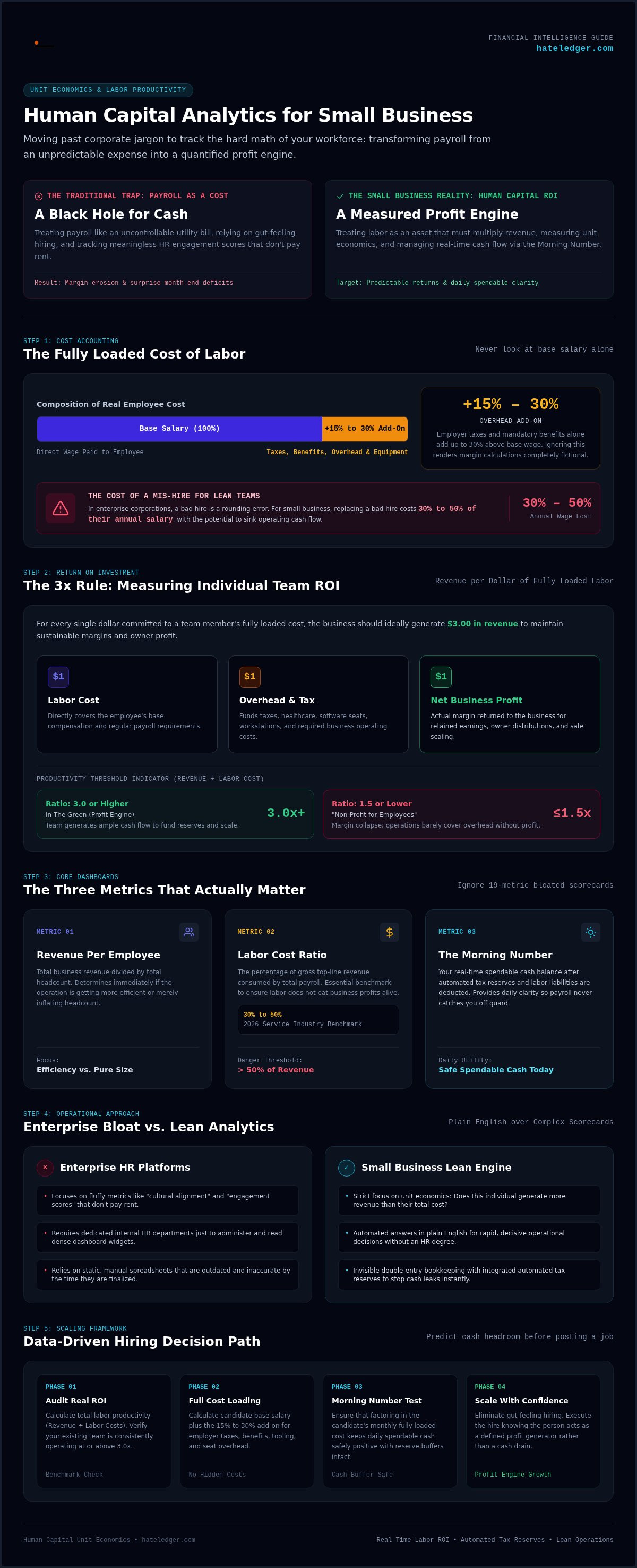
You don't need 19 different metrics to master human capital analytics for small business. You need three numbers that tell you the truth about your margins. First is Revenue per Employee. This is the simplest way to see if your team is getting more efficient or just getting bigger. Second is your Labor Cost Ratio. According to 2026 industry benchmarks, service businesses often see labor consume 30% to 50% of revenue. If you are over that, your profit is being eaten alive.
Finally, there is the Morning Number connection. This is your daily spendable cash after all reserves are set aside. When you understand your labor costs in real-time, you know exactly how much cash is safe to spend today. It turns your payroll from a surprise at the end of the month into a predictable part of your daily growth strategy.
Measuring Human Capital ROI: Is Your Team Profitable?
Calculating the return on your team isn't about complex HR scorecards. It is about cold, hard math. Most owners look at a salary and think that is the total cost. They are wrong. To get the truth, you must look at the "fully loaded" cost. This includes base pay, employer taxes, healthcare, equipment, and office overhead. Industry standards show that taxes and benefits alone add 15% to 30% on top of a base wage. If you aren't accounting for this, your profit margins are a fiction.
Effective human capital analytics for small business uses the 3x Rule. For every dollar you spend on a team member, they should ideally generate three dollars in revenue. One dollar covers their pay. One dollar covers the overhead. The third dollar is your profit. If that ratio slips to 1.5 or lower, you aren't running a business; you are running a non-profit for your employees. Identifying your "Profit MVPs" versus high-cost bottlenecks allows you to stop guessing who is actually moving the needle.
The ROI Calculation Formula
You don't need a degree in finance to do this. The most basic way to measure success is looking at labor productivity and unit labor costs. Take your total revenue and divide it by your total labor costs. If the number is 3.0 or higher, you are in the green. To make this work, you must be disciplined about integrating tax reserves into your labor cost calculations. If you wait until tax season to realize how much an employee actually cost you, it is already too late.
Visualizing Your Team Performance
Spreadsheets are the enemy of real-time growth. They are static, manual, and usually wrong by the time you finish the last cell. You need a system that uses invisible double-entry bookkeeping to track every cent in real-time. This allows you to spot a profit leak before it drains your bank account. Replacing a bad hire costs between 30% and 50% of their annual salary. You cannot afford to wait for a monthly P&L to see those losses. Seeing your team's value in real-time is the only way to stay agile. You can calculate your team's profitability automatically to ensure every hire is a win.
Enterprise Bloat vs. Small Business Lean Analytics
Stop trying to run your five-person shop like it’s a multinational corporation. Big-box software like Workday or TriNet is built for departments that have departments. They sell you "Human Capital Management" suites that require a certification just to log in. You don't need a global ERP integration. You need to know if you can afford a new hire today. For a small team, human capital analytics for small business should be invisible. It should work in the background while you actually run the company. If the software takes more time to manage than the people it tracks, it is a liability, not an asset.
Large organizations use AI agents to model talent density and global compliance. That is overkill for a lean operator. You aren't managing a thousand-person headcount; you are managing a tight-knit profit engine. The difference between enterprise bloat and lean analytics is the difference between academic theory and Tuesday morning reality. One tells you about cultural alignment. The other tells you if you have the cash flow headroom to scale without risking your personal paycheck.
Comparing Features That Matter
Manual data entry is a death sentence for productivity. Enterprise tools demand you feed them data every day. You spend hours tagging "attrition risks" while your actual revenue sits unmeasured. Contrast this with automated bank sync that reconciles payroll against incoming cash instantly. You need daily spendable numbers, not a quarterly retrospective that tells you what went wrong three months ago. This accounting software for people who hate accounting approach works for your team metrics too. If it isn't automated, it won't get done. You need a system that works for you, not the other way around.
The Hidden Costs of Enterprise HR Tools
Legacy systems come with a "Consultant Trap." You pay for the software, then you pay an expert to explain what the software is saying. Setup times for these behemoths can drag on for six months or more. We offer a 90-day setup promise because we value your time. Following SBA guidelines on hiring and managing employees is hard enough without fighting your own tech stack. Data from 2026 shows that 82% of small businesses lack an in-house finance professional. You shouldn't need a degree to read a profitability report. Focus on utility, skip the tradition, and get back to growing your business.
Hiring Decisions: Using Data to Know When to Scale
Hiring based on a "gut feeling" is a fast track to insolvency. You feel overwhelmed, so you assume you need more hands. That is a trap. Being busy does not always mean you are being profitable. You need a decision engine that tells you if your cash flow can actually support another mouth to feed. Real human capital analytics for small business allows you to move from guessing to knowing. If your current Labor Efficiency Ratio is below the 2.0x benchmark, adding a new person will likely just accelerate your losses and erode your remaining margin.
Hiring too early kills more small businesses than hiring too late. When you scale prematurely, you lock in fixed costs that your current revenue cannot sustain. According to 2026 SHRM data, the mean non-executive cost per hire has climbed to $5,475. When you factor in the 39 days it typically takes to fill a seat, the "empty chair" cost can drain between $4,000 and $9,000 per month in lost productivity. You cannot afford to make these moves without a clear "Safe to Spend" threshold based on your real-time Morning Number.
The 5-Step Hiring Decision Framework
- Analyze Capacity: Check your revenue per head. If it is dropping while you are "busy," your current team is inefficient.
- Forecast the Morning Number: Model the impact of a new salary plus the 20% to 25% labor burden for taxes and benefits.
- Evaluate Alternatives: Compare the ROI of hiring a new person versus financing new equipment or software.
- Check Headroom: Ensure your daily spendable cash won't drop below your safety reserve.
- Validate: Use the Small Business Hiring Decision Tool to see the financial impact before you post the job ad.
Avoiding the "Growth Trap"
Headcount is a vanity metric. More employees do not automatically equal more profit. Every new hire adds invisible layers of communication and management overhead. This complexity cost is what often stalls growing teams. You stay lean by using data to shield your profit, not by chasing a larger staff count just to look successful. Analytics should be used to identify where you can automate tasks before you resort to a new salary. You can get started with the Human Capital ROI Engine to see exactly when your business has the financial strength to grow.
Hate Ledger’s Human Capital ROI Engine: Plain English Growth
Traditional PEOs and HR consultants want you to believe that managing people requires a $2,000 monthly retainer. They bury your data in PDFs that are outdated by the time you read them. We built the Human Capital ROI Engine to kill that inefficiency. It is a financial cockpit designed for lean operators who value their time. By starting at just $19 per month, we provide a level of human capital analytics for small business that used to require a dedicated finance department. No jargon. No complex dashboards. Just the truth about your team's value.
The core of this system is its connection to your Morning Number. Labor costs aren't abstract concepts; they are daily drains on your spendable cash. Our engine pulls your payroll and bank data together automatically. It reconciles every cent so you can see exactly how much revenue each role is generating. You move from defensive accounting to offensive growth. You stop worrying about if you can afford your team and start seeing them as the profit engine they should be.
Zero Manual Entry, Maximum Insight
If you have to type data into a system, the system is broken. Our platform uses automated bank syncing to categorize your labor costs without you lifting a finger. It employs invisible double-entry bookkeeping to build your profitability reports while you sleep. We offer a 90-day setup promise to take you from financial chaos to total clarity. You get the insights of an enterprise-grade analytics suite without the enterprise-grade headache. It is about utility over tradition, ensuring your mental energy stays focused on winning, not data entry.
Start for Free, Scale When You’re Ready
We don't believe in locking you into a contract before you see the value. Our Free Forever tier requires no credit card and carries zero risk. It gives you the foundation to stop using messy spreadsheets and start using a real decision engine. When your team grows and your needs become more complex, you can transition to our paid plans seamlessly. You can try the Human Capital ROI Engine for free today. Stop guessing about your team's impact and start measuring your way to a more profitable business.
Stop Guessing and Start Scaling
You now have the roadmap to move from financial anxiety to total control. Payroll isn't a black hole. By focusing on unit economics and real-time ROI, you turn your team into a measurable profit engine. You've seen how to cut through the jargon and focus on the only thing that pays the bills: your daily spendable cash. Implementing human capital analytics for small business is no longer a luxury reserved for giant corporations with massive HR budgets. It is a survival tool for the lean operator.
It is time to ditch the manual spreadsheets and the expensive consultants. You deserve a system that works as hard as you do. With our 90-day setup promise and an automated daily Morning Number, you will always know exactly where you stand. There is zero risk to getting started today. No credit card is required for our Free Tier. You have the data. You have the framework. Now, go build something profitable.
Stop guessing and start growing with Hate Ledger’s Human Capital ROI Engine; Try it Free
Frequently Asked Questions
What is the difference between human capital and human resources?
Human resources is the paperwork, compliance, and legal boxes you have to check to stay out of trouble. Human capital is the economic value of your team. It is the shift from managing people to managing profit. One is an administrative burden that costs you time. The other is a strategic investment that multiplies your revenue. You don't need more HR administration; you need a better way to measure your team's real return.
How do I calculate ROI on a single employee?
Take the revenue that person generates and subtract their fully loaded cost. This includes salary, taxes, benefits, and equipment. Divide that result by the total cost again to get a percentage. A healthy ratio is 3.0 or higher. If they cost you $100,000 and bring in $300,000, they are a profit engine. If they only bring in $120,000, they are a margin leak you need to plug before it drains your bank account.
Is human capital analytics only for large corporations?
No, lean teams actually need human capital analytics for small business more than corporations do. A giant company can survive a bad hire that costs them six figures. You can't. When your margins are thin, every person on the payroll must be a profit multiplier. Small business analytics isn't about complex talent density charts. It is about knowing exactly when you can afford to grow without risking your personal paycheck or the company's survival.
What is a good revenue-per-employee ratio for a small business?
You should aim for at least 3x their fully loaded cost. This ensures you cover their salary, business overhead, and your own profit margin. If your ratio is below 1.5x, you are likely losing money on that hire once you factor in taxes and equipment. Service businesses typically target $150,000 to $250,000 in revenue per head to stay healthy. Tracking this number daily prevents surprise losses and keeps your team lean and efficient.
Can I track human capital ROI if I only use contractors?
Yes, the math is exactly the same for contractors as it is for full-time staff. You are still trading cash for output. Tracking contractor ROI is often easier because their costs are usually fixed and direct. The goal remains the same: ensure the value they deliver exceeds what you pay them. Our engine treats every labor expense as an investment that needs to prove its worth, regardless of the worker's official tax status.
How does human capital analytics help with tax planning?
It automates your tax reserves so you never get a surprise bill from the IRS. Every time you run payroll, our engine calculates the exact employer tax burden and moves it into a virtual reserve. This keeps your Morning Number accurate. You see the fully loaded cost of your team in real-time. This prevents you from spending money that actually belongs to the government, protecting your cash flow and your peace of mind.
What happens to my ROI data if I decide to fire an employee?
Your historical data stays in the system to help you learn from the experience. It shows you the total cost of the hire and where the profit leak occurred. This data is vital for refining your next hiring decision. You can use these insights to adjust your future safe to spend thresholds. Turning a failed hire into a data point ensures you don't make the same expensive mistake twice as you scale your team.
Does Hate Ledger integrate with my existing payroll provider?
Yes, we integrate with your workflow through automated bank syncing. Our system watches your payroll transactions and reconciles that data against your revenue in real-time. This creates an invisible double-entry record without any manual entry on your part. You get the insights of a high-end ROI engine without changing the tools you already use. It is designed to work in the background so you can focus on leading your team toward growth.
Frequently Asked Questions
Human resources is the paperwork, compliance, and legal boxes you have to check to stay out of trouble. Human capital is the economic value of your team. It is the shift from managing people to managing profit. One is an administrative burden that costs you time. The other is a strategic investment that multiplies your revenue. You don't need more HR administration; you need a better way to measure your team's real return.
Take the revenue that person generates and subtract their fully loaded cost. This includes salary, taxes, benefits, and equipment. Divide that result by the total cost again to get a percentage. A healthy ratio is 3.0 or higher. If they cost you $100,000 and bring in $300,000, they are a profit engine. If they only bring in $120,000, they are a margin leak you need to plug before it drains your bank account.
No, lean teams actually need human capital analytics for small business more than corporations do. A giant company can survive a bad hire that costs them six figures. You can't. When your margins are thin, every person on the payroll must be a profit multiplier. Small business analytics isn't about complex talent density charts. It is about knowing exactly when you can afford to grow without risking your personal paycheck or the company's survival.
You should aim for at least 3x their fully loaded cost. This ensures you cover their salary, business overhead, and your own profit margin. If your ratio is below 1.5x, you are likely losing money on that hire once you factor in taxes and equipment. Service businesses typically target $150,000 to $250,000 in revenue per head to stay healthy. Tracking this number daily prevents surprise losses and keeps your team lean and efficient.
Yes, the math is exactly the same for contractors as it is for full-time staff. You are still trading cash for output. Tracking contractor ROI is often easier because their costs are usually fixed and direct. The goal remains the same: ensure the value they deliver exceeds what you pay them. Our engine treats every labor expense as an investment that needs to prove its worth, regardless of the worker's official tax status.
It automates your tax reserves so you never get a surprise bill from the IRS. Every time you run payroll, our engine calculates the exact employer tax burden and moves it into a virtual reserve. This keeps your Morning Number accurate. You see the fully loaded cost of your team in real-time. This prevents you from spending money that actually belongs to the government, protecting your cash flow and your peace of mind.
Your historical data stays in the system to help you learn from the experience. It shows you the total cost of the hire and where the profit leak occurred. This data is vital for refining your next hiring decision. You can use these insights to adjust your future safe to spend thresholds. Turning a failed hire into a data point ensures you don't make the same expensive mistake twice as you scale your team.
Yes, we integrate with your workflow through automated bank syncing. Our system watches your payroll transactions and reconciles that data against your revenue in real-time. This creates an invisible double-entry record without any manual entry on your part. You get the insights of a high-end ROI engine without changing the tools you already use. It is designed to work in the background so you can focus on leading your team toward growth.