
Financial Decision Making Software for Small Business: Stop Guessing, Start Growing
September 18, 2026 · 14 min read
Your bank balance is a liar. It shows you a number, but it hides the tax bill lurking in the shadows and the payroll due next Friday. If you're still relying on messy spreadsheets and gut feelings, you're playing a dangerous game. Most owners suffer through soul-crushing manual entry just to stay afloat. It's time to stop. Implementing the right financial decision making software for small business turns your historical data into a forward-looking engine. Stop guessing. Start growing.
You likely feel the anxiety of every hiring decision. You wonder if you can actually afford that new hire or if one lean month will sink the ship. It's exhausting. We agree that you shouldn't need a math degree to know if you can spend money today. This article reveals how to move beyond basic bookkeeping to a system that tells you exactly when to hire, spend, or scale. No more "Bank Balance Trap." No more tax season surprises.
We'll break down how a single "Morning Number" replaces complex P&L statements. You'll see how to automate tax reserves and get clear "Yes or No" indicators for every major investment. Stop looking at the past. Start making moves.
Key Takeaways
- Stop trusting a bank balance that hides your true liabilities and learn why traditional accounting is failing your future growth.
- Discover how financial decision making software for small business calculates the exact ROI of your next hire before you commit to a salary.
- Learn the "Safe to Spend" method to automatically set aside tax reserves and eliminate quarterly payment anxiety.
- Replace soul-crushing manual spreadsheets with an automated "Morning Number" that tells you exactly how much cash is yours to keep.
- Move from survival mode to strategic scaling with clear indicators that tell you when to invest and when to hold back.
Why Traditional Accounting Software Fails Your Decision-Making
Traditional accounting software is a digital archive. It exists to satisfy the government and your CPA. It records what happened. It doesn't tell you what should happen next. This is the fundamental gap between recording and deciding. When you use legacy tools, you're looking at a rearview mirror while trying to drive a race car. It's a digital shoebox of receipts that offers no roadmap for tomorrow.
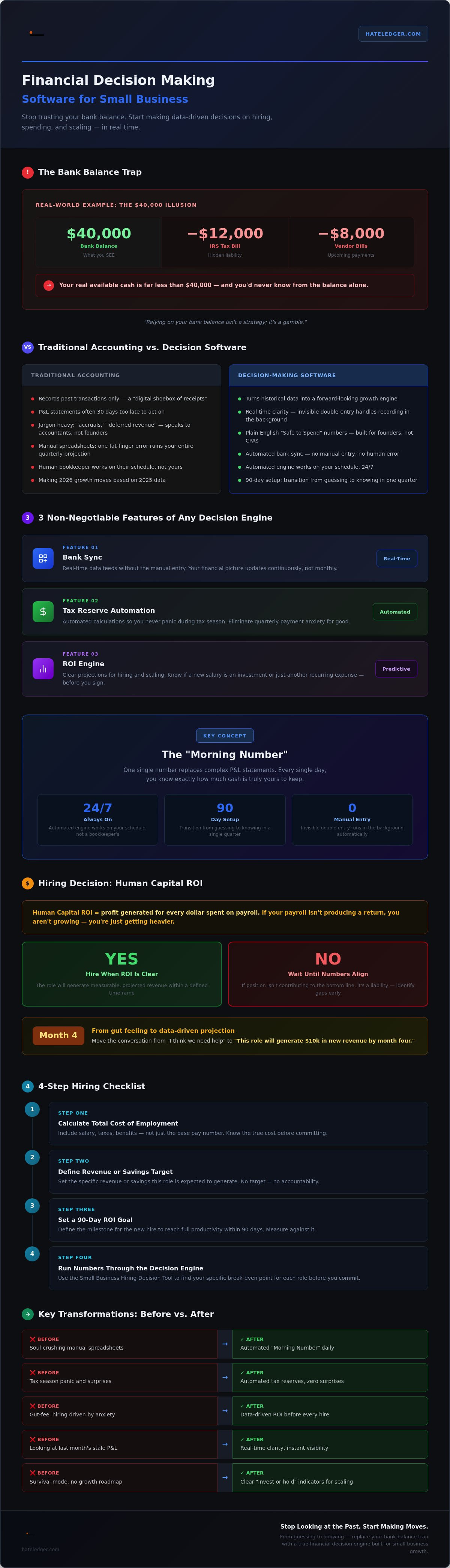
Most owners fall into the "Bank Balance Trap." You log in, see $40,000 in the account, and feel a surge of confidence. You start thinking about that new hire or a major marketing spend. But that number is a liar. It doesn't account for the $12,000 you owe the IRS or the $8,000 in upcoming vendor bills. Relying on your bank balance isn't a strategy; it's a gamble. Manual spreadsheets are the usual fix, but they bring their own soul-crushing mental load. One fat-finger error in a single cell can ruin your entire quarterly projection. You don't need a ledger. You need a growth partner.
The Lagging Indicator Problem
P&L statements are usually 30 days too late. By the time your bookkeeper closes the previous month, the opportunity to pivot has already passed. Making 2026 growth moves based on 2025 data is a recipe for stagnation. You need real-time clarity, not historical reports. Modern financial decision making software for small business solves this through invisible double-entry. The software handles the recording in the background so you can focus on the deciding. It removes the manual recording burden and replaces it with instant visibility.
Plain English vs. Financial Jargon
Legacy platforms bury utility under jargon-heavy interfaces. They speak the language of accountants, not founders. Terms like "accruals" or "deferred revenue" don't help you decide if you can afford a new office today. You need a system built on plain English. Modern tools act as specialized decision support systems that translate raw data into "Safe to Spend" numbers. Switching to financial decision making software for small business isn't just about tech; it's about reclaiming your mental energy.
There are three non-negotiable features for any decision engine:
- Bank Sync: Real-time data feeds without the manual entry.
- Tax Reserve: Automated calculations so you never panic during tax season.
- ROI Engine: Clear projections for hiring and scaling.
Automation beats a human bookkeeper for daily clarity every time. A human works on their schedule; an automated engine works on yours. It provides a "Morning Number" every single day. With a 90-day setup promise, you can transition from guessing to knowing in a single quarter. Stop living in the past. Start building for 2026.
The Hiring Decision: Calculating Human Capital ROI
Hiring is the single most expensive bet you'll make. Most founders treat it like a coin toss. They feel overwhelmed, so they hire for relief. This is a trap. Human Capital ROI is the only metric that matters here. In plain English, it's the profit generated for every dollar spent on payroll. If your payroll isn't producing a return, you aren't growing; you're just getting heavier. You need to know if a new salary is an investment or just another recurring expense.
Using dedicated financial decision making software for small business allows you to project this impact before you sign a contract. It moves the conversation from "I think we need help" to "This role will generate $10k in new revenue by month four." This clarity stops the "growth at all costs" mentality that kills otherwise healthy companies. It's a binary choice: hire when the ROI is clear, or wait until the numbers align. There is no middle ground when your cash flow is on the line.
Measuring Team Profitability
You don't need to watch the clock to know if a team member is profitable. You need to watch the numbers. Tracking output against payroll is the core of small business financial management. Use the Small Business Hiring Decision Tool to find your specific break-even point for each role. If a position isn't contributing to the bottom line, it’s a liability. Identifying these gaps early saves you from the slow bleed of an overstaffed, underperforming team. It's about efficiency, not micromanagement.
Hiring Without the Anxiety
Anxiety comes from the unknown. Data kills anxiety. Replace your gut feeling with a 4-step checklist for your next recruitment move. First, calculate the total cost of employment, including taxes and benefits. Second, define the specific revenue or savings target for that role. Third, set a 90-day ROI goal for the new hire to reach full productivity. Finally, run the numbers through a decision engine to see the impact on your "Morning Number." This process replaces "I hope this works" with "I know this works." If you're tired of the hiring headache, you can explore our Human Capital ROI Engine to see how automation makes these high-stakes choices simple and safe.
Spending Safely: Automated Tax Reserves and Cash Flow
Most small business owners treat their bank balance like a scoreboard. It's not. Half of that money belongs to the IRS, your vendors, or your future self. The "Safe to Spend" philosophy is about radical clarity. It separates what you have from what you own. By using automated tax reserves for the self-employed, you stop playing hide-and-seek with the government. You know exactly what is yours. No more quarterly panic. No more checking the account and hoping for the best. You deserve to spend your profit without looking over your shoulder.
This level of precision is only possible when you move beyond basic bookkeeping. Implementing financial decision making software for small business allows you to automate the mental gymnastics of cash flow management. It acts as an invisible ally that does the heavy lifting while you focus on operations. Instead of waiting for a monthly report that tells you where your money went, you get a system that tells you where it can go. It’s the difference between being a historian of your own failure and an architect of your own growth.
The Daily Spendable Income Calculation
Your real number is simple math: Revenue minus Tax Reserve minus Operating Expenses. Traditional accounting waits until the end of the month to tell you this. That's too slow. High-performance software calculates this every single morning. This "Morning Number" provides psychological relief that a P&L statement never could. It tells you if you can buy that new equipment today without bouncing a check tomorrow. Following U.S. Small Business Administration financial management guidance is easier when the math happens automatically in the background. You shouldn't have to be a math whiz to know if you can afford lunch or a laptop.
Decision Engines for Financing and Loans
Debt is either a lever or a noose. A lever helps you lift more than you could alone. A noose just hangs there until it chokes your cash flow. Before you take out a loan, you need to project the repayment impact on your daily spendable income. Don't guess. Use the Business Financing Decision Tool to see if the debt actually fuels growth or just creates a new weight. If the repayment kills your "Morning Number," the loan is a noose. If it scales your ROI, it's a lever. The right software makes this distinction clear before you sign the paperwork. If you're ready to stop the guesswork and start spending with total confidence, explore our Pro Plan to see how we automate your safety net.
Scaling Your Small Business with the Right Data
Survival mode is a choice. You stay there because you're scared of the numbers. You check your bank account, see a balance, and hope it lasts until the next invoice clears. Strategic growth happens when that fear is replaced by a roadmap. Scaling isn't just about doing more of the same; it's about adding complexity without losing your mind. As you grow, your responsibilities shift. You move from being the person who does the work to the person who manages the engine. You need data that keeps up with that shift.
High-growth founders use financial decision making software for small business to plan for big-company benefits without the big-company overhead. You want to offer a PEP retirement plan? You should. It’s how you keep top talent. But you can't guess if you can afford the employer match. Your decision engine tells you exactly how those benefits impact your bottom line before you announce them to the team. Read our guide on affording employee benefits to see how small teams compete with the giants using automated data.
Transitioning from Spreadsheets
Spreadsheets are for hobbyists. Scaling businesses use systems. If you're still manually updating cells, you're wasting the most valuable resource you have: your time. Follow the "3-Day Rule" to swap your messy logs for a clean financial engine. Spend day one exporting your historical mess. Day two is for syncing your accounts. By day three, you're looking at your real numbers. It’s a fresh start for 2026. You don't need a credit card to start with a Free Forever tier. It's the best way to see the relief of automation before you commit to a paid plan.
Your 2026 Growth Roadmap
Stop waiting for quarterly planning sessions to see if you're winning. Set automated alerts for your profitability milestones. Your software should tell you the moment you've earned enough to hire your next lead or invest in that new marketing channel. This turns your finances into a proactive tool rather than a reactive chore. It’s about momentum. When you know your numbers, you move faster. You take bigger swings because you know where you'll land. Stop playing accountant and start being a founder. The data is ready. Are you?
Build Your Financial Decision Engine Today
You've spent enough time staring at spreadsheets and hoping for the best. Traditional accounting software tells you what happened yesterday; it doesn't help you win tomorrow. By switching to financial decision making software for small business, you move from survival mode to strategic growth. You gain a daily dashboard that reveals your true spendable cash and a Human Capital ROI Engine that takes the risk out of your next hire. This isn't just about record-keeping. It's about building a foundation for a business that lasts.
Stop letting the "Bank Balance Trap" dictate your next move. You deserve a system that handles the mental gymnastics of tax reserves and cash flow in the background. With our 90-day setup promise and paid plans starting at $19/month, the path to clarity is shorter than you think. There is no reason to keep guessing when you can start knowing. Your time is too valuable to waste on manual data entry and quarterly panic.
Try Hate Ledger for free; no credit card required.
Your business is ready to scale. Give it the engine it needs to get there. Your future self will thank you for the relief.
Frequently Asked Questions
What is the difference between accounting software and financial decision-making software?
Traditional accounting software is a historian. It records the past so you stay compliant with the IRS. Financial decision making software for small business is a navigator. It uses your real-time data to tell you what to do next. While one focuses on record-keeping, the other focuses on growth. You don't just need a ledger of where your money went; you need an engine that tells you where it can go today.
Can I use financial decision software if I already have a CPA?
Yes. Your CPA is for your taxes; this software is for your life. Most CPAs only look at your numbers once a quarter or once a year. That is too slow for daily operations. This tool gives you the "Morning Number" you need to make fast moves while your CPA handles the high-level compliance. It bridges the gap between your tax return and your daily bank balance.
How does automated tax reserve calculation work for the self-employed?
The system calculates your tax obligations in real-time as revenue hits your account. It automatically separates what you owe the government from what you can safely keep. This removes the "Bank Balance Trap" where you accidentally spend money that belongs to the IRS. You get total peace of mind because your tax reserves are always accurate and invisible until you actually need to pay them.
Is it safe to sync my business bank account with decision-making software?
It is completely safe. We use secure, bank-level encryption to protect your data. The sync acts as an invisible ally that automates your data entry so you don't have to manually log every single transaction. This automation eliminates human errors and ensures your dashboard is always current. You get the speed of a digital system with the security of a traditional bank.
How much does small business financial decision software cost in 2026?
Getting professional clarity shouldn't break your bank. Hate Ledger offers a Free Forever tier that requires no credit card to start. If your business needs more advanced features, paid plans start at $19 per month for 2026. This tiered approach ensures you only pay for the utility you actually need. It is a small investment to eliminate the soul-crushing mental load of manual spreadsheets and guesswork.
Do I need to understand double-entry bookkeeping to use Hate Ledger?
No. We built this for founders, not accountants. The system uses "invisible double-entry" to handle the technical requirements in the background. You interact with a plain-English interface that shows you the real-world results of your tasks. You don't need to learn a new language to understand your own money. We translate the jargon into actionable numbers so you can focus on running your business.
Can this software help me decide if I should take out a business loan?
Absolutely. The platform includes a specific decision engine for financing choices. It doesn't just look at the interest rate; it projects how the monthly repayment will hit your daily spendable income. This allows you to see if a loan acts as a lever for growth or a noose for your cash flow. You will know if you can actually afford the debt before you ever sign the paperwork.
What is a 'Morning Number' and why is it important for my business?
The "Morning Number" is a single figure on your dashboard that shows exactly how much cash is yours to keep. It accounts for your revenue, tax reserves, and operating expenses automatically. It is important because it replaces the "Bank Balance Trap" with radical honesty. Knowing this number every morning gives you the confidence to spend, hire, or scale without the constant anxiety of an unknown tax bill.
Frequently Asked Questions
Traditional accounting software is a historian. It records the past so you stay compliant with the IRS. Financial decision making software for small business is a navigator. It uses your real-time data to tell you what to do next. While one focuses on record-keeping, the other focuses on growth. You don't just need a ledger of where your money went; you need an engine that tells you where it can go today.
Yes. Your CPA is for your taxes; this software is for your life. Most CPAs only look at your numbers once a quarter or once a year. That is too slow for daily operations. This tool gives you the "Morning Number" you need to make fast moves while your CPA handles the high-level compliance. It bridges the gap between your tax return and your daily bank balance.
The system calculates your tax obligations in real-time as revenue hits your account. It automatically separates what you owe the government from what you can safely keep. This removes the "Bank Balance Trap" where you accidentally spend money that belongs to the IRS. You get total peace of mind because your tax reserves are always accurate and invisible until you actually need to pay them.
It is completely safe. We use secure, bank-level encryption to protect your data. The sync acts as an invisible ally that automates your data entry so you don't have to manually log every single transaction. This automation eliminates human errors and ensures your dashboard is always current. You get the speed of a digital system with the security of a traditional bank.
Getting professional clarity shouldn't break your bank. Hate Ledger offers a Free Forever tier that requires no credit card to start. If your business needs more advanced features, paid plans start at $19 per month for 2026. This tiered approach ensures you only pay for the utility you actually need. It is a small investment to eliminate the soul-crushing mental load of manual spreadsheets and guesswork.
No. We built this for founders, not accountants. The system uses "invisible double-entry" to handle the technical requirements in the background. You interact with a plain-English interface that shows you the real-world results of your tasks. You don't need to learn a new language to understand your own money. We translate the jargon into actionable numbers so you can focus on running your business.
Absolutely. The platform includes a specific decision engine for financing choices. It doesn't just look at the interest rate; it projects how the monthly repayment will hit your daily spendable income. This allows you to see if a loan acts as a lever for growth or a noose for your cash flow. You will know if you can actually afford the debt before you ever sign the paperwork.
The "Morning Number" is a single figure on your dashboard that shows exactly how much cash is yours to keep. It accounts for your revenue, tax reserves, and operating expenses automatically. It is important because it replaces the "Bank Balance Trap" with radical honesty. Knowing this number every morning gives you the confidence to spend, hire, or scale without the constant anxiety of an unknown tax bill.