
Self-Employed Tax Prep: The No-Nonsense 2026 Guide
September 15, 2026 · 17 min read
Most self-employed people are accidentally stealing from their future selves every time they swipe a business card. It's called the Tax Trap. You look at your bank balance, see a healthy number, and spend it. Then April hits. Suddenly, that money belongs to the IRS, and you're left scrambling to fill a hole you didn't know you dug. Learning how to prepare for taxes self employed shouldn't feel like a second job you never applied for. You're done with messy spreadsheets that make no sense and the constant, nagging fear of an audit.
We agree that the old way of doing things is broken. It's inefficient, stressful, and outdated. This guide is your shortcut to radical simplification. You'll learn how to automate your tax readiness so you never face a surprise bill again. We're showing you how to turn tax season from a 10-day marathon into a 10-minute victory lap. By the end of this, you'll know your "Safe to Spend" number every single day. It's time to stop playing accountant and start enjoying financial peace of mind. Here's how to make your tax obligations invisible and your business truly yours.
Key Takeaways
- Stop trusting your bank balance. Traditional accounting looks backward, but you need a system that tells you what you own today.
- Master how to prepare for taxes self employed by automating your tax reserves so you never have to guess what's safe to spend.
- Ditch the spreadsheets. Manual tracking isn't just slow; it's a mental weight that keeps you from growing your business.
- Isolate your business survival. A dedicated bank account is your first line of defense against messy books and audit fears.
- Use the "Morning Number" to get instant clarity. This one metric replaces hours of bookkeeping with a single, daily confidence boost.
The Self-Employed Tax Trap: Why Your Bank Balance is Lying
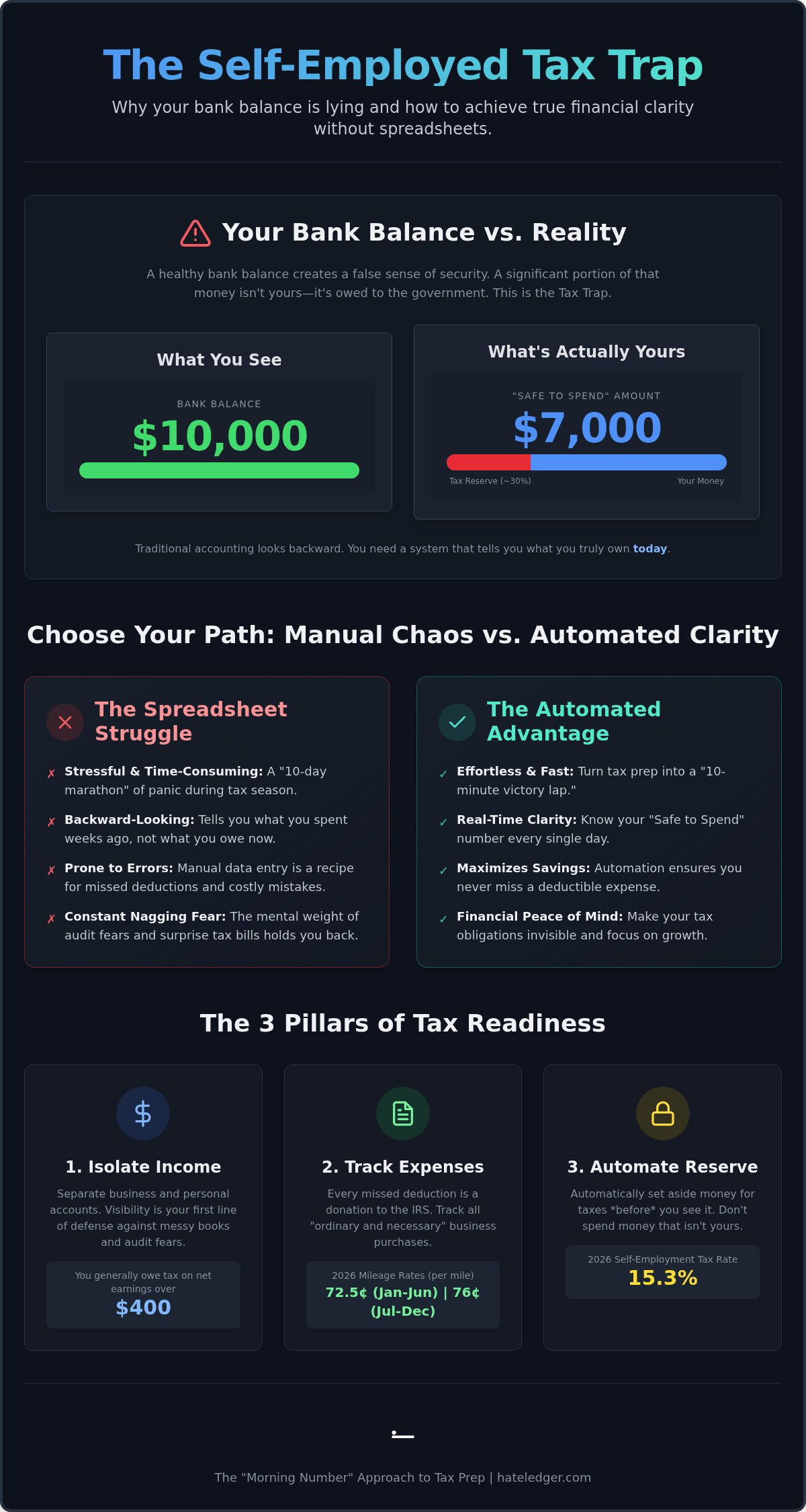
Your bank account is a liar. It shows you a total balance that feels like a reward for your hard work, but a significant portion of that cash isn't yours. It belongs to the government. This is the "Tax Trap." It's the primary reason many new ventures struggle. While exact causes vary, some industry data suggests roughly 20% of small businesses fail within their first year, often due to cash flow crises. When you don't know how to prepare for taxes self employed, you treat your gross revenue like personal spending money. You spend what you should be saving. Then, you're left staring at a bill you can't pay.
Traditional accounting software makes this worse. Most tools are built to look backward. They tell you what you spent on coffee three weeks ago. They don't tell you that you owe a 15.3% Self-Employment Contributions Act (SECA) tax on every dollar you just earned. This backward-looking approach fails the modern founder. You need to know your obligations before you swipe your card, not months after the money is gone. Waiting for a report to generate is a waste of your time and mental energy.
The Myth of the Year-End Tax Prep
Waiting for tax season is a strategy for failure. By the time April 15, 2026, rolls around, your money is already gone. You've likely spent your tax reserve on rent, marketing, or a new laptop. You need a continuous prep mindset. This isn't about playing accountant every Friday. It's about having a system that makes tax readiness invisible. You should be a founder, not a data entry clerk. Radical simplification means your books are ready in real-time, not in a panicked rush during the spring. If you're still digging through shoe boxes in April, you've already lost the game.
Understanding Your "Safe to Spend" Amount
Your "Safe to Spend" amount is the only number that actually matters. It's the gap between your gross revenue and your total obligations. To calculate a basic reserve manually, you have to account for the 15.3% self-employment tax plus your estimated income tax bracket. For 2026, the Social Security portion of that tax applies to your first $184,500 of net earnings. If you expect to owe $1,000 or more, the IRS demands quarterly payments. If you miss these, you face a 7% underpayment penalty compounded daily. Stop guessing. Your bank balance is a dangerous metric because it ignores the debt you're accruing with every invoice you send.
The 3 Pillars of Tax Readiness (In Plain English)
Most tax guides drown you in jargon. They talk about Schedule C and Double-Entry like you're studying for a CPA exam. You aren't. You're running a business. To master how to prepare for taxes self employed, you only need to focus on three pillars: Income, Expenses, and the Reserve. If these three are solid, tax season becomes a non-event. It moves from a 10-day crisis to a 10-minute task.
Income: Every Dollar Counts
The Golden Rule is simple: separate your accounts. If you're mixing grocery money with client payments, you're building on sand. In 2026, you generally owe tax if your net earnings hit $400. Whether it's a formal 1099 or a direct Venmo payment, every dollar counts. Keeping business income in its own lane creates a paper trail that shields you during an audit. Visibility is your first line of defense.
Expenses: Finding the Hidden Savings
Expenses are legal ways to keep your own money. The IRS "Ordinary and Necessary" rule is your guide. If a purchase helps your trade, it's likely deductible. This includes your home office, software, and gear. In 2026, mileage rates are 72.5 cents per mile (Jan-Jun) and 76 cents (Jul-Dec). Digital records are the only way to survive. Every missed deduction is an unnecessary donation to the IRS you didn't need to make.
The final pillar is the Tax Reserve. You must set aside money before you even think about touching it. According to the official IRS guidance on self-employment tax, the standard rate for 2026 is 15.3%. This covers Social Security and Medicare. If you don't siphon this off immediately, you're spending money that isn't yours. This is exactly why you need to stop playing accountant and start using a system that does the heavy lifting for you.
Real financial peace comes from automation, not manual math. When you master how to prepare for taxes self employed, you stop worrying about the IRS and start focusing on your work. Legacy systems want you to suffer through spreadsheets. We don't. Knowing exactly what you can safely spend today is a superpower. If you want to see how radical simplification feels, check out Hate Ledger and see your safe-to-spend number in real-time. It's the ultimate shield between you and the tax man.
Tax Prep Methods: Spreadsheets vs. Automation
You have three choices for tracking your money: a spreadsheet, a pro accountant, or a system that works while you sleep. Most people start with a spreadsheet because it's free. But "free" is a lie. If you're spending four hours a month wrestling with cells, you're losing hundreds in billable time. Learning how to prepare for taxes self employed shouldn't involve becoming a part-time data entry clerk. It should be a background process that stays out of your way.
Accountants are great for the finish line. They know the codes and the filing deadlines. But they're terrible for daily speed. An accountant can't tell you if you can afford a new desk on a Tuesday morning. They look at your past; you're trying to build your future. Automated software fills this gap by making the data entry invisible. While a spreadsheet costs you hours of sanity and an accountant costs you a high monthly fee, automation costs you almost nothing in time. It gives you the "Morning Number" you need to make decisions in real-time.
When to Ditch Your Spreadsheet
If you have more than five transactions a week, your spreadsheet is a liability. This is the "5-transaction rule." Past this point, manual entry leads to errors. You miss a zero, or a formula breaks, and suddenly your tax reserve is off by thousands. Spreadsheets also hide the true cost of your labor. Every minute you spend auditing your own math is a minute you aren't making money. Formula rot is real. One wrong click in March ruins your totals for the entire year, leading to a massive surprise bill in April.
The Rise of Invisible Accounting
The future isn't a better spreadsheet. It's no spreadsheet at all. "Invisible Double-Entry" means the software handles the complex math in the background while you just categorize a transaction with a swipe. Bank syncing eliminates the manual errors that lead to IRS headaches. According to the IRS guide to self-employment tax, you're responsible for the full 15.3% rate. Automation ensures that money is identified and set aside before you have a chance to spend it.
Our 90-day setup promise is a commitment to getting your books right once and for all. It isn't just about software; it's about a total shift in how you view your business. You move from a "crisis" mindset to an "automated" one. You don't need to learn the mechanics of accounting. You just need a system that acts as a shield between your bank account and the tax man. This is the only way to master how to prepare for taxes self employed without losing your mind.
Your 2026 Self-Employed Tax Prep Checklist
Stop treating your business like a side project. If you want to know how to prepare for taxes self employed without the usual April panic, you need a system that works in real-time. This isn't a suggestion; it's the survival guide for founders who value their time and sanity. Follow these five steps to move from chaos to clarity.
- Step 1: Separate your lives. Mixing personal and business money is the fastest way to trigger an audit and lose your mind. Open a dedicated business account today. No exceptions.
- Step 2: Automate your tax reserve for self-employment. Never guess what you owe. Move your tax money into a separate bucket the moment it hits your account.
- Step 3: Establish a daily "Morning Number" habit. Check your safe-to-spend balance every morning. It's the only metric that matters for daily decision-making.
- Step 4: Categorize as you go. Spending 30 seconds a day on your phone is better than spending 30 hours a month on a laptop. Swipe, categorize, and move on.
- Step 5: Audit your ROI. Use the Human Capital ROI Engine to see if your billable hours actually justify your overhead. If a task isn't profitable, kill it.
Quarterly Estimated Taxes: Avoiding the Penalty
The IRS doesn't like waiting until April to get paid. If you expect to owe $1,000 or more in 2026, you must pay quarterly. If you don't, you'll face a 7% underpayment penalty that compounds daily. It's an expensive mistake that's easy to avoid. Mark these 2026 deadlines on your calendar: April 15, June 15, September 15, and January 15, 2027. You can pay online through the IRS portal in under five minutes. Don't let the government profit from your procrastination.
The Document Vault
Digital records are the 2026 standard. The "shoebox of receipts" is a relic that will get you crushed in an audit. You must keep your business records for seven years. This includes every 1099-NEC you receive from clients and every 1099-K from payment processors. Organize these in a digital vault the moment they arrive. When you know how to prepare for taxes self employed, you realize that a clean digital trail is your ultimate shield. It turns a potential audit from a nightmare into a minor inconvenience.
Ready to stop guessing and start growing? Get your Morning Number with Hate Ledger today.
Hate Ledger: The "Morning Number" Approach to Tax Prep
Tax prep shouldn't be a project. It should be a byproduct of your business day. Hate Ledger calculates your 2026 tax obligation in real-time. You don't need to learn how to prepare for taxes self employed in the traditional sense; the software does it for you. It sits between you and the IRS like a shield. You'll never see a T-account. You'll never deal with a manual ledger. It's invisible double-entry for people who have better things to do than audit themselves. If you're tired of legacy bloat, transitioning from Xero or QuickBooks is painless. We focus on utility, not formalities.
The "Morning Number" is your financial north star. Every day starts with a single, clear figure. This is your "Safe to Spend" amount. It's the cash left over after your 15.3% self-employment tax, income tax reserves, and business expenses are subtracted. No math is required on your part. No spreadsheets are needed. No anxiety remains. You look at the number, you know your limits, and you get back to work. It's the ultimate relief for the self-employed mind. Knowing exactly what is yours and what belongs to the government changes how you operate.
Automation vs. Intervention
We don't offer human bookkeeping services. You don't need them. A human is a bottleneck in a world that moves at the speed of a digital bank sync. Our Business Plan includes the Human Capital ROI Engine. It uses your tax data to act as a Decision Engine. It tells you exactly when your time is too valuable for admin and when it's safe to invest in growth. We offer a Free Forever Tier because we believe you should see the value before you pay a cent. No credit card is required. There is zero risk. You get instant clarity without the overhead of a traditional firm.
The 90-Day Setup Promise
Messy books are a mental weight that slows you down. We promise to get your records sorted in 90 days. Our "Founder’s Founder" philosophy means we speak your language, not the jargon of a detached professional. We prioritize results over tradition. We aren't here to teach you the mechanics of accounting. We're here to make those mechanics disappear entirely. You deserve financial peace of mind and a system that respects your time. Stop hating your accounting and start your free trial today.
Reclaim Your Time and Your Profit
You've spent enough time playing accountant. The old way of managing your money is a trap that leads to surprise bills and constant stress. By separating your accounts and automating your reserves, you turn tax season into a background process rather than a seasonal crisis. Mastering how to prepare for taxes self employed isn't about learning complex codes; it's about installing a system that works while you focus on your craft. You deserve a business that serves you, not a ledger that haunts you.
Stop guessing what you can afford to spend today. Our 90-Day Setup Promise ensures your messy books are fixed for good. With our Invisible Double-Entry Tech, the heavy lifting happens behind the scenes. You get the clarity you need without the jargon you hate. No credit card is required to begin. It's the ultimate shield between your bank account and the government. You're a founder, not a bookkeeper. It's time to start acting like one. Radical simplification is just a click away.
Get your "Morning Number" – Start for Free
Frequently Asked Questions
How much should I set aside for taxes if I am self-employed in 2026?
Set aside at least 25% to 30% of every dollar that hits your business account. This covers the 15.3% self-employment tax plus your federal income tax obligations. If your income puts you in a higher bracket, you might need to push that reserve closer to 35%. Learning how to prepare for taxes self employed starts with this reserve. It's the only way to ensure you aren't accidentally spending money that belongs to the government.
Do I need a separate bank account for my self-employed business?
Yes. Mixing personal and business money is a recipe for an audit nightmare. A dedicated business account creates a clean paper trail that shields you from the IRS. It makes your accounting invisible because you don't have to sift through grocery receipts to find your software subscriptions. If you want a tax season that takes 10 minutes rather than 10 days, stop mixing your money today.
What is the "Morning Number" and how does it help with taxes?
The Morning Number is your "Safe to Spend" balance. It's the amount of cash left in your business after all tax obligations and expenses are accounted for. Instead of guessing based on your total bank balance, you see one clear figure every morning. It eliminates the anxiety of self-employment by telling you exactly what is yours to keep and what is already reserved for the IRS.
Can I deduct my home office even if I don’t own the house?
You can absolutely deduct your home office if you rent. You don't need to own the property to claim the space you use exclusively for business. You can deduct a portion of your rent, utilities, and insurance based on the square footage of your office. It's one of the most effective ways to lower your taxable income without spending extra cash on new gear or software.
What happens if I miss a quarterly estimated tax payment?
You'll face a 7% underpayment penalty that compounds daily on the amount you owe. The IRS expects their cut throughout the year, not just in April. If you miss a deadline, pay as much as you can as soon as possible to stop the interest from stacking up. Understanding how to prepare for taxes self employed means respecting the four quarterly deadlines: April, June, September, and January.
How does Hate Ledger differ from QuickBooks or Xero for tax prep?
Legacy software like QuickBooks or Xero is built for accountants, not founders. They focus on backward-looking reports and complex ledgers that require manual entry. Hate Ledger uses invisible double-entry tech to show you your financial future in real-time. We prioritize utility over tradition. You get a decision engine that tells you what you can safely spend today, not a pile of confusing spreadsheets you'll never open.
Is there a free version of tax prep software for freelancers?
Yes. Hate Ledger offers a Free Forever Tier that requires no credit card. You get access to the core features you need to track your income and automate your tax reserves. Most "free" tools are just limited trials designed to trap you into a subscription later. Ours is a functional solution for pragmatic operators who want to simplify their lives without adding a new monthly bill to their overhead.
What is human capital ROI and why does it matter for my taxes?
Human capital ROI measures the profitability of your own time. It shows you if the hours you spend on admin or client work are actually generating a return. This matters for taxes because it helps you decide when to invest in automation or when it's safe to hire help. Our Human Capital ROI Engine turns your tax data into a decision engine for growth, not just a tool for compliance.
Frequently Asked Questions
You should set aside at least 25% to 30% of your gross income to stay safe. This covers the 15.3% self-employment tax and your federal income tax obligations. For 2026, remember that the Social Security portion only applies to the first $184,500 of net earnings. Automating this reserve is the most effective way how to prepare for taxes self employed so you never accidentally spend money that belongs to the IRS.
Yes, a dedicated business account is non-negotiable for anyone serious about their finances. Mixing personal and business transactions is the fastest way to lose track of your actual profit and trigger an audit. It creates a "Tax Trap" where your bank balance looks higher than it actually is. Separating your funds ensures your tax reserves stay untouched and your bookkeeping remains invisible and automated.
The "Morning Number" is a daily calculation of the exact amount of cash you can safely spend right now. It subtracts your real-time tax obligations and business reserves from your total bank balance. Instead of guessing if you can afford an expense, you check one number every morning. It provides instant financial peace of mind by ensuring your tax bill is already covered before you pay for anything else.
You can absolutely claim the home office deduction as a renter. The IRS allows you to deduct a portion of your rent and utilities based on the square footage used exclusively for your business. This is one of the most common ways how to prepare for taxes self employed while lowering your total bill. Just ensure the space is your principal place of business and used for nothing other than work.
If you miss a deadline, the IRS will likely charge an underpayment penalty and interest on the amount you owe. These penalties accumulate from the day the payment was due until the day you actually pay it. For 2026, the deadlines are April 15, June 15, September 15, and January 15. If you miss one, pay as much as you can immediately to stop the interest from climbing.
QuickBooks and Xero were built for accountants to look at your past. They use complex jargon and require manual data entry that drains your time. Hate Ledger is built for founders to look at their future. It uses invisible double-entry technology to automate your tax reserves and show you a "Morning Number" in plain English. It is a decision engine, not just a digital shoebox for receipts.
Hate Ledger offers a Free Forever Tier specifically for freelancers and small operators. You get access to automated bank syncing and tax reserve calculations without ever providing a credit card. It is a zero-risk way to stop playing accountant and start using a system that works in the background. You can manage your basic tax readiness for free and only upgrade as your business grows more complex.
Human capital ROI measures the profit your business generates for every dollar spent on labor, including your own time. It matters for taxes because it helps you determine if your business is actually profitable after all obligations are met. If your ROI is low, you might be overpaying in taxes relative to your real growth. Our Human Capital ROI Engine helps you decide exactly when it's safe to hire help.