
Automated Quarterly Tax Calculator: Stop Guessing and Start Spending Safely in 2026
September 13, 2026 · 17 min read
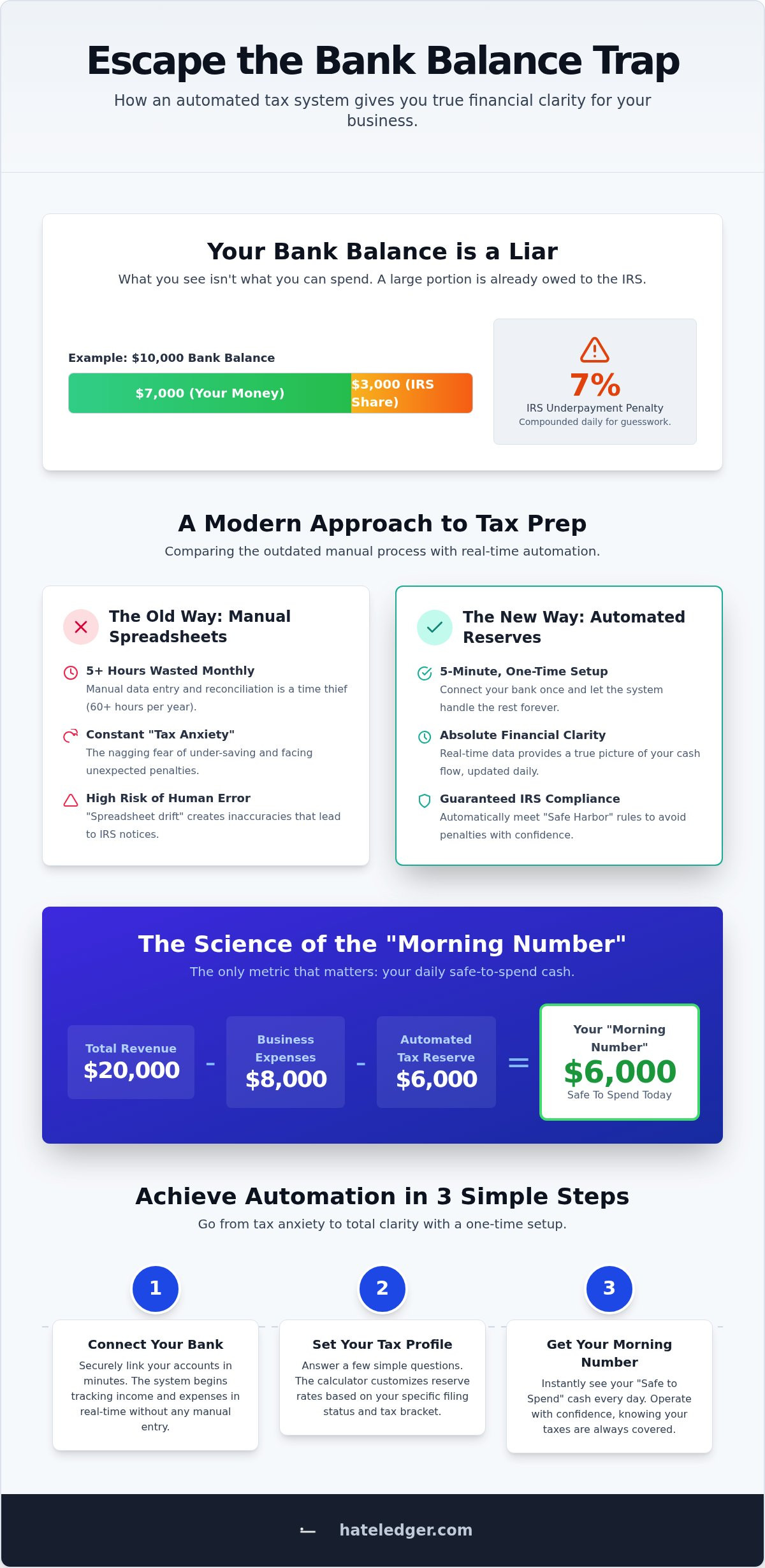
Your bank balance is a liar. That $10,000 you see on your screen isn't actually yours. At least $3,000 of it already belongs to the IRS, but your manual spreadsheet hasn't updated to tell you that yet. It's called the Bank Balance Trap, and it's the fastest way to hit a wall when tax season arrives. You're likely exhausted by manual data entry and the constant, nagging fear of the 7% underpayment penalty. We agree that tracking your own taxes shouldn't feel like a second job, which is why using an automated quarterly tax calculator is the only way to stay ahead in 2026.
You're about to learn how to replace guesswork with absolute certainty. We'll show you how to ditch the spreadsheets for a system that calculates your obligations in real-time so you never overpay or get blindsided by the IRS. You'll discover how to generate a Morning Number that tells you exactly what's safe to spend every single day. This guide covers the total automation of your tax reserves, ensuring you move through the year with total confidence and zero surprises. It's time to stop playing defense with your cash flow and start operating with a clear view of what's actually yours.
Key Takeaways
- Stop trusting your bank balance and learn why manual tracking is a direct threat to your business cash flow.
- Discover how an automated quarterly tax calculator replaces spreadsheets with real-time data to eliminate the risk of underpayment penalties.
- Master the "Morning Number" to see exactly what you can safely spend after invisible tax reserves are set aside.
- Replace five hours of monthly data entry with a five-minute setup that automates your bookkeeping without the jargon.
- Implement "Safe Harbor" targets to satisfy the IRS while keeping as much cash in your pocket as possible.
Why Most Quarterly Tax Calculators Are a Waste of Your Time
Most "calculators" you find online are just digital versions of a 1990s worksheet. You type in a number, it spits one out, and you're left doing the heavy lifting again next month. In 2026, an automated quarterly tax calculator isn't a form you visit; it's a system that lives inside your bank account. It doesn't wait for you to remember a deadline. It watches every dollar move and calculates your liability instantly. If your tool only works once every three months, it's already obsolete.
Your checking account is lying to you. Seeing $15,000 in the bank feels like success until you realize the IRS owns a chunk of it. This is the Bank Balance Trap. Without real-time tracking, you're guessing. Guessing leads to "spreadsheet drift," where your manual records stop matching reality. When they don't match, you underpay. In 2026, the IRS underpayment penalty has hit 7% per year, compounded daily. That's a steep price for a simple math error.
The Hidden Cost of Manual Tax Prep
Manual reconciliation is a time thief. Most business owners lose five hours a month just trying to make sense of their transactions. That's 60 hours a year spent on data entry instead of growth. Beyond the time, there's the mental load. You carry the weight of "did I save enough?" everywhere you go. The U.S. income tax system isn't designed to be simple, and "good enough" math is a fast track to an IRS notice. This uncertainty creates a tax anxiety that drains your creative energy.
What 'Automated' Actually Means in 2026
True automation means you never hit "upload." It means real-time bank syncing that feeds a dynamic ledger. Older systems require manual data entry, which is just a recipe for human error. Modern automation uses invisible double-entry to handle the math behind the scenes without the jargon. It turns your financial data into a "Morning Number," showing you exactly what you can spend after your tax obligations are covered. It's the difference between a static snapshot and a live GPS for your business cash flow. You don't need a calculator; you need a reserve that fills itself.
The Science of the Morning Number: Beyond Basic Math
Most business owners check their bank balance like they're checking the weather. It tells you what's there now, but it doesn't tell you if a storm is coming. The "Morning Number" is your daily financial truth. It's the only figure that matters because it ignores the money that isn't actually yours. While a standard automated quarterly tax calculator might tell you what you owe every three months, the Morning Number tells you what you can spend every single day. It's the difference between guessing your way through the year and knowing your exact position at sunrise.
The formula for this clarity is brutal but liberating: Revenue - (Expenses + Tax Reserve) = Safe Spendable Cash. Most people stop at Revenue minus Expenses. They forget that Uncle Sam is a silent partner in every transaction. By using an automated quarterly tax calculator that updates with every swipe or transfer, you stop treating the IRS's money like your own. Seeing $20,000 in your account feels like a win, but if $6,000 of that is earmarked for the 2026 tax brackets, your actual operating capital is much lower. Ignoring this reality is how businesses go under. Knowing your "Safe to Spend" figure is infinitely more valuable than seeing a high total balance that's destined to vanish in April.
How Automated Reserves Work
The system sets aside tax money before you even have a chance to think about spending it. It accounts for IRS estimated tax requirements by factoring in your specific income tax brackets and self-employment tax obligations automatically. This isn't a static guess; it's a living calculation that adjusts as your income fluctuates. The Morning Number is the ultimate shield against tax debt. It turns the "invisible double-entry" process into a visible safety net that grows with your business. If you want to see this clarity in action, you can start with a Free Forever Tier to get a feel for how automation protects your cash flow.
Eliminating the 'Tax Season Scramble'
Quarterly panic is a choice. Most entrepreneurs spend the week before a deadline digging through receipts and begging their bank statements for answers. That's a waste of a good life. When you connect your bank once, you automate your financial future. The system handles the 11th-hour bookkeeping for you by categorizing transactions and updating your reserves in real-time. You move from a state of constant anxiety to a state of daily peace of mind. You don't have to wait for January 15th to know if you're on track because the data is already working for you. Automation makes your financial data useful instead of just keeping it in a digital pile.
Manual Spreadsheets vs. Automated Tax Reserves: A 2026 Comparison
Manual spreadsheets are a liability masquerading as a tool. If you are still copy-pasting bank data into an Excel sheet, you aren't managing your business; you're doing data entry for a system that's designed to fail. The choice is simple. You can spend five hours every month reconciling transactions and praying your formulas are correct, or you can spend five minutes setting up an automated quarterly tax calculator that does the work for you. One gives you a headache; the other gives you your time back.
Accuracy isn't just about getting the math right. It's about having that math reflect reality every single day. Most business owners follow a guide to quarterly estimated taxes to understand the basics, but a static guide won't catch a typo in cell B12. Human error is the leading cause of underpayment penalties. An automated system uses algorithmic precision to ensure every dollar is accounted for as it moves. You move from having visibility once a quarter to having a clear financial picture 365 days a year.
The Spreadsheet Failure Point
Spreadsheets break the moment your business gets interesting. When you add a new revenue stream or hire your first employee, your custom Excel sheet becomes a tangled mess of outdated tax formulas. These "free" templates often lack the logic needed to handle the 2026 tax law changes, leaving you exposed to IRS interest rates. The time you "save" by not paying for software is quickly eaten up by the hours spent fixing broken links. If you want to dive deeper into why this matters for your specific setup, read our guide on an Automated Tax Reserve for Self-Employed users.
The Automation Advantage
An automated quarterly tax calculator doesn't just track the past; it prepares you for the future. As your business grows, the system scales with you without requiring more of your time. It acts as a decision engine, helping you understand if you can actually afford that new hire or a piece of equipment based on your real-time tax obligations. In 2026, IRS rules are more dynamic than ever. Automation ensures your reserves are updated instantly as regulations shift, keeping you safe without the manual research. You get the confidence of a professional operation with the effort of a single connection.
How to Set Up an Automated Tax System in 3 Simple Steps
Setting up a real-time system shouldn't take a weekend. It should take a coffee break. Most business owners avoid new tools because they fear a steep learning curve or a messy migration. We've killed that. By following a simple three-step process, you can transform your financial chaos into a streamlined machine. This isn't about learning a new skill; it's about letting your data work for you. You don't need to be an expert to get expert results.
Step 1: Connect Your Business Accounts
Stop manually entering transactions. The first step is to link your business accounts for invisible data syncing. This allows your automated quarterly tax calculator to see reality as it happens. When you connect your bank, the system begins pulling in data instantly, removing the need for manual data entry or end-of-month reconciliation marathons.
Connecting Your Bank Safely
Security is non-negotiable. Modern systems use read-only access as the standard. This means the software can see your data to categorize it, but it can never move your money or change your records. By connecting your bank, you eliminate the need for manual receipt uploads. The system uses smart categorization to learn your spending patterns over time. It recognizes your recurring software subscriptions and office rent, filing them away so you don't have to. This isn't just a connection; it's an invisible assistant that gets smarter every day.
Step 2: Define Your 'Safe Harbor' Targets
To avoid the 2026 underpayment penalty of 7%, you need a target. Step two is defining your Safe Harbor goals. This ensures you are paying enough to satisfy the IRS without overpaying and starving your business of cash.
Defining Your Tax Goals
You can set your tax percentage based on your 2025 earnings to ensure you meet federal requirements. The system also adjusts for state-specific tax rules automatically, so you aren't stuck doing legal research for every jurisdiction where you do business. This keeps your reserve ahead of your obligations. If you earn more this month than last, the automated quarterly tax calculator scales your reserve instantly. You are never playing catch-up with the government.
Step 3: Check Your Morning Number Daily
The final step is the easiest. You check your Morning Number and ignore everything else. Stop looking at your total bank balance. Stop worrying about "spreadsheet drift." If your Morning Number says you have $500 to spend today, you have $500 to spend. The math is already done. Our 90-day setup promise ensures your books are perfect without the typical pain of manual reconciliation. You get a clean, automated ledger that handles the heavy lifting while you focus on growth. Ready to see your real spendable cash? Connect your first account for free and see the difference on day one.
Why Hate Ledger is the Last Tax Tool You'll Ever Need
Most tax tools are built by accountants for other accountants. They are packed with legacy features that make sense to a CPA but feel like a second language to a business owner. Our "Accounting for People Who Hate Accounting" philosophy isn't just a clever slogan. It's a direct rebellion against the idea that you should have to become a part-time bookkeeper just to run a successful company. You need a result, not a new hobby. This isn't just an automated quarterly tax calculator. It's a full financial decision engine that guards your cash flow while you focus on building your legacy.
You shouldn't have to pay a professional just to tell you what's in your own bank account. We believe in radical simplification. That's why our Free Forever Tier lets you connect your first account without even touching your credit card. You get the same "invisible double-entry" technology that powers our Pro and Business plans. It's the fastest way to stop the guessing game and start seeing your financial truth. If you want to see how we've redesigned the entire accounting experience for the modern operator, read our Accounting Software for People Who Hate Accounting guide.
Plain English vs. Jargon
You don't need to know what a "General Ledger" is to be a great founder. You don't need to understand the difference between specific accounting methods to avoid an IRS audit. We've stripped away the dry, detached professionalism of the sector and replaced it with functional, everyday language. We translate complex IRS rules into one thing: actionable numbers. While other tools bury you in compliance and forms, we focus on your ROI and growth. We handle the math in the background so your mental load stays light and your focus stays on the work that actually generates revenue.
A Decision Engine for Your Business
An automated quarterly tax calculator is only useful if it helps you make better choices. Your Morning Number is that guide. It tells you exactly when it's safe to hire a new team member or invest in that piece of equipment you've been eyeing. When your tax reserves are automated, you don't have to "check with your guy" before making a purchase. You have the answer on your phone every single morning. This level of clarity makes financing easier and scaling predictable. You move from a state of defensive worrying to a state of aggressive growth. Stop letting tax anxiety hold your business back. Start for free and find your Morning Number today.
Reclaim Your Time and Your Peace of Mind
Your business deserves more than a "best guess" financial strategy. We've seen how manual spreadsheets lead to drift and how the Bank Balance Trap drains reserves before the IRS even sends a bill. The shift from manual tracking to an automated quarterly tax calculator is the single most effective move you can make for your business health in 2026. By automating your reserves and focusing on your Morning Number, you move from constant anxiety to total clarity. You finally know exactly what you can spend without looking over your shoulder.
Stop doing data entry for a system that doesn't serve you. Hate Ledger is built for self-employed professionals who hate accounting but love results. With our 90-day setup promise, we ensure your books are perfect without the typical manual pain. You can start calculating your spendable cash for free with Hate Ledger today. No credit card is required for our Free Forever tier, so you can see your real numbers immediately. Take the first step toward a future where tax season is just another Tuesday. You're ready for this.
Frequently Asked Questions
Do I still need an accountant if I use an automated tax calculator?
You don't need an accountant for daily tracking or basic bookkeeping, but you might want one for high-level strategy. Hate Ledger replaces the manual labor of transaction entry, not the expert advice of a CPA. It provides the clean data your accountant needs without the typical back-and-forth. Since it uses invisible double-entry, your records stay accurate 365 days a year. You keep the expert for big moves and let the software handle the daily grind.
How often does an automated calculator update my tax obligation?
Your tax obligation updates every time your bank data syncs. Most users see their Morning Number refresh daily. This means you aren't waiting until the end of the month or quarter to see what you owe. An automated quarterly tax calculator that only works once a quarter is useless. Real-time updates ensure your spendable cash figure is always accurate, reflecting every transaction as it hits your ledger so you can make decisions fast.
Can an automated tool help me avoid IRS underpayment penalties?
Yes, it helps by ensuring you have the cash ready before the deadline hits. In 2026, the IRS underpayment penalty has reached 7% per year, compounded daily. An automated quarterly tax calculator prevents this by calculating your exact liability based on real-time revenue. It moves you away from "good enough" math and into algorithmic precision. You'll have the right amount in your reserve, so you never get hit with a surprise bill or expensive late fees.
What is the 'Safe Harbor' rule for quarterly taxes in 2026?
The Safe Harbor rule is your legal shield against underpayment penalties. To qualify in 2026, you generally must pay at least 90% of your 2026 tax liability or 100% of your 2025 tax liability. If your 2025 adjusted gross income was over $150,000, that target jumps to 110%. The software tracks these specific thresholds for you. It ensures your automated tax reserves stay within these limits so you satisfy the IRS while keeping your cash flow liquid.
Is it safe to link my bank account to an automated tax tool?
It is safer than manual entry. Modern tools use read-only access, meaning the software can see your data to categorize it but can't move your money or change your records. This is the industry standard for financial security. Linking your account eliminates the human error inherent in manual spreadsheets. You get the benefit of invisible data syncing without compromising your control. It's a secure, one-way street that feeds your decision engine while keeping your funds locked.
Does an automated calculator handle state taxes as well as federal?
Yes, the platform accounts for both federal and state-specific requirements. Tax laws vary wildly by location, and trying to track them manually is a recipe for disaster. The system adjusts your reserves based on where you operate, ensuring you don't overpay in one area while underpaying in another. You get a comprehensive view of your total obligation. This includes self-employment tax and local income tax brackets, all calculated automatically without you needing to learn the jargon.
What happens if my income fluctuates significantly each month?
The system scales with you automatically. If you have a $20,000 month followed by a $2,000 month, your tax reserve adjusts instantly. Static calculators fail here because they assume a steady flow of income. An automated system watches your actual revenue and recalculates your liability on the fly. This prevents you from over-saving during slow months or falling behind during a windfall. Your Morning Number stays accurate regardless of how volatile your monthly income becomes.
Can I use an automated tax calculator for my S-Corp or just as a freelancer?
It works for both. Whether you're a solo freelancer or running an S-Corp with a team, the logic remains the same. You need to know what's safe to spend after your obligations are met. The Business Plan even includes team access and advanced tools for growing operations. It handles the complexity of different business structures without forcing you to learn accounting. You get the same radical simplification and daily clarity regardless of your legal entity.
Frequently Asked Questions
You don't need an accountant for daily tracking or basic bookkeeping, but you might want one for high-level strategy. Hate Ledger replaces the manual labor of transaction entry, not the expert advice of a CPA. It provides the clean data your accountant needs without the typical back-and-forth. Since it uses invisible double-entry, your records stay accurate 365 days a year. You keep the expert for big moves and let the software handle the daily grind.
Your tax obligation updates every time your bank data syncs. Most users see their Morning Number refresh daily. This means you aren't waiting until the end of the month or quarter to see what you owe. An automated quarterly tax calculator that only works once a quarter is useless. Real-time updates ensure your spendable cash figure is always accurate, reflecting every transaction as it hits your ledger so you can make decisions fast.
Yes, it helps by ensuring you have the cash ready before the deadline hits. In 2026, the IRS underpayment penalty has reached 7% per year, compounded daily. An automated quarterly tax calculator prevents this by calculating your exact liability based on real-time revenue. It moves you away from "good enough" math and into algorithmic precision. You'll have the right amount in your reserve, so you never get hit with a surprise bill or expensive late fees.
The Safe Harbor rule is your legal shield against underpayment penalties. To qualify in 2026, you generally must pay at least 90% of your 2026 tax liability or 100% of your 2025 tax liability. If your 2025 adjusted gross income was over $150,000, that target jumps to 110%. The software tracks these specific thresholds for you. It ensures your automated tax reserves stay within these limits so you satisfy the IRS while keeping your cash flow liquid.
It is safer than manual entry. Modern tools use read-only access, meaning the software can see your data to categorize it but can't move your money or change your records. This is the industry standard for financial security. Linking your account eliminates the human error inherent in manual spreadsheets. You get the benefit of invisible data syncing without compromising your control. It's a secure, one-way street that feeds your decision engine while keeping your funds locked.
Yes, the platform accounts for both federal and state-specific requirements. Tax laws vary wildly by location, and trying to track them manually is a recipe for disaster. The system adjusts your reserves based on where you operate, ensuring you don't overpay in one area while underpaying in another. You get a comprehensive view of your total obligation. This includes self-employment tax and local income tax brackets, all calculated automatically without you needing to learn the jargon.
The system scales with you automatically. If you have a $20,000 month followed by a $2,000 month, your tax reserve adjusts instantly. Static calculators fail here because they assume a steady flow of income. An automated system watches your actual revenue and recalculates your liability on the fly. This prevents you from over-saving during slow months or falling behind during a windfall. Your Morning Number stays accurate regardless of how volatile your monthly income becomes.
It works for both. Whether you're a solo freelancer or running an S-Corp with a team, the logic remains the same. You need to know what's safe to spend after your obligations are met. The Business Plan even includes team access and advanced tools for growing operations. It handles the complexity of different business structures without forcing you to learn accounting. You get the same radical simplification and daily clarity regardless of your legal entity.