
Software to Calculate Self Employment Tax: Stop Guessing and Start Spending
September 16, 2026 · 17 min read
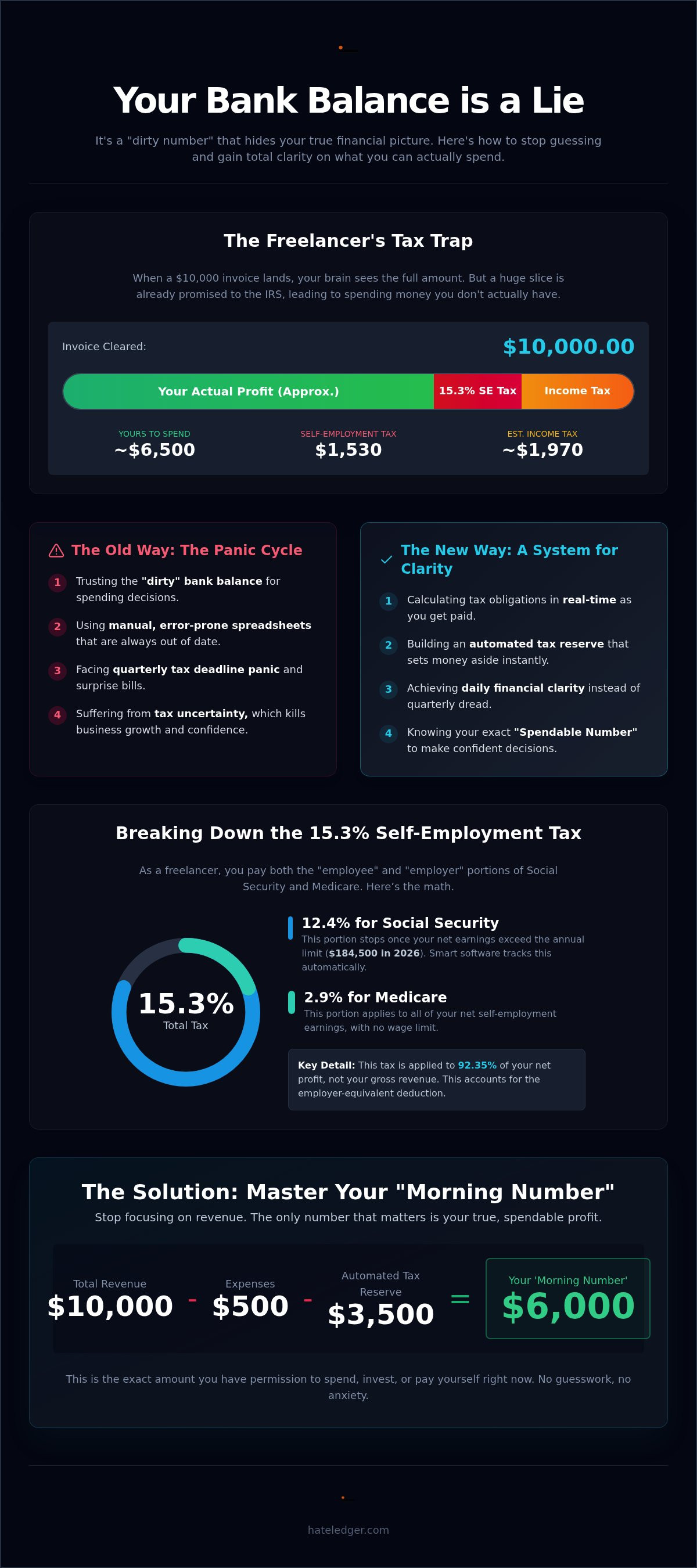
Your bank balance is a lie. That $10,000 invoice you just cleared isn't all yours. A significant slice belongs to the IRS; however, most tools leave you guessing exactly how much. You're tired of the quarterly panic. You're over the manual spreadsheets that break the moment you add a new line item. Using basic software to calculate self employment tax usually tells you what you owed yesterday, not what you can safely spend today.
You deserve to know your real number without doing mental gymnastics. It's time to stop treating your taxes like a looming disaster and start treating them like a solved problem. We agree that the traditional way of saving a random percentage is a recipe for constant anxiety. This guide will show you how to swap the guesswork for a system that automates your savings and gives you total permission to spend your profit. We'll look at the tools that actually work for freelancers and how to get that 15.3% set aside before you even think about touching it. No more panic. Just clarity.
Key Takeaways
- Stop trusting your total bank balance; it is a "dirty number" that hides what you actually owe the IRS.
- Ditch the manual spreadsheets and find software to calculate self employment tax that updates in real-time as you get paid.
- Understand the 15.3% tax breakdown to move from year-end panic to daily financial clarity.
- Build an automated tax reserve that sets aside funds instantly, making your tax obligation practically invisible.
- Master your "Morning Number" to finally know exactly how much profit is yours to spend right now.
The Bank Balance Lie: Why You Need Real-Time Tax Calculation
Your bank balance is a dirty number. It's a mirage that convinces you you're wealthier than you actually are. When you log into your banking app and see $10,000, your brain immediately starts planning how to spend it. You think about new equipment, marketing spend, or a well-deserved bonus. The problem is that a significant portion of that cash is already spoken for. It belongs to the IRS. Ignoring this reality is how most freelancers fall into the "Tax Trap," which is the dangerous habit of spending money today that you'll desperately need to pay your taxes tomorrow.
Traditional accounting is built on rear-view mirror thinking. It tells you what happened three months ago, but it does nothing to help you make a decision right now. You don't need a history lesson; you need a pulse check. Using Self-Employment Contributions Act (SECA) tax rules as a baseline, you're looking at a standard 15.3% hit before you even consider income tax. If you aren't using modern software to calculate self employment tax in real-time, you're essentially flying blind through a storm. A dedicated tax reserve isn't just a financial line item. It's a mental safety net that separates your survival cash from your "IRS tribute" cash.
Why your current spreadsheet is lying to you
Your manual spreadsheet is a failure point waiting to happen. It relies on your memory, which is the first thing to go when business gets busy. You forget the $15 app subscription. You miss the $40 client lunch. Every missed deduction makes your tax estimate wrong. More importantly, spreadsheets are static. They don't react when your income spikes or dips, leaving you with a calculation that's perpetually out of date. Spendable income is the only number that matters for a founder. If your tools don't give you that number instantly, they're wasting your time.
The psychological cost of tax uncertainty
Tax dread is a silent killer of business growth. When you don't know your exact obligation, you hesitate. You don't hire that contractor. You don't upgrade your software. You play small because you're afraid of a surprise bill in April. Real relief comes when you know your tax obligation is already "gone" from your spendable pool. Most software to calculate self employment tax fails here because it buries the truth under jargon-heavy dashboards and complex menus. You don't need to be an accountant to understand your finances. You just need to know what's actually yours to keep.
Breaking Down the 15.3%: Self-Employment Tax in Plain English
You're the boss now. That sounds great until you see the bill. When you were a W-2 employee, your company paid half your taxes in secret. You only saw the "employee" portion disappear from your paycheck. Now, you're the employer and the employee. You're footing the whole bill. This is why your tax obligation looks twice as high as it used to. It's not a mistake. It's just the reality of being self-employed. You are responsible for the full 15.3% yourself.
The math is simple but brutal. 12.4% goes to Social Security. 2.9% goes to Medicare. That's your 15.3% baseline. However, the IRS gives you a small break. You don't pay this on every dollar of gross revenue. You only pay it on 92.35% of your net profit. This rule accounts for the fact that you can deduct the employer-equivalent portion of your tax. It's a minor shield in a world of complex rules. To use it correctly, you must accurately calculate your self-employment tax based on your actual profit, not just your total sales. This is where most manual systems fail. They miss the nuance. They overcharge you. They leave you with less spendable cash than you deserve.
Social Security and Medicare: The 'Invisible' Employer Half
As a freelancer, you're paying the portion your boss used to cover. It's an extra 7.65% hit to your bottom line. But there's a limit. For 2026, the Social Security wage base limit is $184,500. Once you earn more than that, the 12.4% portion of the tax stops. You only pay the 2.9% Medicare tax on earnings above that limit. If you aren't using smart software to calculate self employment tax, you might keep saving at the full rate. That's a mistake. It starves your business of liquidity. Your tools must track this threshold automatically. No manual math allowed.
The 1040-ES and the Quarterly Deadline Myth
Quarterly deadlines are a myth. They suggest you only need to think about taxes four times a year. That is a lie. If you only calculate your debt every 90 days, you are living on borrowed time. You need a system that turns "estimated" into "exact." You should see your tax obligation shrink and grow in real-time. This is how you build an Automated Tax Reserve for Self-Employed that actually protects you. Don't wait for a deadline to find out you're broke. You can start seeing your real profit today with the Free Forever Tier.
Static Tax Calculators vs. Automated Financial Engines
A web calculator is a toy. You find it, you type in a few numbers, and it spits out a guess. It lives in a total vacuum. It doesn't know what you spent on Tuesday or what you earned on Friday. This is the "data silo" problem. Your tax math is separated from your actual bank activity. Most people think they're being smart by using these free tools, but they're actually losing money. Software to calculate self employment tax should be a persistent engine, not a one-off visit to a website. You need a system that lives inside your workflow, not a bookmark you visit when you're already stressed.
Free calculators often cost you the most in the long run. They follow basic IRS guidelines on self-employment tax, but they don't hunt for your specific deductions. They don't know about your home office, your travel, or your equipment. If your calculator doesn't see your spending, it overestimates your profit. You end up saving too much for the IRS and not enough for your own life. Automation turns your bookkeeping into an invisible process that works while you sleep. It moves you from guessing to knowing.
The manual entry nightmare
Typing in receipts is a waste of your talent. If you have to manually enter every transaction, you'll eventually stop doing it. Life gets in the way. Work gets busy. The moment you fall behind, your tax calculation becomes a work of fiction. Automated bank syncing is the only solution. It provides 24/7 accuracy without you lifting a finger. This is the core of Accounting Software for People Who Hate Accounting. It removes the boring data hurdle and gives you the truth every morning. You stop being a data entry clerk and start being a founder.
Beyond the math: Decision-making power
A calculator tells you what you owe. An engine tells you what you can do. This is a critical distinction for any operator. When you use the right software to calculate self employment tax, your math is integrated with your real-time revenue. You can make bold moves. You stop wondering if you can afford to grow. You use your data to power the Human Capital ROI Engine. You know exactly when to hire or when to scale based on real profit, not bank balance fantasies. By using invisible double-entry bookkeeping, your accounts stay audit-ready. You get the protection of a professional system without the headache of learning accounting. You don't just calculate taxes; you master your entire cash flow.
How to Build an Automated Tax Reserve That Actually Works
Calculating your tax is only half the battle. If you know you owe $2,000 but that money is sitting in your main checking account, you're going to spend it. You need a bridge between the math and your bank. Building a reserve isn't about personal discipline; it's about financial architecture. You need a system that removes the human element entirely. Follow these four steps to turn your tax obligation into an invisible background process.
- Step 1: Sync your business accounts to a platform that understands plain English finance. Avoid tools that force you to map a complex chart of accounts manually.
- Step 2: Define your tax profile. Whether you're an S-Corp, LLC, or Sole Prop, your software to calculate self employment tax must apply the correct logic to every dollar earned.
- Step 3: Establish a separate "Tax Vault." This is a sub-account where your reserves live, untouched and out of sight.
- Step 4: Automate the sweep. Move money based on incoming revenue the moment it hits your account. Waiting until the end of the month is a trap.
Setting your 'Invisible' tax logic
Your software must be smart enough to know the difference between a $5,000 client payment and a $5,000 transfer from your personal savings. One is taxable; the other is not. High-quality software to calculate self employment tax identifies these patterns automatically. It also accounts for state-specific rates, ensuring you aren't blindsided by local obligations. Tax reserves are painless when they happen in the background of every sale. You don't feel the loss because you never saw the money as yours to begin with.
The 'Safe to Spend' threshold
A high bank balance is a dangerous distraction. Your software should show you a "Safe to Spend" number by subtracting your tax reserve and upcoming bills from your total balance. This is the only number that matters for your daily operations. When you incur a business expense, your tax liability drops. A smart system will "claw back" that saved tax money and move it back into your spendable pool. If you're tired of complex legacy systems, check out the Best Xero Alternatives for Freelancers to find a tool that prioritizes your cash flow over data entry. You can start building your reserve today with the Hate Ledger Business Plan.
The Hate Ledger Way: Mastering Your 'Morning Number'
Accounting shouldn't be a post-mortem. It should be a live feed. Most freelancers wait until April to see if they won or lost. That is a loser's game. You need to know your standing every single day. We call this the "Morning Number." It is the single most important metric for your business. It isn't your bank balance. It isn't your gross revenue. It is the exact amount of cash you can spend right now without getting screwed later. This number is your financial truth.
Traditional software to calculate self employment tax treats your taxes like a separate problem. It leaves you to bridge the gap between your bookkeeping and your bank account. Hate Ledger kills that gap. Our platform calculates your tax obligation daily. It looks at your income, applies the 15.3% rate, adjusts for the 92.35% taxable portion, and tracks the $184,500 wage base limit automatically. You don't have to touch a calculator. You don't have to guess. You just wake up and see what is actually yours.
This visibility transforms how you run your business. When your tax-clear profit is visible, you can use the Decision Engine to make moves. You can stop wondering if you can afford a new project or a loan. Use your real data to decide on business financing with total confidence. We promise to have your financial life on autopilot within 90 days. That is our setup guarantee. No more spreadsheets. No more panic.
Your financial green light
The Morning Number is your green light. It gives you permission to spend. If the number is positive, you are safe. You can take a personal draw. You can reinvest in marketing. You can stop feeling guilty about your success because you know the IRS is already paid. This clarity leads to better hiring decisions. You'll know exactly when you have the Human Capital ROI to bring on a new team member. You're no longer playing defense; you're playing to win.
Start for free, grow with confidence
You don't need a massive budget to get organized. Our Free Forever Tier is built for those just starting their self-employment journey. It provides the essential tools to stop the bleeding. As you scale, you can move to the Business Plan for advanced ROI insights and deeper automation. You deserve a partner that grows with you. Stop playing accountant and get your Morning Number today. Your future self will thank you for the relief.
Own Your Profit and Kill the Tax Dread
You've spent too long looking at your bank account and wondering how much of that cash is actually yours. The truth is simple: if you aren't calculating your 15.3% obligation in real-time, you're just guessing. We've shown you that static spreadsheets are a liability and that your bank balance is a "dirty number" that hides the truth. Finding the right software to calculate self employment tax is the only way to stop the quarterly panic and start growing your business with confidence.
You deserve a system that works in the background so you can focus on being a founder. We promise to have your financial life on autopilot within 90 days using a jargon-free interface that speaks your language. No more mental math. No more tax-time surprises. Just a clear daily number that tells you exactly what you can spend today. Your financial freedom starts with visibility.
Get Your Morning Number: Start Hate Ledger for Free. There's no credit card required to start the Free Tier today. Take the first step toward a business that serves you instead of stressing you out. You've got this.
Frequently Asked Questions
Is self-employment tax the same as income tax?
Self-employment tax is not income tax. It's specifically your contribution to Social Security and Medicare. While income tax rates vary based on your total earnings and brackets, the self-employment tax rate is a flat 15.3% for most founders. You pay both because you are the employer and the employee. You'll file both on your annual return; however, they serve entirely different purposes for the government.
How do I calculate self-employment tax if my income fluctuates?
You calculate it by using automated software to calculate self employment tax that syncs with your bank. Static math fails when your revenue is a roller coaster. By tracking every dollar as it arrives, you can set aside the exact 15.3% required without over-saving or under-funding your life. This ensures your tax reserve stays accurate whether you have a $20,000 month or a $2,000 month. You stop guessing and start knowing.
Can software help me avoid underpayment penalties from the IRS?
Yes, software helps you avoid penalties by providing exact numbers for your 1040-ES payments. The IRS generally requires quarterly payments if you expect to owe at least $1,000 in taxes. By knowing your exact liability in real-time, you can make precise payments before the quarterly deadlines. This eliminates the underpayment sting that happens when your year-end math doesn't match your actual earnings. Precision beats estimation every single time.
Do I need to pay self-employment tax if I have a side hustle but also a W-2 job?
You must pay self-employment tax if your net earnings from your side hustle reach $400 or more in 2026. Your W-2 job already handles your payroll taxes for that specific income; however, the IRS views your side business as a separate entity. You'll owe the full 15.3% on your freelance profit regardless of how much you've already contributed through your employer's payroll system. There are no shortcuts here.
What is the 'Morning Number' and how does it help with taxes?
The Morning Number is a proprietary Hate Ledger metric that shows your real spendable profit. It isn't just a bank balance. It's the cash left over after the platform automatically subtracts your real-time tax obligations and business expenses. This helps with taxes by making your IRS debt invisible. You only see the money that is actually yours to keep, spend, or reinvest without the fear of a surprise bill.
Can I deduct my health insurance premiums from my self-employment tax?
No, you cannot deduct health insurance premiums from your self-employment tax base. While you can often deduct these premiums to lower your regular income tax, the 15.3% self-employment tax is calculated on your total net profit before those adjustments. This is a common trap where founders think they owe less than they do. Your software should handle this distinction automatically to prevent nasty surprises when you finally file your return.
How often should I update my tax calculations?
You should update your tax calculations daily. Waiting for a quarterly deadline or a year-end meeting with an accountant is a recipe for disaster. Using software to calculate self employment tax allows you to see your obligation shift with every transaction. Daily updates turn tax season from a looming crisis into a non-event because the money is already accounted for. You deserve to know your standing every single morning.
Why shouldn't I just use a free online tax calculator?
Free online calculators are static toys that rely on manual data entry. They don't know your specific business expenses, your state-specific rates, or your year-to-date progress toward the $184,500 Social Security wage base. A free tool is a snapshot; an automated engine is a movie. You need a system that lives in your bank account, not a website you have to remember to visit when you're already stressed.
Frequently Asked Questions
No. They are two separate bills. Self-employment tax covers your Social Security and Medicare contributions at a flat 15.3% rate for 2026. Income tax is a separate calculation based on your specific tax bracket. You are responsible for both. Most people forget the self-employment portion because it is not withheld by an employer. Using software to calculate self employment tax ensures you aren't blindsided by the combined total when the IRS comes knocking.
Stop using static spreadsheets. If your income changes monthly, your tax obligation changes too. You need a system that syncs with your bank feed to adjust your reserves in real time. Static tools only give you a snapshot of the past. A dynamic engine recalculates your liability every time a new deposit hits your account. This prevents you from over-saving during slow months or under-saving during a windfall.
Yes. The IRS expects exact quarterly payments, not rough guesses. If you underpay by more than $1,000, they often tack on penalties. Automated software tracks your year-to-date earnings and the $184,500 Social Security wage base for 2026. It tells you exactly what to send each quarter. By automating your tax reserve, you ensure the cash is always ready before the January, April, June, and September deadlines.
Yes, if your net side hustle earnings are $400 or more. Your W-2 job only covers the taxes for that specific salary. Your freelance income is a separate bucket. You must pay the full 15.3% on your business profit. This is where many part-time founders fail. They spend their side-hustle cash today and realize too late that they owe a significant chunk back to the government.
The Morning Number is your financial green light. It is the single amount you can safely spend today after all obligations are removed. Hate Ledger calculates this by stripping away your 15.3% tax reserve, upcoming bills, and business expenses from your total balance. It turns software to calculate self employment tax into a daily utility. You stop looking at a "dirty" bank balance and start looking at real profit.
No. This is a common point of confusion. You can often deduct health insurance premiums as an adjustment to your gross income to lower your income tax. However, these premiums do not reduce your self-employment tax. You still pay the 15.3% on your net business profit before that deduction is applied. This is why "gross profit" is a lie; your tax bill is often higher than you expect.
You should update them daily. Waiting until the end of the month or quarter is too slow for a modern business. If you land a big contract on Tuesday, your tax liability increases on Tuesday. You need to know that new "spendable" number immediately. Real-time visibility prevents you from spending money that technically belongs to the IRS. Automation makes this daily update invisible so you don't have to think about it.
Free calculators are snapshots. They are digital toys that require manual data entry every time you want an answer. They don't talk to your bank, and they don't track your deductions over time. A persistent accounting engine lives inside your financial flow. It provides a continuous, accurate reserve that adjusts as you spend. Free tools leave you to manage your own cash flow; a real engine manages it for you.