
How to Calculate Employee ROI: The No-Nonsense Guide for Business Owners
September 20, 2026 · 17 min read
Your payroll is likely your biggest expense, yet you’re probably treating it like a blind bet. Most owners look at their bank balance and hope there’s enough left over after the team gets paid. It's a black hole strategy that keeps you awake at night. You want to know how to calculate employee ROI to stop the guessing game, but traditional accounting makes it feel impossible.
I get it. You're tired of feeling like you're subsidizing a team instead of running a profit engine. You need a clear way to see team profitability every day without drowning in complex spreadsheets. This guide provides a jargon-free way to measure the real value of every hire. We're stripping away the fluff to reveal the math behind your team's actual output.
We'll break down the true loaded cost of a 2026 employee, including the $184,500 Social Security wage base and the 30% benefit overheads. You'll gain a simple yes/no framework for every future hiring decision. It's time to stop guessing and start scaling based on data, not gut feelings.
Key Takeaways
- Stop viewing payroll as a "black hole" expense and start treating it as a measurable investment. You'll learn how to separate money that's simply gone from money that grows your business.
- Master the exact formula for how to calculate employee ROI by uncovering the "Real Cost" of labor. Salary is only 60% of the story; we'll show you how to find the hidden 40%.
- Treat hiring as a financing decision by calculating the 90-day ramp-up period. This ensures every new hire has a clear path to profitability before they even start.
- Get a definitive "yes" or "no" on scaling your team by using your daily cash flow numbers. Stop making hiring decisions based on gut feelings and start using hard data.
- Eliminate manual spreadsheets by automating your team's performance tracking. See your profitability every morning without wasting hours on traditional accounting reports.
Stop Guessing: Why Traditional Payroll Reporting Fails Small Businesses
Most business owners treat payroll like a utility bill. You see a lump sum leave your bank account every two weeks, you wince, and you move on. This is the "black hole" approach to management. When you view labor as a generic expense, you lose the ability to see who is actually driving your business forward. You aren't just paying for time; you're buying a result. If you don't know what that result is worth, you don't have a team. You have a collection of expensive habits.
Traditional accounting doesn't help. Standard reports are designed for tax compliance, not for making fast decisions. They bury the information you need under layers of jargon that feel intentionally confusing. To truly understand how to calculate employee ROI, you must shift your perspective. An expense is money that is simply gone. An investment is capital that you expect to grow. If an employee isn't an investment, they shouldn't be on your payroll.
Relying on a "gut feeling" to hire is the fastest way to sink a lean business. You feel overwhelmed, so you hire. You feel flush with cash, so you expand. This reactive cycle ignores the math. You need a way to see if your team is a profit engine or a drain on your resources before the bank balance hits zero.
The Bank Balance Trap
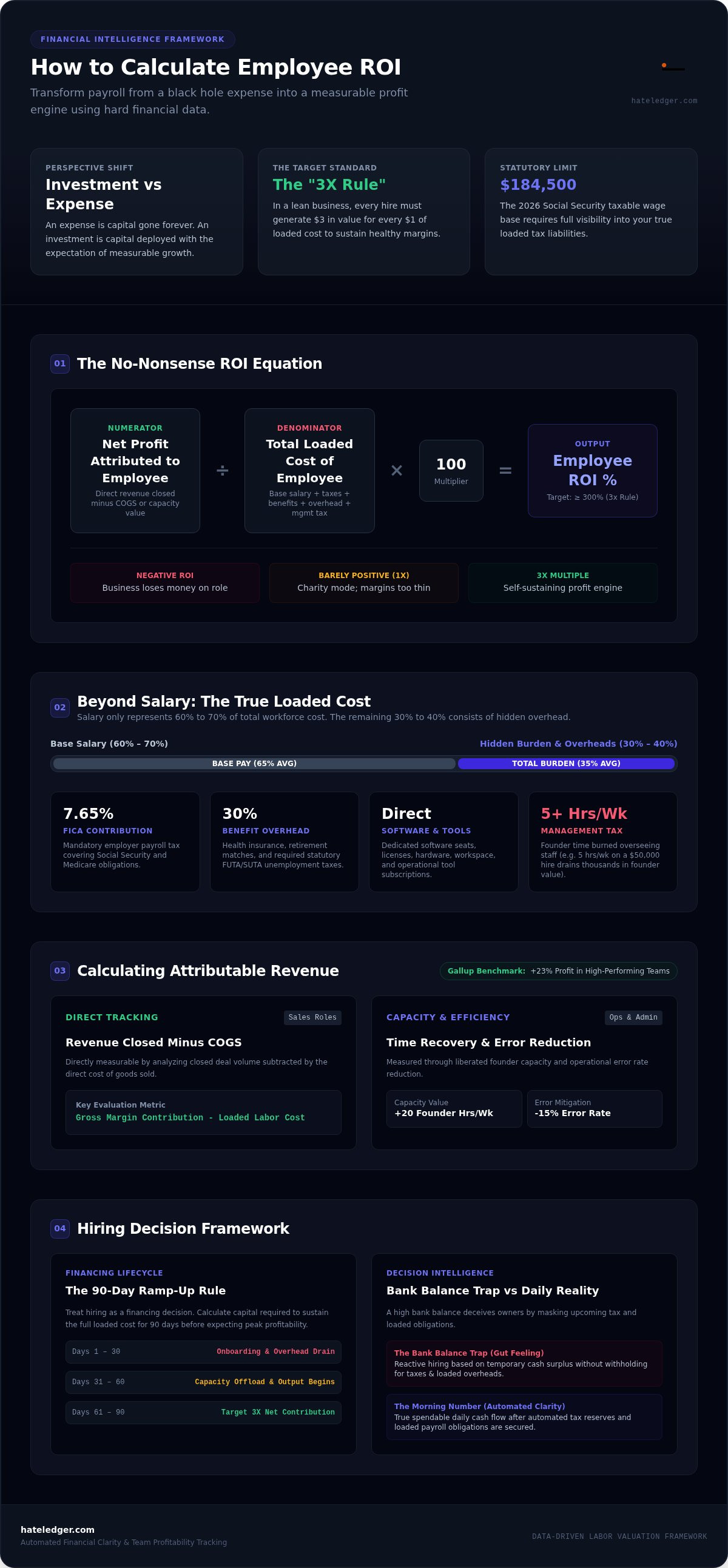
A high bank balance is a deceptive metric. It doesn't account for the fact that you’re acting as a tax collector for the government. With the 2026 Social Security taxable wage base sitting at $184,500, your hidden obligations are higher than ever. If you use your current balance to justify a new hire, you're ignoring the "fully loaded" reality of employment. This is where The Morning Number becomes critical. It strips away the noise and tells you exactly what you can afford to spend today without compromising tomorrow's tax bill.
Why 'Culture Scores' Aren't Enough
HR experts love to talk about "engagement" and "culture scores." While a positive environment matters, you cannot pay your mortgage with a "happiness" metric. Small businesses need to treat every role as a profit unit. This requires applying a standard return on investment (ROI) formula to human capital. Are they increasing your capacity? Are they reducing costly errors? If you can't tie their presence to a financial outcome, you aren't managing a business. You're managing a social club. The shift from "managing people" to "managing profit" is what separates struggling founders from those who scale with confidence.
The No-Nonsense Formula for Calculating Employee ROI
Forget the complex spreadsheets your accountant sends you. If you want to know how to calculate employee ROI, you only need one simple equation: (Net Profit Attributed to Employee / Total Loaded Cost of Employee) x 100. If the result is negative, you’re losing money. If it's barely positive, you're running a charity. In a lean business, every hire should ideally hit the "3x Rule." This means for every dollar they cost you, they should generate three dollars in value. Anything less and your margins are likely too thin to support them long-term.
Step 1: Calculating the Fully Burdened Cost
Your biggest mistake is thinking salary is the total price tag. It isn't. Salary usually accounts for only 60% to 70% of the true cost of an employee. To find the "fully burdened" number, you must sum up the base pay, the 7.65% employer FICA contribution, and FUTA/SUTA taxes. Then, add the benefits, insurance, and software seats. Don't forget the "Management Tax." If you spend five hours a week managing a $50,000 hire, that's thousands of dollars of founder time you’re burning. You have to account for that drain on your own productivity to see the real investment.
Step 2: Determining Attributable Revenue
Sales roles are easy to track. You look at the revenue they close and subtract the cost of goods sold. Non-sales roles, like admin or ops, require a different lens. You measure them by capacity. If an admin frees up 20 hours of your time, what is that time worth? If an operations manager reduces error rates by 15%, how much did those mistakes cost you last year? Linking these numbers is how you find the real financial impact. Gallup's research on employee engagement and profitability shows that high-performing teams can drive a 23% increase in profit, but you can't manage what you don't measure.
Doing this manually every month is a waste of your mental energy. You should be making decisions, not building formulas. Using a tool like the Human Capital ROI Engine automates this attribution, giving you a clear picture of who is paying for themselves. If you want to see your team's performance without the manual grind, consider starting with the Human Capital ROI Engine to get your first numbers today. It turns your labor data into a decision engine that tells you exactly when to scale.
Beyond the Salary: Factoring in the Invisible Costs of Human Capital
Hiring is a high-stakes financing decision. You aren't just adding a name to an org chart; you're taking on a massive recurring liability. Most owners fail to realize that a new hire is a net loss for months. Industry data shows it takes 8 to 12 months for a typical employee to reach 100% productivity. During that first 90-day window, you're paying full price for roughly 50% output. This "ramp-up" cost is an invisible drain on your cash flow that most accounting reports ignore. If you don't know how to calculate employee ROI during this vulnerable phase, you're risking the stability of your entire operation.
Then there’s the compounding tech debt. Every new hire requires a suite of software licenses, specialized hardware, and physical or digital workspace. These aren't one-time fees. They are sticky, recurring costs that follow the employee. You also have to weigh the opportunity cost. Every dollar spent on a salary is a dollar you can't spend on lead generation or automated systems. Understanding how to calculate employee ROI means looking past the paycheck and seeing the total ecosystem of expense that surrounds a single human being. You must decide if that person will generate more value than the marketing campaign you had to cancel to afford them.
The Realities of Human Capital
Traditional education often gets this wrong. Some academic definitions suggest that human capital is the machines and equipment produced by workers. In the real world, human capital is far more volatile. It’s the collective skills and time of your team. Unlike a machine, human output fluctuates. People get sick, they lose focus, or they leave for competitors. If you don't manage these profit units with data, your margins will vanish as you scale. Protecting your profit requires you to treat time as a finite, billable asset, even for your internal staff.
The Hidden Tax Reserve
The real profit killer is the tax surprise at quarter-end. You have to account for the 7.65% employer FICA contribution and the FUTA/SUTA obligations. With the 2026 Social Security taxable wage base increasing to $184,500, these numbers add up fast. You need a system that sets these reserves aside automatically so payroll never feels like a crisis. Use a business financing decision tool to see if your cash flow can actually handle a new fully-burdened cost. It stops the guessing and starts the growth by showing you the truth before you sign the offer letter.
From Data to Decisions: When to Hire vs. When to Wait
Most founders hire when they're exhausted. You feel the weight of a hundred tasks, so you throw a salary at the problem to make the pain stop. This is a panic move. It is the opposite of a "Decision Engine." To scale with confidence, you must base the call on math. You have already learned how to calculate employee ROI by looking at the fully burdened cost. Now, you need to apply that number to your daily reality to see if the investment is actually safe.
Start with your Morning Number. This is your ultimate guardrail. It tells you exactly what you can spend today without compromising your future tax obligations or operational safety. If your Morning Number cannot absorb a new $54.00 per hour fully-burdened cost, which is the 2026 average for full-time private industry employees, you wait. It does not matter how tired you are. Hiring into a cash flow deficit is not growth. It is a slow-motion wreck.
Next, look at the ROI threshold. For a founder, the most valuable metric is time. If a new hire will not free up at least 20 hours of your week, the investment is not ready. You are just trading your productive time for management time. You also need to monitor your current team's capacity. If the ROI per employee starts dropping, your team is likely hitting a burnout wall. In this case, a new hire is not just an expense. It is an insurance policy for your existing profit units.
Using a Small Business Hiring Decision Tool
You don't need a degree in finance to get this right. You need a way to input your current revenue and see how a new hire moves the needle. Identifying your "break-even" point is the difference between a calculated risk and a blind bet. Research indicates most new hires operate at only 25% productivity in their first 30 days. You must account for that lag. Use the Small Business Hiring Decision Tool to map out your 2026 growth. It removes the emotion from the process and gives you a clear green light or a hard stop based on your actual bank balance.
Scaling Without the Headaches
Sophisticated HR platforms are often a trap. They offer complexity when you need clarity. You maintain a lean team by maximizing the ROI of every individual. This means knowing when to provide more training and when to replace a low-ROI employee. If an employee's output does not hit the 3x rule, you have a decision to make. Training is an investment, but keeping a non-performer is a tax on your entire business. If you're ready to stop the guesswork and start scaling with data, check out our Human Capital ROI Engine to see your real numbers today.
Automating the ROI Engine: Get Your Team Performance Number Daily
Manual math is a trap. If you spend your weekends buried in a spreadsheet trying to figure out how to calculate employee ROI, you are failing as a leader. Your job is to make decisions, not to manually track every software seat and insurance premium. Traditional bookkeeping forces you to wait weeks for a report that is already out of date. You need to know your team's profitability today, not next month. If you are still guessing about your team's value because you dread the data entry, you are leaving your growth to chance.
This is where Invisible Double-Entry accounting changes the game. It works in the background, syncing with your bank and payroll systems to capture every cent. It tracks the real-time cost of your human capital without you ever touching a ledger. By automating the friction, you get a daily update on your team performance. You wake up, see a single number, and know exactly who is driving profit. It turns the "black hole" of payroll into a transparent engine of growth. You move from hating the process of accounting to loving the clarity of the results.
The Hate Ledger Difference
We built this for people who would rather do anything else than look at a balance sheet. We take complex payroll data and translate it into a single, plain-English number. Our system automates bank syncs to capture the specific software licenses or the benefit costs that typically add 30% to your base salary expenses. This is accounting software for people who hate accounting. It stops the jargon and starts the results by giving you a clear "Morning Number" you can actually use to run your business.
Getting Started in 2026
Transitioning from financial chaos to total clarity doesn't happen overnight, but it shouldn't take forever. We offer a 90-day setup promise to get your Human Capital ROI Engine fully operational. You can even start today on our Free Forever tier to begin tracking your first hire without any upfront cost. There is no risk, only the relief of finally knowing the truth about your team. Stop playing accountant. Start leading your team with the confidence that every hire is a win. It is time to learn how to calculate employee ROI the automated way and finally get your time back.
Take Command of Your Team's Profitability
You're no longer blind to the black hole of payroll. You've moved past the bank balance trap and learned that a salary is only 60% of the true cost. By mastering how to calculate employee ROI, you've turned your team from a generic expense into a high-performance investment engine. You know your Morning Number. You understand the 3x Rule. You finally have the data to decide when to scale and when to wait.
Knowledge without action is just more mental load. You shouldn't spend your weekends wrestling with spreadsheets to keep these numbers current. You need a system that tracks the invisible costs and reveals your team's value every single morning. It's time to strip away the jargon and focus on the results that actually grow your business.
Stop guessing and start growing with Hate Ledger's ROI Engine. We offer a Free Forever tier and a 90-day setup promise to move you from chaos to clarity. Our platform reduces accounting time by 80%, giving you the freedom to lead instead of just track. You've got the tools. Now, build the team you deserve.
Frequently Asked Questions
What is a good ROI for a new employee?
A good ROI is generally a 3:1 ratio. This means for every dollar you spend on their fully burdened cost, you receive three dollars in value. If you’re just breaking even, you aren't growing; you're just treading water. High-performing teams often push this higher. When you learn how to calculate employee ROI, focus on hitting that 3x threshold to ensure your business remains profitable after all overhead is paid.
How do I calculate ROI for a non-revenue generating employee like an admin?
You calculate ROI for non-revenue roles by measuring the capacity they create. If an admin saves you 20 hours a week, multiply those hours by your own billable rate or the value of the growth tasks you can now complete. You can also measure the reduction in costly errors or the displacement of more expensive contractor fees. Every role must have a financial value attached to it, or it shouldn't exist on your payroll.
Should I include payroll taxes in the employee ROI calculation?
Yes, you must include every cent of employer-side taxes. Ignoring the 7.65% FICA contribution or FUTA/SUTA obligations is a recipe for a cash flow crisis. A true calculation uses the fully burdened cost, which includes taxes, benefits, and even the software seats they use. If you only look at base salary, you are underestimating your actual investment by at least 30%. Accuracy here is the only way to protect your profit margins.
How long does it typically take for a new hire to show a positive ROI?
It typically takes 8 to 12 months for a new hire to reach 100% productivity. Most employees operate at roughly 25% productivity in their first month and 50% by day 90. This means you will likely see a negative ROI during the initial ramp-up period. Understanding how to calculate employee ROI involves accounting for this "ramp-up debt" and ensuring your cash flow can support the hire until they become a net asset.
Is there an easy way to track employee ROI without using spreadsheets?
Yes, you can stop using manual spreadsheets entirely. Automated tools like the Human Capital ROI Engine track your labor costs and output in the background. By syncing directly with your bank and payroll, these systems provide a daily update on team profitability. This removes the manual grind and the risk of human error. You get the answers you need without the headache of building complex formulas or updating data every weekend.
What are the biggest mistakes small businesses make when calculating employee value?
The biggest mistake is treating salary as the total cost. Owners also frequently ignore the "Management Tax," which is the cost of the time they spend supervising the employee. Another error is relying on "culture scores" or "happiness" instead of hard financial data. If you don't know your Morning Number, you can't tell if a hire is a profit engine or a liability. Scaling on gut feelings alone leads to expensive mis-hires.
Can I use accounting software to automate my employee ROI tracking?
Most traditional accounting software is too focused on tax compliance to track real-time ROI. You need a platform built for founders, like Hate Ledger, which uses Invisible Double-Entry to track labor costs automatically. It turns payroll data into a plain-English performance number. This allows you to see the financial impact of every hire without hiring a human bookkeeper or spending hours in a traditional accounting system that wasn't designed for decision-making.
How often should I review my team's ROI numbers?
You should review your team's ROI numbers every single day. Waiting for a monthly or quarterly report means you are reacting to old news. A daily Morning Number gives you the confidence to make fast hiring or spending decisions based on real-time profitability. Regular reviews allow you to spot a drop in ROI before it becomes a crisis. Daily visibility ensures your team remains an asset that grows your bank balance, not a drain on it.
Frequently Asked Questions
A good ROI is generally a 3:1 ratio. This means for every dollar you spend on their fully burdened cost, you receive three dollars in value. If you’re just breaking even, you aren't growing; you're just treading water. High-performing teams often push this higher. When you learn how to calculate employee ROI, focus on hitting that 3x threshold to ensure your business remains profitable after all overhead is paid.
You calculate ROI for non-revenue roles by measuring the capacity they create. If an admin saves you 20 hours a week, multiply those hours by your own billable rate or the value of the growth tasks you can now complete. You can also measure the reduction in costly errors or the displacement of more expensive contractor fees. Every role must have a financial value attached to it, or it shouldn't exist on your payroll.
Yes, you must include every cent of employer-side taxes. Ignoring the 7.65% FICA contribution or FUTA/SUTA obligations is a recipe for a cash flow crisis. A true calculation uses the fully burdened cost, which includes taxes, benefits, and even the software seats they use. If you only look at base salary, you are underestimating your actual investment by at least 30%. Accuracy here is the only way to protect your profit margins.
It typically takes 8 to 12 months for a new hire to reach 100% productivity. Most employees operate at roughly 25% productivity in their first month and 50% by day 90. This means you will likely see a negative ROI during the initial ramp-up period. Understanding how to calculate employee ROI involves accounting for this "ramp-up debt" and ensuring your cash flow can support the hire until they become a net asset.
Yes, you can stop using manual spreadsheets entirely. Automated tools like the Human Capital ROI Engine track your labor costs and output in the background. By syncing directly with your bank and payroll, these systems provide a daily update on team profitability. This removes the manual grind and the risk of human error. You get the answers you need without the headache of building complex formulas or updating data every weekend.
The biggest mistake is treating salary as the total cost. Owners also frequently ignore the "Management Tax," which is the cost of the time they spend supervising the employee. Another error is relying on "culture scores" or "happiness" instead of hard financial data. If you don't know your Morning Number, you can't tell if a hire is a profit engine or a liability. Scaling on gut feelings alone leads to expensive mis-hires.
Most traditional accounting software is too focused on tax compliance to track real-time ROI. You need a platform built for founders, like Hate Ledger, which uses Invisible Double-Entry to track labor costs automatically. It turns payroll data into a plain-English performance number. This allows you to see the financial impact of every hire without hiring a human bookkeeper or spending hours in a traditional accounting system that wasn't designed for decision-making.
You should review your team's ROI numbers every single day. Waiting for a monthly or quarterly report means you are reacting to old news. A daily Morning Number gives you the confidence to make fast hiring or spending decisions based on real-time profitability. Regular reviews allow you to spot a drop in ROI before it becomes a crisis. Daily visibility ensures your team remains an asset that grows your bank balance, not a drain on it.