
Is My New Employee Profitable? The No-Nonsense Guide to Human Capital ROI
September 19, 2026 · 17 min read
Your bank balance is a liar. It shows you what's left, but it hides the truth about who's actually building your wealth and who's just taking up space. Most founders treat hiring like a high-stakes poker game where they can't see their own cards. You look at a new hire and wonder: is my new employee profitable? Then you get buried in a mountain of spreadsheets trying to find the answer. It's exhausting. It's inefficient. It's a trap that keeps you from scaling with confidence.
We're done with the guesswork. You deserve to know the exact impact every person has on your bottom line without needing a degree in forensic accounting. This guide breaks down the fully loaded math of human capital and introduces a radical simplification of ROI. We'll show you how to find your morning number and use a Human Capital ROI Engine to automate the tracking. By the end, you'll have the clarity to either double down on your winners or cut the dead weight before it sinks your ship.
Key Takeaways
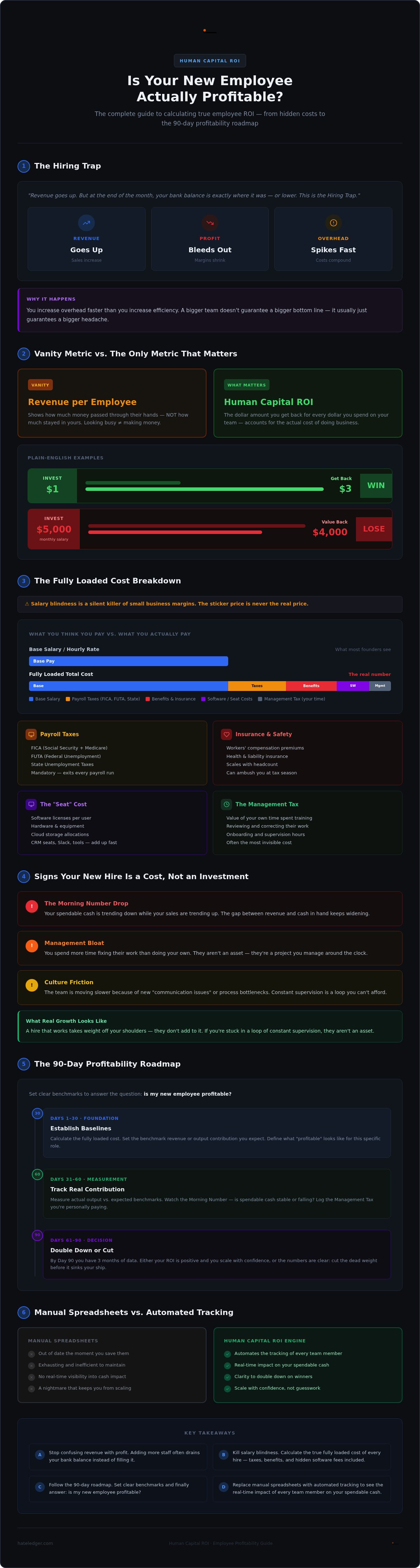
- Stop confusing revenue with profit and learn why adding more staff often drains your bank balance instead of filling it.
- Kill salary blindness by calculating the true, fully loaded cost of every hire, including taxes, benefits, and hidden software fees.
- Follow a 90-day roadmap to set clear benchmarks and finally answer the question: is my new employee profitable?
- Replace manual spreadsheets with automated tracking to see the real-time impact of every team member on your spendable cash.
The Hiring Trap: Why 'More Hands' Often Means Less Profit
Scaling is seductive. You hit a bottleneck, your hair is on fire, and you think a new hire is the fire extinguisher. You hire. Revenue goes up. But at the end of the month, your bank balance is exactly where it was before. Or worse, it's lower. This is the Hiring Trap. It happens when you increase your overhead faster than your efficiency. A bigger team doesn't guarantee a bigger bottom line. It usually just guarantees a bigger headache.
Founders often confuse "more hands" with "more growth." They chase the ego boost of a large staff while their profit margins bleed out in silence. You're left staring at your dashboard, wondering: is my new employee profitable? Without a way to measure the impact, you're just gambling with your payroll. The Human Capital ROI Engine is your only defense against this cycle of expensive, empty growth.
What is Human Capital ROI in Plain English?
Forget the textbook jargon. Human Capital ROI is simply the dollar amount you get back for every dollar you spend on your team. It's the only metric that matters because it accounts for the actual cost of doing business. Most people look at "Revenue per Employee." That's a vanity metric. It tells you how much money passed through their hands, not how much stayed in yours. It's the difference between looking busy and actually making money.
For a small business, this isn't optional. A massive corporation can survive a few bad hires. You can't. You need to treat human capital like any other investment. If you put $1 into a marketing campaign and get $3 back, you're winning. If you put $5,000 into a monthly salary and get $4,000 in value, you're losing. It's that simple. Contrast this automated clarity with the nightmare of manual ROI spreadsheets that are out of date the moment you save them.
Signs Your New Hire is a Cost, Not an Investment
You don't need a complex audit to see if a hire is failing. The signs are usually staring you in the face. If you aren't seeing these results, you're likely subsidizing a hire that isn't pulling their weight. Watch for these red flags:
- The Morning Number Drop: Your spendable cash is trending down while your sales are trending up.
- Management Bloat: You spend more time fixing their work than doing your own.
- Culture Friction: The team is moving slower because of new "communication issues" or process bottlenecks.
Real growth happens when a hire takes weight off your shoulders. If you're stuck in a loop of constant supervision, they aren't an asset; they're a project. If you're unsure where you stand, use a Small Business Hiring Decision Tool: Stop Guessing and Start Growing (2026) to re-evaluate. Stop asking how to scale and start asking: is my new employee profitable right now?
Calculating the Fully Loaded Cost: It’s More Than Just Payroll
Salary blindness is a silent killer of small business margins. You see a resume, you agree on a salary, and you think you know the price tag. You don't. Looking only at the hourly rate or the annual salary is like looking at the sticker price of a car and forgetting about the insurance, fuel, and maintenance. If you're asking, is my new employee profitable, you're asking about the wrong number if you're only looking at gross pay.
The truth is buried in the "fully loaded" math. This includes every cent that leaves your business because that person exists on your payroll. According to official data on the fully loaded cost of an employee, employer costs for compensation go far beyond the base wage. If you ignore this gap, you aren't just miscalculating profit; you're actively draining your cash reserves without realizing it.
The Hidden Tax and Benefit Burden
Payroll taxes are the first invisible hit. You're on the hook for FICA, FUTA, and state unemployment taxes. These aren't suggestions. They are mandatory cash exits that happen every time you run payroll. Then there is the cost of safety. Workers' comp and insurance premiums scale with your headcount. If you don't account for these, tax season will feel like an ambush. You need an Automated Tax Reserve for Self-Employed: Stop Guessing What You Can Spend to keep your cash flow predictable. Without it, you're just guessing how much of your bank balance actually belongs to the IRS.
Overhead and the 'Seat' Cost
Every hire needs a "seat" to sit in. In the digital age, that seat is built out of software licenses, hardware, and cloud storage. A $15 monthly Slack fee here and a $50 CRM seat there add up fast. Don't forget the Management Tax. This is the value of your own time spent training, reviewing, and correcting their work. If you spend five hours a week managing a new hire, that is five hours you aren't spending on high-level strategy. Fully loaded cost is the total cash exit required to keep an employee active.
Ignoring these details is why revenue can go up while your personal take-home pay stays flat. You can't manage what you don't measure. If you're tired of doing the manual math on every hire, the Human Capital ROI Engine handles the invisible double-entry for you, so you always know your real margins.
Revenue vs. Contribution: Measuring What Actually Hits the Bank
Revenue is loud. It's the number founders brag about at dinner parties. But revenue is a vanity metric. It doesn't tell you if you're getting richer or just getting busier. To answer the question, is my new employee profitable, you have to look past the top line. You have to measure net contribution. This is the only number that matters because it's the only number you can actually spend.
Think of your business like a filter. Total revenue enters the top. After you pay for materials, software, and the employer costs for employee compensation, a much smaller number comes out the bottom. That's your gross margin. If a salesperson brings in $10,000 but your margin is 40%, they only generated $4,000 for the house. If their fully loaded cost is $5,000, they didn't make you money. They cost you $1,000 for the privilege of managing them. They are a liability in a fancy suit.
Every hire starts as a hole in your bank balance. The break-even point is the moment they finally climb out of that hole. Before that point, they're a bet. After that point, they're an engine. You need to know exactly when that shift happens. If you don't, you're just subsidizing a lifestyle instead of building an asset.
The Net Contribution Framework
Stop guessing. Use a simple framework: (Revenue Generated x Gross Margin %) minus Fully Loaded Cost. This is the truth. Your bank account doesn't care about "projected growth" or "brand awareness." It cares about spendable cash. For non-sales roles, the revenue generated is the "Time Saved" value. If an admin saves you 10 hours a week, and your time is worth $200 an hour, that's $2,000 of contribution. It's a real number. Treat it like one. If the math doesn't work, the hire doesn't work.
Direct Hires vs. Support Hires
Direct hires are easy to track. There's a straight line from their desk to a sale. Support hires are trickier but just as vital. They are capacity multipliers. They don't bring in new money. They make it possible for you to handle more of it. They clear the path so the direct hires can run faster. If you want to see how these roles impact your bottom line without the spreadsheet fatigue, you can use the Human Capital ROI Software pillar to track these relationships automatically. It turns invisible effort into visible profit. It shows you exactly who is fueling the engine and who is just along for the ride.
The 90-Day Profitability Roadmap: Setting Benchmarks That Matter
Culture fits and "good vibes" don't pay the bills. If you want a team that builds wealth instead of burning it, you need a timeline. Most founders wait six months to check their bank balance. That's too late. You need to know if your new employee is profitable by day 90. This roadmap stops the bleeding by setting hard financial milestones from the first day.
Month 1: The Investment Phase. This is the "burn" month. You're paying a full salary for zero output. They're learning your systems and eating your time. Accept the high cost but track the learning curve. If they aren't hitting training benchmarks now, they won't hit profit benchmarks later. You're buying potential, but the bill is due immediately.
Month 2: The Integration Phase. The goal here is cost neutrality. By day 60, the value they provide should cover their own fully loaded cost. They shouldn't be a drain on your cash flow anymore. They're finally carrying their own weight. If they're still a net loss at this stage, you need to look at your training process or the hire itself.
Month 3: The Contribution Phase. This is where you get paid. You should target a 1.5x to 3x ROI on their total cost. If you're still asking, is my new employee profitable at the end of month three, you have your answer. Don't fall for the sunk cost fallacy. If the numbers aren't moving, cut the hire before they sink your margins. Keeping a failing hire because you've "already spent the time" is just throwing good money after bad.
Setting Hard Financial KPIs
"Doing a great job" is a useless metric. It's subjective and dangerous. You need hard targets. Set revenue goals for sales roles or task completion quotas for operations. These numbers must tie directly to your Morning Number. If the work they do doesn't move that number up, the work doesn't matter. Automation makes this easy. You can see your Human Capital ROI in real-time without touching a single spreadsheet.
The 'Safe to Scale' Signal
One profitable hire is a win. Two profitable hires is a strategy. You reach the 'Safe to Scale' signal when a hire's ROI covers their own cost plus a 20% buffer. This extra margin protects you from market dips and unexpected expenses. Once you hit this mark, you aren't just guessing; you're ready for the next person. If you need capital to bridge the gap for that next hire, use the Business Financing Decision Tool to fund your growth with confidence. Scaling without this signal is just a fast way to go broke.
Automating the Math: How the Hate Ledger Decision Engine Tracks ROI
Manual spreadsheets are where profit margins go to die. You didn't start a business to become a data entry clerk. If you're still spending Sunday nights cross-referencing payroll with bank statements just to see if your team is paying for itself, you're doing it wrong. It's time to end the spreadsheet nightmare. We built the Human Capital ROI Engine to handle the heavy lifting while you focus on the actual work. It uses invisible double-entry to track labor costs against real revenue in the background. No manual updates. No human error. Just the truth.
Our software visualizes your team's impact in real-time. It turns a wall of numbers into a clear picture of who is driving growth and who is draining cash. The Decision Engine acts as a "Yes/No" button for your next hire. It looks at your existing margins and tells you if you have the "Safe to Scale" signal we discussed earlier. It removes the emotional weight of hiring. You stop guessing. You start knowing. This is the transition from hating accounting to loving the results it brings to your bank balance. You finally get to answer the question: is my new employee profitable without opening a single calculator app.
Real-Time ROI Reporting
Clarity shouldn't be a monthly event. You need to see the impact of payroll on your daily spendable income every single morning. Our system provides automated tax reserves that adjust instantly as your team grows. When you add a new person, your "Morning Number" updates to reflect the new reality of your cash flow. For teams that are serious about scaling, the Pro Plan offers the deepest insights into these ROI shifts. It's built for the pragmatic operator who values time above all else. It ensures that every dollar spent on a "seat" is actually returning value to the business.
The 90-Day Setup Promise
We don't do "discovery calls" or endless manual setup guides. We promise to have your ROI tracking live within 90 days without you needing to play accountant. We handle the technical details so you can build the "Morning Number" habit. It takes 30 seconds to check your dashboard. Those 30 seconds give you more financial clarity than a dozen meetings with a traditional bookkeeper. Stop wondering if your payroll is a black hole and start seeing the light. Start tracking your team ROI for free today and take back control of your bank balance.
Stop Guessing and Start Scaling With Certainty
Growth without profitability is just a slow way to go broke. You've seen the math. To truly scale, you must look past the vanity of revenue and master your fully loaded costs. By following a strict 90-day roadmap and focusing on net contribution, you turn your payroll from a black hole into a wealth-building engine. No more wondering: is my new employee profitable? You'll have the answer in plain English every single day.
Hate Ledger's Human Capital ROI Engine removes the mental load of tracking individual impact. With our 90-Day Setup Promise and Daily Morning Number tracking, you get a clear view of your spendable cash without ever touching a manual spreadsheet. It's time to stop playing defense with your bank balance and start making aggressive, data-backed decisions. This is the radical simplification your business needs to thrive in a crowded market.
Stop guessing and start growing with Hate Ledger's ROI Engine. You built this business to create freedom, not a second job as an accountant. Take back your time and build a team that actually pays for itself.
Frequently Asked Questions
How do I calculate the ROI of an administrative employee?
Calculate the "Time Saved" value by multiplying the hours freed up by your own hourly rate. If an admin saves you 15 hours and your time is worth $200 per hour, they have generated $3,000 in value. Compare this total to their fully loaded cost. This capacity multiplier effect is how you determine if your new employee is profitable in a support role. It turns invisible operational support into a concrete financial contribution.
What is a good Human Capital ROI ratio for a small business?
Target a 3:1 ratio as your baseline. For every dollar spent on a hire's fully loaded cost, you need to see three dollars in gross profit return. A 1:1 ratio is a trap because it leaves no margin for your own profit or business reinvestment. Lean small businesses often aim for 4:1 ratios to ensure safety. If your ratio stays below 2:1, you are likely overpaying for the output you're receiving.
How long should it take for a new hire to become profitable?
A new hire should hit the break-even point within 60 to 90 days. The first month is a pure investment phase where training costs outweigh output. By month two, the hire should be cost-neutral. By month three, they must contribute a net profit to the business. If you are still losing money on a hire after four months, your training process is broken or the hire isn't the right fit for your team.
Should I include my own salary in employee profitability math?
Include a market-rate salary for yourself to keep the math honest. If your business only appears profitable because you take zero pay, your ROI calculations are a fantasy. Your time is a finite resource with a specific dollar value. Including your own cost allows you to see if a new hire is truly freeing you up for higher-level strategy. True scale requires the business to pay everyone, including the founder, while still growing.
What are the biggest hidden costs of a new employee?
Employer-side payroll taxes and software licenses are the most common invisible drains. You are responsible for FICA, unemployment taxes, and workers' comp premiums on top of the base salary. Add in the "Management Tax," which is the value of the time you spend supervising. These overhead costs usually add 25% or more to the base pay. Ignoring these details is a fast way to discover your bank balance is lower than your spreadsheets predicted.
Can accounting software really tell me if a hire is working out?
Modern software replaces manual guesswork with real-time ROI tracking. Hate Ledger provides a Human Capital ROI Engine that visualizes how payroll impacts your spendable cash daily. You don't need a human bookkeeper or a discovery call to find these answers. The platform uses invisible double-entry to show if your headcount is building wealth or burning it. It gives you a clear signal to scale or cut based on hard data rather than gut feelings.
What is the difference between revenue per employee and profit per employee?
Revenue per employee is a vanity metric that ignores your actual costs. Profit per employee is the only number that matters for your bank balance. It accounts for gross margins, taxes, and overhead before declaring a win. If a hire generates high revenue but leaves you with thin margins, they are a liability. Use the net contribution framework to answer the question: is my new employee profitable? Focus on what stays in the bank.
How does the 'Morning Number' change when I hire someone?
Your Morning Number drops immediately because it accounts for new payroll liabilities and automated tax reserves. It shows your true spendable cash, not just a raw bank balance. As the hire begins to produce results, the number should recover and eventually surpass its previous level. This daily pulse check ensures you see the financial impact of your hiring decisions in real-time. It prevents the "bank balance trap" where you feel rich but have unpaid obligations.
Frequently Asked Questions
Forget the textbook jargon. Human Capital ROI is simply the dollar amount you get back for every dollar you spend on your team. It's the only metric that matters because it accounts for the actual cost of doing business. Most people look at "Revenue per Employee." That's a vanity metric. It tells you how much money passed through their hands, not how much stayed in yours. It's the difference between looking busy and actually making money. For a small business, this isn't optional. A massive corporation can survive a few bad hires. You can't. You need to treat human capital like any other investment. If you put $1 into a marketing campaign and get $3 back, you're winning. If you put $5,000 into a monthly salary and get $4,000 in value, you're losing. It's that simple. Contrast this automated clarity with the nightmare of manual ROI spreadsheets that are out of date the moment you save them.
Calculate the "Time Saved" value by multiplying the hours freed up by your own hourly rate. If an admin saves you 15 hours and your time is worth $200 per hour, they have generated $3,000 in value. Compare this total to their fully loaded cost. This capacity multiplier effect is how you determine if your new employee is profitable in a support role. It turns invisible operational support into a concrete financial contribution.
Target a 3:1 ratio as your baseline. For every dollar spent on a hire's fully loaded cost, you need to see three dollars in gross profit return. A 1:1 ratio is a trap because it leaves no margin for your own profit or business reinvestment. Lean small businesses often aim for 4:1 ratios to ensure safety. If your ratio stays below 2:1, you are likely overpaying for the output you're receiving.
A new hire should hit the break-even point within 60 to 90 days. The first month is a pure investment phase where training costs outweigh output. By month two, the hire should be cost-neutral. By month three, they must contribute a net profit to the business. If you are still losing money on a hire after four months, your training process is broken or the hire isn't the right fit for your team.
Include a market-rate salary for yourself to keep the math honest. If your business only appears profitable because you take zero pay, your ROI calculations are a fantasy. Your time is a finite resource with a specific dollar value. Including your own cost allows you to see if a new hire is truly freeing you up for higher-level strategy. True scale requires the business to pay everyone, including the founder, while still growing.
Employer-side payroll taxes and software licenses are the most common invisible drains. You are responsible for FICA, unemployment taxes, and workers' comp premiums on top of the base salary. Add in the "Management Tax," which is the value of the time you spend supervising. These overhead costs usually add 25% or more to the base pay. Ignoring these details is a fast way to discover your bank balance is lower than your spreadsheets predicted.
Modern software replaces manual guesswork with real-time ROI tracking. Hate Ledger provides a Human Capital ROI Engine that visualizes how payroll impacts your spendable cash daily. You don't need a human bookkeeper or a discovery call to find these answers. The platform uses invisible double-entry to show if your headcount is building wealth or burning it. It gives you a clear signal to scale or cut based on hard data rather than gut feelings.
Revenue per employee is a vanity metric that ignores your actual costs. Profit per employee is the only number that matters for your bank balance. It accounts for gross margins, taxes, and overhead before declaring a win. If a hire generates high revenue but leaves you with thin margins, they are a liability. Use the net contribution framework to answer the question: is my new employee profitable? Focus on what stays in the bank.
Your Morning Number drops immediately because it accounts for new payroll liabilities and automated tax reserves. It shows your true spendable cash, not just a raw bank balance. As the hire begins to produce results, the number should recover and eventually surpass its previous level. This daily pulse check ensures you see the financial impact of your hiring decisions in real-time. It prevents the "bank balance trap" where you feel rich but have unpaid obligations.