
Daily Business Finance Snapshot: How to Know Your Morning Number Without the Jargon
September 4, 2026 · 16 min read
Your bank balance is a liar. It shows you a big, beautiful number while quietly hiding the fact that a chunk of it already belongs to the IRS. Most founders fall into the bank balance trap, using a misleading daily business finance snapshot to make major decisions. Then reality hits when a quarterly tax bill arrives and the spreadsheet you spent three hours building fails to explain where the cash went.
It's time to stop guessing. You've probably felt that mid-morning anxiety, wondering if you can actually afford that new software or a key hire. I'm going to show you how to find your true Morning Number. This is the only figure that matters. It tells you exactly what you can safely spend right now after every tax cent and bill is accounted for. We'll replace the complex jargon with total clarity. You'll learn how to automate your reserves and gain the confidence to invest in your growth without looking over your shoulder. No more surprises. Just a clear path to spend on what matters.
Key Takeaways
- Stop falling for the "Bank Balance Trap" and learn why your current account balance is a financial hallucination that leads to tax surprises.
- Identify your Morning Number, a plain-English value that reveals your true spendable income after accounting for every cent you owe.
- Build a reliable daily business finance snapshot by accounting for the invisible liabilities that traditional reports and manual spreadsheets often miss.
- Ditch lagging monthly reports for a 5-minute daily ritual that provides total clarity on your cash flow before you even open your inbox.
- Learn how to automate your tax reserves so the money in your account is actually yours to keep and spend on growth.
Why Traditional Financial Snapshots are Lying to You
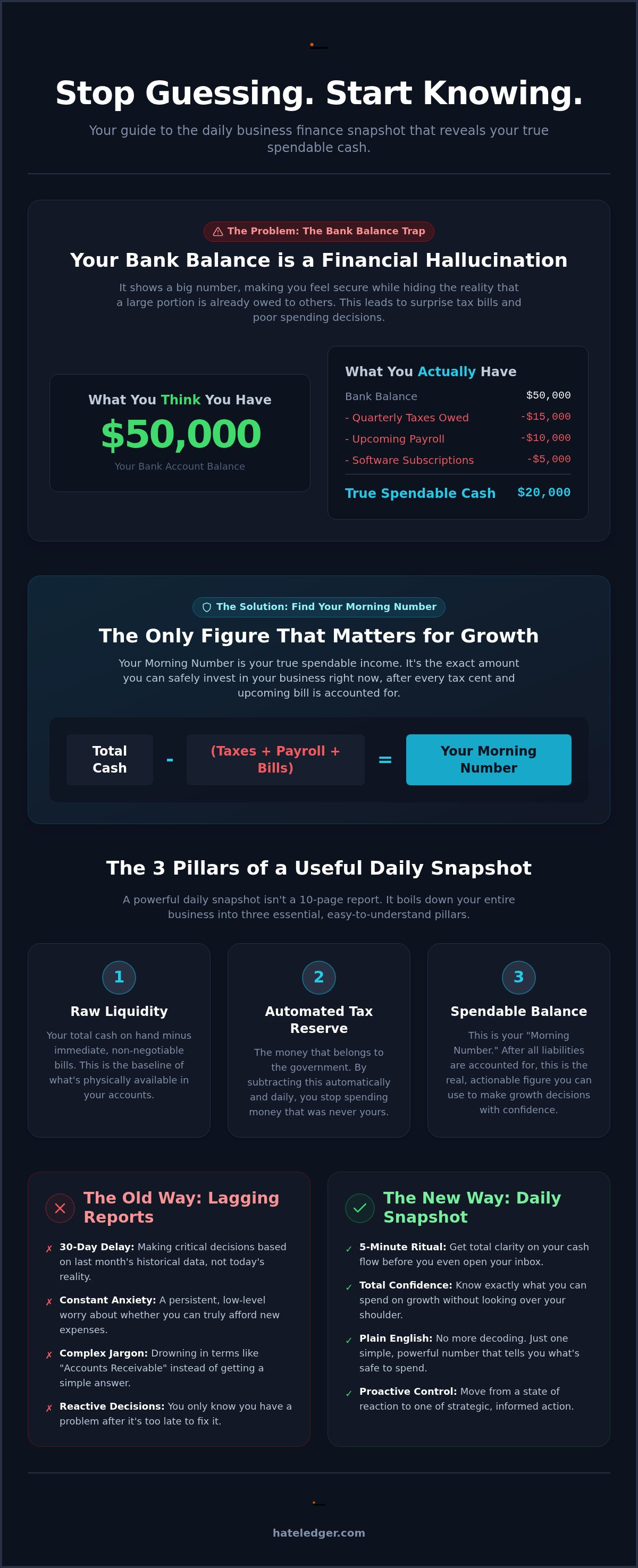
Your bank account is a liar. It presents a high number that makes you feel safe while ignoring the thousands of dollars already earmarked for the IRS, your landlord, and your team. Most founders fall straight into the Bank Balance Trap. You look at a balance of $50,000 and think it's time to hire a new developer. In reality, $15,000 is owed in quarterly taxes, $10,000 is for upcoming payroll, and $5,000 is tied up in software subscriptions. You don't have $50,000. You have $20,000. This is why a daily business finance snapshot is the only way to see the truth.
Traditional snapshots are often just a hallucination of wealth. They show you cash on hand without subtracting the invisible obligations that are already spoken for. When you rely on a monthly Profit and Loss statement, you're looking at a ghost. That data tells you how you performed three weeks ago. It doesn't tell you if you can afford to pay a vendor today. You need a real-time snapshot that accounts for the money that was never yours to begin with.
The Lagging Indicator Problem
Waiting 30 days for an accountant to close your books is a recipe for disaster. It forces you to make critical decisions in a state of financial blindness. This delay creates a constant hum of background anxiety. You never quite know if you're winning or losing until it's too late to change course. A lagging indicator is a piece of data that confirms a trend only after it has already happened. By the time your monthly report arrives, the opportunity to pivot has passed. You need speed, not history.
The Jargon Barrier
Traditional accounting was built for bankers and tax authorities, not for the people actually running the business. Industry terms are often used to mask simple concepts. "Accounts Receivable" is just a fancy way of saying "money people owe me." While understanding financial ratios is useful for long-term analysis or securing a bank loan, those numbers don't help you navigate a Tuesday morning cash crunch. They add layers of complexity where you need radical simplicity. If you're tired of decoding your own data, it's time to look into Accounting Software for People Who Hate Accounting. You deserve a view of your business that speaks plain English and provides a daily business finance snapshot that actually makes sense.
The 3 Pillars of a Useful Daily Business Finance Snapshot
A daily business finance snapshot shouldn't be a 10-page report. It shouldn't include inventory turnover or complex debt-to-equity ratios. Those are for banks. For you, they're just noise. A useful snapshot boils your entire business down to three essential pillars that tell you if you're safe or if you're sinking.
- Pillar 1: Raw Liquidity. This is your total cash minus any immediate, non-negotiable bills. It's the baseline of what's physically available in your accounts.
- Pillar 2: The Automated Tax Reserve. This is the money that belongs to the government. If you don't subtract this first, you're spending someone else's cash.
- Pillar 3: The Spendable Balance. This is the "Morning Number." It's what's left after your taxes, upcoming bills, and payroll are accounted for. This is the only figure that matters for your growth.
These pillars act as a financial safety net. They stop you from making aggressive growth bets with money that is already spoken for. When you see these three numbers every morning, you stop guessing and start operating with total confidence. It's about moving from a state of constant reaction to one of proactive control over your destiny.
Calculating Your Tax Reserve in Real-Time
Most self-employed founders play a dangerous game with a flat 25% or 30% tax rule. It's too high for some months and too low for others. It's a guess that leads to a "Quarterly Tax Panic." Real-time automation solves this by calculating exactly what you owe based on your actual profit every single day. You can learn more about how this works in our guide on the Automated Tax Reserve for Self-Employed. When the reserve is invisible and automatic, the anxiety disappears. You don't have to remember to save; the system does it for you.
From Cash Flow to Spendable Income
Cash flow is a movement, but spendable income is a reality. You might have $10,000 in the bank, but if your upcoming payroll is $6,000 and your software subscriptions total $2,000, you only have $2,000 to spend. Traditional accounting tools often hide these key financial performance measures behind layers of jargon. A daily business finance snapshot strips that away. It prioritizes your mental health by giving you one reliable number. If you want to stop playing accountant and start being a founder again, you can try a simpler way to track your cash. Knowing your true spendable balance is the ultimate metric for peace of mind. It's the difference between "I think we're okay" and "I know we're winning."
Manual vs. Automated Snapshots: Choosing Your Workflow
Choosing how you track your money is a choice between doing the work or letting the work do itself. You can spend 30 minutes every morning fighting a spreadsheet, or you can spend 30 seconds glancing at a dashboard while you wait for your coffee to brew. A manual daily business finance snapshot might feel productive, but it's actually a massive leak in your schedule. If your bookkeeping requires a manual trigger, it won't happen when you're busy. And when you're busy is exactly when you need the data most.
Traditional accounting software isn't much better. These tools often feel like a second job. They demand you log in, click through five menus, and "generate" a report. If you have to work for your data, the data is failing you. True visibility shouldn't require an invitation. It should be waiting for you. The difference between the old way and the new way is the difference between being an operator and being an administrator.
Why Spreadsheets Fail at Scale
Spreadsheets are the ultimate "stale data" trap. The moment you finish typing a number, it's already old. For a growing business, this delay is dangerous. You might make a significant investment based on a formula that broke three weeks ago and nobody noticed. Manual entry is prone to human error, and those errors compound over time. Your time has a specific dollar value. If you're spending hours every month on data entry, you're paying a premium for a system that's likely wrong anyway. It's a false economy that keeps you trapped in the weeds.
The Rise of Invisible Accounting
The game changed when bank syncing became the standard. We call this "Invisible Double-Entry." It's the engine that powers a truly modern daily business finance snapshot without you lifting a finger. By connecting directly to your bank, the software categorizes transactions in real-time. It removes the "I'll do it this weekend" bookkeeping hurdle that kills most small business habits. You don't have to be an expert to see the result. You just need a system that works in the background, keeping your Morning Number accurate while you focus on actually running your business. Your financial truth should be a reflex, not a chore.
How to Build Your 5-Minute Daily Financial Ritual
Most business gurus talk about "financial health" in vague, airy terms. They suggest you "keep an eye" on things without giving you a roadmap. That's a waste of your time. A structured daily business finance snapshot isn't a chore; it's a 300-second habit that protects your future. You don't need to be an accountant to master this. You just need to follow four simple steps before the chaos of your day takes over.
- Step 1: The Morning Check. Open your dashboard before you open your email. Look at your Spendable Balance first. This is your true Morning Number. It tells you exactly what's yours to keep after taxes and bills are stripped away.
- Step 2: Review New Transactions. Spend 60 seconds glancing at what happened yesterday. Your AI should have categorized 95% of it already. Quickly verify anything it missed so your data stays clean.
- Step 3: Check the Decision Engine. Look at your growth metrics. Are you trending toward a surplus? This step moves you from "surviving" to "strategizing."
- Step 4: The "Safe Spend" Decision. If you need new equipment or a software upgrade, look at your Morning Number. If the cash is there, buy it. If it's not, you wait. No guilt. No guessing.
This ritual replaces hours of spreadsheet agony with a few moments of clarity. It ensures your daily business finance snapshot is always accurate and actionable. If you're ready to stop guessing and start knowing, get your Morning Number automated today.
Using the Decision Engine for Growth
Data beats gut feelings every time. When you're considering a new hire, don't just look at your current bank balance. Use your snapshot to see if your profit margins can actually sustain another salary long-term. For a deeper dive into the math of expansion, check out our Small Business Hiring Decision Tool. It helps you transition from "I think we can afford this" to "I know this hire will be profitable." True growth requires a foundation of hard facts, not optimistic projections.
The Psychology of Daily Financial Contact
The "avoidance cycle" is the biggest killer of small businesses. When you're afraid of your numbers, you stop looking at them. This leads to surprises, and surprises in business are rarely good. Daily visibility breaks this cycle. Small, daily corrections are easy to manage. Massive monthly overhauls are exhausting. By facing your numbers for five minutes every morning, you build financial confidence. You stop seeing your accounts as a source of terror and start seeing them as a tool for your success. Clarity is the ultimate cure for founder anxiety.
Hate Ledger: The Daily Snapshot for People Who Hate Accounting
Traditional accounting tools are built for accountants. They're designed to help professionals balance ledgers and file complex returns. But you aren't an accountant. You're a founder. You need a daily business finance snapshot that speaks your language and respects your time. Hate Ledger strips away the complexity to give you the one thing that actually matters: your Morning Number. This isn't just another dashboard. It's a radical simplification of your financial life.
We know the mental load of running a business is heavy enough without adding "amateur bookkeeper" to your resume. That's why we offer a 90-day setup promise. We'll move you from financial chaos to total clarity in three months or less. You don't have to learn a new language or change how you think. You just have to be willing to stop guessing. With our Free Forever Tier, you can start seeing your true spendable balance today without a credit card or a single cent of risk. It's visibility without the baggage.
Automation That Actually Works
The secret behind your daily business finance snapshot is what we call Invisible Double-Entry. While you're sleeping, our platform is busy syncing with your bank accounts and categorizing every transaction. It does the heavy lifting in the background so your numbers are ready when you wake up. You won't find terms like "debits" or "credits" here. We use plain-English descriptors that focus on the real-world result of your spending. If money goes out for a subscription, we call it a subscription. If a client pays you, we call it income. It's a "No Jargon" guarantee that ensures you actually understand what your data is trying to tell you.
Getting Started Today
Onboarding shouldn't be a project. For freelancers and small teams, getting started with Hate Ledger is a matter of minutes, not days. You connect your bank, we run the math, and your Morning Number appears. It's that simple. There are no complex modules to install and no expensive consultants to hire. You get immediate access to the automated tax reserves we discussed earlier, ensuring that every dollar you see is a dollar you can actually keep. If you're tired of the Bank Balance Trap and ready for real confidence, it's time to switch. Get your free Morning Number with Hate Ledger and start making decisions based on facts, not feelings. Your growth depends on it.
Master Your Money and Move Forward
You don't have to be a victim of the Bank Balance Trap. You now know that a true daily business finance snapshot is built on spendable income, not just the cash sitting in your account. By automating your tax reserves and focusing on your Morning Number, you strip away the anxiety that kills founder productivity. You've seen that manual spreadsheets are a slow leak in your schedule. It's time to choose a workflow that works as hard as you do.
We've simplified the entire process with a no-jargon, plain-English interface designed for people who actually run businesses. We offer a 90-day setup promise to get you from confusion to total clarity. There's no risk to start. Our Free Forever Tier is available right now so you can stop flying blind. You deserve a system that protects your profit and fuels your growth without the headache of traditional accounting. Stop guessing and see your Morning Number for free. Your future self will thank you for the clarity. Let's build something great.
Frequently Asked Questions
What is a daily business finance snapshot?
It's a real-time view of your cash flow that subtracts what you owe from what you have. Unlike old-school reports, it shows your true spendable balance every morning. It cuts through the noise of bank balances to show what is actually yours. This daily business finance snapshot ensures you never spend money that is already earmarked for the government or upcoming bills.
How is a financial snapshot different from a balance sheet?
A balance sheet is a static, lagging report designed for bankers. It lists assets and liabilities in a way that feels like a history lesson. A daily business finance snapshot is a decision-making tool. It focuses on immediate liquidity and upcoming obligations so you can act today, not review what happened last month. It prioritizes utility over tradition.
Can I create a financial snapshot in Excel or Google Sheets?
You can, but it's a trap. Manual entry is slow and prone to human error. You'll spend more time fighting broken formulas than making money. While spreadsheets are free, the cost of using stale data is high. Automated systems provide a reliable snapshot without the 30-minute daily data entry chore. Speed matters more than saving a few dollars on software.
How much time does it take to maintain a daily finance snapshot?
If you use automation, it takes about 30 seconds. You glance at your dashboard while your coffee brews. The system handles the bank syncing and categorization in the background. If you're doing it manually, expect to lose 20 to 30 minutes every single day to data entry and reconciliation. A modern daily business finance snapshot should be invisible until you need it.
Do I need an accountant to understand my daily snapshot?
No. We've stripped away the jargon so you don't need a degree to read your own data. You'll see plain-English terms that describe real-world results. While accountants are great for long-term strategy, you shouldn't need a middleman to know if you can afford a new laptop on a Tuesday. Radical simplification means you stay in the driver's seat of your business.
What is the "Morning Number" and why is it important?
The Morning Number is your true spendable balance. It's the amount left in your account after every tax cent and upcoming bill is subtracted. It's important because it prevents the Bank Balance Trap. It gives you the confidence to spend on growth without worrying about a surprise tax bill later. It's the ultimate metric for your daily peace of mind.
How do I factor taxes into my daily financial view?
Use an automated tax reserve. Setting aside a flat percentage is a guess that usually ends in panic. A real snapshot calculates what you owe based on your actual daily profit. It moves that money into a mental reserve so you never see it as spendable cash. This eliminates the quarterly tax surprise and keeps your business safe from the IRS.
Is a daily snapshot accurate enough for big business decisions?
It's more accurate than a monthly P&L because it's real-time. You're making choices based on what's happening now, not what happened 20 days ago. A daily business finance snapshot provides the data-backed foundation you need for hiring, financing, or major equipment purchases. It replaces gut feelings with hard facts. Accuracy comes from consistency, not from waiting for a month-end close.
Frequently Asked Questions
It's a real-time view of your cash flow that subtracts what you owe from what you have. Unlike old-school reports, it shows your true spendable balance every morning. It cuts through the noise of bank balances to show what is actually yours. This daily business finance snapshot ensures you never spend money that is already earmarked for the government or upcoming bills.
A balance sheet is a static, lagging report designed for bankers. It lists assets and liabilities in a way that feels like a history lesson. A daily business finance snapshot is a decision-making tool. It focuses on immediate liquidity and upcoming obligations so you can act today, not review what happened last month. It prioritizes utility over tradition.
You can, but it's a trap. Manual entry is slow and prone to human error. You'll spend more time fighting broken formulas than making money. While spreadsheets are free, the cost of using stale data is high. Automated systems provide a reliable snapshot without the 30-minute daily data entry chore. Speed matters more than saving a few dollars on software.
If you use automation, it takes about 30 seconds. You glance at your dashboard while your coffee brews. The system handles the bank syncing and categorization in the background. If you're doing it manually, expect to lose 20 to 30 minutes every single day to data entry and reconciliation. A modern daily business finance snapshot should be invisible until you need it.
No. We've stripped away the jargon so you don't need a degree to read your own data. You'll see plain-English terms that describe real-world results. While accountants are great for long-term strategy, you shouldn't need a middleman to know if you can afford a new laptop on a Tuesday. Radical simplification means you stay in the driver's seat of your business.
The Morning Number is your true spendable balance. It's the amount left in your account after every tax cent and upcoming bill is subtracted. It's important because it prevents the Bank Balance Trap. It gives you the confidence to spend on growth without worrying about a surprise tax bill later. It's the ultimate metric for your daily peace of mind.
Use an automated tax reserve. Setting aside a flat percentage is a guess that usually ends in panic. A real snapshot calculates what you owe based on your actual daily profit. It moves that money into a mental reserve so you never see it as spendable cash. This eliminates the quarterly tax surprise and keeps your business safe from the IRS.
It's more accurate than a monthly P&L because it's real-time. You're making choices based on what's happening now, not what happened 20 days ago. A daily business finance snapshot provides the data-backed foundation you need for hiring, financing, or major equipment purchases. It replaces gut feelings with hard facts. Accuracy comes from consistency, not from waiting for a month-end close.