
Tax Reserves for Small Business: The No-Nonsense Guide
August 16, 2026 · 17 min read
Your bank balance is lying to you. It shows a total that looks like profit, but a significant portion of that cash already belongs to the IRS. Most founders live in a constant state of financial anxiety, never quite sure if they can afford a new hire or if they're accidentally spending their quarterly payment. You've likely wasted hours in spreadsheets trying to figure out how to calculate tax reserves for small business, only to end up with a guess that still leaves you sweating when tax season arrives.
It's time to stop playing defense with your own money. You deserve a system that runs on autopilot and gives you total permission to spend on growth. This guide delivers a no-nonsense framework to set aside the right amount every time. We'll show you how to find your magic percentage and move toward a system that tells you exactly what's yours to keep. You're about to trade spreadsheet fatigue for permanent peace of mind and a bank account that finally tells the truth.
Key Takeaways
- Stop trusting your bank balance as a growth metric. It's a mix of your profit and the government's money, and you need to separate them before you spend what isn't yours.
- Master how to calculate tax reserves for small business using the 30% rule. This simple percentage covers self-employment obligations and your income tax bracket in one move.
- Set up a dedicated high-yield savings account for your reserves. Keeping your tax cash in a separate bucket ensures it stays out of sight and out of reach until payment day.
- Transition from manual spreadsheets to an automated system. Tracking your reserves in real-time eliminates math fatigue and prevents expensive tax season surprises.
- Shift your focus to your "Morning Number." When your taxes are automated, you know exactly how much cash is safe to reinvest in your business every single day.
The Bank Balance Trap: Why Your Account is Lying to You
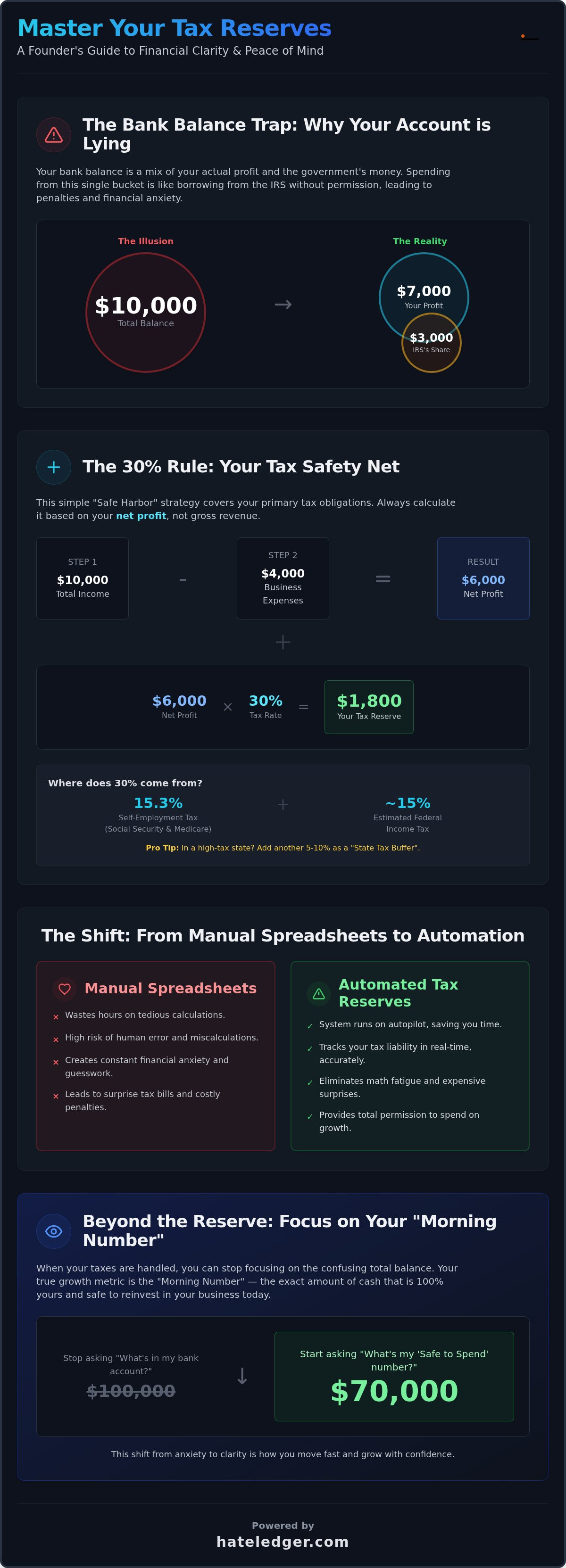
Your business bank account is a liar. It flashes a number that feels like victory, but it's actually a messy mix of your hard work and the government's mandatory cut. Most founders see $10,000 and think they have $10,000. They don't. A huge chunk of that balance is the "Tax Ghost," money that is legally already gone before you even touch it. When you spend that cash on a new laptop or a team dinner, you aren't spending profit. You're borrowing from the IRS at a high interest rate you never agreed to. Understanding how to calculate tax reserves for small business is the only way to kill the ghost and see the truth.
Spending the tax man's money creates a debt cycle that kills small businesses. You use Q1 tax money to pay for Q2 expenses. Then you use Q3 revenue to cover the Q1 tax bill. It's a financial treadmill that only goes faster until you eventually fall off. This is why seeing a raw bank balance is dangerous. It provides a false sense of security that leads to reckless decisions. You need to see what's actually yours, not just what's sitting in the vault. Knowing your true cash position provides a psychological relief that a raw balance never can.
Revenue vs. Spendable Cash
Every dollar that hits your account is immediately split into three specific pieces. One part goes to overhead and operating costs. Another part is your actual profit, which you might keep as retained earnings to fuel future growth. The third part belongs to the tax man. If you treat your main business account as a single spending bucket, you're flying blind. You're effectively operating on a deficit without even knowing it. A tax reserve is a protective financial barrier that ensures your personal stability isn't compromised by business tax obligations.
The Cost of Guessing
Guessing is an expensive habit. The IRS doesn't care if you "didn't know" how much you owed. Underpaying your quarterly estimates triggers penalties and interest that eat your margins from the inside out. Even worse is the mental load. Tax anxiety is a silent killer of bold business moves. You hesitate to hire a new assistant or invest in better software because you're scared of a surprise bill in April. Waiting until the end of the year to find out your true balance isn't a strategy; it's a gamble. Mastering how to calculate tax reserves for small business removes the guesswork and replaces it with a "Safe to Spend" number that allows you to move fast and grow with confidence.
The 30% Rule: How to Calculate Your Tax Reserve Manually
The 30% rule is your baseline for survival. It's the "Safe Harbor" strategy that prevents the IRS from knocking on your door with a collection notice. For most freelancers and solo operators, setting aside 30% of your earnings is the gold standard. This isn't a random number plucked from the air. It covers the 15.3% self-employment tax, which is essentially your price of admission for being your own boss, plus your estimated federal income tax rate. It's a blunt instrument, but it's effective for staying out of debt.
When learning how to calculate tax reserves for small business, the most common mistake is calculating based on gross revenue. That's a rookie move that leaves you cash-poor. You only owe taxes on your net profit. If you brought in $10,000 but spent $4,000 on software, ads, and equipment, you only calculate your 30% on the $6,000 left over. This distinction is vital for your cash flow. As noted in the Tax Guide for Small Business, business expenses are your best friend because they lower your taxable income. Don't forget your state. If you live in a high-tax state, add a 5% "State Tax Buffer" to that 30% to ensure you aren't caught short when state filings come due.
The Basic Tax Reserve Formula
Manual tracking is tedious, but you need a system. Follow these three steps every single month. First, calculate your monthly net profit by subtracting every business expense from your total income. Second, multiply that net profit by 0.30. Finally, move that exact amount to a dedicated "No-Touch" savings account. Do it the moment the money clears. If you wait until the end of the month, that cash will likely disappear into operating expenses. If you want to skip the manual math and move toward a system that runs on autopilot, you can use automated tax reserve software to handle the heavy lifting.
When the 30% Rule Fails
The 30% rule is a guide, not a law. It fails when your business starts winning too much. If your net profit puts you in a higher tax bracket, you might need to push that reserve to 35% or 40%. Conversely, if you have massive equipment deductions, 30% might be overkill. Static percentages are dangerous for seasonal businesses. A high-revenue month in December shouldn't be treated with the same flat logic as a slow July. You need a dynamic approach that adjusts as your profit fluctuates. This is how to calculate tax reserves for small business without leaving yourself vulnerable to bracket creep or sudden cash flow shortages.
Manual Spreadsheets vs. Automated Tax Reserves
Manual spreadsheets are a relic. They demand your time, punish your focus, and reward you with "math fatigue." You spend hours wrestling with cells and formulas just to figure out how to calculate tax reserves for small business. One wrong decimal point turns your safety net into a liability. It's a reactive way to Manage your finances. You shouldn't have to be a part-time accountant to run a full-time business. The old way relies on your memory and your willpower. If you forget to update the sheet after a busy week, your "reserve" is suddenly a work of fiction.
Modern software takes an "invisible" approach. It doesn't wait for you to open a file. It calculates reserves the moment a client pays. Your small business tax estimation software should be proactive. It should tell you what you owe before you even think to ask. This shifts the dynamic from "Quarterly Chores" to "Daily Visibility." You stop guessing and start knowing. Seeing your actual spendable cash every morning changes how you operate. You make decisions based on reality, not a hopeful estimate scribbled on a sticky note.
The Problem with 'Tax Season' Software
Traditional programs are built for the past. They help you file, which is just looking in the rearview mirror to see how much you already messed up. Reserving is about looking forward. You need year-round tax planning software that prepares you for the road ahead. Filing is a legal requirement; reserving is a growth strategy. Most "tax software" is really just a digital version of the 1040 form. It doesn't help you manage cash flow in July; it just tells you why you're broke in April.
The Benefits of Automation
Automation kills human error. It removes the need for "discipline" because the system does the work for you. Using automated tax reserves for the self-employed means you don't need a mid-year check-in with a high-priced accountant just to see if you're on track. The math happens in real-time. If you have a big expense, the system adjusts your reserve immediately. It's dynamic, not static. It gives you the freedom to focus on your work instead of your liabilities. You get a system that runs on autopilot, allowing you to scale without the constant fear of an impending IRS bill.
A 4-Step Checklist for Setting Up Your Tax Safety Net
Setting up a safety net isn't about complex accounting. It's about building a fortress around your profit. You've already learned the basic math of how to calculate tax reserves for small business; now you need to execute. This checklist turns abstract theory into a mechanical process. It protects your cash flow from your own impulses and ensures you're never scrambling in April. Follow these steps to stop reacting to the IRS and start controlling your capital.
- Step 1: Open a 'High-Yield' business savings account. Put your tax money to work while it sits. Ensure this account is dedicated solely to taxes. Keeping it in your primary checking account is a recipe for accidental spending.
- Step 2: Determine your 'Magic Percentage'. Look at your last tax return. Divide your total tax liability by your total income to find your effective rate. This is the most accurate way to handle how to calculate tax reserves for small business because it's based on your actual history, not a generic industry guess.
- Step 3: Establish a 'Transfer Trigger'. Decide exactly when the money moves. This could be weekly, per-invoice, or every time a specific payment clears. The goal is to make the movement of money automatic and predictable.
- Step 4: Audit your reserve every 90 days. Your business isn't static. Revenue changes and expenses fluctuate throughout the year. Review your math every quarter to ensure you aren't over-saving and starving your growth, or under-saving and creating a future crisis.
Setting Up Your Accounts
The "out of sight" rule is your best defense against tax season surprises. Move your tax reserve to a different bank entirely. If you have to wait two days for a transfer to clear, you won't use that money for an "emergency" marketing spend. Name the account something aggressive like "IRS - DO NOT TOUCH." This psychological barrier works. This separation prevents the "borrowing from Peter to pay Paul" trap that kills most startups. When it's time for estimated quarterly payments, pay them directly from this account. Your main checking balance stays stable because that money was never truly yours to begin with.
The Transfer Cadence
Consistency beats intensity every time. For freelancers with irregular income, per-invoice transfers are the gold standard. The moment a payment hits, move your percentage immediately before you have a chance to get attached to it. If your revenue is steady, use the "Friday Sweep." Every Friday morning, calculate your net for the week and move the cut. Treat this transfer like a non-negotiable business expense, just like rent or payroll. You wouldn't skip your lease payment; don't skip your tax obligation. If you're ready to stop doing this manually, you can automate your tax reserves and let the system handle the discipline for you.
Beyond the Reserve: Using Your 'Morning Number' to Grow
Tax reserves aren't just a defensive shield. They're an offensive weapon. Once you stop obsessing over how to calculate tax reserves for small business every single week, your brain finally has room to think about scale. Most founders are paralyzed by "ghost money." They see a large balance and hesitate to hire because they don't know what's actually theirs to keep. When your tax reserve is automated, that hesitation vanishes. You gain a higher risk tolerance because your financial floor is protected. You aren't just surviving tax season; you're finally strategizing for the next decade of growth.
This is where the "Morning Number" changes everything. At Hate Ledger, we ignore the dry, detached professionalism of traditional ledgers. We focus on the "Safe to Spend" amount. It's the ultimate evolution of the manual tax reserve. Our system subtracts your taxes, your operating costs, and your future liabilities in real-time. It's the truth, delivered to your dashboard every morning. It turns your bank balance from a guessing game into a reliable tool for expansion.
The Decision Engine
Your reserve data is a decision engine. It tells you exactly when to pull the trigger on major equipment purchases or a new marketing campaign. Instead of guessing if you can afford a new head of sales, you can use the Human Capital ROI Engine to see the real-world impact of your team's performance. A clear understanding of how to calculate tax reserves for small business is the foundation of any 90-day growth plan. It provides the clarity needed to make bold moves without the fear of a surprise bill. You move from a state of constant anxiety to a state of calculated aggression.
Starting for Free
You don't need a massive budget or an accounting degree to get organized. You can start with our Free Forever Tier to get your reserves automated without even reaching for a credit card. We provide a 90-day setup promise for founders who are tired of being accidental accountants. It's time to stop wasting hours in spreadsheets and start focusing on the work you actually love. Ditch the manual math. Stop playing defense. Start being the founder your business needs you to be.
Take Command of Your True Profit
You now have the framework to stop the debt cycle. Your bank balance isn't your spending limit; it's a raw number that needs filtering. By mastering how to calculate tax reserves for small business, you've moved past the bank balance trap and into a position of power. Remember the core pillars: separate your tax cash into a dedicated account, use a realistic percentage based on net profit, and move away from manual tracking as soon as possible. These steps ensure your business remains a source of wealth rather than a source of anxiety.
The transition from a manual spreadsheet to an automated engine is what separates struggling operators from scaling founders. You shouldn't be losing sleep over the IRS or wasting hours in a spreadsheet on a Friday night. You need a system that delivers a daily Morning Number so you can reinvest in your growth with total confidence. No more jargon. No more surprises. Just results that protect your personal life and fuel your business.
Stop guessing and start spending safely with Hate Ledger; get started for free.
You've done the hard work of building a business. Now it's time to enjoy the peace of mind that comes with knowing exactly where you stand. Your future self will thank you for making the switch today.
Frequently Asked Questions
What is the simplest way to calculate my small business tax reserve?
Use a flat percentage of your monthly net profit. For most solo operators, 30% is the magic number that covers both self-employment and income taxes. You take your income, subtract your expenses, and multiply the remainder by 0.30. It's a blunt tool that works. This eliminates the need for complex spreadsheets and gives you a clear target to hit every time you get paid.
Should I calculate tax reserves based on my gross income or net profit?
Always calculate based on net profit. You only owe taxes on what you keep after business expenses are paid. Calculating based on gross income will lead to over-saving, which starves your business of the cash it needs for growth. Subtract your overhead, software costs, and marketing spend first. Then apply your reserve percentage to the remaining amount to see your true tax obligation.
How much should a self-employed person set aside for taxes in 2026?
Set aside at least 30% of your net profit to stay safe. This figure accounts for the 15.3% self-employment tax plus a baseline for federal income tax. Depending on your state, you might need to bump this to 35% to cover local requirements. Understanding how to calculate tax reserves for small business means staying ahead of these rates so you aren't hit with a massive bill in April.
Do I really need a separate bank account for my tax reserves?
Yes, you absolutely need a separate account to prevent accidental spending. Keeping tax money in your main operating account creates a false sense of wealth. When the money is out of sight, it stays out of mind until it's time to pay the IRS. Use a high-yield savings account at a different bank. This physical and psychological barrier is the best defense against the "bank balance trap."
What happens if I don't set aside enough money for my quarterly taxes?
You face underpayment penalties and mounting interest from the IRS. If you miss your marks, the government adds a percentage-based fine to your total bill. This creates a debt cycle that's hard to break. Beyond the money, you suffer from constant financial anxiety. You'll hesitate to make big moves because you're scared of a surprise bill that your current balance can't cover.
Can I use accounting software to automate my tax reserve transfers?
Automation is the only way to ensure 100% consistency. Manual transfers rely on your discipline, which eventually fails during busy seasons. Modern software can track your income in real-time and move the correct percentage to your reserve automatically. This is how to calculate tax reserves for small business without the manual labor. It turns a quarterly chore into an invisible system that runs silently in the background.
Is 30% enough for both federal and state tax reserves?
It depends on your location and total income. For most founders, 30% covers the essentials, but high-earners in states like California or New York should aim for 35% or 40%. Check your effective tax rate from last year to be certain. If your business is growing fast, a flat 30% might leave you short as you move into higher federal tax brackets. Always audit your percentage quarterly.
How often should I move money into my tax reserve account?
Move the money as soon as a payment clears. Waiting until the end of the month is a mistake because the cash often gets swallowed by operating expenses. Per-invoice transfers are the most effective way to maintain a true safety net. If you have high transaction volume, a "Friday Sweep" works well. The goal is to move the money before you get attached to it.
Frequently Asked Questions
Use a flat percentage of your monthly net profit. For most solo operators, 30% is the magic number that covers both self-employment and income taxes. You take your income, subtract your expenses, and multiply the remainder by 0.30. It's a blunt tool that works. This eliminates the need for complex spreadsheets and gives you a clear target to hit every time you get paid.
Always calculate based on net profit. You only owe taxes on what you keep after business expenses are paid. Calculating based on gross income will lead to over-saving, which starves your business of the cash it needs for growth. Subtract your overhead, software costs, and marketing spend first. Then apply your reserve percentage to the remaining amount to see your true tax obligation.
Set aside at least 30% of your net profit to stay safe. This figure accounts for the 15.3% self-employment tax plus a baseline for federal income tax. Depending on your state, you might need to bump this to 35% to cover local requirements. Understanding how to calculate tax reserves for small business means staying ahead of these rates so you aren't hit with a massive bill in April.
Yes, you absolutely need a separate account to prevent accidental spending. Keeping tax money in your main operating account creates a false sense of wealth. When the money is out of sight, it stays out of mind until it's time to pay the IRS. Use a high-yield savings account at a different bank. This physical and psychological barrier is the best defense against the "bank balance trap."
You face underpayment penalties and mounting interest from the IRS. If you miss your marks, the government adds a percentage-based fine to your total bill. This creates a debt cycle that's hard to break. Beyond the money, you suffer from constant financial anxiety. You'll hesitate to make big moves because you're scared of a surprise bill that your current balance can't cover.
Automation is the only way to ensure 100% consistency. Manual transfers rely on your discipline, which eventually fails during busy seasons. Modern software can track your income in real-time and move the correct percentage to your reserve automatically. This is how to calculate tax reserves for small business without the manual labor. It turns a quarterly chore into an invisible system that runs silently in the background.
It depends on your location and total income. For most founders, 30% covers the essentials, but high-earners in states like California or New York should aim for 35% or 40%. Check your effective tax rate from last year to be certain. If your business is growing fast, a flat 30% might leave you short as you move into higher federal tax brackets. Always audit your percentage quarterly.
Move the money as soon as a payment clears. Waiting until the end of the month is a mistake because the cash often gets swallowed by operating expenses. Per-invoice transfers are the most effective way to maintain a true safety net. If you have high transaction volume, a "Friday Sweep" works well. The goal is to move the money before you get attached to it.