
New Business Accounting Setup: The 2026 Founder's Guide
September 22, 2026 · 14 min read
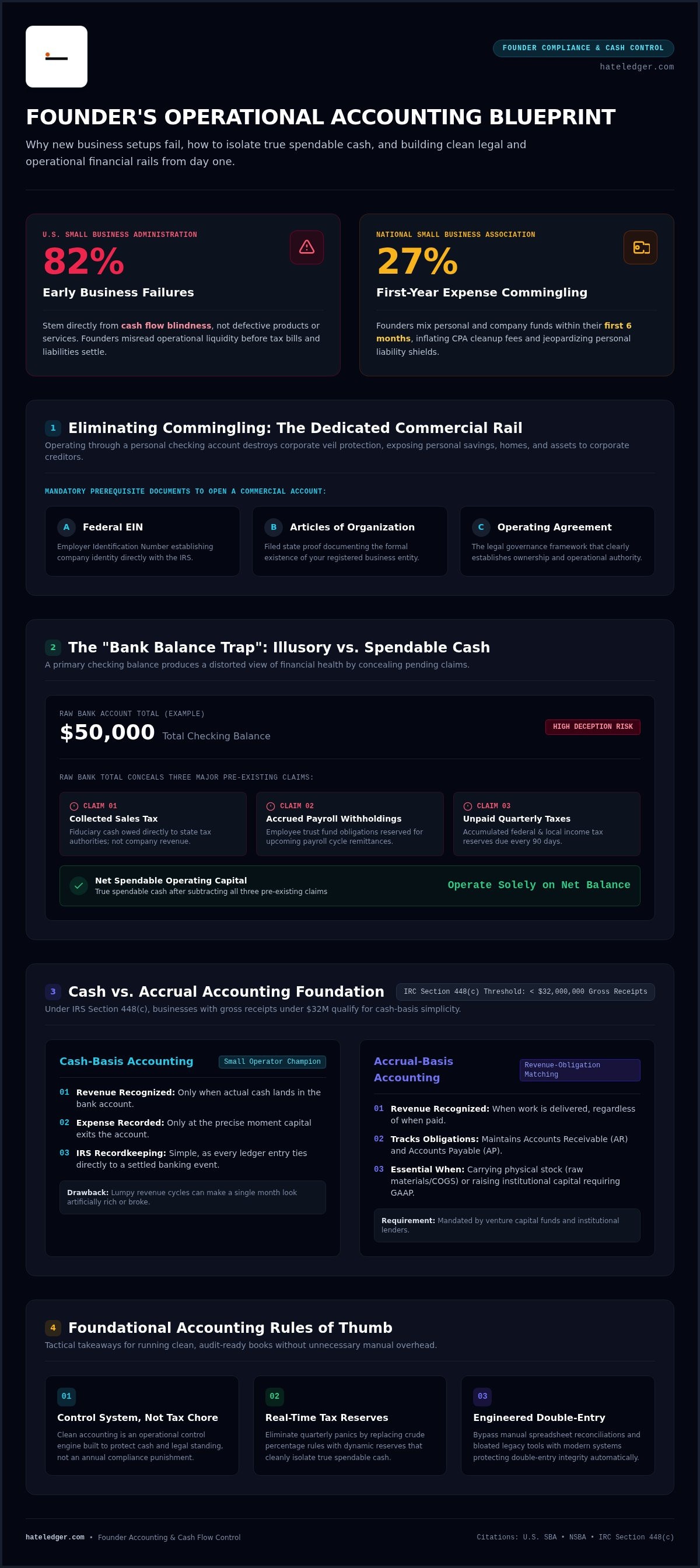
According to the U.S. Small Business Administration, roughly 82% of early business failures stem directly from cash flow blindness, not bad products. Yet most founders treat financial admin like a mandatory punishment. If you are looking for how to set up accounting for a new business, you probably dread decoding complex debits, credits, and endless ledger jargon. You fear an unexpected tax bill wiping out your operating account, and you don't have weeks to learn bloated legacy software. You shouldn't have to become a bookkeeper just to keep your company alive.
You can run a clean, compliant operation without drowning in paperwork. In this 2026 founder's guide, you'll learn how to establish a bulletproof, jargon-free accounting setup from day one without manual spreadsheets or outdated tools. We will walk through the exact operational steps to cleanly separate your personal funds, automate your tax reserves, and maintain audit-ready books while knowing your exact spendable cash every single morning.
Key Takeaways
- Accounting is an operational control system, not an annual tax chore. Clean separation of personal and company funds from day one protects your liability and saves hours of expensive cleanup.
- Choosing between cash and accrual accounting dictates your daily operational visibility. Pick the foundation that fits your business model without getting tangled in compliance confusion.
- Follow an actionable blueprint on how to set up accounting for a new business, establishing clean banking rails and automated feeds that bypass manual reconciliations.
- Eliminate quarterly tax panics by replacing crude percentage rules with real-time tax reserves that clearly isolate your actual spendable operating cash.
- Ditch manual spreadsheet maintenance and bloated legacy software in favor of modern, plain-English systems that protect accounting integrity behind the scenes.
Laying the Groundwork: Why Most New Business Accounting Setups Fail Early
Most founders treat setup as an annual tax obligation. That mindset kills companies. Real accounting setup is not a tax-filing chore; it is an operational control engine built to protect your cash and legal standing. True business accounting setup establishes absolute cash clarity while creating an impenetrable legal shield between your company and personal assets.
According to the National Small Business Association, over 27% of first-year founders commingle personal and business expenses during their first six months. That single shortcut ruins balance sheets, inflates CPA cleanup fees, and exposes personal wealth. When learning how to set up accounting for a new business, your day-one objective is building clean boundaries, not memorizing journal entries.
Eliminating Commingling: The Dedicated Business Account Mandate
Operating out of a personal checking account destroys the liability shield of an LLC or corporation. In court, commingling funds allows creditors to pierce the corporate veil, exposing your personal savings, home, and personal assets to corporate debts. To open a true commercial account, you need three core documents:
- Federal Employer Identification Number (EIN): Your business identity with the IRS.
- Filed Articles of Organization: Proof of your registered business entity.
- Operating Agreement: The governance framework defining ownership and operational rights.
Swiping personal cards for enterprise software or inventory creates immediate friction. You lose clean receipt trails, complicate deductions, and waste hours unravelling mixed statements. Separate accounts create clean data at the source.
The Bank Balance Trap: Why Current Accounts Deceive Founders
Checking your primary bank balance gives you a dangerously distorted view of operational health. A $50,000 checking balance does not mean you have $50,000 to spend. That top-line figure routinely conceals three massive pending claims: collected sales tax, accrued payroll withholdings, and unpaid quarterly income taxes. None of that money belongs to you.
Relying on raw bank totals breeds false confidence. When unexpected tax bills land, cash-blind businesses scramble or take on expensive debt to survive. Modern systems rely on a robust double-entry bookkeeping system to track what you own versus what you owe behind the scenes. Successful operators ignore gross account balances and run their daily operations based strictly on net spendable capital.
Cash vs. Accrual Accounting: Selecting Your Operating Foundation
Picking your accounting method feels like a massive fork in the road. It shouldn't. Stripped of theoretical fluff, the decision hinges on a single question: do you track money when it actually hits your account, or when you earn it?
Under Section 448(c) of the Internal Revenue Code, the IRS allows businesses with average annual gross receipts under $32,000,000 to use the cash method. That covers virtually every new company. You don't need complex accrual workflows unless your business model specifically demands them. When deciding how to set up accounting for a new business, choose the method that gives you the cleanest visibility without creating unnecessary manual admin.
Cash-Basis Accounting: The Simplicity Champion for Small Operators
Cash accounting recognizes income only when dollars land in your bank, and expenses only when money exits. If you invoice a client today but they pay next month, that cash counts next month. It aligns your books directly with your bank balance. Adhering to baseline IRS recordkeeping requirements is far simpler because every recorded transaction ties directly to a settled banking event. The main drawback? Lumpy revenue cycles can make a single month look artificially rich or broke.
Accrual-Basis Accounting: Matching Revenues to Obligations
Accrual connects revenue to the exact moment you deliver work, regardless of when the client pays. It tracks accounts receivable (uncollected cash) and accounts payable (unpaid debts). Accrual becomes essential if you:
- Carry physical stock: Tracking raw materials and cost of goods sold accurately across production cycles.
- Raise institutional capital: Venture funds and institutional lenders demand GAAP-compliant accrual statements.
- Bill on long terms: Preventing wild swings in monthly profitability when managing net-60 enterprise accounts.
The trap is forcing yourself to manually calculate accrual mechanics. You shouldn't spend nights balancing unearned revenue or complex journals. Modern founders use platforms like Hate Ledger to automate the underlying double-entry logic behind plain-English inputs, giving you rock-solid financial records without the traditional accounting overhead.
The 5-Step Operational Blueprint for Setting Up Your Books
Setting up your financial plumbing shouldn't take weeks. Legacy vendors drag you through dozens of configuration menus and manual ledger adjustments. You don't need accounting credentials to get this right. Follow this five-step sequence when mapping out how to set up accounting for a new business:
- Lock in your business identity: Grab your federal EIN and register with state revenue authorities.
- Isolate your operational capital: Follow federal guidelines on opening a dedicated business bank account alongside a separate reserve account for upcoming taxes.
- Sync direct bank feeds: Connect credit cards and deposit accounts to pull live transaction data without manual statement imports.
- Deploy a lean chart of accounts: Track only high-impact categories rather than building complex, multi-tiered ledgers.
- Standardize receivables and payables: Automate invoices and configure payout splits from merchant processors like Stripe to avoid gross-versus-net discrepancies.
Executing these steps cleanly turns accounting into a background background engine that works automatically.
Constructing a Pain-Free Chart of Accounts
Accountants love creating hundreds of granular categories. Avoid that trap. Micro-categorization adds administrative drag without offering actionable insights. Group your outgoing cash into four straightforward operating buckets:
- Direct Delivery Costs: Software, contractors, and raw hosting needed to fulfill client contracts.
- Customer Acquisition: Advertising, outreach tools, and marketing spend.
- Operating Overhead: Legal, productivity platforms, hardware, and routine admin subscriptions.
- Owner Distributions: What you pay yourself out of company net profit.
Keep your chart lean. If a categorization choice doesn't help you make an operational decision, collapse it into a broader parent bucket.
Automating Expense Capture and Digital Receipt Hygiene
According to the FreshBooks Small Business Report, founders manually tracking receipts spend 11 to 15 hours every month on bookkeeping. That is pure waste. Modern IRS substantiation rules don't require paper receipts stuffed into physical shoe boxes. Digital images capturing the date, vendor, amount, and business purpose satisfy compliance standards for travel, meals, and major equipment purchases.
Ditch paper completely. Configure cloud storage or ledger sync to archive digital invoices automatically upon purchase. Then, schedule a five-minute review every Friday to glance over auto-categorized charges. Catching occasional outliers weekly keeps your books audit-ready while freeing up two full workdays each month.
Mastering Cash Flow and Tax Reserves Without Flying Blind
Surviving your first year requires solving the cash flow riddle before it breaks you. Profit on paper means nothing if your bank account is empty when tax bills arrive. Most new operators fail here because they rely on outdated rules of thumb, like socking away an arbitrary 30% of every customer invoice. That static approach fails during uneven revenue cycles. It ignores dynamic write-offs, creates artificial cash shortages during lean months, and leaves you vulnerable when revenue spikes.
Instead of guessing, dynamic tax reserving automatically isolates tax obligations in real time as money clears. To see how to implement this rhythm without manual spreadsheets, check out our automated tax reserve guide. Knowing how to set up accounting for a new business means installing guardrails that defend your working capital every hour of the day.
The Reality of Quarterly Estimated Taxes for New Businesses
The IRS expects its cut every quarter, not just in April. As a pass-through entity, your profit faces both ordinary income tax and the self-employment tax rate of 15.3% on net earnings up to $184,500. Add state liabilities, and your effective rate climbs quickly. Missing quarterly estimated deadlines triggers immediate underpayment penalties.
To stay protected, track IRS safe harbor thresholds: pay at least 90% of your current year liability or 100% of your prior year tax bill (110% for higher earners). Waiting until annual tax season to tally your numbers creates sudden, catastrophic cash crunches that wipe out your operating runway.
Calculating Your Daily Spendable Capital
Traditional profit-and-loss statements are historical autopsies. They tell you what happened three weeks ago, not what you can spend before lunch today. Real operational clarity requires knowing your true spendable capital: gross cash minus locked tax reserves, upcoming payroll, and recurring operational commitments.
- Eliminates emotional spending: Prevents hiring contractor support or signing software leases based on temporary cash bulges.
- Guarantees tax liquidity: Ensures quarterly IRS payments leave your primary operations completely undisturbed.
- Replaces backward reports: Trades lagging monthly reconciliations for live daily visibility.
When you know your exact spendable number each morning, you stop second-guessing every operational decision. Ready to stop guessing your balances? Lock in your automated financial visibility with Hate Ledger today.
Choosing Your Stack: Spreadsheets vs. Legacy Bloatware vs. Plain-English Platforms
Founders face three distinct routes when establishing their financial stack: manual spreadsheets, legacy enterprise software, or modern plain-English platforms. Choosing the wrong path creates immediate operational drag. Determining how to set up accounting for a new business comes down to selecting a system that protects your time rather than consuming it.
Legacy accounting suites were engineered in the 1990s for professional accountants, not pragmatic operators. They bury basic functions under labyrinthine menus, obscure debit-credit journals, and steep subscription hikes. You end up paying for enterprise features you will never touch while losing hours trying to decode basic reports.
Why Spreadsheets Break Under Real Business Demands
Spreadsheets look appealing on day one because they cost zero dollars upfront. That free price tag is an illusion. As transaction volume scales, manual workbooks break down fast:
- Formula rot: A single accidentally overwritten formula corrupts months of cash data without warning.
- Zero audit protection: Static cells offer no immutable ledger trails or automated timestamping to substantiate expenses during a tax review.
- Wasted operational hours: Typing bank statement entries by hand drains high-value time away from acquiring customers.
Manual entry is a self-imposed founder tax. The moment your transaction volume expands, spreadsheet maintenance becomes an unsustainable liability.
The Rise of Plain-English Financial Platforms
The modern alternative bypasses legacy clutter entirely. Next-generation platforms use invisible double-entry architecture, maintaining full GAAP compliance behind functional, everyday terms like income, costs, and spendable capital. You get rock-solid books without deciphering accountant shorthand.
Instead of wrestling with balance sheets, you wake up to automated daily summaries that tell you what you can safely spend today. If you want a setup that handles the heavy lifting without burying you in administrative tasks, explore modern accounting software for people who hate accounting. Learning how to set up accounting for a new business shouldn't turn you into an amateur bookkeeper; it should free you to build your company.
Put Your Financial Plumbing on Autopilot
Setting up your company's financial core doesn't require an accounting degree or painful hours in broken spreadsheets. Mastering how to set up accounting for a new business boils down to three non-negotiable habits: isolating personal funds from day one, locking away tax liabilities automatically as revenue lands, and choosing tools that handle ledger mechanics invisibly.
You don't have to tolerate clunky legacy software or late-night manual reconciliations just to stay compliant. With invisible double-entry bookkeeping keeping your books audit-ready automatically, you get pure operational clarity without the jargon. Wake up to an automated daily morning number calculating safe spendable cash so you always know your exact operating runway. Protect your focus, take the friction out of bookkeeping, and launch on the Free Forever tier with zero credit card required to begin. Start your hassle-free accounting setup with Hate Ledger and build your business with total financial confidence.
Frequently Asked Questions
Can I use my personal bank account when starting a new business?
No, you should never run business transactions through a personal account. Commingling funds destroys the corporate veil that shields your personal assets from commercial liabilities and business debts. It also turns tax season into an expensive mess of manual reconciliations. Open a dedicated business checking account as soon as you receive your EIN. Keeping accounts separate from day one protects your personal assets and guarantees clean financial records.
Do I need to hire a bookkeeper or CPA immediately upon launching?
No, most early-stage founders don't need an expensive human bookkeeper on day one. When learning how to set up accounting for a new business, modern software can easily automate bank syncs, expense tagging, and tax reserves without manual entry. You may still want a CPA to handle annual tax filing or complex corporate structuring, but paying monthly retainers for basic bookkeeping early on burns valuable operating cash.
What is the difference between single-entry and double-entry bookkeeping?
Single-entry bookkeeping works like a personal checkbook register, recording incoming cash and outgoing payments as single positive or negative numbers. Double-entry bookkeeping records every transaction twice, logging an offsetting debit and credit across your assets, liabilities, or equity. While single-entry is simple, double-entry maintains total balance integrity and prevents errors. Modern software manages double-entry rules invisibly in the background, giving you audit-ready books without confusing ledger mechanics.
How much money should a new business set aside for taxes?
Aim to isolate roughly 25% to 30% of your net profits rather than your top-line revenue. Pass-through entities face self-employment tax alongside standard federal and state brackets. Locking away a flat percentage of gross sales can needlessly starve your working capital, while saving nothing invites sudden quarterly penalties. Dynamic reserving is far safer, holding back tax cash in real time based on actual profits after accounting for deductible operating expenses.
What accounting records does the IRS require small business owners to keep?
The IRS requires documentation that substantiates all gross revenue, operational expenses, asset purchases, and claimed deductions. This includes bank statements, vendor receipts, merchant summaries, payroll records, and written business purposes for travel or meals. You don't need physical file cabinets; clear digital records securely stored in cloud software satisfy federal standards. Maintain these supporting documents for at least three to seven years to stay audit-ready.
Can I set up my business accounting using free spreadsheet templates?
You can start on a spreadsheet, but doing so creates immediate operational risks. Free templates lack live bank connections, break easily when formulas get accidentally overwritten, and offer no tamper-evident audit trails. As customer activity grows, manual entry becomes an exhausting time sink. Knowing how to set up accounting for a new business means investing in automated software early so you don't waste weekends typing statement numbers by hand.
When is the right time to transition from cash-basis to accrual-basis accounting?
Switch to accrual accounting when your business model demands it, particularly if you manage physical inventory or plan to raise venture capital. Cash-basis works cleanly for solopreneurs and straightforward service agencies. If you invoice corporate accounts on extended net-30 or net-60 terms, accrual gives you a far more accurate view of earned revenue versus unpaid commitments. Make the transition before scaling your payroll or pitching institutional investors.
Frequently Asked Questions
No, you should never run business transactions through a personal account. Commingling funds destroys the corporate veil that shields your personal assets from commercial liabilities and business debts. It also turns tax season into an expensive mess of manual reconciliations. Open a dedicated business checking account as soon as you receive your EIN. Keeping accounts separate from day one protects your personal assets and guarantees clean financial records.
No, most early-stage founders don't need an expensive human bookkeeper on day one. When learning how to set up accounting for a new business, modern software can easily automate bank syncs, expense tagging, and tax reserves without manual entry. You may still want a CPA to handle annual tax filing or complex corporate structuring, but paying monthly retainers for basic bookkeeping early on burns valuable operating cash.
Single-entry bookkeeping works like a personal checkbook register, recording incoming cash and outgoing payments as single positive or negative numbers. Double-entry bookkeeping records every transaction twice, logging an offsetting debit and credit across your assets, liabilities, or equity. While single-entry is simple, double-entry maintains total balance integrity and prevents errors. Modern software manages double-entry rules invisibly in the background, giving you audit-ready books without confusing ledger mechanics.
Aim to isolate roughly 25% to 30% of your net profits rather than your top-line revenue. Pass-through entities face self-employment tax alongside standard federal and state brackets. Locking away a flat percentage of gross sales can needlessly starve your working capital, while saving nothing invites sudden quarterly penalties. Dynamic reserving is far safer, holding back tax cash in real time based on actual profits after accounting for deductible operating expenses.
The IRS requires documentation that substantiates all gross revenue, operational expenses, asset purchases, and claimed deductions. This includes bank statements, vendor receipts, merchant summaries, payroll records, and written business purposes for travel or meals. You don't need physical file cabinets; clear digital records securely stored in cloud software satisfy federal standards. Maintain these supporting documents for at least three to seven years to stay audit-ready.
You can start on a spreadsheet, but doing so creates immediate operational risks. Free templates lack live bank connections, break easily when formulas get accidentally overwritten, and offer no tamper-evident audit trails. As customer activity grows, manual entry becomes an exhausting time sink. Knowing how to set up accounting for a new business means investing in automated software early so you don't waste weekends typing statement numbers by hand.
Switch to accrual accounting when your business model demands it, particularly if you manage physical inventory or plan to raise venture capital. Cash-basis works cleanly for solopreneurs and straightforward service agencies. If you invoice corporate accounts on extended net-30 or net-60 terms, accrual gives you a far more accurate view of earned revenue versus unpaid commitments. Make the transition before scaling your payroll or pitching institutional investors.