Bookkeeping Automation for Small Business: 5 Myths Killing Your Profit in 2026
August 26, 2026 · 17 min read
Most small business owners are actually just unpaid, overworked data entry clerks in disguise. You didn't start your company to babysit spreadsheets or lose sleep over whether your cash balance is "safe to spend." It's 2026, and clinging to manual bookkeeping automation for small business is costing you more than just time. It's draining your mental energy and killing your profit. You're exhausted by the friction, and frankly, you should be. You want to run your business, not an accounting department.
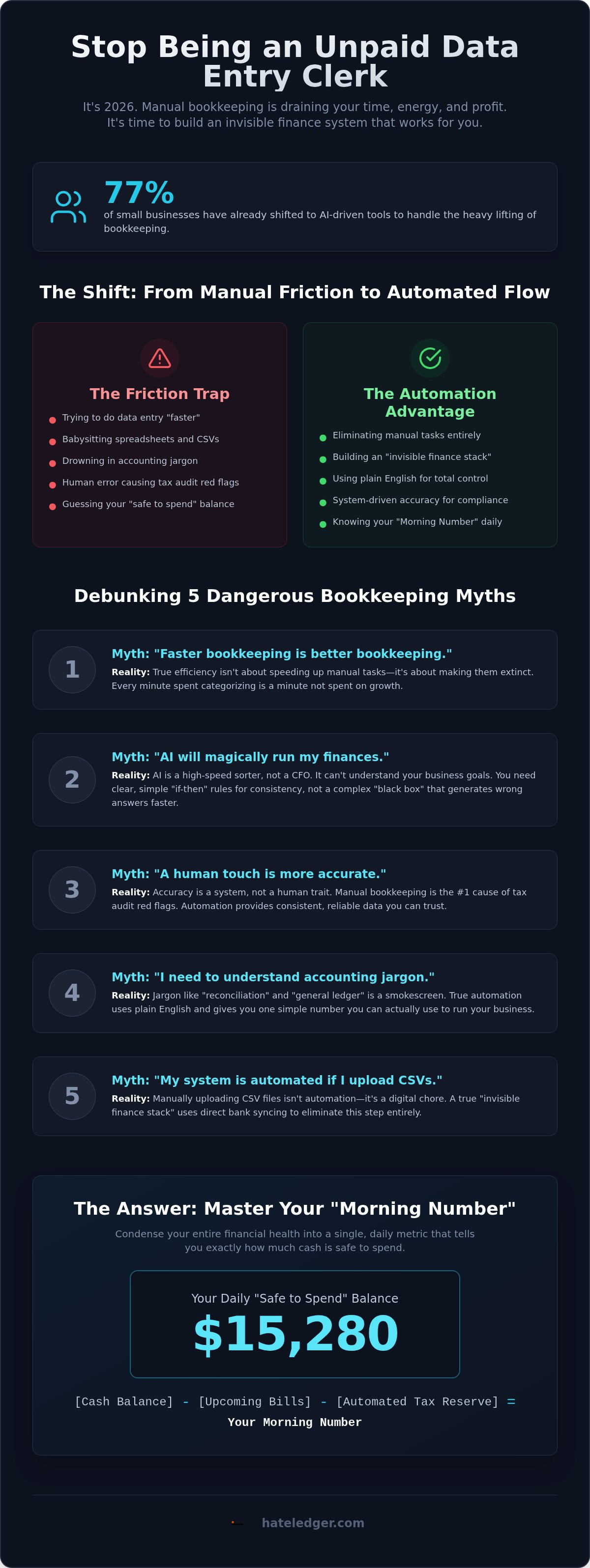
We believe accounting should be invisible. You deserve a system that works in the background while you focus on growth. Recent reports show that 77% of small businesses have already shifted to AI-driven tools to handle the heavy lifting. This article will expose five dangerous myths that keep you stuck in the manual past. We'll show you how to trade the jargon for plain English and the anxiety for total control. It's time to stop playing accountant and start making moves based on real data. Let's get your time back.
Key Takeaways
- Stop trying to do data entry faster. Learn why real efficiency means deleting manual tasks from your workflow entirely.
- AI is a tool, not a brain. Discover how to turn bookkeeping automation for small business into a decision engine that actually guides your hiring and spending.
- Accuracy is a system, not a human trait. See why manual bookkeeping is the number one cause of tax audit red flags and how to fix it.
- Build an invisible finance stack. Stop the CSV uploads and start using automated tax reserves to keep your spending money separate from the government's money.
- Master the "Morning Number." Learn how to condense your entire financial health into a single, daily metric that tells you exactly how much cash is safe to spend.
The Great Efficiency Lie: Why Faster Bookkeeping Isn't Better Bookkeeping
Efficiency is the most expensive word in your business. It sounds productive. It feels like progress. But for most founders, "efficient bookkeeping" just means spending two hours on a Sunday instead of four. That is still two hours too many. True bookkeeping automation for small business isn't about making manual tasks faster; it's about making them extinct. If your software still asks you to "categorize" every single cup of coffee or digital subscription, it isn't automating your life. It's just nagging you more efficiently.
The reality is simple. True automation removes the need for data entry entirely. It creates an invisible environment where your financial data flows, sorts, and settles while you sleep. You didn't start a company to become a part-time clerk. Every minute you spend hovering over a spreadsheet is a minute you aren't selling, hiring, or scaling. Efficiency is a trap because it keeps you involved in a process you should have deleted months ago.
The 'Faster Accountant' vs. The 'Invisible Ledger'
Traditional software is built for accountants, not for you. It uses a "faster shovel" approach. It assumes you want to be intimately involved with every decimal point and bank feed. But you're a founder. Your time is worth more than the $20 an hour you're saving by doing it yourself. The goal isn't "automated entry" where you still have to click "confirm" a thousand times. The goal is automated insight.
An invisible ledger doesn't just record what happened; it tells you what it means. Transitioning from a manual mindset to a decision-first mindset is the only way to survive in 2026. You need to stop looking at what happened thirty days ago and start looking at what you can afford to do today. If your bookkeeping automation for small business doesn't give you that clarity instantly, it's just a digital paperweight.
Why Jargon is the Real Enemy of Automation
Jargon is a smoke screen. Terms like "reconciliation" and "general ledger" exist to make simple math feel like a secret society. This complexity serves the legacy industry, not your bottom line. When you spend your mental energy trying to navigate a complex Accounting information system, you aren't being a CEO. You're playing a role you never applied for. The cost of "playing accountant" is the slow death of your creative edge.
True automation uses plain English. It tells you if you're safe to spend or if you need to pull back. It replaces the "general ledger" with a "Morning Number" you can actually use. If you're tired of the noise and the endless clicking, it's time to switch to Accounting Software for People Who Hate Accounting. Stop counting. Start leading.
The 'AI Magic' Trap: Why Your Automation Still Needs a Brain
AI is the biggest buzzword in 2026, but it's also the most dangerous. Many founders fall into the trap of thinking a "smart" system will magically understand their business strategy. It won't. AI is exceptionally good at categorization, but it doesn't have a pulse on your goals. It can put a receipt in a digital folder, but it can't tell you if that expense actually moved the needle for your growth. To truly scale, you need to understand what accounting automation is at its core. It is a high speed sorter, not a CFO.
The danger here is "black box" accounting. This happens when numbers appear on your screen and you have no idea how they got there. If you can't trace the logic, you can't trust the result. Relying on bookkeeping automation for small business without a clear set of rules leads to expensive mistakes at tax time. Clean data is the only foundation that matters. Without it, your automation is just a faster way to generate wrong answers.
Rules vs. Intelligence: Knowing the Difference
Complex AI models often hallucinate or overcomplicate simple transactions. For a small business, basic "if-then" rules are often more reliable than a neural network. If a transaction comes from a specific vendor, it belongs in a specific bucket. You don't need "intelligence" for that; you need consistency. This starts with direct bank syncing. If you are still manually uploading CSV files, you aren't using automation. You're just doing digital chores.
Your system should also provide a "Human Capital ROI" view. Most owners treat payroll as a giant, terrifying lump sum. You need to see exactly what your labor costs are producing in real time. This isn't about being a spreadsheet nerd. It's about knowing if your team is an investment or a drain. You can start tracking these vital signs with our Free Forever Tier to see the difference between data and insight.
The Decision Engine: Turning Data into Action
Profit is a vanity metric if it doesn't lead to a decision. Knowing you made money last month is fine, but knowing if you can afford to hire a new lead developer today is what actually runs a company. Automation must act as a decision engine. It should answer the "Can I afford this?" question before you even finish the thought.
Most software stops at the report. It gives you a PDF and leaves the hard part to you. That's not a solution; it's a homework assignment. You need a system that translates those rows of numbers into actionable moves. If you're stuck wondering if it's time to expand, use a Small Business Hiring Decision Tool to get a clear yes or no. Stop guessing and start deciding.
Automated Bookkeeping vs. The Human Touch: Replacing the Middleman
The idea that you need a human to keep your books accurate is a legacy myth. Humans get tired. They get distracted. They make typos. In fact, human error is the number one cause of tax audit red flags. Why pay $500 a month for a human who might mess up your filings when bookkeeping automation for small business costs a fraction of that? Software doesn't sleep. It doesn't forget. It just works. While a human might miss a transaction or miscategorize a vendor, a system built on logic remains consistent every single time.
There is a time and place for a CPA. You need them for high-level strategy and for the actual act of filing your taxes. But for the daily grind of recording data, a human is a bottleneck. Entrepreneurs who use bookkeeping tools for small businesses find that they gain more than just money. They gain the peace of mind that comes from knowing the math is handled by a machine designed for precision, not a person who might be having a bad Tuesday.
The 'Bank Balance Trap' and How Humans Fall for It
Humans are slow. By the time your bookkeeper sends you a P&L statement, the data is usually three weeks old. You can't run a business on news from last month. That's the "Bank Balance Trap." You look at your bank account and think you're rich, but you aren't accounting for the invisible bills or tax liabilities. The Morning Number is the only financial metric a founder needs to check daily to know exactly how much cash is safe to spend. If you are waiting for a person to tell you your balance, you've already lost the race.
Invisible Double-Entry: The Best of Both Worlds
You need the integrity of a double-entry system, but you don't need to see the gears turning. Modern bookkeeping automation for small business maintains accounting integrity in the background without making you learn the jargon. It's audit-proof because every transaction is tracked with digital precision, creating a trail that is far cleaner than any manual ledger.
If you're a freelancer tired of the manual grind, check out these Best Xero Alternatives for Freelancers. You deserve a system that protects your profit without demanding your time. Stop paying for a middleman to do what a machine does better. Replace the friction with invisibility.
Building an Invisible Finance Stack: How to Automate Without the Headache
Stop trying to build a "stack." Most founders end up with a collection of heavy, expensive tools that don't talk to each other. That isn't a solution; it's technical debt. To make bookkeeping automation for small business actually work, you need a system that disappears. You don't need more dashboards. You need fewer chores. A real finance stack is an engine that runs in the background, not a second job you have to manage.
- Step 1: Audit your bank feeds. If you're still downloading CSV files and uploading them like it's 2005, you're failing. Manual uploads are a point of failure and a waste of your cognitive load. You need direct, live connections that refresh while you sleep.
- Step 2: Automate your tax reserve. Stop treating every dollar in your bank account like it's yours. It isn't. A chunk belongs to the government. If your system doesn't peel that off daily, you're just setting yourself up for a heart attack in April.
- Step 3: Connect payroll to ROI. Your team is your biggest expense. Use a Human Capital ROI Engine to see the real-world result of that spend. If you don't know the return on your labor, you don't have a business; you have an expensive hobby.
- Step 4: Set up a daily Morning Number habit. One number. One glance. Total clarity.
The 90-Day Setup Promise: Getting it Right the First Time
Most automation projects die in the first two weeks. Founders get bogged down in the "spreadsheet nightmare" and give up before they see the benefit. The key is a setup-and-forget mentality. You spend the time upfront to build the logic so you never have to touch it again. We offer a 90-day setup promise to ensure your bookkeeping automation for small business is calibrated perfectly from day one. If you're ready to stop the manual grind, our Business Plan is designed to handle this heavy lifting for you.
The 'Safe to Spend' Framework
The "Safe to Spend" framework is about radical simplification. It defines your automated tax reserves so you never have to guess if you can afford that new piece of equipment or a new hire. By calculating your obligations daily, you eliminate the tax season panic before it even starts. You need to know exactly what is yours and what is the government's. For a deeper look at how this works, read about the Automated Tax Reserve for Self-Employed. Stop guessing. Start spending with confidence.
Beyond the Spreadsheet: Using Automation to Find Your Morning Number
You don't need a twenty page report to tell you if your business is healthy. You need one number. We call it the "Morning Number." It represents your total revenue minus your daily tax obligation and your overhead. In 2026, bookkeeping automation for small business has evolved past simple record keeping. It's now a real-time dashboard for your life. If you can't see exactly how much cash is safe to spend before you finish your first cup of coffee, your system is broken.
The psychological relief of this clarity is radical. Most founders live in a state of low level anxiety because they're mentally subtracting "maybe" taxes and "probably" bills from their bank balance. Automation deletes that mental load. It replaces the "I think I'm okay" with "I know I'm safe." Hate Ledger acts as your shield, handling the invisible double-entry math so you never have to play accountant again. You stay in the CEO chair. We stay in the engine room.
Real-Time ROI: Is Your Team Making You Money?
Your team is likely your biggest investment. But are they your biggest return? Most owners rely on gut feelings or outdated time-tracking to answer this. By using our Human Capital ROI Engine, you can see the real-world impact of your labor costs without the friction of manual logs. This is a decision engine designed for growth. It turns raw data into a clear signal on whether you should hire a new lead or wait until your revenue hits a specific milestone.
Stop guessing. Start deciding. When your bookkeeping automation for small business is connected directly to your payroll, you see the truth. You'll know instantly if a new hire is adding to the bottom line or just adding to the noise. This is the ultimate growth hack for founders who value their time and their margins.
Starting for Free: No Credit Card, No Excuses
There is no reason to keep drowning in spreadsheets. We built the Free Forever Tier specifically to help you test the waters of true automation without any risk. You can move from "I hate accounting" to "I don't even think about accounting" in a matter of days. It's time to stop letting legacy software and expensive middlemen drain your profit.
You deserve a system that works as hard as you do. Join the 77% of small businesses already using AI to reclaim their productivity. Take control of your cash flow and find your Morning Number today. Sign up for Hate Ledger now and start running your business instead of your books.
Stop Counting and Start Leading
Manual data entry is a relic. It's a weight that drags down your growth and clouds your judgment. True efficiency isn't about working faster; it's about making the work disappear entirely. You've seen how human error triggers audits and how "AI magic" is useless without a functional decision engine. Implementing bookkeeping automation for small business is the only way to ensure your finance stack remains invisible while your profit remains visible. Thousands of founders who hate accounting already use Hate Ledger to shield themselves from the tedious details of the ledger.
You shouldn't have to guess if you can afford to grow. With automated tax reserves calculated daily and our 90-day setup promise, we take the anxiety out of your bank balance. It's time to trade the spreadsheet nightmare for total clarity. Start knowing your Morning Number for free with Hate Ledger; no credit card required. You built this business to create something meaningful. Let the machines handle the math so you can focus on the mission. You've got this.
Frequently Asked Questions
Can automated bookkeeping software really replace a human bookkeeper?
Yes, it replaces the tedious data entry that defines most bookkeeping roles. While a person might miss a line item or transpose a number, software maintains perfect consistency. You don't need a human to move data from point A to point B. You need a system that removes the manual workload entirely. This shift allows you to focus on growth while the machine handles the repetitive math without getting tired.
Is it safe to sync my business bank account with automation software?
Syncing is significantly safer than the old method of emailing CSV files or spreadsheets. Modern bookkeeping automation for small business uses read-only, bank-level encryption. The software can't move your money; it can only see it to categorize it. This eliminates the risk of human exposure to your sensitive data and ensures your records are always up to date without manual intervention. It's the standard for 2026 security.
How does automated tax reserve calculation actually work for the self-employed?
It works by calculating your tax liability in real time as revenue hits your account. Instead of waiting until the end of the quarter, the system identifies the tax portion of every dollar and sets it aside mentally. You stop treating the government's money as your spending money. This daily calculation removes the tax season panic and ensures you always know your true bottom line without checking a single spreadsheet.
What is the 'Morning Number' and why should I care about it?
The Morning Number is the only financial metric you need to check every day. It is your bank balance minus your automated tax reserves and upcoming overhead. Most founders look at their bank account and see a lie because that money isn't all theirs. The Morning Number tells you exactly how much cash is actually safe to spend right now without hurting your future self or your business.
Do I still need to hire a CPA for tax season if I use automation?
Yes, you should still work with a qualified CPA for high-level strategy and final tax filing. Automation is a tool for daily operations and clean data, but it doesn't replace professional tax advice. Your CPA will actually love you for using bookkeeping automation for small business because they'll receive a clean, error-free ledger instead of a shoebox full of messy receipts and broken spreadsheets. It makes their job much faster.
How long does it take to set up bookkeeping automation for a small business?
Initial bank syncing takes minutes, but we offer a 90-day setup promise to ensure your logic is perfectly calibrated. This period allows the system to learn your specific vendor patterns and refine your Safe to Spend rules. The goal is a setup-and-forget environment. Once the foundation is built, you spend zero minutes a week on manual data entry or reconciliation. It's built for founders who hate accounting.
What happens if the automation software makes a categorization mistake?
If a transaction is miscategorized, you simply correct it once. The system learns from that correction and creates a rule for all future transactions from that vendor. Unlike a human who might make the same typo twice, the software doesn't repeat its mistakes. This feedback loop ensures your data gets cleaner over time, eventually making your bookkeeping completely invisible and hands-off. You stay in control without doing the work.
Is bookkeeping automation expensive for a solo professional?
It is remarkably affordable, especially compared to the $500 monthly fee of a human bookkeeper. Most solo professionals can start with a Free Forever Tier to get their bank feeds connected without any financial risk. Even the paid plans are designed to cost less than a single business lunch. You aren't just buying software; you're buying back the hours you currently waste on spreadsheets and manual entry. It's a no-brainer.
Frequently Asked Questions
Your team is likely your biggest investment. But are they your biggest return? Most owners rely on gut feelings or outdated time-tracking to answer this. By using our Human Capital ROI Engine, you can see the real-world impact of your labor costs without the friction of manual logs. This is a decision engine designed for growth. It turns raw data into a clear signal on whether you should hire a new lead or wait until your revenue hits a specific milestone. Stop guessing. Start deciding. When your bookkeeping automation for small business is connected directly to your payroll, you see the truth. You'll know instantly if a new hire is adding to the bottom line or just adding to the noise. This is the ultimate growth hack for founders who value their time and their margins.
Yes, it replaces the tedious data entry that defines most bookkeeping roles. While a person might miss a line item or transpose a number, software maintains perfect consistency. You don't need a human to move data from point A to point B. You need a system that removes the manual workload entirely. This shift allows you to focus on growth while the machine handles the repetitive math without getting tired.
Syncing is significantly safer than the old method of emailing CSV files or spreadsheets. Modern bookkeeping automation for small business uses read-only, bank-level encryption. The software can't move your money; it can only see it to categorize it. This eliminates the risk of human exposure to your sensitive data and ensures your records are always up to date without manual intervention. It's the standard for 2026 security.
It works by calculating your tax liability in real time as revenue hits your account. Instead of waiting until the end of the quarter, the system identifies the tax portion of every dollar and sets it aside mentally. You stop treating the government's money as your spending money. This daily calculation removes the tax season panic and ensures you always know your true bottom line without checking a single spreadsheet.
The Morning Number is the only financial metric you need to check every day. It is your bank balance minus your automated tax reserves and upcoming overhead. Most founders look at their bank account and see a lie because that money isn't all theirs. The Morning Number tells you exactly how much cash is actually safe to spend right now without hurting your future self or your business.
Yes, you should still work with a qualified CPA for high-level strategy and final tax filing. Automation is a tool for daily operations and clean data, but it doesn't replace professional tax advice. Your CPA will actually love you for using bookkeeping automation for small business because they'll receive a clean, error-free ledger instead of a shoebox full of messy receipts and broken spreadsheets. It makes their job much faster.
Initial bank syncing takes minutes, but we offer a 90-day setup promise to ensure your logic is perfectly calibrated. This period allows the system to learn your specific vendor patterns and refine your Safe to Spend rules. The goal is a setup-and-forget environment. Once the foundation is built, you spend zero minutes a week on manual data entry or reconciliation. It's built for founders who hate accounting.
If a transaction is miscategorized, you simply correct it once. The system learns from that correction and creates a rule for all future transactions from that vendor. Unlike a human who might make the same typo twice, the software doesn't repeat its mistakes. This feedback loop ensures your data gets cleaner over time, eventually making your bookkeeping completely invisible and hands-off. You stay in control without doing the work.
It is remarkably affordable, especially compared to the $500 monthly fee of a human bookkeeper. Most solo professionals can start with a Free Forever Tier to get their bank feeds connected without any financial risk. Even the paid plans are designed to cost less than a single business lunch. You aren't just buying software; you're buying back the hours you currently waste on spreadsheets and manual entry. It's a no-brainer.