
How Much to Save for Taxes: 2026 Self-Employed Guide
September 8, 2026 · 17 min read
Your bank balance is a liar. That five-figure spread in your checking account isn't a profit margin. It's a debt waiting to be collected. Most freelancers treat their accounts like a buffet until April hits and the IRS sends a bill that feels like a gut punch. You're likely wondering how much should I set aside for taxes self-employed 2026 just to keep the lights on and the penalties at bay. It's exhausting to see "your" money and realize a massive chunk of it doesn't actually belong to you.
Stop the guessing. You need a formula, not a prayer. This guide strips away the detached professional jargon to show you exactly how to calculate your 2026 tax reserve. We will break down the 15.3% self-employment rate, the $184,500 Social Security wage base, and the updated income brackets for the year. You'll learn how to automate this entire mess so you can focus on your work instead of your spreadsheets. It's time to find your "morning number" and stop fearing the mailbox for good.
Key Takeaways
- Your bank balance is a lie. Learn why a flat 30% savings rule might leave you short or unnecessarily broke in 2026.
- Stop guessing how much should I set aside for taxes self-employed 2026 by mastering the 15.3% self-employment rate and updated federal brackets.
- Turn your tax liability into a "morning number" that tells you exactly what you can safely spend every single day.
- Establish a "Tax Vault" and automate transfers from every invoice to kill the anxiety of quarterly IRS notices.
- Ditch manual spreadsheets for invisible double-entry that handles the math while you focus on scaling your business.
The 30% Rule: Why Your Bank Balance is Lying to You
Your bank balance is a beautiful, dangerous illusion. You see $10,000 in your account and think you're winning. You aren't. A massive, invisible chunk of that cash already belongs to the government. This is the Bank Balance Trap. It's the primary reason freelancers find themselves paralyzed when it's time to invest in their own growth. If you don't know exactly how much should I set aside for taxes self-employed 2026, you're just playing a high-stakes guessing game with your future.
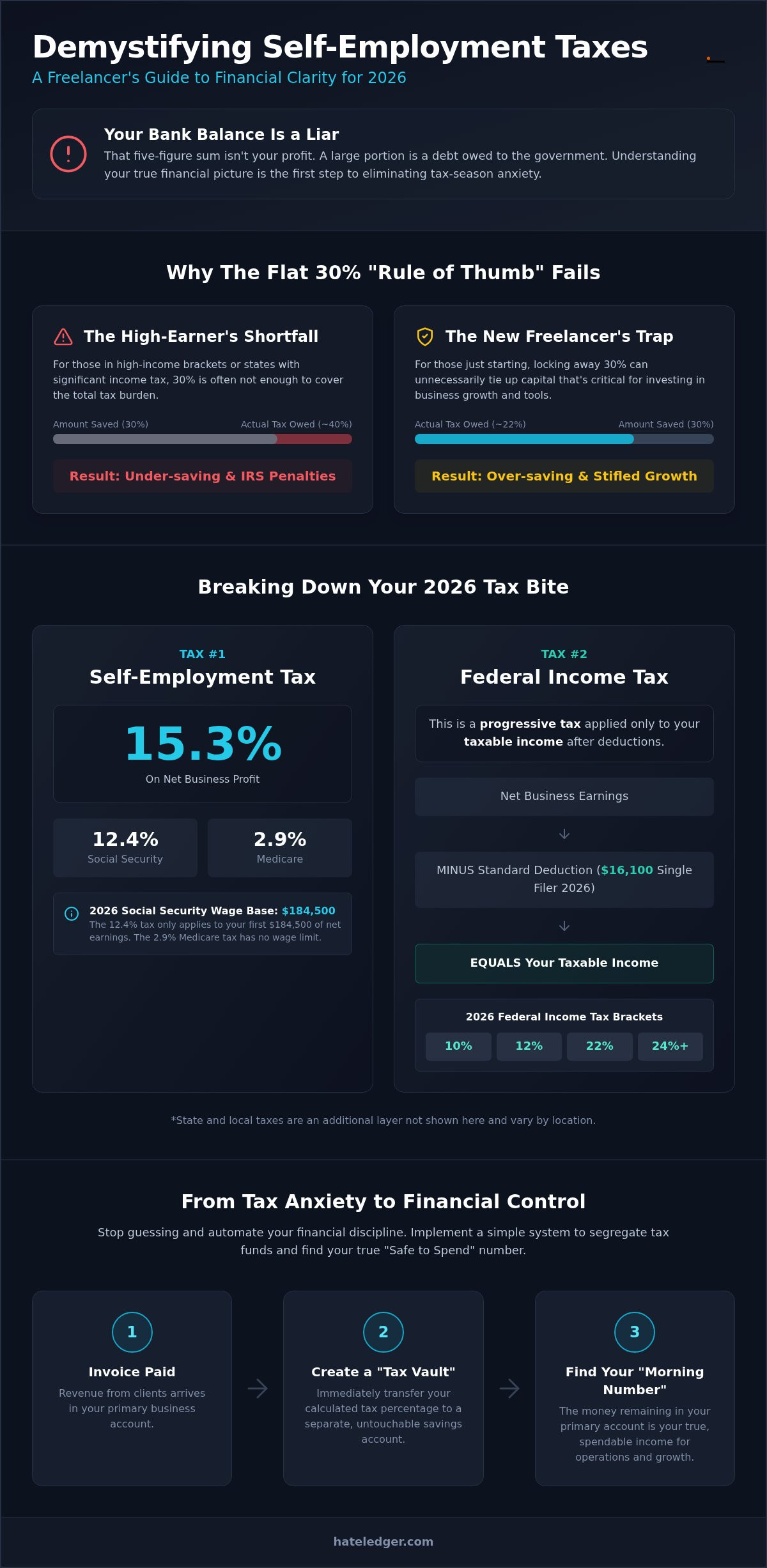
Standard advice tells you to save a flat 30%. This is lazy math. For a high-earner in a state with aggressive income taxes, 30% is a fast track to an IRS audit and a heavy bill. For someone just starting out, locking away 30% might mean you can't afford the software or help you need to actually scale. A "rule of thumb" is just a polite way of saying "we don't want to do the real math."
There is also a hidden cost: Tax Debt Anxiety. It's that low-level hum of dread every time you swipe your business card. You don't know if you're spending your profit or the government's tribute. This mental load kills creativity. It makes you play small. By understanding self-employment obligations early, you can replace that dread with certainty.
What is a Tax Reserve?
A tax reserve is a non-negotiable liability fund specifically for your 2026 obligations. It is not your money. You must treat it as a bill that has already been sent but hasn't been collected yet. The "Accounting Way" asks you to manage complex ledgers and track every cent manually. The Hate Ledger way is different. We use invisible double-entry to give you a daily "morning number." This is the only number that matters. It's the cash you can actually spend after every tax obligation has been stripped away.
Why 'Rules of Thumb' Lead to Tax Season Surprises
Generic rules ignore the reality of where you live and how much you make. State taxes and local levies vary wildly. In some jurisdictions, your total 2026 tax bite can easily creep toward 40%. If you follow the 30% rule, you're short. That leads to IRS penalties and interest rates that compound your problems.
- Under-saving: Triggers penalties and creates a debt cycle that's hard to break.
- Over-saving: Stifles your business by trapping capital that should be used for hiring or marketing.
You need precision, not a guess. You need to know how much should I set aside for taxes self-employed 2026 based on your actual revenue and real-time expenses. Anything else is just waiting for a surprise you can't afford.
Breaking Down the 2026 Tax Bite: Self-Employment vs. Income Tax
You're the CEO and the intern. That's the dream. It's also the reason you get taxed twice. When you were a W-2 employee, your boss paid half of your Social Security and Medicare taxes. Now, you are the boss. You're on the hook for the whole 15.3%. This is the "Double Tax" reality that catches most freelancers off guard. You aren't just paying for the privilege of earning; you're paying for the privilege of employing yourself.
The 15.3% Self-Employment Tax Explained
This tax is split into two parts: 12.4% for Social Security and 2.9% for Medicare. For 2026, the Social Security portion only applies to the first $184,500 of your net earnings. Anything above that threshold only gets hit with the 2.9% Medicare rate. If you're a high earner bringing in over $200,000 (single) or $250,000 (married filing jointly), expect an additional 0.9% Medicare surtax to kick in. It's a progressive bite that gets deeper as you grow.
Unlike income tax, this doesn't wait for your standard deduction to kick in. It applies to every dollar of your business profit. You do get a small break, though. You can deduct 50% of your self-employment tax from your gross income on your Form 1040. It's a minor "above-the-line" deduction that offers a sliver of relief. For the technical specifics on how these rates are calculated, you can review the official IRS guidance on SE tax.
2026 Federal Income Tax Brackets for Freelancers
After the 15.3% bite, the federal government comes back for seconds with income tax. For 2026, the standard deduction for single filers is $16,100. You don't pay income tax on that first chunk. After that, the progressive brackets start at 10% and move to 12%, 22%, and 24% for most independent operators. Your taxable income is not your total revenue; it's what's left after you've paid for your tools, your office, and your operations.
If you're wondering how much should I set aside for taxes self-employed 2026, you have to account for these two layers plus the "hidden" third bite: state and local taxes. Depending on where you live, state levies can add another 3% to 9% to your total bill. This is why the generic 30% rule often fails. It's a lot of math to do while you're trying to run a business. It's why many founders use automated tracking to see their real-time liability without opening a spreadsheet. Knowing your real profit means knowing your real tax bill before it's actually due.
Calculating Your Real 2026 Liability (Without the Jargon)
Calculating how much should I set aside for taxes self-employed 2026 doesn't require an accounting degree. It requires four logical steps. Step one is your gross revenue. This is every cent that hits your business account before you pay for a single coffee or a software seat. Step two is subtracting your "invisible" expenses. These are the costs you actually spent to run the business. What's left is your profit. This is the only number the IRS actually cares about. If you ignore these expenses, you're giving the government a tip you can't afford.
Step three is applying the 2026 standard deduction. For single filers, that's $16,100 of "free" income. You don't pay federal income tax on this first chunk. Step four is the final math. You apply the 15.3% self-employment tax to your profit, then calculate your income tax bracket on the remainder. Understanding the legal definition of self-employment tax helps you realize it's a fixed liability. It isn't a surprise. It's a predictable cost of doing business that you can track every single day.
Revenue vs. Profit: The Only Math That Matters
You only pay taxes on what you keep. If you make $100,000 but spend $20,000 on software, equipment, and a dedicated home office, you are taxed on $80,000. Many freelancers miss these deductions and end up overpaying. Missing a $500 software subscription or failing to measure your home office square footage might seem small. It isn't. These missed opportunities compound across the year. Using an automated tax reserve for self employed handles these subtractions instantly. It ensures your tax estimate is always based on your actual profit, not an inflated revenue figure that scares you into over-saving.
State Tax: The Wildcard in Your 2026 Budget
Federal taxes are only part of the story. If you're in Texas or Florida, your state income tax is zero. If you're in California or Oregon, it's a significant bite. You can find your local 2026 rate on your state's Department of Revenue website without needing a CPA on retainer. A smart move is to add a 5% buffer to your federal estimate. This covers local levies, city taxes, and unexpected changes. It's better to have a small surplus in your tax vault than to be $2,000 short when the deadline hits. Precision is the goal, but a small safety margin is the strategy for peace of mind.
5 Steps to Setting Aside Tax Money in 2026
Don't treat your taxes like a seasonal chore. Treat them like a transaction cost. If you want to stop guessing how much should I set aside for taxes self-employed 2026, you need a system that works while you sleep. Most freelancers fail because they wait for a "tax season" that never actually ends. The IRS expects their cut in real time. If you aren't moving money as you earn it, you're just spending someone else's cash. Use these five steps to build a fortress around your profit.
- Open a Tax Vault: This is a dedicated account separate from your business and personal spending. It is a one-way street for cash. Money goes in; it only comes out to pay the IRS.
- Transfer Immediately: Move your percentage every time a client pays an invoice. Don't wait for the end of the month.
- Automate the Process: Use tools that handle the math so you don't have to play accountant every Friday.
- Check Your Morning Number: Know your true spendable balance daily to avoid the temptation to dip into your reserves.
- Pay Your Quarters: Use the cash in your vault to satisfy the IRS deadlines and avoid the "late fee" trap.
The 'Every Invoice' Habit
Waiting until the end of the quarter is a recipe for disaster. You'll see a high bank balance, feel a false sense of security, and spend money that isn't yours. Micro-transfers reduce the psychological pain of losing that cash. Moving $300 from a $1,000 check feels like a transaction fee. Writing a $3,000 check at the end of the month feels like a robbery. By making this a habit, you ensure your Tax Vault is always ready. You can calculate your spendable cash automatically to ensure you never touch a cent of your reserve.
Quarterly Estimates: The 2026 Deadlines You Can't Miss
The IRS doesn't give interest-free loans. They want their money as you earn it. If you expect to owe more than $1,000 in taxes, you must pay quarterly estimates. Mark these 2026 dates in your calendar now: April 15, June 15, September 15, and January 15, 2027. If you skip these, you'll face underpayment penalties and interest that compound your debt. When these dates arrive, your Tax Vault should already be full. You aren't scrambling for cash; you're just clicking "send" on money you already set aside. It's a mechanical process that replaces the usual tax-time panic with a simple administrative task.
Stop Playing Accountant: Automating Your 2026 Tax Reserve
Spreadsheets are where your productivity goes to die. If you're still manually logging every client check and software subscription, you aren't a founder. You're an unpaid data entry clerk. To answer how much should I set aside for taxes self-employed 2026, you need a system that doesn't require your constant attention. Manual math is slow. It's prone to error. Most importantly, it feeds the anxiety of not knowing what you actually own. Automation isn't just a luxury for high earners. It's a survival tactic for every independent operator in 2026.
Hate Ledger replaces the manual grind with invisible double-entry. It handles the boring stuff in the background. It calculates your tax bite in real-time as money moves. The result is your "Morning Number." This is the only figure that matters. It tells you exactly what you can safely spend after every tax obligation has been stripped away. Knowing this number is the difference between "tax fear" and financial mastery. You stop playing accountant and start acting like a CEO.
Beyond the Spreadsheet: Real-Time Tax Visibility
Automated bank syncing is the end of the manual ledger. When a payment hits your account, the software already knows the drill. It sets aside the 15.3% for self-employment. It calculates your specific 2026 income tax bracket. It subtracts your known expenses. Seeing your tax obligation grow daily might sound stressful, but it's actually a relief. It means there are no surprises. It's better to see the reality in small, daily doses than to face a massive shock when the quarterly deadline hits. For a deeper look at how to ditch the manual work, read our Accounting Software for People Who Hate Accounting: The 2026 Guide.
Your 2026 Decision Engine
Your tax-adjusted profit is your decision engine. It's the filter for every business move you make. Can you afford that new piece of equipment? Is it time to bring on a contractor? If you're looking at a raw bank balance, you're just guessing. If you're looking at your Morning Number, you're deciding with total confidence. This clarity allows you to invest back into your business without the nagging fear that you're spending the government's money. Use our Small Business Hiring Decision Tool: Stop Guessing and Start Growing (2026) to see if your current profit supports your next big move. Mastery starts when you stop guessing and start using real data. Try Hate Ledger for free and see your Morning Number today.
Take Control of Your Spendable Cash
You've spent too long guessing your actual profit. The old 30% rule is a relic that either leaves you cash-poor or dangerously short at tax time. By mastering the 15.3% self-employment rate and the specific 2026 income brackets, you move from anxiety to a clear strategy. You finally know exactly how much should I set aside for taxes self-employed 2026 to shield your business from the IRS. It's about seeing your "morning number" every day instead of a bank balance that tells you lies.
Ditch the manual spreadsheets and the late-night math. You deserve real-time tax reserve calculations that happen in the background while you work. We offer a 90-day setup promise to get your finances automated and a free tier with no credit card required. Stop guessing and start spending safely with Hate Ledger, try it for free. You've done the hard part by building a business people want. Now, use the tools that let you actually keep and spend your profit with total confidence. The math is done. Now go build.
Frequently Asked Questions
Is 25% enough to set aside for self-employed taxes in 2026?
Setting aside 25% is a dangerous gamble for most earners. The self-employment tax alone takes 15.3% of your profit. Once you add federal income tax brackets and state levies, you are often looking at a total bite of 30% or higher. If you want to know how much should I set aside for taxes self-employed 2026, start with 30% as your baseline and adjust based on your specific state and profit goals.
What happens if I don't set aside enough for my 2026 taxes?
You face underpayment penalties and compounding interest that the IRS calculates daily. It is a debt trap that is hard to escape once you fall behind. Beyond the financial hit, the stress of an IRS notice kills your focus. You'll spend more time playing defense with your bank account than offense with your business. It is always cheaper to save than to borrow from the government.
Do I have to pay quarterly taxes if I just started my business?
Yes, if you expect to owe at least $1,000 in taxes for the year. The IRS expects you to pay as you go, even in your first month of operation. Waiting until April of the following year to pay for your first year of success is a recipe for a massive, unmanageable bill. Use your estimated first-year profit to start making quarterly payments by the next 2026 deadline.
How do I calculate taxes if I have a W-2 job and a side hustle?
Your side hustle profit is added to your W-2 income to determine your total tax bracket. You pay your marginal income tax rate on those extra earnings, plus the full 15.3% self-employment tax. It is a heavy hit because your W-2 job already used up the lower tax brackets. You must be aggressive with your side hustle tax reserve to avoid a nasty surprise when you file your return.
Can I use my tax reserve for business emergencies?
Absolutely not. Your tax reserve is a liability, not an emergency fund. Using that money for a business emergency is just taking out a high-interest loan from the IRS without their permission. If you can't afford an emergency without touching your tax money, your business isn't actually profitable. Keep your tax vault locked and build a separate cushion for unexpected costs to ensure your business stays safe.
What is the self-employment tax rate for 2026?
The self-employment tax rate for 2026 is 15.3%. This is broken down into 12.4% for Social Security and 2.9% for Medicare. For 2026, the Social Security portion applies to the first $184,500 of your net earnings. Any income above that threshold is only subject to the 2.9% Medicare tax. High earners may also face an additional 0.9% Medicare surtax on income over certain thresholds, such as $200,000 for single filers.
Does Hate Ledger actually file my taxes for me?
No, Hate Ledger does not file or submit your tax returns. We provide the automated math and real-time visibility you need to stay prepared. Our platform calculates your morning number so you know what is safe to spend and what must stay in your reserve. You still use your preferred filing software or a professional to handle the actual submission to the IRS while we handle the daily tracking.
How do I know which tax bracket I'm in for 2026?
Your bracket is determined by your taxable income, which is your business profit minus the 2026 standard deduction of $16,100 for single filers. For most freelancers, the 10%, 12%, and 22% brackets cover the majority of their income. You don't need a CPA to guess this. Automated tools can track your profit in real-time and show you exactly which bracket your next dollar will fall into as you earn.
Frequently Asked Questions
A tax reserve is a non-negotiable liability fund specifically for your 2026 obligations. It is not your money. You must treat it as a bill that has already been sent but hasn't been collected yet. The "Accounting Way" asks you to manage complex ledgers and track every cent manually. The Hate Ledger way is different. We use invisible double-entry to give you a daily "morning number." This is the only number that matters. It's the cash you can actually spend after every tax obligation has been stripped away.
Setting aside 25% is a dangerous gamble for most earners. The self-employment tax alone takes 15.3% of your profit. Once you add federal income tax brackets and state levies, you are often looking at a total bite of 30% or higher. If you want to know how much should I set aside for taxes self-employed 2026, start with 30% as your baseline and adjust based on your specific state and profit goals.
You face underpayment penalties and compounding interest that the IRS calculates daily. It is a debt trap that is hard to escape once you fall behind. Beyond the financial hit, the stress of an IRS notice kills your focus. You'll spend more time playing defense with your bank account than offense with your business. It is always cheaper to save than to borrow from the government.
Yes, if you expect to owe at least $1,000 in taxes for the year. The IRS expects you to pay as you go, even in your first month of operation. Waiting until April of the following year to pay for your first year of success is a recipe for a massive, unmanageable bill. Use your estimated first-year profit to start making quarterly payments by the next 2026 deadline.
Your side hustle profit is added to your W-2 income to determine your total tax bracket. You pay your marginal income tax rate on those extra earnings, plus the full 15.3% self-employment tax. It is a heavy hit because your W-2 job already used up the lower tax brackets. You must be aggressive with your side hustle tax reserve to avoid a nasty surprise when you file your return.
Absolutely not. Your tax reserve is a liability, not an emergency fund. Using that money for a business emergency is just taking out a high-interest loan from the IRS without their permission. If you can't afford an emergency without touching your tax money, your business isn't actually profitable. Keep your tax vault locked and build a separate cushion for unexpected costs to ensure your business stays safe.
The self-employment tax rate for 2026 is 15.3%. This is broken down into 12.4% for Social Security and 2.9% for Medicare. For 2026, the Social Security portion applies to the first $184,500 of your net earnings. Any income above that threshold is only subject to the 2.9% Medicare tax. High earners may also face an additional 0.9% Medicare surtax on income over certain thresholds, such as $200,000 for single filers.
No, Hate Ledger does not file or submit your tax returns. We provide the automated math and real-time visibility you need to stay prepared. Our platform calculates your morning number so you know what is safe to spend and what must stay in your reserve. You still use your preferred filing software or a professional to handle the actual submission to the IRS while we handle the daily tracking.
Your bracket is determined by your taxable income, which is your business profit minus the 2026 standard deduction of $16,100 for single filers. For most freelancers, the 10%, 12%, and 22% brackets cover the majority of their income. You don't need a CPA to guess this. Automated tools can track your profit in real-time and show you exactly which bracket your next dollar will fall into as you earn.