Avoid the Surprise Tax Bill: A Freelancer’s Guide to Spending Safely
September 9, 2026 · 18 min read
Your bank balance is a liar. You see a five-figure deposit and feel like you've finally made it, but deep down, you know that money isn't all yours. Every freelancer has felt that cold spike of anxiety when looking at a healthy account, wondering how much of it is actually spendable and how much is a ticking time bomb for the IRS. If you want to avoid surprise tax bill freelancer headaches, you have to stop treating your checking account like a source of truth.
Managing your money shouldn't feel like a second job. You didn't start a business to become a part-time accountant or to spend your Sunday nights fighting with a manual spreadsheet that's probably wrong anyway. You deserve total clarity on your income without the mental load of constant tax math. It's time to stop guessing and start knowing exactly what you can afford to spend today.
This guide will show you how to automate your tax savings and find your "Morning Number." We are going to strip away the jargon and give you a simple, invisible system that keeps you safe from April surprises. You'll learn how to separate your true profit from your tax obligations so you can finally spend your money with total confidence.
Key Takeaways
- Stop trusting your bank balance. Every deposit has a hidden debt you need to strip away before you can spend safely.
- Build a physical wall between your cash and the IRS. A three account system is the fastest way to avoid surprise tax bill freelancer panic.
- Ditch the spreadsheets for an automated tax reserve. You'll stop guessing your liability and start seeing your real profit in real time.
- Use the "Morning Number" to make fast decisions. It's the only metric you need to know if you can afford that new gear or a night out.
- Move from tax season dread to total financial safety. Automation handles the boring math so you never have to think about a ledger again.
Why Your Bank Balance is Lying to You (The Tax Trap)
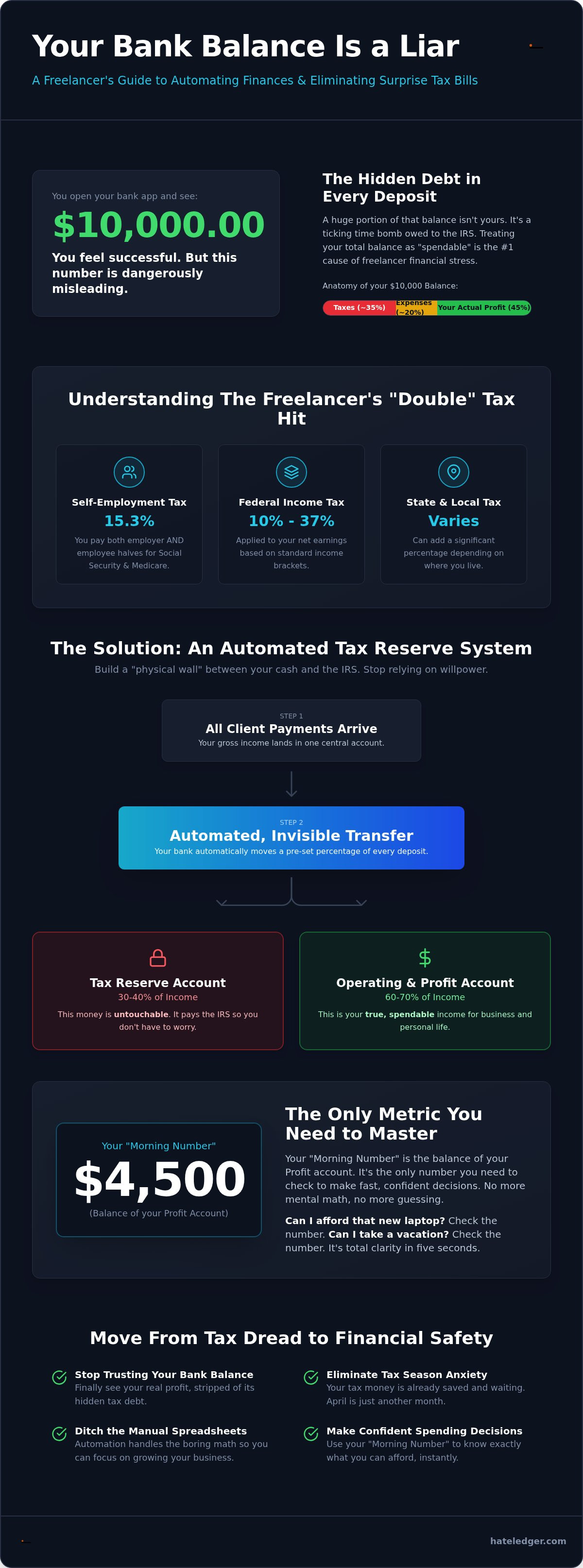
Your bank app is lying to you every single day. You open it, see a $10,000 balance, and feel a surge of victory. But that money isn't yours. Some of it belongs to the landlord, some to your software subscriptions, and a massive chunk belongs to the government. If you treat that total balance as "spendable," you are walking straight into a trap. This is the primary reason people fail to avoid surprise tax bill freelancer disasters.
The emotional cost of this uncertainty is heavy. It's a low-level hum of anxiety that follows you into every purchase. You hesitate at the grocery store or skip a necessary business upgrade because you don't know your real number. Manual tracking is the usual solution, but it fails every time. The "I'll move money to savings on Friday" promise is a lie we tell ourselves to feel better in the moment. When business is growing, a sudden five-figure tax bill doesn't just hurt; it can derail your entire momentum.
The Anatomy of a Surprise Tax Bill
Freelancing comes with a double tax hit. You pay the standard income tax everyone pays, plus the full 15.3% for Social Security and Medicare. This is the core of understanding self-employment taxes. Most people forget that as a freelancer, you are both the employer and the employee. You pay both halves of the bill, which is why your liability feels so much heavier than it did at a traditional job.
Even if you pay quarterly estimates, you're likely off. Your income isn't a flat line. It peaks and valleys. If you base your savings on last year's numbers while having a record-breaking year, you're building a debt you can't see. The IRS doesn't care about your "I'll save later" logic. They calculate what you owe based on the cold reality of your net earnings, and they expect their cut regardless of your personal cash flow. To truly avoid surprise tax bill freelancer panic, you need a system that updates as fast as your income does.
Stop Playing Accountant and Start Being a Founder
You started this business to build something, not to spend three hours every Sunday fighting with a spreadsheet. Doing mental math every time you want to buy lunch is a waste of your cognitive energy. It’s the "mental load" of accounting that burns people out. It forces you into a defensive crouch where you're constantly looking backward instead of moving forward.
You shouldn't need a CPA on speed dial just to know if you can afford a new laptop. The goal is to move from reactive filing to proactive spending. You need to know your "Morning Number" immediately. This is the number that tells you what is yours to keep after every obligation is met. When you stop playing accountant, you gain the freedom to actually run your company like a professional operator.
Calculating Your Real Tax Liability Without the Jargon
A Tax Reserve is the money you owe the government before you even earn it. Most freelancers hear the "30% rule" and think they're safe. It's a decent starting point, but it's often wrong. If you live in a high-tax city or state, 30% might leave you thousands of dollars short. Conversely, if you have high business expenses, you might be over-saving and starving your own growth. To truly avoid surprise tax bill freelancer moments, you need precision instead of a guess.
W2 employees have it easy because their taxes are invisible. The money is gone before it ever hits their bank account. As a freelancer, you see the full amount. You feel the weight of every dollar. This "visible pain" makes it tempting to spend what isn't actually yours. You must treat your tax liability as an immediate expense rather than a future problem. When you stop looking at your total balance as "your money," you start making better decisions.
The Math You Actually Need
For 2026, the self-employment tax rate is 15.3%. This covers Social Security and Medicare. But that's just the baseline. You also have federal income tax brackets, which start at 10% and climb once you cross the $12,400 mark for single filers. When you layer on state or local taxes, your actual effective rate can shift wildly. Following IRS guidelines for self-employed individuals is necessary for compliance, but it doesn't help you manage your daily cash flow.
Deductions are your best defense. Every dollar you spend on your business reduces the amount the IRS can touch. You don't need a shoebox of receipts; you need a system that captures these costs in real time. If you're tired of the daily guesswork, look into an Automated Tax Reserve for Self-Employed. It calculates these variables automatically so you can focus on your actual work.
Why Your "Spendable Income" is the Only Number That Matters
Gross revenue is vanity. Net profit is for your accountant. Spendable cash is the only number that keeps you in business. There's a massive danger in spending your tax money to fund business growth. If you use the government's money to buy ads or hire help, you're taking a high-interest loan you didn't sign up for. It's a gamble that rarely pays off when April arrives.
You must separate your money into three buckets: Business Money for expenses, Tax Money for the government, and My Money for your life. Keeping these clear is the only way to avoid surprise tax bill freelancer stress. If you want to see exactly what you can spend right now, finding your Morning Number is the fastest way to get total clarity.
How to Set Up an Automated Tax Reserve System
Relying on willpower is a losing strategy. If you have to manually calculate and move money every time a client pays you, you will eventually slip up. To truly avoid surprise tax bill freelancer nightmares, you need a system that works in the background without your permission. You need to build a machine that handles the math so you can handle the work. Setting up this infrastructure takes less than an hour but saves you hundreds of hours of future anxiety.
Follow these four steps to build your automated reserve:
- Step 1: Separate your accounts. Open three distinct accounts: Business Checking, Personal Checking, and a "Don't Touch" Tax Savings account. Mixing these is the fastest way to lose track of what you actually own.
- Step 2: Connect your bank feed. Link your business account to a platform that understands "Invisible Double-Entry." You want a system that sees a deposit and immediately knows how to categorize it.
- Step 3: Set a percentage-based rule. Apply a rule to every incoming payment. Based on official IRS guidance on self-employment tax, you'll start with the 15.3% baseline for Social Security and Medicare, then add your projected income tax rate.
- Step 4: Audit your reserves monthly. Spend ten minutes once a month checking your balance against your actual earnings. This ensures you aren't over-saving and starving your cash flow or under-saving and falling behind.
The "Invisible" Setup
Automation removes the "willpower" requirement from your finances. When the system calculates your reserve daily, you never have to guess. Waiting until the end of the quarter to see what you owe is a legacy approach that leads to panic. Modern tools should tell you your tax debt in real time, every single morning. If you're tired of fighting with spreadsheets, check out this guide on Accounting Software for People Who Hate Accounting.
Avoiding the Quarterly Panic
By the time the 2026 estimated tax deadlines arrive, April 15, June 15, September 15, and January 15, 2027, the money should already be sitting in your "Don't Touch" account. You simply send the payment and move on with your day. There is no cash flow crunch because that money was never part of your spendable balance to begin with.
Knowing your "Safe Spend" threshold is the key to confidence. If your tax account has a surplus because of high business deductions, that's extra profit you can reinvest. If you're already behind on savings, don't panic. Start the automated rule today at a slightly higher percentage, like 35% or 40%, until your reserve catches up to your year-to-date liability. This is the only way to avoid surprise tax bill freelancer stress and get back to building your business.
The "Morning Number" Habit: Daily Financial Mastery
Most freelancers wake up and check their bank app. This is a mistake. Your bank app shows you a total, but it doesn't show you the truth. The Morning Number is the only digit that matters. It is your total balance minus your tax reserve and your upcoming bills. It is the money you can actually spend today without hurting your future self. It represents total freedom from the spreadsheet.
When you check your "Spendable Balance" instead of your raw bank total, you eliminate the need for mental math. If the number says $500, you can spend $500. You don't have to wonder if you still owe for that quarterly payment or if you've set aside enough for Social Security. This is the ultimate tool to avoid surprise tax bill freelancer stress. It creates a "Decision-Free" lifestyle where your finances are a solved problem. You aren't looking at what you have; you're looking at what is yours.
Building the 30-Second Routine
Mastery doesn't require hours of study. It requires 30 seconds every morning. You check the number, make your decisions, and get back to your real work. This habit changes how you view growth. Instead of guessing if you can afford a new camera or a faster laptop, you look at the Morning Number. If the cash is there, the decision is made. This clarity is vital when using a Small Business Hiring Decision Tool to see if your next freelancer or assistant is a safe bet for 2026.
Human Capital ROI: Is Your Spending Actually Growing Your Business?
Once you know you're safe, you can start being strategic. You stop asking "Can I afford this?" and start asking "Is this making me money?" This is the shift from a freelancer to a founder. You must track the ROI of your own time. If you spend four hours a week on manual bookkeeping, that's four hours you aren't billing clients. That is a massive leak in your revenue.
Outsourcing that work or automating it might cost money, but if it frees you up to earn triple that amount, it's a win. You use your data to justify every investment. If your Morning Number stays healthy while you outsource, you've successfully scaled. You aren't just surviving; you're operating with precision. Stop letting your finances be a mystery and start using Hate Ledger to see your real profit today.
Eliminating Tax Anxiety with Hate Ledger
Hate Ledger is accounting software for people who would rather do literally anything else. We don't offer human bookkeeping or tax filing services. We offer something better: clarity. Our platform is the definitive solution to avoid surprise tax bill freelancer panic. We shield you from the tedious details of tax math by automating the entire process. It is invisible, it is accurate, and it is built for operators who value their time.
We make a 90-day setup promise. Within three months, you move from a chaotic tax mess to total financial mastery. We systematically replace industry jargon with plain English. We don't care about "assets" or "liabilities" in the traditional sense. We care about your "Morning Number." This is the radical simplification you've been looking for. It's the end of the "I'll deal with it later" mindset.
Start for Free, Stay for the Peace of Mind
You can start protecting your income today with our Free Forever Tier. There is no credit card required and no hidden catch. It provides the essential tax reserve automation every freelancer needs to stay safe. As your revenue grows, our Business Plan and Pro Plan scale with you. These tiers unlock the Human Capital ROI Engine, giving you a high-level view of your business health.
This isn't just a tracker; it's a decision engine. It helps you decide on financing and hiring by showing you the real-world result of every dollar spent. It moves you beyond "Can I afford this?" to "How much will this make me?" You get the tools of a CFO without the detached professionalism or the high price tag. You stay in control while the software handles the heavy lifting.
Your Next Step to a Surprise-Free April
It is time to delete your manual spreadsheets. They are legacy systems that waste your mental energy and leave you vulnerable to errors. Join the rebellion against inefficient accounting. Stop guessing what you owe and start knowing what you can spend. You work too hard to let a surprise bill crush your momentum in April. You deserve a system that works as hard as you do.
You are a founder, not an accountant. Let the automation handle the reserves while you focus on the work that actually generates revenue. The path to avoid surprise tax bill freelancer safety is a single click away. Get your Morning Number today and experience the relief of a solved problem.
Take Back Your Financial Freedom
The bank balance trap is a choice you no longer have to make. You've seen how manual spreadsheets and "mental math" lead to burnout and anxiety. To truly avoid surprise tax bill freelancer disasters, you must move from a reactive filing mindset to a proactive spending strategy. By automating your tax reserves and focusing on your "Morning Number," you strip away the complexity of self-employment and reclaim your mental energy.
You didn't start your business to fight with a ledger every Sunday night. You started it to build something meaningful. It is time to treat your cash flow with the professional precision it deserves. Our system is designed for people who value results over formalities, replacing technical jargon with a single source of truth you can trust.
Stop guessing and start spending safely—Try Hate Ledger for Free. There is no credit card required for our Free Forever Tier. We offer a 90-day setup promise to move you from chaos to mastery. Our platform calculates your "Morning Number" automatically so you never have to guess again. You have the talent to grow; we have the tools to keep you safe. Take the first step today.
Frequently Asked Questions
How much should a freelancer set aside for taxes in 2026?
You should generally set aside 25% to 30% of your net income to stay safe. This covers the 15.3% self-employment tax rate for 2026 and your federal income tax bracket. If you earn $150,000, you'll pay roughly $21,200 in self-employment tax alone before income tax hits. Using a flat percentage is a good start, but an automated system that adjusts for your specific deductions is the only way to be precise.
Can I just use a separate savings account for my freelance taxes?
You can use a separate account, but manual transfers often fail because of human error. It's too easy to skip a week or guess the amount. A dedicated "Don't Touch" account is a vital part of your infrastructure, but it works best when connected to software that moves the money for you. This separation is the first step to help you avoid surprise tax bill freelancer stress during the quarterly deadlines.
What happens if I can’t pay my surprise tax bill?
The IRS will charge you underpayment penalties and interest that accrues daily. If you owe at least $1,000 after credits, they expect their cut on time. You can apply for a payment plan, but those come with setup fees and more interest. It's a high-interest loan you never wanted. The goal is to build a reserve now so you never have to negotiate with the government from a position of weakness.
How do quarterly estimated tax payments work for freelancers?
You pay the IRS four times a year based on what you expect to owe. For 2026, the deadlines are April 15, June 15, September 15, and January 15, 2027. You calculate your total estimated tax for the year and divide it by four. If your income fluctuates, you need a system that tracks your actual earnings in real time so you don't overpay in slow months or underpay during a windfall.
Do I need an LLC to avoid a high tax bill?
An LLC alone doesn't change your tax bill; it's a legal structure for liability protection. However, if your net income hits $60,000 to $80,000, you might consider an S-Corp election. This can reduce your self-employment tax by allowing you to pay yourself a reasonable salary and take the rest as a distribution. It's a common strategy for high-earning freelancers, but it requires more administrative work than a simple sole proprietorship.
What is the "Morning Number" and how is it calculated?
The Morning Number is your total bank balance minus your automated tax reserve and upcoming business bills. It's the only number that tells you what you can safely spend right now. We calculate it by looking at your real-time bank data and stripping away every dollar that already has a job. It turns your bank account from a confusing list of transactions into a single, actionable decision-making tool every single day.
How do I track business expenses without keeping physical receipts?
You don't need a shoebox of paper in 2026. Digital bank feeds and "invisible" bookkeeping capture every transaction as it happens. For tax purposes, the IRS accepts digital records and bank statements as proof of purchase for most items. If you use a dedicated business card for every expense, the software categorizes the spend automatically. This ensures you never miss a deduction that could lower your overall tax liability.
Is automated tax software safe to connect to my bank?
Modern financial tools use the same high-level encryption as your bank. They use read-only connections, meaning the software can see your transactions to calculate your taxes but cannot move your money or make payments. This visibility is what allows you to avoid surprise tax bill freelancer headaches. You get the benefit of automation without giving up control over your actual funds. It’s the safest way to get total financial clarity.
Frequently Asked Questions
Once you know you're safe, you can start being strategic. You stop asking "Can I afford this?" and start asking "Is this making me money?" This is the shift from a freelancer to a founder. You must track the ROI of your own time. If you spend four hours a week on manual bookkeeping, that's four hours you aren't billing clients. That is a massive leak in your revenue. Outsourcing that work or automating it might cost money, but if it frees you up to earn triple that amount, it's a win. You use your data to justify every investment. If your Morning Number stays healthy while you outsource, you've successfully scaled. You aren't just surviving; you're operating with precision. Stop letting your finances be a mystery and start using Hate Ledger to see your real profit today. Hate Ledger is accounting software for people who would rather do literally anything else. We don't offer human bookkeeping or tax filing services. We offer something better: clarity. Our platform is the definitive solution to avoid surprise tax bill freelancer panic. We shield you from the tedious details of tax math by automating the entire process. It is invisible, it is accurate, and it is built for operators who value their time. We make a 90-day setup promise. Within three months, you move from a chaotic tax mess to total financial mastery. We systematically replace industry jargon with plain English. We don't care about "assets" or "liabilities" in the traditional sense. We care about your "Morning Number." This is the radical simplification you've been looking for. It's the end of the "I'll deal with it later" mindset.
You should generally set aside 25% to 30% of your net income to stay safe. This covers the 15.3% self-employment tax rate for 2026 and your federal income tax bracket. If you earn $150,000, you'll pay roughly $21,200 in self-employment tax alone before income tax hits. Using a flat percentage is a good start, but an automated system that adjusts for your specific deductions is the only way to be precise.
You can use a separate account, but manual transfers often fail because of human error. It's too easy to skip a week or guess the amount. A dedicated "Don't Touch" account is a vital part of your infrastructure, but it works best when connected to software that moves the money for you. This separation is the first step to help you avoid surprise tax bill freelancer stress during the quarterly deadlines.
The IRS will charge you underpayment penalties and interest that accrues daily. If you owe at least $1,000 after credits, they expect their cut on time. You can apply for a payment plan, but those come with setup fees and more interest. It's a high-interest loan you never wanted. The goal is to build a reserve now so you never have to negotiate with the government from a position of weakness.
You pay the IRS four times a year based on what you expect to owe. For 2026, the deadlines are April 15, June 15, September 15, and January 15, 2027. You calculate your total estimated tax for the year and divide it by four. If your income fluctuates, you need a system that tracks your actual earnings in real time so you don't overpay in slow months or underpay during a windfall.
An LLC alone doesn't change your tax bill; it's a legal structure for liability protection. However, if your net income hits $60,000 to $80,000, you might consider an S-Corp election. This can reduce your self-employment tax by allowing you to pay yourself a reasonable salary and take the rest as a distribution. It's a common strategy for high-earning freelancers, but it requires more administrative work than a simple sole proprietorship.
The Morning Number is your total bank balance minus your automated tax reserve and upcoming business bills. It's the only number that tells you what you can safely spend right now. We calculate it by looking at your real-time bank data and stripping away every dollar that already has a job. It turns your bank account from a confusing list of transactions into a single, actionable decision-making tool every single day.
You don't need a shoebox of paper in 2026. Digital bank feeds and "invisible" bookkeeping capture every transaction as it happens. For tax purposes, the IRS accepts digital records and bank statements as proof of purchase for most items. If you use a dedicated business card for every expense, the software categorizes the spend automatically. This ensures you never miss a deduction that could lower your overall tax liability.
Modern financial tools use the same high-level encryption as your bank. They use read-only connections, meaning the software can see your transactions to calculate your taxes but cannot move your money or make payments. This visibility is what allows you to avoid surprise tax bill freelancer headaches. You get the benefit of automation without giving up control over your actual funds. It’s the safest way to get total financial clarity.